Stratasys Expands 3D Printing with New Materials and Precision Software
Additive manufacturing has been edging steadily from prototyping into full-scale production, but not without friction. Manufacturers still grapple with consistency, material performance, and the stubborn realities of cost per part.
Stratasys Ltd. has now introduced a series of material and software updates aimed squarely at those operational bottlenecks, extending the usefulness of its existing hardware platforms rather than chasing headline-grabbing new machines.
The move reflects a broader shift across the sector. Instead of focusing solely on hardware innovation, suppliers are tightening the entire workflow, from materials science through to print accuracy and post-processing efficiency. By expanding compatibility and improving precision within established systems, Stratasys is addressing a key industry demand: making additive manufacturing reliable enough for repeatable, industrial-scale production.
At the centre of this update is a combination of high-performance thermoplastics, photopolymers engineered for demanding environments, and software that directly tackles one of the most persistent challenges in 3D printing, dimensional distortion. Together, these developments signal a practical step forward for sectors such as aerospace, automotive, and industrial tooling, where tolerance, durability, and throughput are non-negotiable.
Briefing
- New materials expand industrial applications across FDM, PolyJet, SLA, and P3 platforms
- ULTEM 1010 filament brings aerospace-grade performance to high-speed FDM production
- Measurement-based modelling software improves dimensional accuracy and reduces rework
- Photopolymer resins target regulated sectors such as food and pharmaceuticals
- Enhancements focus on lowering cost per part and improving production consistency
Industrial Materials Moving Beyond Prototyping
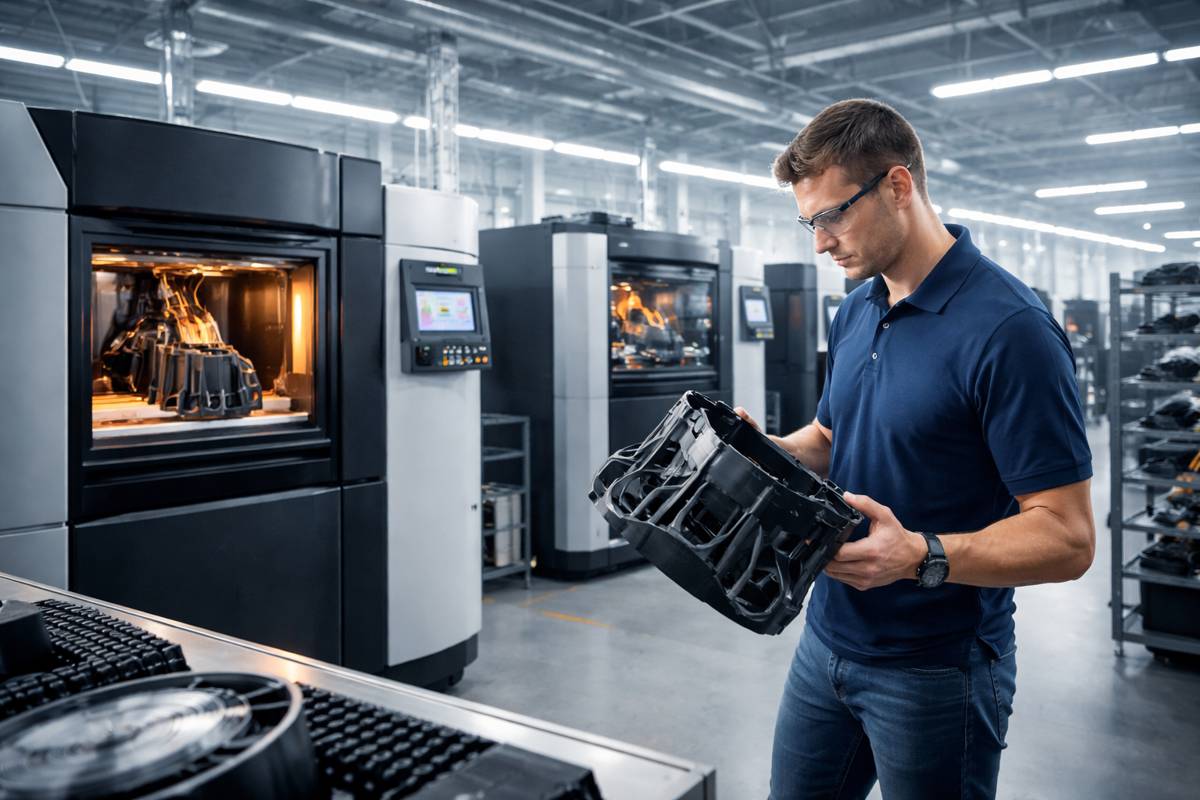
One of the most notable developments is the introduction of ULTEM 1010 filament for the F3300 system. Long recognised in aerospace and high-performance engineering, ULTEM resin offers exceptional thermal resistance and mechanical stability. Its low coefficient of thermal expansion makes it particularly suitable for tooling applications where dimensional accuracy must be maintained under fluctuating temperatures.
By bringing this material into a filament format compatible with high-throughput FDM systems, Stratasys is effectively lowering the barrier for manufacturers seeking to produce end-use parts rather than prototypes. The F3300 platform, designed for speed and efficiency, now gains access to a material capable of meeting stringent engineering requirements without compromising productivity.
This matters commercially because tooling and fixture production has become one of the most viable entry points for additive manufacturing in industrial settings. Traditional tooling methods often involve long lead times and significant cost, particularly for customised or low-volume applications. With ULTEM 1010, manufacturers can produce heat-resistant jigs and fixtures in-house, reducing reliance on external suppliers and shortening production cycles.
Scaling Production With Integrated Material Handling
The introduction of larger spool formats and compatibility with the Fortus FDC filament dryer further reinforces this production focus. Material handling has often been an overlooked factor in additive manufacturing, yet moisture sensitivity can significantly affect print quality, particularly for engineering-grade thermoplastics.
By integrating drying systems directly into the workflow, Stratasys is addressing a subtle but critical variable. Consistent material conditions translate into more predictable results, fewer failed builds, and ultimately lower operational costs. For facilities running extended production cycles, this level of control becomes essential rather than optional.
Compatibility with established systems such as the F900 and Fortus 450mc Gen III also highlights a strategic approach. Rather than forcing customers to invest in entirely new platforms, the company is extending the capabilities of installed equipment. In a capital-intensive industry, that kind of upgrade path can significantly influence adoption decisions.
Photopolymers Designed For Functional Use
While thermoplastics continue to dominate heavy-duty applications, photopolymer technologies have been advancing rapidly. The introduction of P3 Deflect 110 resin for Origin systems is a case in point. Designed to withstand elevated temperatures and mechanical stress, it positions additive manufacturing as a viable option for functional components such as automotive connectors and industrial fixtures.
Historically, photopolymers have been associated with visual prototypes rather than load-bearing parts. However, improvements in material formulation are narrowing that gap. By offering higher heat deflection temperatures and improved mechanical properties, these resins enable engineers to use additive processes in applications that were previously off-limits.
Equally significant is the introduction of Loctite 3D IND3785 Low Migration resin, developed for regulated environments. In sectors such as food production and pharmaceuticals, material compliance is a critical requirement. Components must meet strict standards to ensure they do not contaminate products or degrade under operational conditions.
The ability to produce compliant parts using additive manufacturing opens new opportunities for small-batch production and rapid iteration. Instead of relying on injection moulding for every component, manufacturers can use 3D printing for specialised or short-run applications while maintaining regulatory compliance.
Tougher Prototypes That Behave Like Final Products
In the product development cycle, the gap between prototype and finished part has long been a source of inefficiency. Designers often test prototypes that fail to accurately replicate the mechanical behaviour of final components, leading to multiple design iterations and extended development timelines.
PolyJet ToughONE materials aim to bridge that gap. Available in both white and black variants for J3 and J5 systems, these materials offer improved resistance to snapping and flexing. This allows prototypes to undergo more realistic testing, whether for mechanical performance or user interaction.
The addition of a black variant is not merely aesthetic. Visual contrast plays a role in design validation, particularly when assessing surface features, fit, and assembly. By combining durability with visual clarity, these materials support more effective design reviews and functional demonstrations.
For industries such as automotive and consumer products, where development cycles are tightly compressed, the ability to validate designs earlier can translate into significant cost savings. Fewer iterations mean less time spent refining designs and a faster route to production.
Tackling Warping With Measurement-Based Modelling
Dimensional accuracy remains one of the most persistent challenges in additive manufacturing. Warping, caused by thermal gradients and material behaviour during printing, can lead to deviations that require rework or redesign. This is particularly problematic for precision components such as electrical connectors and industrial fixtures.
The introduction of Measurement-Based Warped Adaptive Modeling within GrabCAD Print Pro addresses this issue directly. By incorporating measured dimensional data into the modelling process, the software can automatically compensate for expected distortion, producing parts that meet design specifications more consistently.
This approach represents a shift from reactive to proactive correction. Instead of adjusting designs after defects are observed, the system anticipates and corrects them during the printing process. For manufacturers, this reduces the number of iterations required to achieve acceptable results, saving both time and material.
In high-volume or precision-driven applications, even small improvements in accuracy can have a significant impact. Reduced scrap rates and fewer failed builds contribute directly to lower production costs and improved efficiency.
Advancing SLA Materials For Detailed Engineering Applications
Stereolithography continues to play a vital role in producing high-detail components, particularly where surface finish and precision are critical. The addition of Somos WaterShed White to the SLA material portfolio enhances this capability, offering moisture resistance and durability alongside a clean, opaque appearance.
This material is well suited to industries such as aerospace and automotive, where prototypes often undergo functional testing before production. Its compatibility with Neo systems, including large-format printers, allows manufacturers to produce sizeable components without sacrificing detail.
The importance of surface quality should not be underestimated. In many applications, the visual and tactile properties of a component influence both performance and perception. Smooth finishes can reduce post-processing requirements and improve the accuracy of downstream testing.
Industry Context And Market Direction
The global additive manufacturing market has been expanding steadily, with increasing adoption in sectors that demand flexibility and rapid turnaround. According to industry analyses, the shift towards production-grade applications is one of the defining trends, driven by advances in materials and process reliability.
Stratasys’ latest updates align closely with this trajectory. By focusing on materials that meet real-world performance requirements and software that improves consistency, the company is addressing the practical concerns that have historically limited adoption.
The emphasis on compatibility and incremental improvement also reflects a maturing market. Early adopters have already invested in hardware, and their priorities have shifted towards maximising return on that investment. Enhancements that extend the lifespan and capability of existing systems are therefore likely to gain traction.
A More Practical Path To Additive Manufacturing Adoption
Rather than presenting a single breakthrough, these developments collectively point to a more pragmatic approach. By refining materials, improving accuracy, and simplifying workflows, Stratasys is helping manufacturers integrate additive processes into everyday operations.
The cumulative effect is a reduction in friction. When materials perform reliably, software compensates for known issues, and systems operate with greater consistency, additive manufacturing becomes less of a specialised tool and more of a standard production method.
For construction, infrastructure, and industrial sectors, this evolution could prove significant. From custom tooling to specialised components, the ability to produce parts on demand has the potential to reshape supply chains and reduce dependency on traditional manufacturing processes.