Inside Greece’s €420 Million Rail Commitment
Greece’s national rail system is entering a decisive phase, shaped by a revised public service contract between the Greek State and Hellenic Train. Finalised after months of negotiation, the agreement resets expectations around investment, accountability, and passenger protection, while anchoring the country’s rail ambitions firmly in modern European standards. At its core sits a €420 million private-sector investment programme, paired with enforceable obligations and, crucially, a clear right for the State to terminate the contract if promises are not delivered.
The centrepiece of the deal is the formal order for 23 new electric trains, valued at €308 million, all of which must be delivered, commissioned, and operating in Greece by 2027. This deadline is not symbolic. For the first time in a Greek rail concession, failure to meet rolling stock commitments triggers a legally binding termination clause. In a sector long criticised for vague timelines and limited consequences, the shift is hard to miss.
Investment Commitments With Teeth
Unlike earlier agreements, the revised contract converts investment pledges into binding obligations, supported by strengthened monitoring and penalty mechanisms. The total €420 million investment package is structured to address both visible service quality and the less glamorous, but vital, backbone of rail operations.
Of this total:
- €308 million is earmarked for the procurement of 23 new electric multiple units
- €112 million is allocated to depots, fleet upgrades, maintenance facilities, and digital monitoring systems
This structure reflects a broader understanding that modern railways are as much about systems and data as they are about trains. New depots and upgraded maintenance facilities are intended to reduce failures, shorten recovery times, and support higher service frequency across the network.
A Termination Clause That Changes the Balance
Perhaps the most significant innovation is the explicit termination clause linked to rolling stock delivery. If the new trains are not operational in Greece by 2027, the State may cancel the agreement outright. A six-month compliance window applies in cases of delay, after which the right to permanent termination becomes enforceable.
This clause rebalances risk in a sector where delays have historically been absorbed by passengers and public authorities. It also sends a clear signal to investors and operators alike that contractual deadlines are no longer aspirational milestones but enforceable commitments.
Modern Rolling Stock for Intercity and Suburban Services
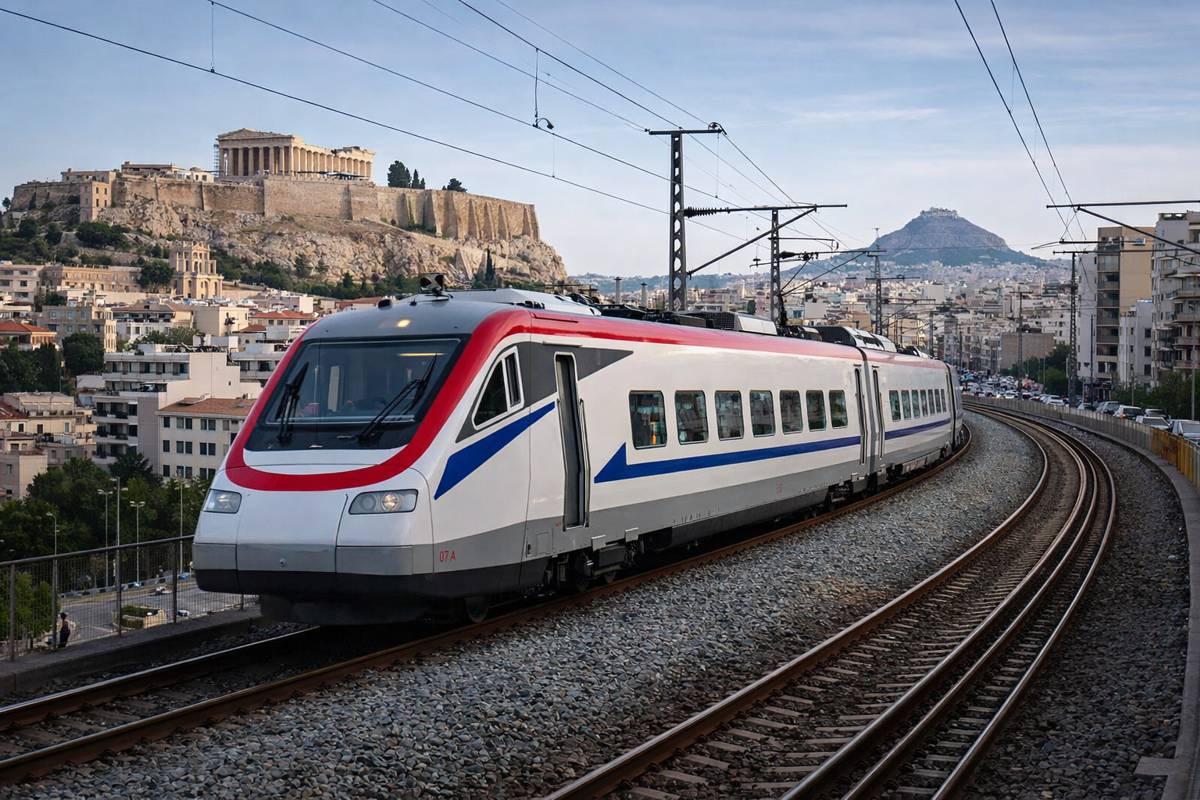
The new fleet will consist of Coradia Stream electric multiple units manufactured by Alstom. Designed for both intercity and suburban operations, the trains introduce a step change in comfort, accessibility, and energy efficiency for Greek passengers.
Key features include low-floor, step-free boarding to improve accessibility, increased seating capacity, dedicated bicycle and luggage areas, and enhanced sound insulation. Energy efficiency improvements of up to 10% are expected, supporting national climate targets while lowering operating costs over the fleet’s lifecycle.
Technologically, the trains are fully equipped with European Train Control System technology and advanced Train Control and Management Systems. These systems enable continuous real-time monitoring of performance and safety, allowing automated interventions where required. Maximum operating speed is 160 km/h, with provision for future upgrades subject to infrastructure capability.
Deployment Across Priority Corridors
Of the 23 new trains, 12 are allocated to the Athens to Thessaloniki corridor, Greece’s busiest and most economically significant rail route. The remaining 11 units will serve suburban networks in Attica and Thessaloniki, where demand for reliable, frequent services continues to grow.
Beyond the new trains, Hellenic Train has committed an additional €20 million to refurbishing existing rolling stock and €35 million to maintenance facilities and digital systems. These parallel investments are intended to stabilise service quality during the transition period before the new fleet enters full operation.
Infrastructure Upgrades Catching Up
Rolling stock modernisation is being matched by substantial infrastructure upgrades, particularly along the Athens to Thessaloniki axis. Works are progressing to deliver full double-track signalling, centralised traffic control, and comprehensive ETCS automatic braking systems by summer 2026.
Similar upgrades are underway on the Thessaloniki to Idomeni section, with completion scheduled for April 2026. Once these projects are delivered and the new trains are in service, journey times between Athens and Thessaloniki are expected to fall below 3.5 hours, a psychological and practical threshold for modal shift from road and air.
Expanding the Network Beyond the Core
The revised contract aligns with a wider programme of rail investment extending beyond the main north-south corridor. Projects scheduled for completion by 2027 include suburban rail extensions in Attica and Thessaloniki, upgrades to regional lines in Thessaly and Central Greece, and undergrounding works in central Athens to improve safety and urban integration.
Phased expansion toward Patras and the Peloponnese remains a strategic priority, alongside the rehabilitation of rail corridors in Northern Greece. Particular emphasis is placed on the Alexandroupoli to Ormenio section, reflecting the growing geopolitical and logistical importance of rail links in the north-east of the country.
Digital Oversight Replaces Manual Reporting
A notable feature of the new agreement is the introduction of a legislated digital geolocation system for operational monitoring. This system replaces manual reporting processes, enabling transparent, data-driven oversight of punctuality, service delivery, and disruptions.
The implications extend beyond performance monitoring. Digital tracking underpins automated compensation mechanisms for passengers and provides an objective basis for public service obligation payments. In practical terms, disputes over delays and cancellations move from subjective reporting to verifiable data.
Stronger Penalties and Passenger Protection
From 1 January 2026, a formal penalty framework comes into force. Financial penalties of up to €1 million may be imposed for prolonged service disruptions, while repeated failures carry escalating consequences.
If more than 10% of annual services are disrupted, either over consecutive days or cumulatively within a single month, the State may initiate contract termination procedures. Passenger compensation provisions are also significantly strengthened, with compensation amounts doubled in cases of serious disruption.
These measures are designed not only to punish poor performance but to shift organisational behaviour toward prevention, maintenance, and rapid response.
Balancing Operator and Infrastructure Risk
While the agreement tightens obligations on the operator, it also recognises the role of infrastructure readiness. Provisions are included to compensate Hellenic Train if infrastructure delays prevent scheduled services, reflecting a more balanced allocation of risk between operator and State.
This balance is critical in a network undergoing simultaneous upgrades, where delays in signalling or electrification can undermine even the best rolling stock investments.
Financial Transparency and Market Access
Under the public service obligation framework, Hellenic Train currently receives €21 million from a maximum annual ceiling of €50 million. The remaining €29 million is returned to the State through infrastructure access charges and leasing fees.
Importantly, the revised contract preserves a non-exclusive operating environment. Multiple rail operators retain access to the Greek network, reinforcing competition and aligning with European Union rail liberalisation principles.
Rebuilding Trust Through Accountability
Taken together, the revised contract marks a structural shift in how Greece approaches rail service provision. Binding investment commitments, enforceable penalties, digital oversight, and a credible termination mechanism collectively aim to rebuild public trust in the railway.
Success will ultimately be measured not in contract clauses but in quieter carriages, shorter journey times, and fewer apologies for disruption. If delivered as planned, the agreement could finally place Greek railways on a footing comparable with their European peers.