ADB Mobilises Climate Finance for Ulaanbaatar’s Urban Transport Upgrade
The Asian Development Bank has approved a $60 million loan for the project finance to support the Government of Mongolia in transforming urban mobility in Ulaanbaatar through the construction of the city’s first bus rapid transit corridor. Complementing the loan is a $500,000 grant from the Innovative Finance Facility for Climate in Asia and the Pacific, reinforcing the project’s climate credentials while strengthening Mongolia’s access to blended finance.
For Ulaanbaatar, a city grappling with rapid urbanisation and mounting congestion, the investment marks a significant policy and infrastructure milestone. Rather than incremental upgrades to an already strained road network, the project introduces a high-capacity public transport backbone designed to move people efficiently, reliably, and at scale. In doing so, it aligns transport planning with economic productivity, environmental performance, and quality of life outcomes.
Why Ulaanbaatar Needs a Step Change
Few capital cities have experienced growth pressures quite like Ulaanbaatar. Over the past two decades, inward migration and demographic change have expanded the urban population at a pace that infrastructure has struggled to match. Vehicle ownership has surged, streets have become saturated, and peak-hour congestion has become the norm rather than the exception.
Traffic conditions have had a direct and measurable impact on public transport performance. Bus services, predominantly diesel-powered, are routinely caught in mixed traffic, with average speeds dropping below 10 kilometres per hour during afternoon peak periods. Slow journeys undermine reliability, deter ridership, and exacerbate emissions, creating a feedback loop that further encourages private car use. Breaking that cycle has become an economic and environmental necessity.
Building a Modern Bus Rapid Transit System
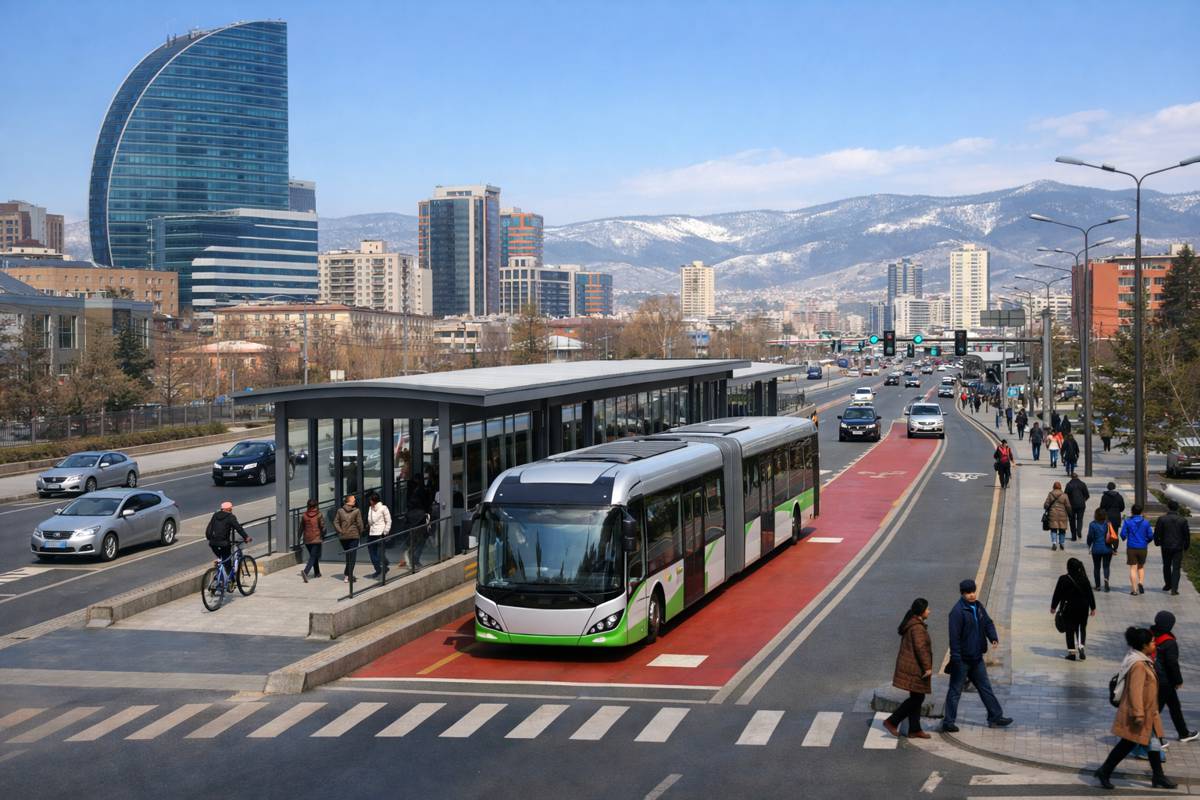
The Ulaanbaatar Transport Improvement Project addresses these challenges through the design and construction of a full-featured bus rapid transit system. Unlike conventional bus lanes, BRT is a proven urban transport solution that combines the flexibility of buses with the operational characteristics of rail-based systems.
The corridor will feature median-aligned, dedicated bus lanes that physically separate BRT services from general traffic. Stations will be designed for universal accessibility, ensuring safe and convenient use for passengers of all ages and abilities. Off-board fare collection will reduce dwell times at stations, while traffic signal priority at intersections will allow buses to maintain consistent operating speeds even during peak periods.
Beyond the core transit infrastructure, the project includes broader streetscape improvements. Dedicated cycle lanes, enhanced pedestrian facilities, and safer crossings are intended to rebalance street space in favour of people rather than vehicles, reflecting international best practice in complete street design.
Encouraging a Shift Away from Private Cars
At the heart of the project is a behavioural objective: persuading commuters to leave their cars behind. High-quality public transport systems succeed when they offer a credible alternative to private vehicles, not merely a fallback option.
As ADB Country Director for Mongolia Shannon Cowlin explained: “The new BRT will be the first system of its kind in Ulaanbaatar, offering passengers a high-quality public transport service.” The expectation is that improved speed, reliability, and comfort will attract new users, easing congestion across the wider road network.
Cowlin added: “We hope it will encourage a shift from private vehicles to public transport, which will help ease traffic congestion, support economic activity, and reduce air pollutant emissions.” Experience from cities across Asia, Latin America, and Africa suggests that well-designed BRT corridors can deliver precisely those outcomes when supported by strong governance and effective operations.
Climate Commitments and Emissions Reduction
Transport is a major contributor to Ulaanbaatar’s air quality challenges, particularly during winter months when temperature inversions trap pollutants close to the ground. While domestic heating is a dominant factor, vehicle emissions remain a significant and visible source of urban air pollution.
The BRT project directly supports Mongolia’s Nationally Determined Contribution under the United Nations Framework Convention on Climate Change. The country has committed to reducing total greenhouse gas emissions by 22.7 percent by 2030 compared to a business-as-usual scenario. Shifting trips from private cars to high-capacity public transport is one of the most cost-effective ways to cut urban transport emissions.
International evidence shows that BRT systems can reduce per-passenger emissions substantially, particularly when combined with fleet modernisation and cleaner fuel technologies. While the initial focus in Ulaanbaatar is on service quality and capacity, the corridor also creates a platform for future electrification as technology and financing conditions evolve.
Economic Productivity and Urban Efficiency
Congestion carries a tangible economic cost. Time lost in traffic reduces labour productivity, increases logistics expenses, and discourages investment. For businesses operating in Ulaanbaatar, unreliable travel times complicate everything from workforce planning to supply chain management.
By improving average travel speeds and journey reliability, the BRT corridor is expected to deliver measurable productivity gains. Faster commutes expand effective labour markets, allowing employers to draw from a wider talent pool. Retail and service sectors benefit from improved accessibility, while construction and engineering industries gain from the delivery of complex urban infrastructure.
Such impacts extend beyond the immediate corridor. International case studies indicate that successful BRT systems often stimulate transit-oriented development, encouraging higher-density, mixed-use projects around stations and reducing long-term dependence on private vehicles.
Aligning with National and Regional Strategies
The project is closely aligned with the Asian Development Bank’s country partnership strategy for Mongolia for 2025 to 2028. That framework prioritises inclusive growth, climate resilience, and sustainable infrastructure, recognising transport as a foundational enabler of economic and social development.
ADB’s involvement also reflects a broader regional shift towards scalable, cost-effective urban transport solutions. Compared with metro systems, BRT corridors can be delivered more quickly and at a fraction of the capital cost, while still providing high passenger capacity when properly designed and managed.
The inclusion of support from the Innovative Finance Facility for Climate in Asia and the Pacific highlights the growing role of blended finance in infrastructure delivery. By sharing risk and mobilising additional capital, such mechanisms allow governments to advance climate-aligned projects that might otherwise face funding constraints.
Lessons from Global BRT Systems
Globally, BRT systems operate in more than 170 cities, carrying tens of millions of passengers each day. Cities such as Bogotá, Guangzhou, and Jakarta have demonstrated how dedicated corridors, strong branding, and consistent service standards can reshape travel behaviour.
Key lessons from these systems include the importance of enforcing lane segregation, maintaining service frequency, and integrating BRT with wider public transport networks. For Ulaanbaatar, institutional capacity and long-term operational planning will be as critical as physical construction in determining the project’s success.
ADB’s technical support and experience in urban transport projects across Asia provide a strong foundation in this regard. Continued engagement with local authorities, operators, and communities will help ensure that the system meets user expectations from day one.
A Foundation for a More Liveable City
Ulaanbaatar’s first bus rapid transit corridor is more than a transport project. It represents a shift in how the city approaches mobility, public space, and environmental responsibility. By prioritising people over vehicles and reliability over congestion, the initiative sets a new direction for urban development.
As construction progresses, attention will increasingly turn to implementation quality, public communication, and operational readiness. If delivered as intended, the BRT corridor has the potential to become a visible symbol of modernisation, demonstrating how targeted infrastructure investment can improve daily life while supporting national climate and economic goals.