ADB Financing Climate Resilient Roads in Timor Leste
The Government of Timor-Leste and the Asian Development Bank have formalised a significant financing package aimed at restoring and futureproofing a vital section of the country’s national road network. The agreement brings together a $75 million loan and a $3 million grant, focused on rehabilitating a strategic corridor that links the eastern region of the country to its southern coast.
This stretch of road plays a central role in domestic mobility, regional trade, and access to essential services. Years of exposure to flooding, landslides, and underinvestment have taken their toll, leaving deteriorated bridges, unreliable drainage, and frequent weather-related disruptions. By targeting this corridor, the project addresses not just physical deterioration but a long-standing bottleneck in national connectivity and economic resilience.
Beyond transport efficiency, the investment reflects a broader shift in development finance priorities. Roads are no longer viewed as standalone assets. Instead, they are increasingly designed as integrated systems that support climate adaptation, community safety, and inclusive growth. In Timor-Leste, where climate vulnerability intersects with development needs, that distinction matters.
Financing Structure and International Partnerships
At the heart of the programme is a carefully structured blend of loan financing and grant support. The $75 million loan will fund the core rehabilitation works, including bridge restoration, pavement upgrades, and flood mitigation measures. Complementing this, a $3 million grant has been secured under the ADB Community Resilience Partnership Program.
That grant draws on contributions from a diverse group of international partners. Financing support has been provided by Agence Française de Développement, the Government of Ireland, the Green Climate Fund, the Nordic Development Fund, and the Government of the United Kingdom. This coalition reflects growing alignment among bilateral and multilateral donors around climate-resilient infrastructure as a development priority.
Grant funding will be directed specifically towards community-led adaptation and resilience measures. While modest in size compared to the overall loan, its impact is amplified by its focus on local capacity building, participatory planning, and the integration of nature-based solutions alongside traditional engineering works.
Community-Led Resilience as Core Infrastructure Policy
One of the defining features of the project is its emphasis on community participation. Villages located along the road corridor, many of which face repeated exposure to floods and extreme rainfall, will co-lead the design and implementation of small-scale adaptation investments tailored to local conditions.
These interventions may be limited in physical scale, but their strategic value is considerable. Community-designed drainage improvements, slope stabilisation using vegetation, and flood diversion features can significantly reduce damage during extreme weather events. Equally important, they foster a sense of ownership and long-term stewardship that is often missing from top-down infrastructure programmes.
Capacity building sits alongside physical works. The programme will strengthen the ability of local communities and national agencies to plan, implement, and maintain resilient infrastructure. It will also support the development of national standards and technical guidelines that formally integrate community-level green and grey infrastructure into transport investment planning.
Engineering for Climate and Disaster Resilience
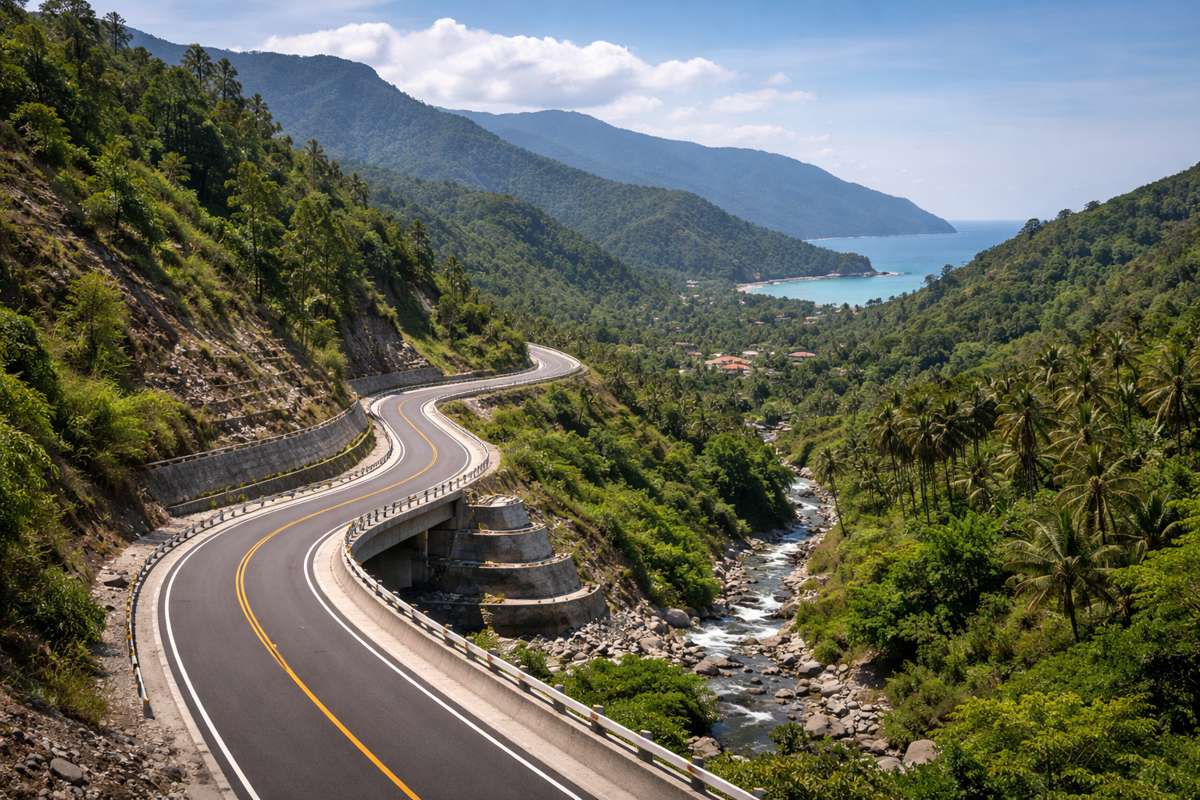
From a technical perspective, the rehabilitation programme combines conventional road engineering with climate-adapted design. Deteriorated bridges along the corridor will be restored or reinforced to improve load capacity and withstand flood forces. Drainage systems will be redesigned to accommodate higher rainfall intensities, reducing the risk of washouts and prolonged closures.
Road embankments in flood-prone areas will be elevated where necessary, while pavement structures will incorporate asphalt mixes adapted for extreme weather conditions. These materials are designed to better resist moisture damage, thermal stress, and accelerated ageing, extending service life in challenging climates.
In landslide-prone sections, bioengineered slopes will be introduced. By combining structural measures with vegetation and soil stabilisation techniques, these solutions reduce erosion while enhancing slope stability. Such approaches are increasingly favoured in mountainous and tropical environments, where purely structural solutions can be costly and environmentally disruptive.
Nature-Based Solutions Along the Corridor
Nature-based solutions form a complementary layer within the overall design strategy. Rather than relying solely on concrete channels and retaining walls, the project integrates natural systems to manage water and stabilise terrain.
Restored vegetation buffers, improved surface water absorption zones, and bioengineered drainage features help slow runoff and reduce peak flows during heavy rainfall. These measures not only protect the road itself but also reduce downstream flood risks for nearby communities and agricultural land.
Globally, development banks have increasingly recognised the cost-effectiveness of such approaches. Studies across Southeast Asia and the Pacific have shown that well-designed green infrastructure can deliver comparable levels of protection at lower lifecycle cost, while also supporting biodiversity and local livelihoods. Timor-Leste’s road rehabilitation programme aligns closely with this emerging best practice.
Economic Connectivity and Inclusive Growth
Improved road reliability has direct economic implications for Timor-Leste. The eastern region and southern coastal areas are home to agricultural production, fisheries, and emerging small enterprises that depend on predictable transport links. Seasonal road closures and damage have historically disrupted supply chains, increased transport costs, and limited market access.
By improving safety, efficiency, and year-round accessibility, the rehabilitated corridor is expected to strengthen domestic trade and support local economic activity. Better roads also improve access to education, healthcare, and public services, particularly for rural communities located far from urban centres.
Inclusive development remains a central objective. Local labour participation during construction and maintenance is expected to generate employment opportunities, while skills transfer initiatives will help build a more capable domestic construction and maintenance workforce.
Institutional Strengthening and Long-Term Standards
Beyond the immediate physical works, the programme invests in institutional development. National agencies will receive technical support to enhance planning, procurement, and maintenance practices. This includes integrating climate risk assessments into routine road design and asset management processes.
The development of national guidelines for combining community-level interventions with large-scale infrastructure is particularly significant. Once established, these standards can be replicated across future transport investments, embedding resilience into the wider road network rather than treating it as a one-off intervention.
Such institutional reforms are often less visible than new bridges or pavements, yet they play a decisive role in ensuring that investments remain effective over decades rather than years.
ADB’s Broader Role in the Pacific
ADB’s involvement in Timor-Leste reflects its wider mandate across Asia and the Pacific to support inclusive, resilient, and sustainable growth. Since its establishment in 1966, the bank has evolved into a key financier of transport, energy, water, and social infrastructure, particularly in countries facing heightened climate risks.
Owned by 69 members, including 50 from the Asia-Pacific region, ADB combines financial resources with technical expertise and policy support. Its approach increasingly emphasises partnerships, blending concessional finance, climate funds, and bilateral contributions to address complex development challenges.
In Timor-Leste, the road rehabilitation programme illustrates how infrastructure investment can serve multiple objectives at once. It restores a critical transport link, strengthens disaster resilience, empowers local communities, and sets the groundwork for more sustainable infrastructure planning nationwide.
Building Resilience That Lasts
The significance of the project extends beyond the immediate corridor it serves. By embedding community leadership, climate-adapted engineering, and institutional reform into a single programme, it offers a model for how small and climate-vulnerable nations can approach infrastructure development.
As ADB Country Director for Timor-Leste Stefania Dina noted: “Building community resilience is essential to safeguarding lives and livelihoods in the face of disasters and climate events. This project will empower local communities to take the lead in developing sustainable, adaptive solutions that protect critical infrastructure and support inclusive development.”
In practical terms, the investment represents a shift from repairing damage after disasters to reducing vulnerability before they strike. For Timor-Leste, that shift could prove decisive in protecting both its infrastructure and the communities that depend on it.