Sweden Opens Industrial Robot Programming to the World
Across manufacturing, logistics, construction, and infrastructure, robotics is no longer a future concept. It is already reshaping how work is planned, executed, and optimised. Yet while robots are becoming more visible on factory floors and in warehouses, the knowledge required to program them has remained locked behind legacy systems, proprietary software, and steep learning curves. Against that backdrop, a new initiative from Sweden is quietly lowering the barrier to entry.
Lund University, in collaboration with Cognibotics, has launched a free online course titled The Juliet Language for Motion Programming on Coursera. Designed as a community impact programme, the course gives anyone with a laptop and an internet connection access to industrial grade robot motion programming knowledge. No licences, no specialist hardware, and no prior access to factory robots are required. The aim is straightforward but ambitious. Make modern robot programming understandable, practical, and accessible to a global audience.
Why Robot Programming Has Been Hard to Access
Despite the rapid adoption of automation, learning how to program robot motion has remained surprisingly difficult. One of the main reasons lies in history. Many of today’s dominant robot programming languages were created decades ago, long before modern software development practices became standard. As a result, they can feel rigid, verbose, and poorly aligned with contemporary workflows.
Another challenge is fragmentation. Each major robot manufacturer tends to promote its own language, tooling, and programming environment. These systems are often incompatible with one another, making skills hard to transfer across platforms. For learners, that fragmentation creates confusion and limits long term value. Add to that the fact that many tools are proprietary and hidden behind paywalls, and it becomes clear why newcomers struggle to gain meaningful experience.
Faced with these constraints, many students, hobbyists, and independent developers turn instead to free and modern software ecosystems. While those environments are easier to access, they rarely reflect the realities of industrial robot motion. Safety, predictability, and real time constraints are often glossed over. The result is a gap between theoretical learning and practical, deployable skills.
A Language Built for Modern Motion Programming
Juliet is a new robot programming language developed by Cognibotics in collaboration with Estun Automation. Rather than extending legacy approaches, Juliet was designed from the ground up with modern software principles in mind. Its syntax is inspired by Julia, a language widely used in scientific computing, combining clarity with expressive power.
Behind Juliet sits Romeo, a real time runtime responsible for executing motion code in a way that meets strict industrial requirements. Romeo ensures robustness, predictability, and safe user interaction, all of which are essential when robots operate in close proximity to people, infrastructure, or valuable assets. Together, Juliet and Romeo form a complete motion programming stack that bridges academic insight and industrial reality.
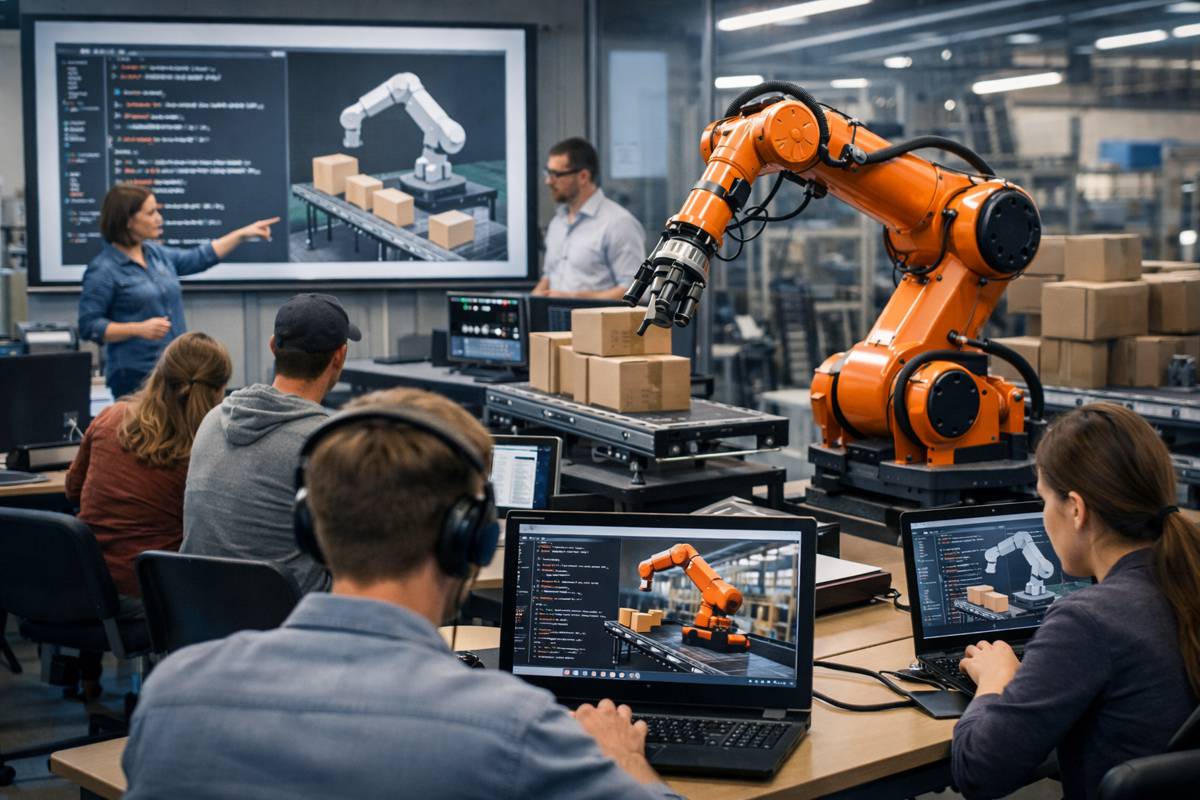
This pairing allows learners to work with concepts that mirror those used in demanding real world applications, including logistics and warehouse automation. Rather than simulating robotics in abstraction, students engage with a language and runtime designed for deployment.
Closing the Skills Gap in Automation
The growing role of robotics has created an unusual skills challenge. Effective robot programming often demands expertise across several domains, including control theory, software engineering, and application specific knowledge. That combination is rare, and the shortage is already being felt across multiple industries.
Fredrik Malmgren, CEO of Cognibotics, sees accessibility as the key to solving that problem. He explained the motivation behind the course as follows: “Today, working with robots often demands a rare mix of control theory, software engineering, and domain expertise. In demanding warehouse applications, where Juliet & Romeo is already in use, partners describe it as ‘plug and play’ compared to traditional systems. This course helps close the skills gap by making industrial grade motion programming accessible to the many more students and engineers. It’s a concrete step toward democratizing robotics.”
By removing financial and technical barriers, the course allows a much wider group of learners to explore what professional robot programming actually involves. That includes university students, engineers transitioning from other disciplines, and experienced developers curious about physical systems.
Inside the Coursera Course
The Juliet Language for Motion Programming is structured to provide both theoretical grounding and practical insight. Rather than focusing purely on syntax, the course explains how core principles of robot motion are represented within Juliet and executed through Romeo.
Learners are introduced to topics such as safe motion design, predictability in real time systems, and interactive robot behaviour. These concepts are essential in industrial environments but are often poorly explained outside specialist training programmes.
The teaching team brings together an unusual mix of experience. Amina Gojak, Philip Olhager, Klas Nilsson, and Sandra Collin collectively contribute deep knowledge of Juliet and Romeo, extensive experience with Julia, hands on familiarity with leading industrial robot languages, and decades of academic research into motion programming. That blend ensures the material remains grounded in reality rather than drifting into theory for its own sake.
Bridging Academia and Industry
For Lund University, the course reflects a broader commitment to applied education. Robotics, after all, does not exist in isolation. It intersects with manufacturing, logistics, construction automation, and emerging digital infrastructure.
Klas Nilsson, CTO at Cognibotics and Senior Lecturer in Robotics and Semantic Systems at Lund University, emphasised the importance of exposure to real tools: “For the university, it’s important that students don’t just learn robotics in theory, but also see how modern tools are used in real industrial systems. This course lets learners anywhere in the world explore motion programming through a language and runtime that reflect today’s robotics challenges.”
That philosophy aligns closely with the needs of industry. Employers increasingly look for engineers who understand not just how robots move, but why they behave the way they do under real constraints.
Preparing for Physical AI
While the current course focuses on motion programming fundamentals, development is already underway on an additional module with a strong artificial intelligence focus. This forthcoming content will explore how Juliet and Romeo can be used in Physical AI applications, where decision making algorithms interact directly with physical motion.
Physical AI is becoming increasingly relevant as robots move beyond repetitive tasks into more adaptive roles. In sectors such as logistics, construction robotics, and autonomous inspection, machines must respond dynamically to changing environments. Teaching how AI driven logic connects to safe, predictable motion is a natural next step.
By integrating AI concepts into the same programming framework, the course aims to keep learners aligned with where robotics is heading rather than where it has been.
Who the Course Is For
One of the strengths of this initiative is its broad target audience. The course is designed to be accessible without being superficial. It can serve as an entry point for beginners while still offering depth for experienced engineers.
Potential learners include:
- University students studying engineering, computer science, or automation
- Professionals transitioning into robotics from software or control disciplines
- Independent developers and hobbyists seeking industrial relevance
- Educators looking for modern teaching material aligned with real world systems
Because the course is free and delivered online, it also opens opportunities for learners in regions where access to robotics hardware and training has traditionally been limited.
A Quiet but Significant Shift
While Sweden is well known for its contributions to engineering and industrial innovation, this initiative stands out for its emphasis on openness. Rather than guarding expertise behind proprietary platforms, Lund University and Cognibotics are placing modern robot programming knowledge into the public domain.
In practical terms, that could accelerate skills development at a time when automation is expanding faster than formal education systems can adapt. In strategic terms, it signals a shift toward treating robotics knowledge as shared infrastructure rather than a closed competitive asset.
As automation continues to reshape construction, manufacturing, and logistics, initiatives like this may prove just as important as the robots themselves.