Inside xTool’s Shift to AI-Powered Creative Manufacturing at CES
At CES 2026 in Las Vegas, xTool arrives with a clear statement of intent. The global premium consumer technology brand is no longer positioning itself as a supplier of standalone desktop machines. Instead, it is presenting a cohesive, AI-driven creative manufacturing platform designed to connect intelligent software, professional-grade hardware, and real-world production workflows. This strategic shift reflects a broader movement across manufacturing and creative industries, where digital tools are increasingly expected to move seamlessly from concept to physical output without friction or specialist intervention.
Exhibiting at Booth 55251 in the Venetian Expo, xTool’s presence is built around a simple premise. Making things should not be complicated, fragmented, or locked behind steep learning curves. By integrating artificial intelligence, advanced motion systems, and production-aware software, the company is seeking to redefine what desktop manufacturing can deliver for small businesses, studios, educational environments, and retail operations.
Award Recognition Signals a Maturing Desktop Manufacturing Sector
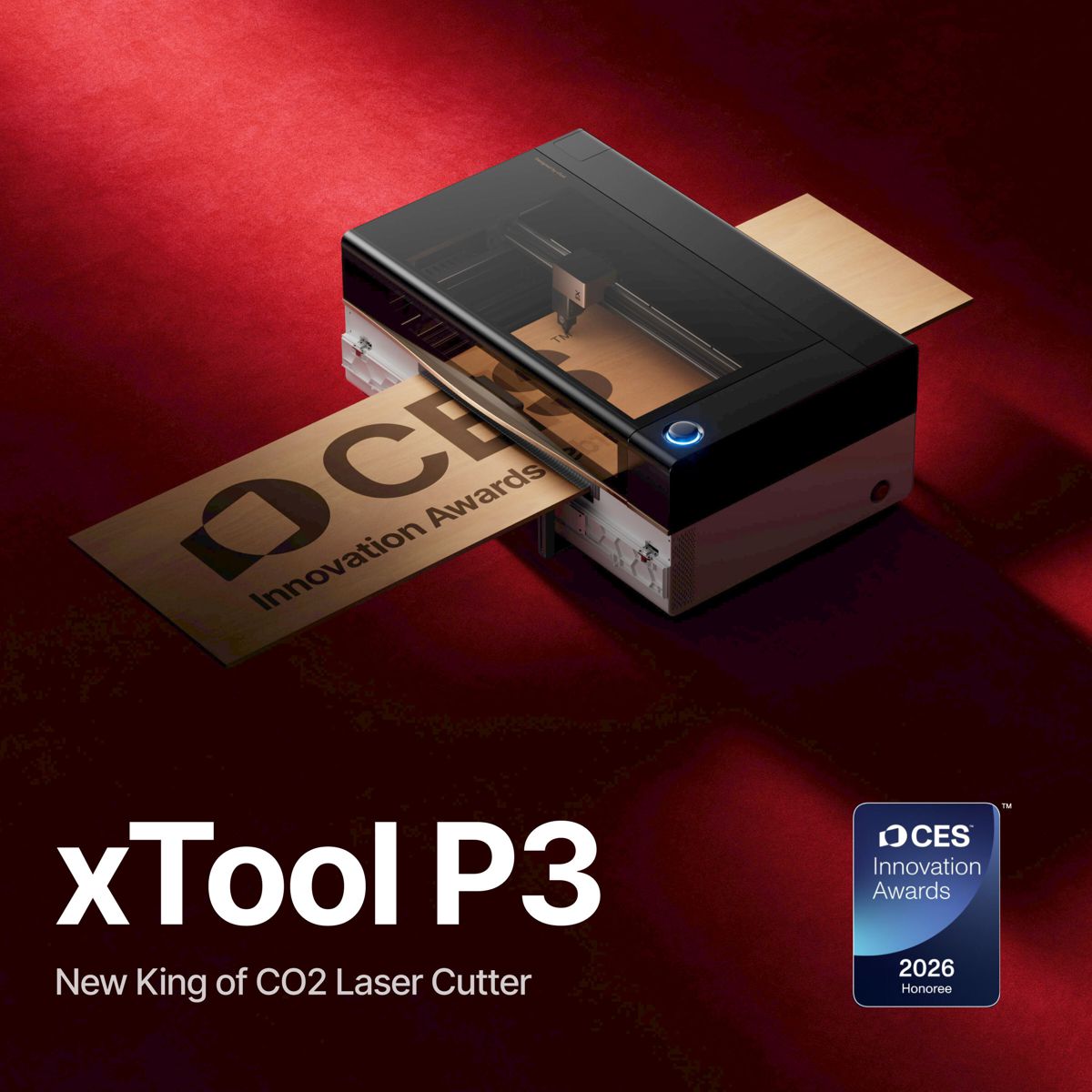
At the centre of xTool’s CES showcase is the xTool P3, the company’s flagship laser system and a recent CES 2026 Innovation Awards Honoree in the Enterprise Technology category. The award, produced by the Consumer Technology Association, signals growing recognition that desktop manufacturing systems are now crossing into professional and enterprise-grade territory.
The recognition is not simply about raw power. It reflects a broader industry acknowledgement that intelligent automation, safety integration, and software-led workflows are becoming essential even at the desktop scale. For xTool, the P3 represents a consolidation of these expectations into a single system that balances performance with usability.
Production-Grade Performance in a Desktop Footprint
Designed for businesses, studios, and educational settings, the xTool P3 is positioned as the company’s most advanced laser system to date. Built around an 80W CO₂ laser engine, it delivers production-grade cutting and engraving capabilities while retaining a desktop form factor. The expanded 36 by 18 inch work area supports larger projects and batch production, while a high-speed motion system is engineered to improve throughput without compromising consistency.
What distinguishes the P3 is not only its mechanical capability but the way intelligence is embedded throughout the system. Rather than relying on operator skill alone, the machine is designed to reduce setup time, minimise manual intervention, and support longer production runs with confidence.
Automation, Vision, and Safety by Design
The P3 integrates xTool’s Automated Creation System, combining dual cameras for full-bed live preview and process recording with LiDAR-based autofocus and an AutoLift Z platform. Together, these features aim to remove much of the trial-and-error traditionally associated with laser work, particularly in mixed-material or multi-piece jobs.
Advanced software functions such as passthrough stitching, auto-nesting, and batch filling enable efficient use of material and time. From a safety perspective, the fully enclosed Class 1 design includes active fire detection and suppression, allowing longer, lower-supervision runs. In educational and shared studio environments, this combination of automation and safety is increasingly seen as non-negotiable rather than optional.
Introducing AImake
One of the most significant announcements at CES 2026 is the introduction of AImake, described by xTool as the world’s first AI crafting agent. Unlike general-purpose generative tools, AImake is designed specifically for digital-to-physical creation. Its role is not simply to generate images or patterns, but to act as an intelligent creative partner that understands materials, machines, and manufacturing constraints.
Integrated directly into xTool Studio, AImake enables end-to-end creation. Users can move from idea generation and design refinement through to production-ready files without switching platforms or manually translating designs for hardware compatibility. The conversational interface allows users to iterate designs while receiving guidance that is aware of the specific machine, material, and workflow involved.
Human and AI Co-Creation in Practice
AImake reflects a growing shift in how artificial intelligence is being applied in manufacturing. Rather than replacing human creativity, it is positioned as an augmentative tool that accelerates decision-making and reduces friction. By embedding real-time crafting expertise and manufacturing context, the system helps users avoid common pitfalls before material is even loaded onto the machine.
This approach aligns with broader trends in industrial software, where AI is increasingly used to support design-for-manufacture principles at earlier stages. For small businesses and independent creators, that capability has the potential to reduce waste, shorten learning curves, and improve the commercial viability of short-run and customised products.
Expanding into Full-Colour with a New UV Printing Platform
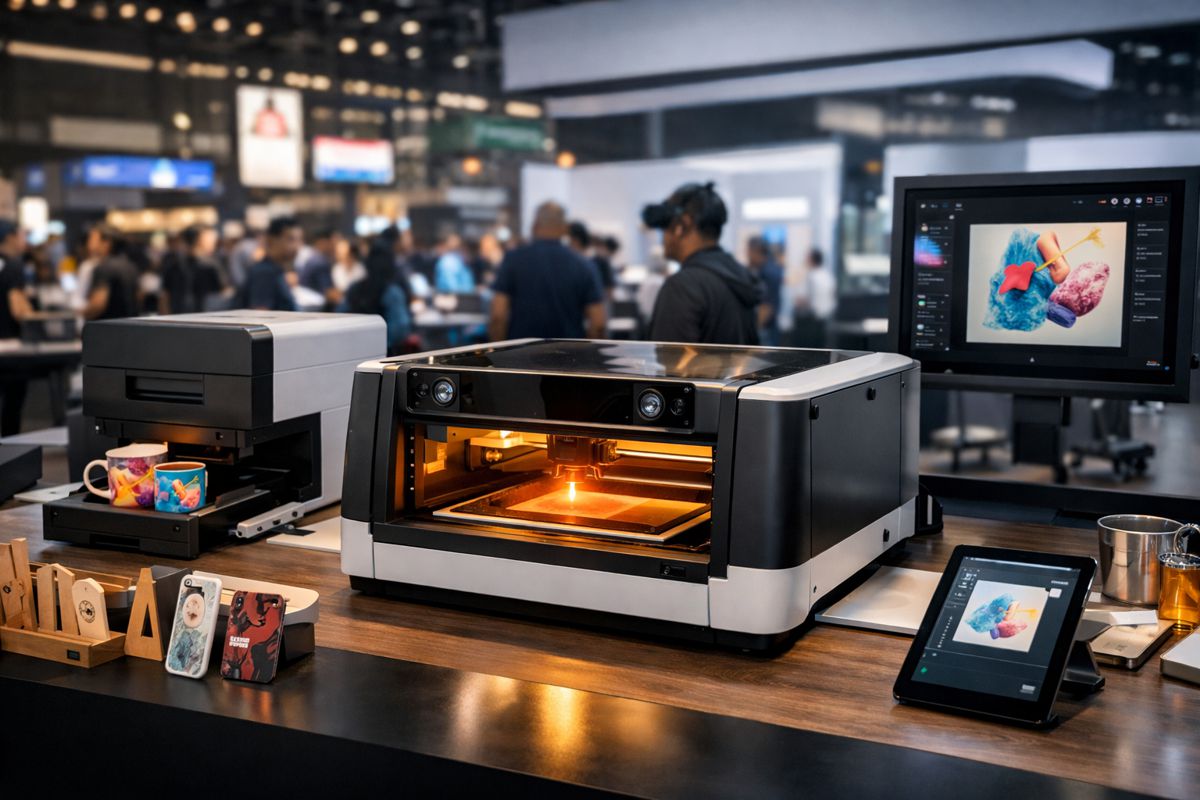
Alongside its laser innovations, xTool is previewing its first UV printer at CES 2026. The move marks a deliberate expansion of the company’s material printing portfolio and introduces what it describes as a true print-on-anything desktop solution. Aimed at creators and small studios, the system is designed to deliver vivid, durable full-colour output across a wide range of materials and object types.
From phone cases and acrylic décor to leather goods, metal items, mugs, and cylindrical products, the UV printer is intended to support applications that extend well beyond flat substrates. This breadth reflects xTool’s assessment that existing desktop UV printers often fall short of real-world creative and commercial needs.
Addressing Gaps in the Desktop UV Market
According to xTool, the new system is engineered for faster print speeds and higher productivity than typical consumer-grade UV printers. Support for taller objects and cylindrical forms is built into the design, expanding the range of viable applications for small-scale production and personalisation.
A smart cycle-based workflow is intended to simplify operation and maintenance while maintaining consistent, commercial-grade results. By packaging these capabilities into a compact, design-forward desktop format, xTool is attempting to bridge the gap between industrial UV systems and the expectations of modern creators and retail operators.
Co-Creation as a Product Development Strategy
Rather than finalising the UV printer in isolation, xTool is introducing the product through a co-creation approach. Ahead of its planned market launch in the second quarter of 2026, the company will open a co-creation programme inviting selected creators to help refine features, workflows, and use cases.
An invite-only preview at CES will offer attendees hands-on access to the machine, including live demonstrations and take-home samples. This collaborative development model reflects a wider trend in manufacturing technology, where user feedback is increasingly integrated earlier in the product lifecycle to ensure tools align with real-world demands.
Demonstrating an Integrated Creative Ecosystem
At Booth 55251, xTool is presenting more than individual machines. Live demonstrations span multiple workflows, from AI-assisted design and laser fabrication to full-colour UV printing and in-store personalisation using xTool Retail Studio. Together, these demonstrations are designed to show how concepts can move fluidly from digital design to finished product within a single ecosystem.
For small businesses and retail brands, this integration is particularly significant. The ability to design, produce, and personalise products on demand supports emerging models of localised manufacturing, rapid prototyping, and in-store customisation without the overheads traditionally associated with industrial equipment.
Supporting Commercialisation at Small Scale
xTool’s platform approach reflects a growing recognition that creators and small enterprises are increasingly operating as micro-manufacturers. Whether producing customised goods, short production runs, or educational projects, these users require tools that are flexible, scalable, and commercially reliable.
By combining intelligent software, professional hardware, and a growing portfolio of production technologies, xTool is positioning itself as an enabler of this shift. The emphasis is not on isolated devices, but on connected workflows that reduce barriers between creativity and commerce.
A Global Brand Focused on Digital-to-Physical Creation
Founded with the mission of empowering digital-to-physical creation, xTool has supported individual creators, SMB owners, and retail brands across more than 80 countries since 2021. Its product range spans desktop laser cutters and engravers, laser welders, material printers, software, accessories, and consumables.
The company’s CES 2026 showcase underscores how quickly this segment of the market is evolving. Desktop manufacturing is no longer defined by hobbyist tools alone. Increasingly, it is becoming a serious component of modern production ecosystems, capable of delivering quality, consistency, and speed at a scale previously reserved for industrial facilities.
Redefining What Desktop Manufacturing Can Be
As CES 2026 unfolds, xTool’s message is clear. The future of making lies in intelligent systems that connect ideas to output without unnecessary complexity. By aligning AI-driven software with production-ready hardware and real-world workflows, the company is seeking to redefine physical-world creativity through technology.
For creators, educators, and businesses navigating an increasingly customised and on-demand economy, that vision may prove timely. Desktop manufacturing, once seen as supplementary, is steadily becoming central to how products are imagined, produced, and delivered.