Lenovo and NVIDIA Push AI Cloud Infrastructure to Gigawatt Scale
Artificial intelligence has moved beyond experimentation and pilots. Across every major economy, AI is now a production workload, expected to deliver commercial value at speed and at scale. That shift places intense pressure on AI cloud providers to move from hardware installation to meaningful output as fast as possible. In this context, speed is no longer measured by deployment milestones alone but by how quickly AI systems generate usable intelligence.
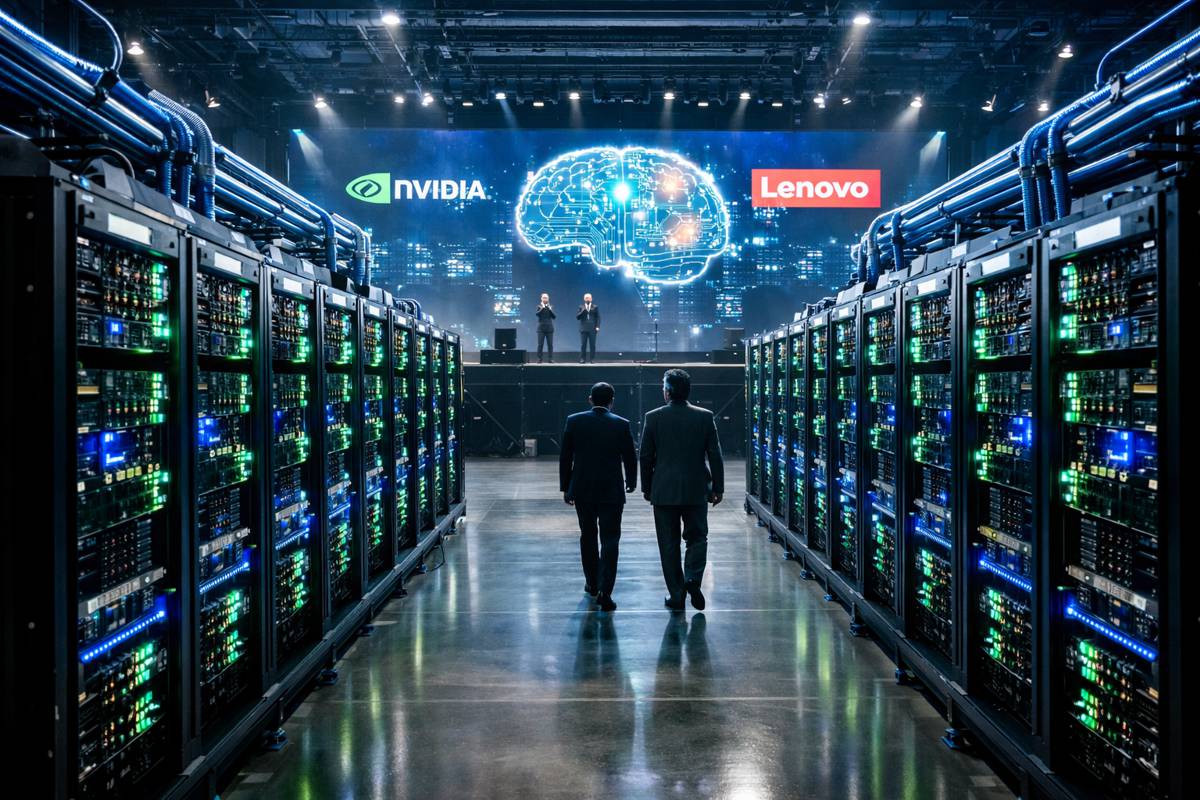
At Tech World @ CES 2026 at the Sphere in Las Vegas, Lenovo and NVIDIA signalled a decisive response to that challenge. The unveiling of the Lenovo AI Cloud Gigafactory with NVIDIA marks a new phase in industrialised AI infrastructure, designed to operate at gigawatt scale while reducing the time between investment and production-ready AI services.
Why Time to First Token Now Defines AI Value
As enterprise AI models grow larger and more complex, traditional measures of compute capacity have lost some relevance. The industry is increasingly focused on time to first token, often abbreviated to TTFT. This metric captures how quickly an AI system can deliver its first usable output after deployment, offering a practical measure of how effectively infrastructure investments translate into real-world value.
For AI cloud providers, TTFT has become a proxy for return on investment. Faster TTFT means earlier revenue generation, faster customer onboarding and shorter paths from concept to commercial deployment. In markets where demand for AI capacity continues to surge, shaving weeks or months off deployment timelines can be decisive.
A Gigawatt-Scale Response to AI Growth
The Lenovo AI Cloud Gigafactory with NVIDIA is positioned as a direct response to the scale and urgency of next-generation AI workloads. These include trillion-parameter agentic AI models, physical AI systems and high-performance computing environments that demand extreme levels of compute density, storage throughput and ultra-low-latency networking.
Rather than treating AI factories as bespoke engineering projects, the new programme introduces an industrialised approach. By combining pre-integrated solutions, expert services and global manufacturing capabilities, AI cloud providers can move from planning to production in weeks rather than months. The goal is clear. Enable providers to bring large-scale AI capacity online quickly, predictably and at commercial scale.
Leadership Perspectives from Lenovo and NVIDIA
The strategic importance of this shift was underscored during the CES keynote by Lenovo Chairman and CEO Yuanqing Yang, alongside NVIDIA founder and CEO Jensen Huang. Both framed the initiative as a fundamental rethink of how AI infrastructure should be designed, built and delivered.
Yuanqing Yang explained the changing nature of value in the AI economy: “In the AI era, value is no longer measured by compute alone, but also by how fast it delivers results. Together, Lenovo and NVIDIA are pushing the boundaries of AI factories to the gigawatt level, simplifying deployment of cloud-scale infrastructure that moves AI intelligence into production faster, with greater efficiency and predictability. With Lenovo’s industry leading Neptune liquid cooling technology, global manufacturing and service capabilities, the Lenovo AI Cloud Gigafactory with NVIDIA sets a new benchmark for scalable AI factory design, enabling the world’s most advanced AI environments to be deployed in record-setting time, fuelling innovation at manufacturing speed across industries.”
Jensen Huang placed the announcement in a broader global context, highlighting how AI factories are becoming core national and industrial assets: “As AI transforms every industry, companies in every country will build or rent AI factories to produce intelligence. Together, NVIDIA and Lenovo are delivering full-stack computing platforms that power agentic AI systems from the cloud and on-premises data centres to the edge and robotic systems.”
Industrialising AI Deployment at Giga-Scale
At the heart of the programme is an integrated framework that unifies solutions, services and manufacturing. This approach is designed to remove many of the friction points that traditionally slow large infrastructure projects. Instead of coordinating multiple vendors and bespoke designs, AI cloud providers gain access to a repeatable, scalable model.
Key elements include Lenovo Neptune liquid-cooled hybrid AI infrastructure, NVIDIA accelerated computing platforms, and Lenovo’s global manufacturing footprint. Together with Lenovo Hybrid AI Factory Services, these components support the full lifecycle of AI factory development, from initial design and co-engineering through deployment, operation and ongoing optimisation.
Liquid Cooling as a Strategic Enabler
Power density is one of the defining challenges of gigawatt-scale AI infrastructure. Traditional air-cooling approaches struggle to keep pace with the thermal demands of densely packed GPUs and CPUs. Lenovo’s Neptune liquid cooling technology plays a central role in addressing this constraint.
By enabling more efficient heat removal, liquid cooling allows higher compute density within a smaller footprint while reducing energy consumption. For AI cloud providers operating at scale, this translates into lower operating costs, improved reliability and the ability to deploy more compute within existing facilities. It also supports sustainability goals, an increasingly important consideration for hyperscalers and public sector deployments alike.
Accelerated Access to NVIDIA’s Most Advanced Architectures
A critical differentiator of the Lenovo AI Cloud Gigafactory with NVIDIA is early and streamlined access to NVIDIA’s latest accelerated computing platforms. Built on decades of close collaboration, the programme ensures rapid time-to-market for new architectures as they become available.
Among the headline offerings is the NVIDIA GB300 NVL72 system from Lenovo. This fully liquid-cooled, rack-scale platform integrates 72 NVIDIA Blackwell Ultra GPUs with 36 NVIDIA Grace CPUs in a single system. Designed for extreme AI training and inference workloads, it delivers the compute density required for next-generation models while maintaining manageable power and cooling profiles.
Preparing for the Rubin Generation of AI
Looking beyond current deployments, the programme is also aligned with NVIDIA’s newly announced Vera Rubin NVL72 system. This flagship platform is designed to support the next wave of AI training and inference at unprecedented scale.
The Rubin NVL72 unifies 72 Rubin GPUs, 36 Vera CPUs, ConnectX-9 SuperNICs, BlueField-4 DPUs and Spectrum-X Ethernet into a rack-scale AI supercomputer. Advanced networking options, including NVIDIA Spectrum-6 Ethernet switches and NVIDIA Photonics Ethernet switches, further enhance throughput and latency performance. For AI cloud providers, this roadmap offers confidence that investments made today will scale into future generations of AI workloads.
From Infrastructure to Differentiated AI Services
While hardware performance is essential, the commercial success of AI factories depends on the ability to deliver differentiated services. Lenovo Hybrid AI Factory Services are designed to reduce stand-up time while enabling long-term competitive advantage.
AI-native platforms and repeatable Lenovo AI Library use cases, integrated with NVIDIA AI Enterprise, help simplify the delivery of both horizontal and vertical AI solutions. Support for open Nemotron models further lowers barriers to deploying specialised workloads across industries such as manufacturing, logistics, finance and public services.
Global Manufacturing and Local Delivery
Lenovo’s role extends well beyond system design. The company powers eight of the world’s top ten public cloud providers and remains the only organisation offering fully in-house design, manufacturing, integration and global services for custom AI cloud solutions.
This combination of global scale and local reach enables AI cloud providers to deploy infrastructure rapidly while maintaining consistent performance and compliance across regions. When paired with NVIDIA’s accelerated computing platforms, the result is a trusted, repeatable path to deploying AI factories reliably at scale.
Shortening the Path from Investment to Outcomes
The strategic outcome of the Lenovo AI Cloud Gigafactory with NVIDIA is a shorter and more predictable journey from capital investment to operational impact. By focusing on TTFT and industrialised deployment, the programme addresses one of the most persistent bottlenecks in AI adoption.
For enterprises, policymakers and investors, this approach signals a maturation of the AI infrastructure market. AI factories are no longer experimental constructs. They are becoming industrial assets, designed, built and operated with the same discipline as advanced manufacturing plants or energy infrastructure.
Building the Next Era of Hybrid AI
With this announcement, Lenovo now offers a complete portfolio of full-stack hybrid AI factory solutions built on NVIDIA accelerated computing, networking and software. These solutions span enterprise deployments and large-scale AI cloud providers, supporting hybrid architectures that extend from core data centres to the edge.
As AI continues to reshape economies and industries, the ability to deploy intelligence at speed and at scale will define competitive advantage. The Lenovo AI Cloud Gigafactory with NVIDIA represents a clear statement of intent, one that positions both companies at the centre of the next era of industrialised AI.