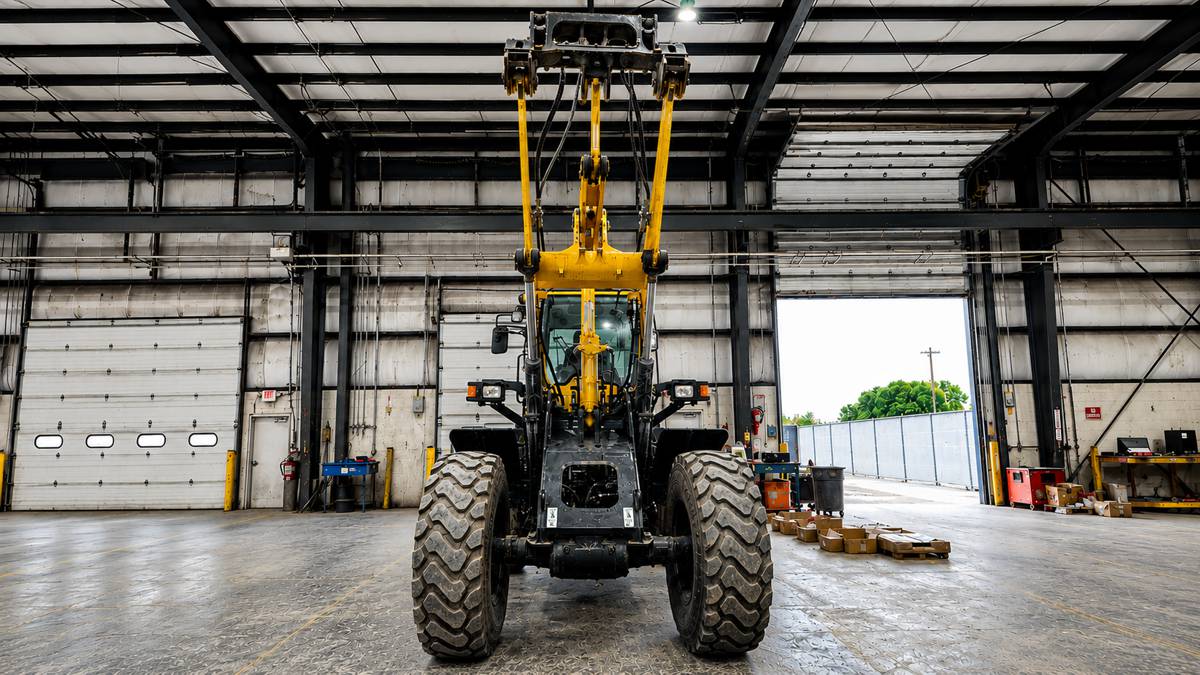
Electric Excavators Finding Their Place in Harsh Quarry Environments
Across the global construction and materials sector, electrification is no longer confined to urban job sites, indoor demolition, or tightly controlled municipal projects. It is edging into places long considered off limits for battery power. Quarries, crushing plants and heavy aggregates operations sit firmly at the sharp end of that transition, where vibration, dust, noise and relentless duty cycles test both machines and mindsets.
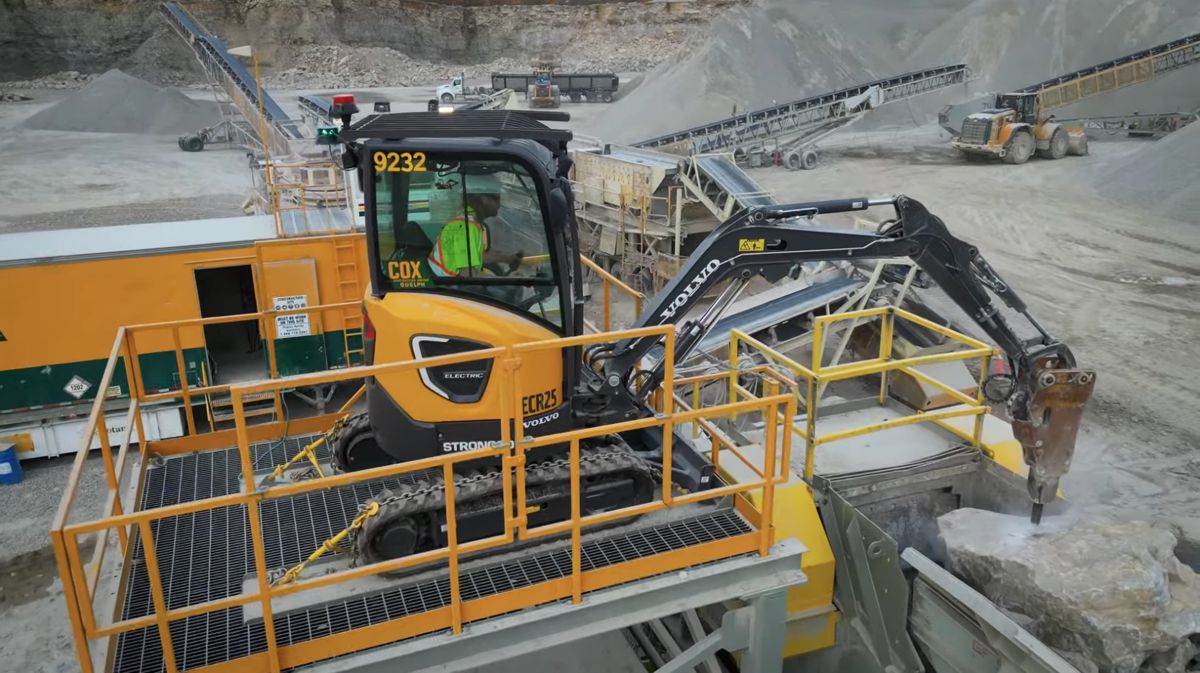
In southern Ontario, one family owned contractor is quietly demonstrating how electric equipment can find a practical foothold in even the most unforgiving environments. By deploying compact battery electric excavators directly on top of crushing plants, Cox Construction is challenging assumptions about what electric machinery can and cannot do. The result is not a marketing experiment or pilot project, but a working production solution that speaks to cost control, fleet efficiency and the changing expectations of public sector clients.
The story matters well beyond one Canadian quarry. As governments, infrastructure owners and financiers increasingly expect contractors to show measurable progress towards lower emissions operations, examples like this are becoming commercially relevant. They reveal where electrification makes sense today, where it does not, and how contractors can integrate new technology without disrupting productivity.
A Quarry Business Built on Adaptation
Cox Construction is no newcomer to hard work or heavy materials. Based in Guelph, Ontario, the family business traces its roots back to 1946, when its founder Russell Cox began crushing stone with equipment that demanded nightly repairs just to keep operating. From those early days, the company evolved steadily into a regional player spanning road building, asphalt production, paving, grading and aggregates extraction across south eastern Ontario.
Now led by Regan Cox, the business operates multiple pits and plants, each with its own logistical challenges and equipment demands. Crushing oversize material has always been part of that equation. Rocks too large to fit into a crusher opening must be broken down quickly and safely to avoid interrupting production. Traditionally, that task has been handled by small diesel excavators fitted with hydraulic hammers, positioned directly above the crusher feed.
What makes Cox Construction noteworthy is not the task itself, but the decision to rethink the tool used to perform it. Rather than defaulting to another diesel machine, the company opted to trial compact electric excavators in one of the least forgiving parts of the operation.
Why Oversize Breaking Became the Test Case
Oversize rock breaking is a deceptively demanding job. The machine must deliver consistent hydraulic power, operate in close proximity to vibrating plant equipment, and remain available throughout long shifts even if actual hammer use is intermittent. Downtime quickly cascades through the crushing circuit, affecting material flow and plant utilisation.
For Cox Construction, this made the role an ideal test bed for electric machinery. The excavator might only be used several times during a shift, but it needed to be instantly available when required. Idle time, warm up routines and unnecessary engine hours on a diesel machine were already seen as inefficiencies. Electrification offered a potential solution, provided it could meet the physical demands of the job.
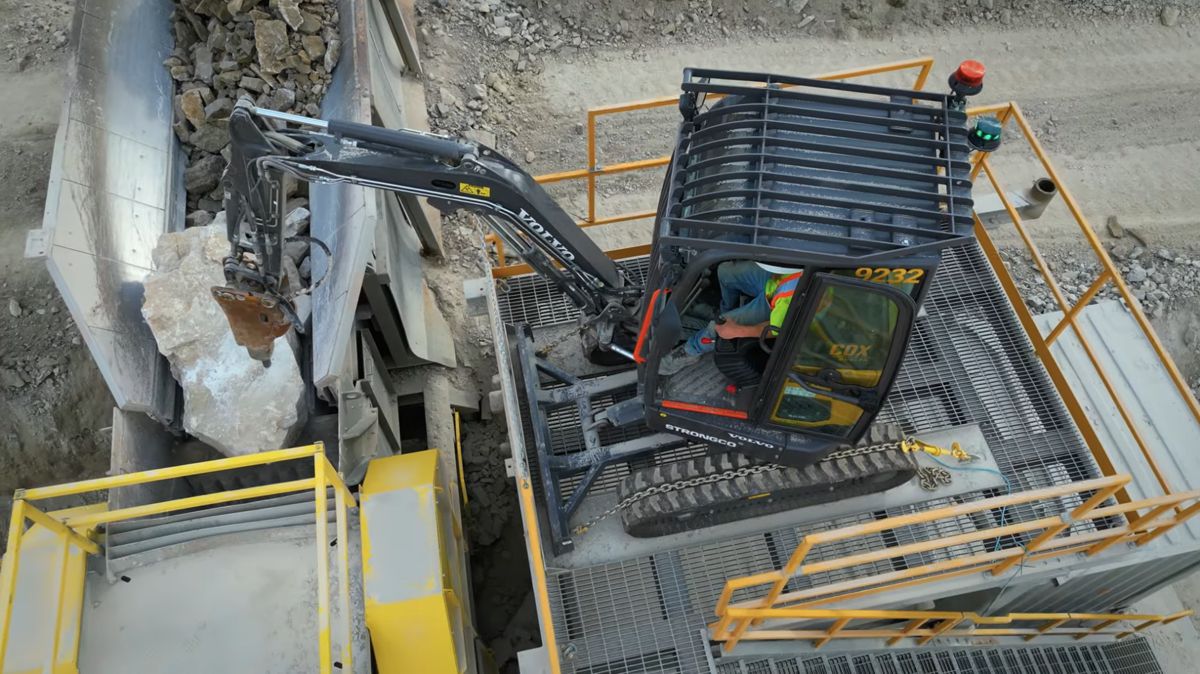
That solution came in the form of the Volvo ECR25 Electric, a compact excavator weighing around two and a half tonnes. Cox Construction now operates two of these machines, both positioned directly on crushing plants to deal with oversize material.
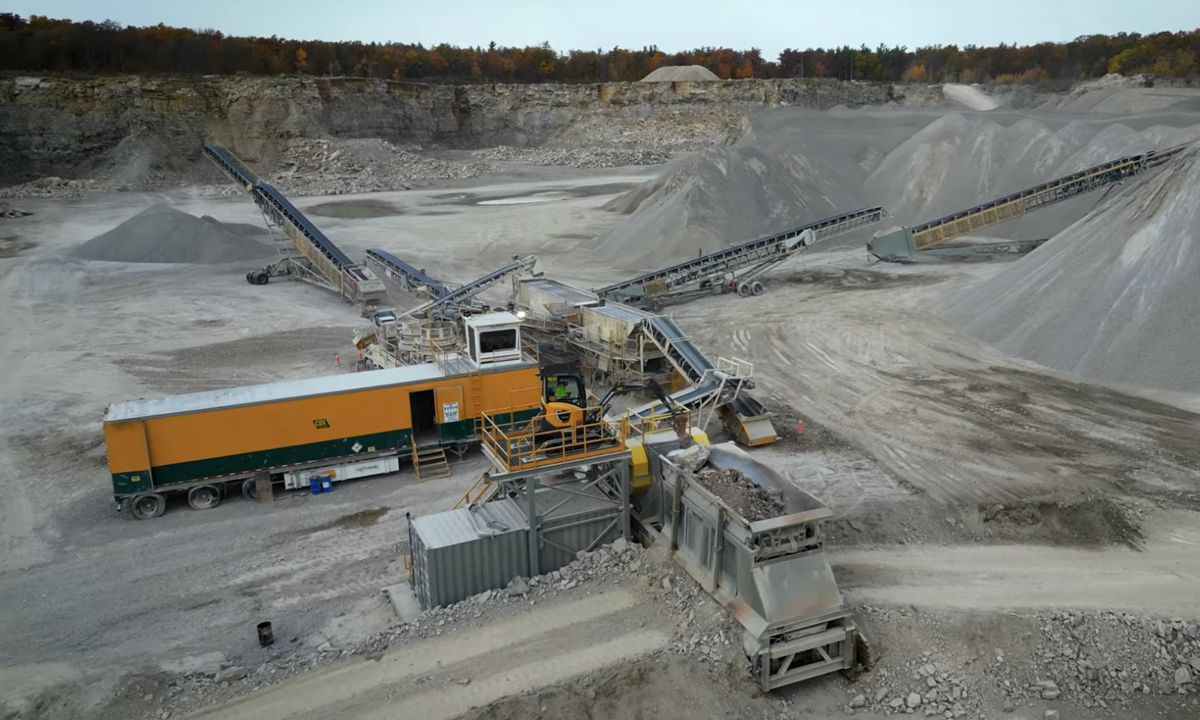
From Scepticism to Seamless Operation
Initial reactions within the team were cautious. Quarry environments are not typically associated with electric equipment, and concerns around power, durability and uptime were openly discussed. Yet once the machines entered service, those doubts began to fade.
According to crusher foreman Brandon Crumbie, the transition from diesel to electric was effectively seamless. The electric excavator delivered the same functional capability as its diesel predecessor, with fewer operational compromises than expected. Instant start up eliminated warm up delays, while the absence of engine noise improved communication around the crusher.
Maintenance differences became apparent almost immediately. With no combustion engine, there was no engine oil to change, no filters to replace, and no fuel logistics to manage. Attention shifted primarily to the hydraulic system, simplifying routine servicing and reducing the risk of unplanned downtime.
Crucially, the machines proved resilient in an environment defined by constant vibration. Electric drivetrains contain far fewer moving parts than diesel engines, reducing exposure to vibration induced failures. Over time, this translated into greater confidence in the machine’s reliability atop the crusher.
Charging Infrastructure That Fits the Job
One of the most persistent concerns around electric equipment in heavy industry is charging logistics. In this case, the challenge proved far less significant than anticipated. The electric excavators operate at sites already powered by high voltage crushing plants, with 600 volt systems feeding the main equipment.
Charging the excavators from the existing generator setup represented a minimal additional load. Because the machines are not in constant use, charging intervals varied depending on duty cycles. In practice, the company found that a single charge could last up to two weeks under certain operating conditions.
The charging process itself was straightforward, involving a simple cable connection and a dash mounted activation. This ease of use reduced any potential resistance from operators and ensured the machines remained ready whenever required.
The electric excavators were also fitted with hydraulic hammers and additional guarding, ensuring they met the same safety and functional standards as their diesel counterparts. In doing so, Cox Construction avoided treating the machines as special cases, instead integrating them fully into standard quarry operations.
Fleet Optimisation and Secondary Benefits
Beyond the immediate performance of the electric excavators, Cox Construction identified secondary benefits that improved overall fleet efficiency. By assigning electric machines to the crusher top role, diesel excavators were freed up for other tasks across the business.
This redistribution of assets allowed the company to maximise utilisation of existing diesel equipment where electrification was less practical. Rather than replacing machines wholesale, Cox Construction used electrification strategically, aligning technology with the most suitable applications.
There were also subtle but meaningful improvements in working conditions. Reduced noise and the absence of exhaust fumes enhanced the environment around the crusher, contributing to operator comfort and site safety without altering productivity.
Even Russell Cox, now 99 years old and still attending the office weekly, took notice of the shift. While cautious about blanket adoption, he recognised the value of electric power in applications where distances are short and infrastructure is already in place.
Dealer Support and Commercial Reality
Behind the scenes, the role of dealer support proved critical. Nors Construction Equipment Canada worked closely with Cox Construction to ensure the electric excavators were properly specified for the application. That included confirming hydraulic performance, assessing duty cycles and addressing concerns around vibration and charging.
From a commercial standpoint, the upfront cost of electric equipment remains higher than comparable diesel machines. However, long term operating costs tell a different story. Reduced maintenance, lower energy costs and the elimination of idle engine hours contribute to a compelling total cost of ownership argument.
There is also a growing regulatory and contractual dimension. Public sector projects in Canada increasingly require contractors to demonstrate a credible path towards sustainability. While electric compact equipment alone will not satisfy those requirements, it forms part of a broader narrative that clients and policymakers are keen to see.
For contractors willing to ask hard questions and explore unconventional solutions, early adoption can deliver both operational and reputational advantages.
Volvo’s Longstanding Role in the Fleet
Cox Construction’s openness to electric equipment did not emerge in isolation. The company has relied on Volvo machinery for decades, beginning with articulated dump trucks and later expanding into excavators and loaders. That long term relationship fostered confidence in the brand’s engineering approach and support network.
Visits to Volvo manufacturing facilities in earlier decades reinforced that trust, exposing the family to production processes and quality standards that influenced purchasing decisions for years to come. Today, the fleet includes multiple Volvo articulated haulers and excavators alongside the electric compact machines.
As Volvo continues to expand its electric line-up, contractors like Cox Construction are watching closely. Advances in battery energy density, charging speeds and machine integration will determine how far electrification can extend into heavier quarry and aggregates applications.
For now, compact electric equipment occupies a niche, but one that is growing steadily as technology matures and use cases multiply.
A Practical Signal of What Comes Next
The experience at Cox Construction underscores a broader lesson for the construction and infrastructure sector. Electrification does not require sweeping transformation or ideological commitment. It begins with identifying specific tasks where electric equipment can outperform diesel alternatives on cost, convenience or compliance.
Breaking oversize rock atop a crusher may seem an unlikely starting point, yet it highlights how electric machines can thrive in roles defined by intermittent use, high vibration and existing power availability. These are not edge cases. They are common conditions across quarries, recycling plants and materials yards worldwide.
As policymakers, investors and clients scrutinise emissions across the infrastructure supply chain, such practical examples carry weight. They demonstrate that sustainability is not solely about future promises, but about decisions made on active job sites today.
For Cox Construction, electric excavators are not symbols. They are tools. And in a business built on nearly eight decades of adaptation, that distinction matters.