Intertraffic Awards Highlight Innovations That Deliver Real-World Impact
The shortlist for the Intertraffic Awards 2026 has landed, and it reads like a snapshot of where mobility is heading next. Fifteen finalists have been named across three categories, highlighting innovations that aim to cut emissions, improve the day-to-day experience of moving around cities, and introduce technologies that could reshape how road networks are monitored, funded and operated.
For an industry that sits at the crossroads of infrastructure investment, climate policy, and rapidly evolving digital capability, the Intertraffic Awards matter because they rarely focus on shiny tech for tech’s sake. They tend to reward tools that can be deployed into the messy reality of highways, streets, construction zones and control rooms, where maintenance budgets are tight, disruption is expensive, and outcomes are measured in safety and uptime rather than headlines.
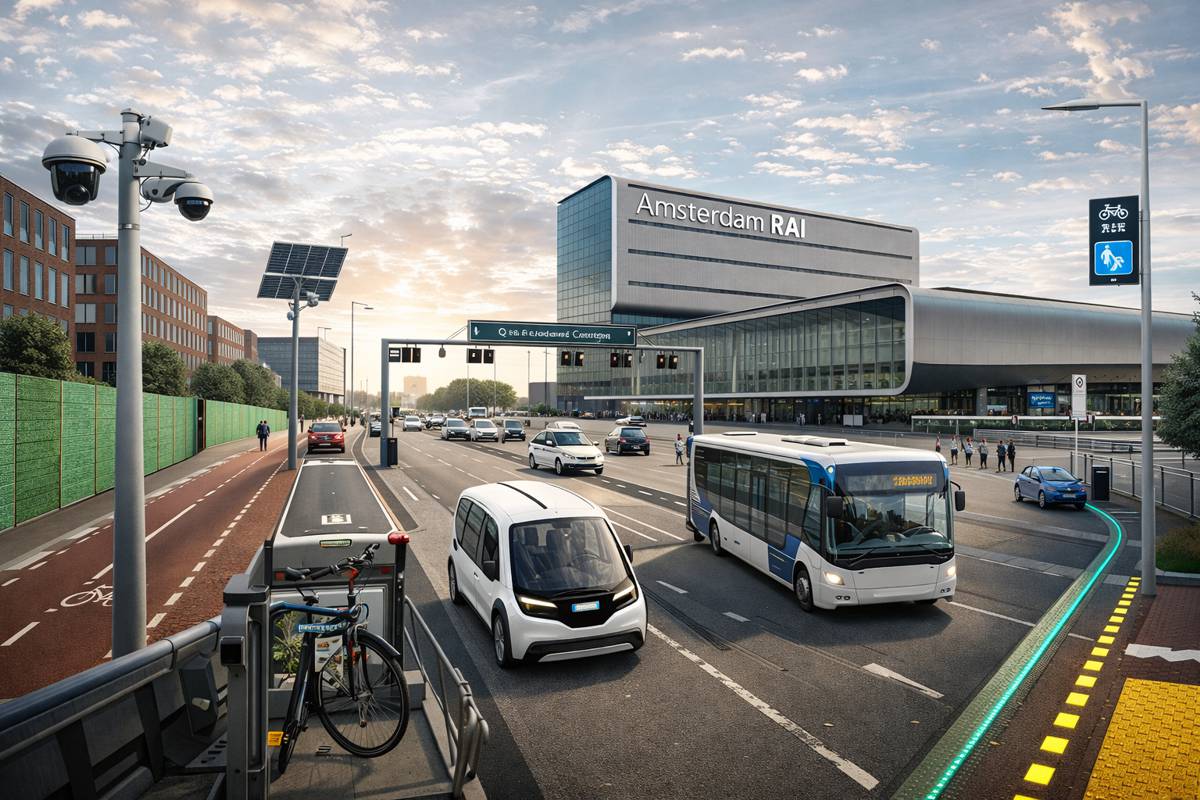
The winners will be announced during the opening ceremony of Intertraffic Amsterdam 2026 on 10 March 2026, with the wider four-day event running until 13 March. It is expected to bring together around 30,000 mobility professionals from more than 140 countries, hosted at RAI Amsterdam, with 900 exhibitors across 12 halls, over 300 sessions, and dedicated zones for emerging technologies. In practical terms, that scale is what makes Intertraffic a bellwether: it’s where road authorities, transport operators, infrastructure owners, and technology suppliers compare notes on what’s working and what’s still stuck in pilot mode.
Awards for Real World Innovations
Mobility innovation often gets framed as a consumer story: new apps, electric vehicles, smart features, sleek automation. But the more consequential transformation is happening in the infrastructure layer, where decisions about how to manage traffic, enforce rules, price road use, and protect vulnerable users ripple out into the economy.
That’s why this year’s nominees feel particularly relevant to the construction and infrastructure ecosystem. Several of the shortlisted solutions respond directly to problems road operators recognise instantly: unreliable detection of hazards, ageing roadside assets, noise and air quality pressures near corridors, and the operational headache of coordinating data between multiple stakeholders. There’s also a noticeable shift toward systems designed to be retrofitted into existing networks, rather than requiring disruptive, capital-heavy rebuilds. Put bluntly, these are tools pitched at getting more out of the roads we already have.
From a broader policy perspective, the shortlist also reflects two big forces reshaping mobility investment decisions. First, there’s the tightening focus on environmental accountability, where “less bad” no longer cuts it and measurable impact is becoming the baseline expectation. Second, there’s the acceleration of automation and AI in enforcement and operations, driven as much by staff constraints and incident-response expectations as by technical ambition.
The Stage for a Global Innovation Showcase
Intertraffic Amsterdam has long played the role of industry crossroads, bringing together city leaders, national road operators, ITS suppliers, and emerging technology companies in one concentrated setting. With the 2026 edition positioned as the most comprehensive to date, the awards programme sits right at the start of proceedings, shaping conversations before the halls even open in earnest.
Behind the scenes, the jury process signals that the shortlist is meant to represent more than marketing polish. The jury members reportedly spent many hours scoring entries individually before debating the merits collectively and narrowing the field to 15 finalists from providers worldwide, a mix that underscores how globally distributed mobility innovation has become.
One jury member, Tom Stone, editor of Intertraffic World magazine, highlighted how even industry veterans still encounter surprises in the process: “The judging process for the Intertraffic Awards has always been fascinating, and this year was no different,” says Jury member Tom Stone, editor of Intertraffic World magazine. “Although the jury panel is made up of industry experts, there are always some innovations that surprise us by bringing completely new technology and solutions to the table that we had previously been unaware of. The high-quality of entries makes picking just five in each category a challenge. But after much debate we’ve done it, and now all look forward to the final judging in Amsterdam.”
That observation matters because it hints at something bigger than a trophy moment. It suggests the sector is still early in discovering which combinations of sensing, connectivity, data exchange, and design will define next-generation road operations.
Green Globe Nominees
Sustainability in mobility is often discussed in terms of electrification and public transport shift, but the Green Globe finalists show a wider interpretation: clean air, circular materials, noise reduction, and optimising scarce urban space.
Ekin Spotter by Ekin Smart City Technologies (Turkey) stands out for combining environmental monitoring with enforcement capability. The solution is described as an “Environmental Governance Engine” that links real-time air quality monitoring with AI-driven traffic enforcement. Its most striking operational idea is Dynamic Green Zones, where pollution spikes trigger immediate restrictions via 6K ANPR and vehicle classification. If executed responsibly, this points toward cities moving from static environmental policies to responsive, measurable interventions that can be adjusted by time, location, and conditions.
Noise is another theme running strongly through the category, and not just as an annoyance. In dense urban corridors, noise is a public health and planning issue, influencing development permissions, property value, and even political support for freight routes. Hatko Sound Barrier by Hatko Sound Barriers (Turkey/Portugal) tackles this with recycled tyres, positioning itself as a low-carbon alternative that also delivers acoustic performance. By turning waste tyres into infrastructure products, it reflects the broader shift toward circular construction materials, where waste streams are increasingly being viewed as industrial feedstock.
A similar approach comes from Italy with Le Difese Wall by Noise, described as a sound-absorbing cladding system made from recycled plastic and fully recyclable. The focus here is not only on performance but also on aesthetics and retrofitting, with UV-resistant, mass-coloured elements that require no paint. That might sound like a minor detail, but it’s often the finishing and maintenance cycle that determines whether a solution survives procurement and lifecycle cost scrutiny.
Brazil’s Noise Detection System by Mobilis Traffic Systems approaches the problem from the enforcement angle, combining microphones, software intelligence, and integrated audio-video-plate capture. With many cities struggling to manage modified exhaust noise and urban disruption, automated systems like this represent a potential shift toward treating excessive noise as enforceable pollution, not just a policing nuisance.
Completing the Green Globe shortlist is a very tangible piece of mobility infrastructure: MB Air by HR Groep Streetcare (Netherlands), a two-tier bicycle parking system using compressed air to move bicycles horizontally, including e-bikes up to 35 kg and bikes with child seats. It has been positioned as the world’s first CE-certified system of its kind. The broader story here is that the e-bike boom has outgrown legacy bicycle infrastructure, and solutions that remove lifting strain aren’t just convenient, they’re accessibility upgrades that help cycling scale beyond the confident and able-bodied.
Inspirational Award Finalists
If the Green Globe category is about measurable progress, the Inspiration Award is where the industry tests the edges of possibility. The 2026 finalists lean heavily into sensing, AI accuracy, work zone safety, and road funding models.
Deltabloc TAM Technology (Austria) introduces fibre optic sensing adapted from pipeline and earthquake monitoring. The concept is ambitious: using high-frequency laser pulses inside fibre optic cables to monitor vehicle behaviour across distances up to 50 km in real time. Detecting traffic jams, accidents, and hazardous manoeuvres and then transmitting alerts to operators and emergency services could have major implications for incident response and secondary crash prevention. For road owners with fibre already in corridors, it hints at a future where “the road listens” continuously, without relying solely on cameras or point sensors.
The UK’s MAV AiQ by MAV Systems focuses on a modern enforcement reality: illegal, cloned, and stealth number plates. Its GhostPlate technology is positioned as a step-change in AI-driven ANPR, claiming 99%+ accuracy, up to 20% more valid reads than legacy systems, and a 30–40% reduction in mismatched records, all without additional gantries or lane closures. That’s the key operational point: improving accuracy without physical expansion. In an era where roadside civil works can be as politically difficult as they are expensive, smarter software upgrades are often the only realistic route.
Work zone safety gets a sharp spotlight through RTS10 by Byda (South Korea), described as a device that provides virtual target information to vehicles with adaptive cruise control. The core problem is simple and serious: ACC systems may not reliably detect stationary obstacles, which includes work vehicles and temporary traffic management setups. By supplying virtual target cues, RTS10 aims to prompt deceleration. The system was reportedly tested in more than 200 drives, with all vehicles decelerating when activated and an average speed reduction of 48%. For construction professionals, it’s a rare example of innovation that targets the vehicle automation gap that makes roadworks so dangerous.
Funding and fairness step into the frame with Q-Free Road User Charging (Norway), a distance-based charging model for private cars using battery-powered, privacy-focused tags. Unlike fixed-point tolling, it enables charging by distance and zone, supporting a shift in road funding as fuel tax revenues decline. This isn’t just a technology discussion, it’s a structural one: governments worldwide are grappling with how to fund road maintenance in a fleet that’s gradually moving away from fuel duty.
Finally, the Netherlands-based Luxene Guidance Line presents a physically grounded innovation: embedded illuminated road marking designed to guide drivers and riders through darkness and harsh weather. The detail that matters is its architecture, with the laser-powered fibre-optic line embedded in markings and no electronics in the road surface, while power and control sit in a roadside cabinet. That approach speaks directly to maintenance pain points, because the road surface is where systems go to die if they’re fragile, hard to access, or difficult to repair quickly.
User Experience Award Nominees
For years, “user experience” in mobility has been treated as a consumer app issue. The User Experience Award shortlist makes it clear the industry is now applying UX thinking to operators, field crews, visually impaired pedestrians, and complex multi-actor data environments.
ePARK Zone Management by SKIDATA (Austria) is described as a platform that enables operators to create, price, and activate parking zones digitally in two minutes. The bigger implication is that parking is becoming programmable infrastructure, with configuration moving from weeks-long projects to near real-time adjustments. That’s particularly relevant as cities experiment with demand-based pricing, event-based restrictions, and kerbside reallocation for deliveries and micromobility.
The UK’s ParkIT by BookFlowGo highlights operational resilience, migrating Manchester Airport Group’s Meet & Greet operations across three airports with zero downtime. It is described as handling more than 850,000 cars and tracking 1.8 million vehicle movements annually. For airports and transport hubs, the lesson isn’t just about software, it’s about continuity, data visibility, and workflow design under pressure, where a bad system becomes a queue, a delay, and a reputational hit in minutes.
From the Netherlands, TLEX Interchange by Monotch takes on the often-overlooked problem of mobility data exchange. Built on AMQP and aligned with standards including C-Roads, it is positioned as a cloud-native engine enabling public authorities and infrastructure owners to deploy complex exchange through guided setup and scale from pilots to operational deployments without redesigning flows. This category of tooling is unglamorous but crucial. Without reliable exchange mechanisms, “smart mobility” becomes a collection of isolated projects rather than an integrated system.
Also from the Netherlands, Cosmos Smart Traffic Management Platform 2.0 by Ortana focuses on design-led innovation in an intelligent transport platform built on a GIS-based architecture. The platform aims to unify field visibility across control centre interfaces and mobile applications, enabling shared situational awareness and on-site reporting. This speaks to a modern operational truth: traffic management is no longer confined to a room full of screens, it’s an ecosystem of distributed teams who need the same picture, fast.
Rounding out the category is NavTac Temporary Tactile Guidance Films by Brite-Line (China), providing temporary tactile guidance and hazard warnings for visually impaired pedestrians in changing environments like construction zones and events. Easy application and removal without residue, plus slip resistance and high visibility, make it a practical intervention that acknowledges a simple gap: temporary works too often erase accessibility.
Reflecting the Changing Rules of Mobility Investment
Across all categories, a handful of patterns emerge. The first is the blending of sensing, AI and enforcement, where “seeing” and “acting” are converging into single operational platforms. The second is circular infrastructure thinking, where barriers and cladding become part of waste reduction strategies rather than just roadside fixtures. The third is a serious emphasis on deployment practicality, whether that means no electronics in the road surface, no need for extra gantries, or configuration in minutes rather than months.
There’s also a subtle shift in mindset away from mobility as a future promise and toward mobility as an operational discipline. In other words, innovation is being judged on whether it can survive procurement, maintenance cycles, integration complexity, and public accountability. The winners will be announced on 10 March 2026 at Intertraffic Amsterdam’s opening ceremony, but the shortlist itself already offers a strong indicator of what road authorities and operators are prioritising right now.
Alongside the three main award categories, Intertraffic’s startup community also gets its moment via the Intertraffic Startup Award, open to all startups participating in ITSUP, with the winner also revealed at the opening ceremony. That parallel track matters because some of the most disruptive ideas in mobility emerge from younger companies willing to challenge legacy assumptions about infrastructure ownership, data governance, and what “normal” operations look like.
The jury behind the 2026 awards includes Pieter Litjens (Director of CROW) as chairman, alongside Margriet van Schijndel (TU/e), Jorrit Weerman (Parking Network), Adam Hill (ITS International), and Tom Stone (TTi and Intertraffic World). With that mix of authority, research insight and industry journalism, the final decision is likely to favour solutions that bridge credibility and real-world impact.
Intertraffic Amsterdam 2026 will bring the sector together once again at a moment when mobility is under pressure to become cleaner, safer, and more equitable without grinding cities to a halt. If these finalists are any indication, the next wave of progress won’t come from a single breakthrough. It’ll come from hundreds of small, deployable improvements that add up to better outcomes on the ground, where it counts.