LEGO and the Future of Creative STEM Education
In early years education, the conversation is increasingly dominated by apps, adaptive learning platforms, and the promise of artificial intelligence guiding children through personalised pathways. On the surface, it all sounds wonderfully efficient. Yet beneath the glow of tablets and interactive screens, educators are quietly wrestling with a different reality: young children don’t just learn by watching, tapping, or repeating. They learn by touching, building, breaking, and trying again.
That’s where LEGO still earns its place at the table, quite literally. More than six decades after LEGO patented its now-iconic interlocking brick design in 1958, the small plastic blocks remain one of the most enduring tools for playful learning. International LEGO Day, marked each year on 28 January, celebrates that legacy, but it also offers a timely reminder of why hands-on learning matters at a moment when the education sector is rapidly digitising.
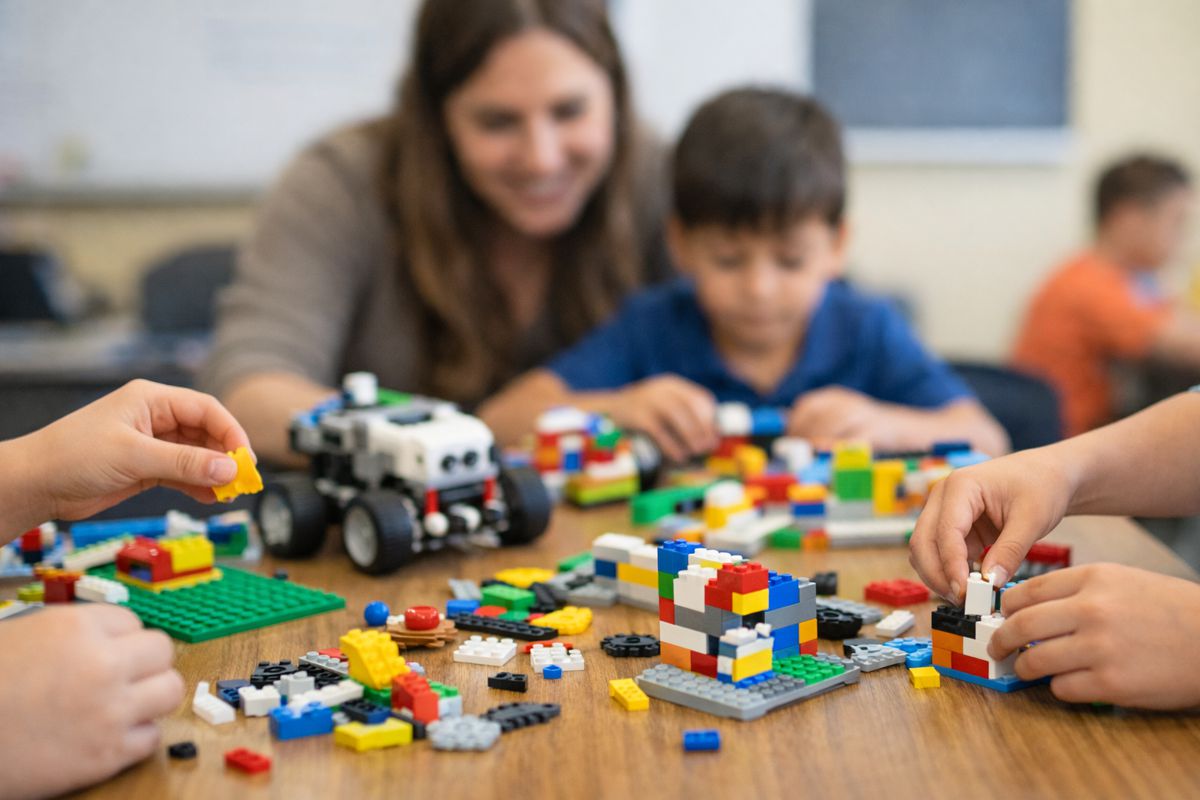
At Florida State University’s Anne Spencer Daves College of Education, Health, and Human Sciences, the bricks are being used not as nostalgia, but as a practical teaching instrument. The Anne’s College Technology Sandbox National LEGO Day Workshop, led by Dina Vyortkina, assistant dean of Innovation and Instructional Technology Enhancement, highlights how the toy’s simplicity still supports foundational STEM thinking, problem-solving skills, and creative collaboration.
What International LEGO Day Reveals About Modern Learning
LEGO’s continued relevance isn’t just about brand longevity. It’s about how learning actually works when children are still developing core cognitive, physical, and social skills. The pressure to introduce coding, robotics, and AI literacy earlier than ever has created a strange contradiction: many classrooms want “future-ready learners”, but the path to future-ready thinking often begins with very analogue experiences.
The point is not to reject digital learning. Far from it. Schools and universities are investing heavily in educational technology because it can widen access, support differentiated learning, and help teachers assess progress. But the most effective learning environments tend to be blended. They pair digital tools with tactile experiences, encouraging children to build ideas in the mind and then test them with their hands.
LEGO fits that balance unusually well. It can be used without screens, it can be open-ended or structured, and it allows children to externalise their thinking in ways that teachers and parents can observe. In STEM education, that visibility matters. Children don’t just arrive at an answer, they show their reasoning through a physical sequence of decisions, changes, and refinements.
Vyortkina’s workshop at Florida State University is positioned as a practical demonstration of this approach, showing how LEGO can act as both a learning material and a language for exploring concepts that might otherwise feel abstract to young learners.
From Play to Engineering Thinking in Early Childhood
The idea that play can be rigorous learning is not new, but it’s still widely misunderstood. In many education systems, “serious learning” becomes associated with worksheets, quiet classroom behaviour, and right answers delivered quickly. LEGO challenges that framing because it makes productive struggle visible. Pieces don’t always fit, structures collapse, instructions get misread, and children have to stop and rethink.
That struggle is not failure. It’s the work.
Vyortkina describes LEGO as more than a toy, positioning it as a platform for foundational academic development and early STEM engagement. As she puts it: “LEGO bricks are a powerful tool for teaching foundational academic concepts, fostering positive attitudes and building interest in STEM. As in any science field, a lot of exploration and inquiry is involved with ‘what if’ scenarios and sequencing steps.”
That “what if” mindset sits at the heart of engineering and scientific thinking. Children begin to experiment: What if this wall is taller? What if the base is wider? What if the bridge is longer? The child is exploring constraints, testing hypotheses, and refining a design. Even before formal language appears, the logic is already taking shape.
Researchers in education and developmental psychology have long emphasised the importance of spatial reasoning in later STEM achievement, and building activities are frequently linked to stronger spatial skills. LEGO, by design, demands spatial thinking. It requires children to picture how pieces connect, anticipate stability, and understand proportion. Those are not just “toy skills”. They are the foundations of later competence in design, geometry, mechanical reasoning, and modelling.
Building Maths Skills Without a Maths Worksheet
Early mathematics is often taught as numbers on a page, but young children develop mathematical understanding more naturally through physical objects. LEGO bricks introduce counting, sorting, grouping, and pattern-making in a way that feels playful but still involves real cognitive effort.
When children count pieces, compare lengths, and create repeating sequences, they are doing mathematics in a form that’s easier to grasp because it’s embedded in action. Even something as simple as deciding whether to use two small bricks or one longer one becomes a lesson in equivalence and measurement.
Vyortkina highlights how hands-on LEGO activities support these early maths strategies, while also encouraging children to “STEM talk” through what they are building. That blend of vocabulary development and numerical reasoning is important because maths learning isn’t only about answers. It’s also about forming the language to describe relationships like bigger, smaller, balanced, aligned, and symmetrical.
There’s also an overlooked benefit here for educators and parents: LEGO structures reveal thinking patterns that might otherwise remain hidden. A child who struggles with a worksheet might show strong reasoning when solving a building challenge. And that changes how teachers support them.
How LEGO Introduces Physics, Mechanics, and Design Principles
For many children, early physics is not something they learn through theory. It is learned through the immediate and sometimes brutal feedback of gravity. LEGO offers that feedback constantly. Build too tall without reinforcement and it falls. Build off-centre and it tips. Add weight to the wrong point and it collapses.
These moments are not accidents. They are lessons.
Children learn through exploration of balance, structural stability, and alignment. They begin to notice symmetry because symmetrical builds often stand better. They discover that wider bases create stronger towers. They learn that small changes can have large impacts. Over time, these experiences form the intuitive understanding that later supports engineering education.
In construction and infrastructure industries, this kind of thinking scales dramatically, from toy towers to bridges, buildings, and transport networks. The principles don’t change, only the stakes do. LEGO provides a low-risk environment where children can develop design instincts and confidence in experimenting, testing, and iterating.
It also introduces the concept of debugging, which is often framed as a digital skill. In reality, debugging is a mindset: find what isn’t working, revise, test again. Children do this naturally with LEGO, and that behaviour becomes an excellent bridge into later computing and engineering pathways.
LEGO as a Pathway Into Coding and Robotics
Coding education has become a focal point for schools worldwide, driven by labour market forecasts and national strategies for digital skills development. But teaching coding to young children can be difficult when it’s reduced to abstract symbols on a screen. LEGO offers a more approachable route because it allows coding to be embodied in physical results.
Vyortkina notes that children can learn to follow instructions and create algorithms through LEGO play, particularly when robotics kits are involved. With tools like LEGO Education and LEGO Spike, young learners can connect sensors and motors, then test and revise code based on what the model actually does in front of them.
The feedback loop is immediate and motivating. A child writes instructions, runs the program, sees the robot move, and adjusts. That’s computational thinking in its most accessible form.
Interestingly, this also aligns with how many industries train technicians and operators today. In modern construction equipment, robotics, and industrial technology, the ability to understand systems, test changes, and interpret results is increasingly valuable. LEGO’s role in early learning begins to look less like a classroom novelty and more like a serious foundation for future technical confidence.
Vyortkina also points to upcoming changes in the LEGO ecosystem, highlighting increasing integration of digital components. She says: “We are excited to see and play with a Lego Smart Brick (launching in March 2026) which is promised to sense and react to motion, position and distance.”
If delivered as described, that kind of capability would reflect a broader trend in education technology: moving beyond screen-based learning and into tangible interactive systems where physical and digital learning merge.
Why “No Screen” Still Has a Place in STEM Education
As AI becomes embedded in classrooms, it’s tempting to assume that every learning experience must be digitally mediated. But there is growing concern among educators and child development specialists about over-reliance on screens, especially during early years when attention, fine motor skills, and social development are still forming.
LEGO stands out because it doesn’t demand a device to be useful. It supports imagination, creativity, and self-directed experimentation. It also encourages children to stay with a challenge, even when it gets frustrating. In a world where technology often reduces friction and speeds everything up, that slow persistence is valuable.
Vyortkina explains why LEGO remains unique even as digital learning grows: “I think having educational toys that encourage imagination and creativity is one of the winning factors. Not having a screen or (not always) requiring a computer is a huge plus. Many LEGO kits are relatively open-ended, and using your imagination you can build different objects and not be limited only to one model.”
That open-ended nature matters because creativity is not a soft skill tucked away from STEM. It is central to problem solving in engineering, construction planning, and technology design. The ability to imagine multiple solutions, test them, and choose the best approach is what separates competent learners from innovative ones.
The Often-Ignored Skills LEGO Builds Beyond STEM
It’s easy to focus on STEM outcomes because they are measurable and marketable. But early childhood development is about much more than technical competence. LEGO play supports a wide range of human skills that later become the foundations for leadership, teamwork, and resilience.
Vyortkina points to an extensive list of benefits children may develop through LEGO play, including imagination, curiosity, problem-solving, pattern recognition, communication, teamwork, persistence, patience, turn-taking, and organisation. It’s a reminder that the learning happening during play is multi-layered.
In many cases, the social side is as important as the engineering side. Children negotiate roles, share pieces, explain their thinking, and resolve disagreements. These moments form early collaboration habits. They teach children to listen, articulate ideas, and work toward shared goals.
In later years, these same behaviours translate directly into workplace competencies. In construction and infrastructure sectors, teams rely on collaboration under pressure. Engineers, site managers, operators, and planners must communicate clearly and adapt quickly when plans change. LEGO play introduces those dynamics early, in a context where mistakes are normal and learning is built into the activity itself.
Supporting Children With Developmental Differences Through Structured Play
Inclusive education is one of the most important global shifts in teaching over the past two decades, and it continues to shape how educators evaluate tools and learning activities. In that context, LEGO can offer benefits for children with developmental disorders, but only when used thoughtfully and with awareness of limitations.
Vyortkina says Anne’s College explores how technologies can benefit children with special needs and notes that LEGO can provide structured and predictable activities, tactile engagement, visual cues, and self-paced learning. She also highlights that LEGO play can reduce reliance on verbal communication while still offering opportunities for social interaction.
She explains: “So, in the LEGO case, we see the benefits in being able to engage students in structured and predictable activities, being tactile, using visual clues, allowing self-paced rhythm, and not relying heavily on verbal communication if working with others.”
The physical act of building can also support fine motor development, functioning as an exercise in coordination and muscle control. Vyortkina notes that this can be beneficial and even therapeutic for some children, particularly those with restricted movement or limited mobility.
Crucially, the value here isn’t that LEGO is a universal solution. It’s that it can be adapted. Teachers can scale the complexity, design activities with different entry points, and support children in ways that respect individual needs. In a time when education technology is often framed as the great differentiator, LEGO’s strength is its flexibility.
Learning Environments That Blend Technology With Hands-On Creativity
The role of the Anne’s College Technology Sandbox offers an interesting lens into how education is evolving at the institutional level. Rather than treating technology as the destination, the Sandbox model treats it as a toolset, something students and faculty can learn, test, and integrate thoughtfully into teaching and research.
That approach reflects how innovation happens in other sectors too. In infrastructure delivery, technology adoption succeeds when professionals understand what tools do well, what they do poorly, and where human judgement is still essential. The same principle applies in education. Tools must fit the learning goal, not the other way around.
LEGO sits comfortably in that philosophy. It can be used as a purely tactile learning tool, or it can connect to robotics and sensors. It can support individual learning or group collaboration. It can be used for quick classroom exercises or long-term design projects.
When educators use it well, LEGO becomes less about the bricks themselves and more about creating conditions for meaningful learning: curiosity, experimentation, communication, and the freedom to test ideas without fear of failure.
A Future Where the Simplest Tools Still Build the Biggest Skills
International LEGO Day may feel like a light-hearted celebration, but it carries a serious message for education and technology leaders. As AI becomes more capable and digital learning tools more sophisticated, the temptation will be to automate learning experiences and prioritise speed, efficiency, and measurable outcomes.
Yet the skills that matter most in the real world, across STEM industries and beyond, aren’t always built by frictionless experiences. They are built by projects that require patience. By problems that don’t solve themselves. By moments where a learner has to stop, think, rebuild, and try again.
LEGO remains valuable because it supports exactly that kind of learning. It is tactile, flexible, creative, and quietly rigorous. Whether used in a university workshop, a primary classroom, or a living room floor, it continues to build the habits that modern societies need: resilience, curiosity, and the confidence to turn ideas into structures that stand.