ABZ Innovation Secures $8.2m to Scale Heavy-Duty Drones
ABZ Innovation, a Hungary-based manufacturer of heavy-duty agricultural and industrial drones, has announced it has closed an $8.2 million funding round led by Vsquared Ventures, with participation from Day One Capital and Assembly Ventures. The company says the capital will be used to expand manufacturing capacity, accelerate product development, and grow its presence in key global markets.
On paper, another venture round in robotics might sound like business as usual. In reality, it lands right in the middle of a much bigger story: the global race to industrialise autonomy while securing supply chains, protecting operational data, and creating alternatives to dominant manufacturing hubs. For construction, infrastructure, and industrial operators, drones have moved beyond glossy demo flights. They’re becoming a work tool, and that changes the stakes considerably.
ABZ’s focus is not on consumer photography drones or niche hobby platforms. It’s targeting the heavy-duty segment, where payloads, reliability, service networks, and real-world safety outcomes matter far more than sleek aesthetics. And, crucially, it’s positioning itself as a European alternative in a market where Chinese manufacturers have built enormous scale and influence.
Why Heavy-Duty Drones Are Becoming a Serious Infrastructure Tool
Heavy-duty drones occupy a different category of value than the ones most people think of when they hear the word “drone”. In agriculture, they are increasingly deployed as precision application systems for spraying and spreading. In industry, they’re being used to support tasks like cleaning in hazardous environments, removing the need for human work at height or exposure to contaminated surfaces.
This matters because global infrastructure is under pressure to deliver more with fewer resources. Labour shortages are hitting multiple sectors at once, from farming and logistics through to industrial maintenance and construction operations. At the same time, regulators and clients are demanding improvements in safety performance, environmental outcomes, and operational transparency. Those aren’t abstract goals, either. They show up as downtime, incident rates, insurance premiums, and compliance costs.
Against that backdrop, drones stop being “nice-to-have” and start becoming a practical lever for productivity. When a drone can handle a repetitive, high-risk task without putting someone in harm’s way, the business case is easy to see. And when precision application reduces waste in agricultural inputs or water use, the economics can stack up quickly, particularly in high-value crops where margins are tight and accuracy is everything.
ABZ says its drones are already deployed across more than 25 countries and that it has established strong traction in the US market. That global footprint is important because it signals the technology is being used in real operations, not confined to controlled pilots or a single domestic market.
Funding That Signals a Shift from Pilot Projects to Production Scale
The $8.2 million raise isn’t just about extending runway. It points to a company entering a scaling phase, where manufacturing output and product development speed become strategic priorities. ABZ says the investment will support production scale-up, faster R&D, and expansion in key global markets, backed by investors experienced in hardware and deep tech.
This is the hard part of robotics. In software, scaling can be as simple as infrastructure costs and customer acquisition. In hardware, scaling means supply chain discipline, quality control, after-sales readiness, maintenance models, parts availability, and the ability to build repeatable reliability into every unit. It’s not glamorous work, but it’s the kind that determines whether a product becomes an industry standard or remains a promising prototype.
A company building heavy-duty drones has to solve a full stack of practical issues. It’s not only about the aircraft itself, but battery endurance, payload performance, software reliability, serviceability in remote locations, and the robustness needed for industrial work. ABZ describes itself as pairing cost-competitive hardware with a “full-stack European autonomy platform” designed to make drones practical automation tools.
That last point is telling. The winning drone companies in heavy industry won’t be the ones selling individual devices. They’ll be the ones building systems that can reliably plug into real workflows, with a support model that operators can trust. Drones don’t succeed on novelty. They succeed when they can be deployed, serviced, and scaled like any other piece of plant or industrial equipment.
Supply Chain Security and Data Sovereignty Take Centre Stage
ABZ is leaning heavily into its positioning as a European-made alternative, specifically pointing to supply chain security and data sovereignty. That’s not marketing fluff. It reflects a real shift in procurement priorities across infrastructure, defence-adjacent industrial sites, critical logistics, and even large agricultural operators.
As drones become operational tools, they become part of an organisation’s data environment. Flight telemetry, mapping outputs, job logs, performance analytics, and operational workflows can all become data assets. In many sectors, that’s commercially sensitive information. In others, it may be regulated or linked to national infrastructure resilience.
A European autonomy stack and manufacturing footprint can be a competitive advantage in environments where customers want clarity on how data is handled and how dependencies are managed. In recent years, global operators have learned the hard way that supply chains are not purely economic. They’re strategic. And autonomy platforms that touch operations are increasingly being assessed with the same scrutiny applied to industrial control systems.
ABZ says it is based in Hungary’s growing robotics cluster. Central and Eastern Europe has become a serious region for engineering talent and advanced manufacturing, and the company’s investor syndicate seems to reflect that view.
Csaba Kákosi, Managing Partner at Day One Capital, said: “The CEE region is producing a growing number of top-tier deep tech companies that are becoming leaders on the global stage. Day One Capital is committed to backing founders and companies of this caliber. ABZ Innovation is a perfect example, and we are delighted to welcome them to our portfolio.”
That statement isn’t just a pat on the back. It’s an indicator of how Europe’s innovation map is diversifying, with clusters outside the traditional Western European capitals increasingly delivering globally competitive technology businesses.
In Agriculture, Precision Spraying Is About More Than Efficiency
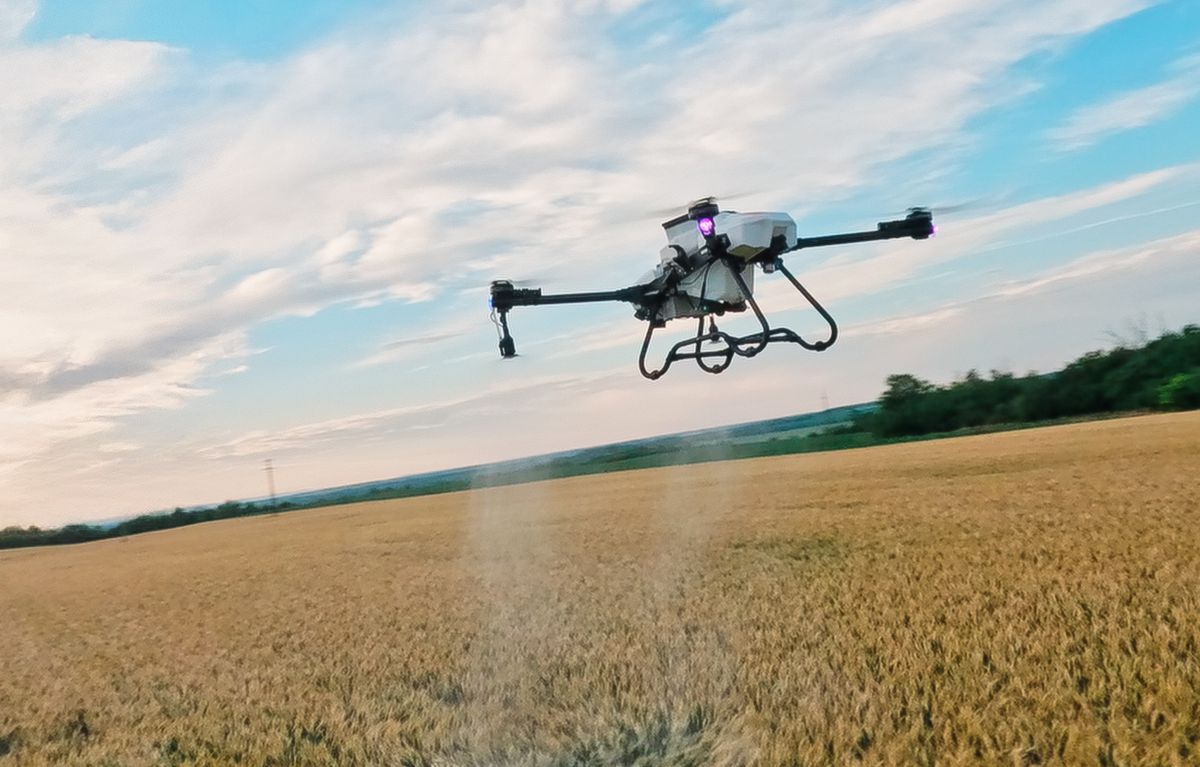
Agriculture is one of the most commercially proven markets for heavy-duty drones, particularly for spraying and spreading tasks. ABZ highlights use cases in orchards and other high-value crops, where precision matters and access can be difficult. Unlike large boom sprayers, drones can work on uneven terrain, reach awkward sections of fields, and operate in smaller plots where conventional machinery is inefficient.
The environmental angle also carries weight. Precise application can help reduce overuse of fertilisers and crop protection products. That supports sustainability targets while also directly improving input efficiency. In a sector where fertiliser prices, labour availability, and climate variability can all swing planning assumptions, having more control at the point of application becomes a real operational advantage.
Drones also offer a pathway to maintain output when labour is scarce. Seasonal labour constraints can be severe in orchards and specialist farming operations. When that shortage collides with time-sensitive spraying windows, yields and crop quality can suffer. A drone platform that is rugged, repeatable, and supported through service providers could become a stabilising tool, helping farms meet production targets without relying on uncertain staffing.
This is where the “platform” idea becomes relevant. A fleet of drones doesn’t need to be owned and operated directly by every farm. There’s a growing service model in agricultural technology, where specialist providers deliver spraying or spreading as a managed service. ABZ explicitly references supporting a network of distributors and service providers, which suggests the company understands how adoption can scale quickly through partners rather than only through direct sales.
Industrial Cleaning Drones and the Business Case for Safer Worksites
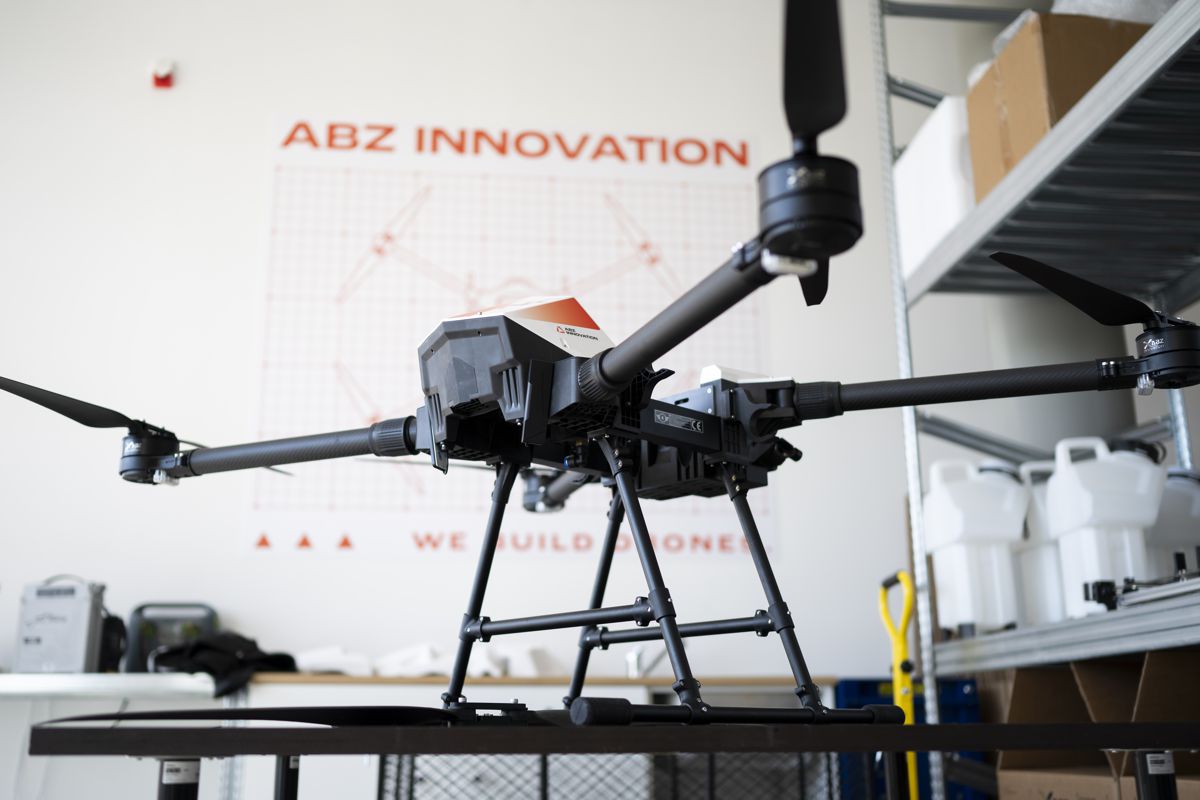
In industrial environments, the use case ABZ highlights is cleaning, specifically removing people from hazardous tasks such as working at height or dealing with contaminated surfaces. That has immediate relevance in heavy industry, processing facilities, ports, energy sites, and large-scale logistics infrastructure where cleaning and maintenance are recurring operational realities.
In construction and infrastructure operations, “work at height” remains a persistent risk category. Every avoided exposure is meaningful, not just morally but commercially. Risk reduction can lead to fewer incidents, less disruption, and a clearer compliance path for operators that must answer to regulators, insurers, and corporate governance standards.
Downtime is another driver. Industrial cleaning can require scaffolding, access planning, exclusion zones, and multiple shifts of preparation. Drones can’t solve every cleaning problem, but in some environments they can reduce the time and disruption required to complete certain tasks. When a site is operating on tight turnaround windows, the value of faster cleaning isn’t theoretical. It becomes an availability metric.
There’s also a psychological shift underway across industry. Safety technology used to be framed as a cost centre. Increasingly, it’s treated as an operational advantage. Companies that can keep people out of harm’s way while maintaining output don’t just reduce incidents, they protect productivity. It’s the same logic driving automation in mining haulage, robotics in warehousing, and remote operations in hazardous environments.
ABZ CEO Karoly Ludvigh framed the company’s focus clearly: “Our mission is simple: we build drones that take people out of dangerous, repetitive work while helping farmers and industrial operators do more with less. This investment lets us scale production, deepen R&D, and equip a growing global network of distributors and service providers with reliable, heavy-duty systems they can turn into revenue-generating services.”
The commercial detail in that statement is important. It suggests ABZ sees its success as tied not only to the drone hardware itself, but to the ability of partners to build sustainable service businesses around the platform.
Europe’s Drone Moment Depends on Industrial Readiness
ABZ’s backers are explicit about why they see the opportunity. The drone market is mature enough to understand what works and what doesn’t, but still open enough for new category leaders to emerge, especially in industrial and agricultural applications.
Thomas Oehl, General Partner at Vsquared, said: “ABZ Innovation stands out by approaching drones not as individual products, but as an end-to-end automation platform for real industrial and agricultural use cases. The incredible team has a clear problem–product–solution mindset, combines robust hardware with a European autonomy stack, and is already proving it can compete globally on performance and cost. That combination is exactly what Europe needs to build: competitive, sovereign drone capabilities at scale.”
The phrase “sovereign drone capabilities” is doing a lot of work there. It reflects a broader European priority to ensure that critical technologies, particularly those linked to infrastructure and industrial operations, are not entirely dependent on external manufacturing ecosystems.
Felix Scheuffelen, Co-Founder at Assembly Ventures, added: “We’re excited to partner with the ABZ Innovation team. As incumbent leaders face mounting restrictions, the opportunity for a new category-defining company in aerial drones is wide open. ABZ’s commitment to hardware performance, data security, and supply chain reliability positions them to lead across European and US markets. This investment reflects Assembly’s focus on backing exceptional companies at key inflection points.”
That mention of “mounting restrictions” is a nod to how regulatory scrutiny and procurement rules can reshape competitive dynamics. Drone adoption isn’t just determined by performance. It can be driven by policy, compliance needs, and customer risk tolerance. Companies able to operate cleanly within those constraints can find significant growth headroom.
From Heavy-Duty Drones to Global Automation Networks
ABZ says it intends to make advanced drone technology more accessible worldwide, supporting partners who need to work faster, safer, and with fewer resources. The heavy-duty drone segment is increasingly about building those partner networks, because service, maintenance, training, and operational support are what turn hardware into infrastructure.
In practical terms, the next phase for ABZ will likely be judged on three factors. First, whether it can scale production without compromising reliability. Second, whether it can keep accelerating product development while meeting the diverse demands of agricultural and industrial customers. Third, whether it can build the distribution and service ecosystem needed to sustain international growth.
It’s a space where the winners may look less like gadget brands and more like industrial equipment firms, complete with service schedules, training pathways, spare parts logistics, and long-term upgrade strategies. That’s good news for infrastructure operators. It means drones are growing up into tools you can procure, insure, deploy, and integrate, rather than technologies that still require specialist handling.
And for Europe, ABZ’s growth ambition represents something bigger than a single company’s trajectory. It’s part of a wider attempt to build industrial autonomy capabilities that can stand on their own two feet. If ABZ can convert this funding into scaled production and durable market expansion, it won’t just be another drone company raising capital. It will be proof that heavy-duty aerial robotics can be built, supported, and scaled from Europe into the global industrial mainstream.