Data Driven Maintenance Helps Extend the Life of Leeds City Flyovers
In the world of highways and urban infrastructure, some of the most important engineering work happens quietly, out of sight, and often under live traffic. It’s rarely glamorous, but it’s the sort of intervention that keeps a city moving and prevents tomorrow’s disruption from becoming a crisis. The Marsh Lane Bearing Replacement Scheme in Leeds is exactly that kind of project: essential, technically demanding, and carried out on a structure that has been doing its job for more than half a century.
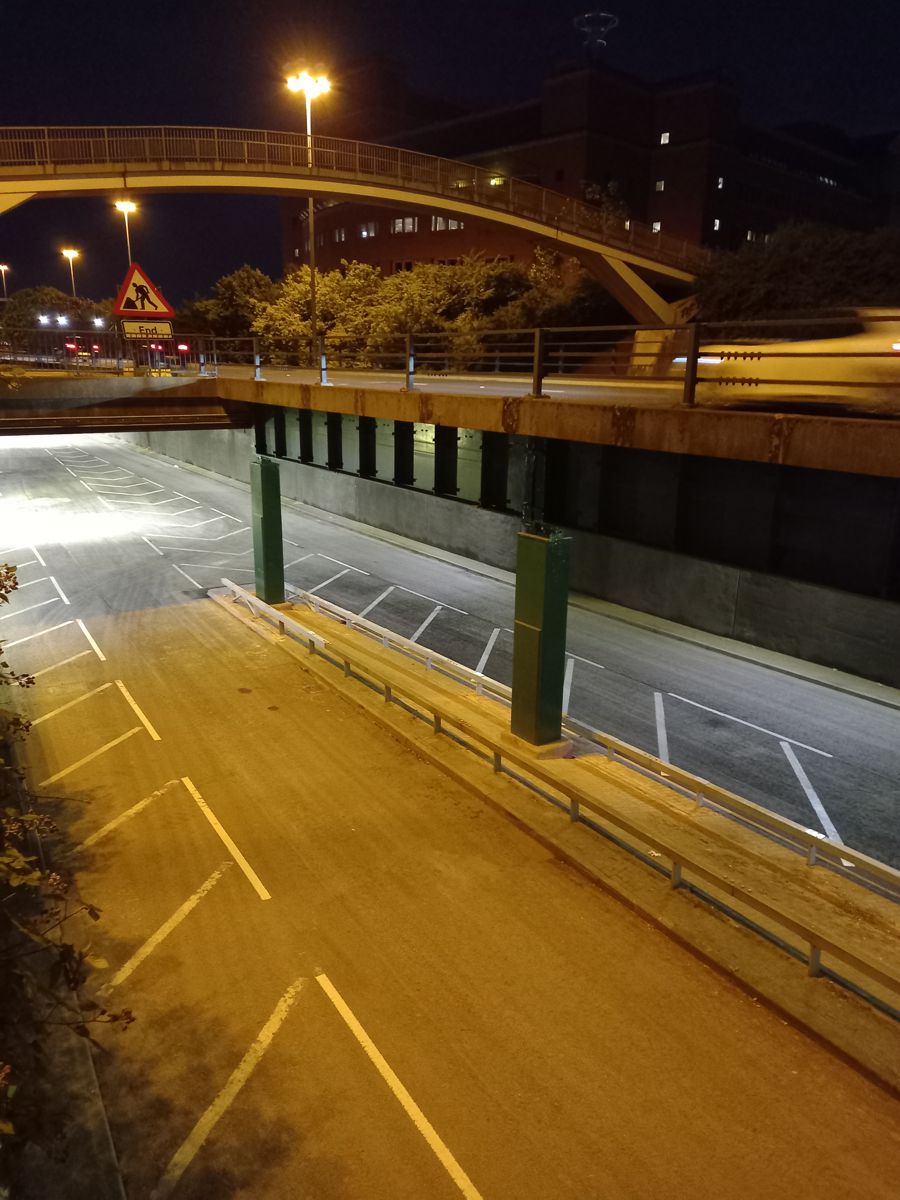
At the heart of the scheme is the New York Road Flyover, built in the 1970s and still serving as a critical arterial route in Leeds city centre. Thousands of people rely on it every day, whether they’re commuting, moving goods, or keeping businesses supplied. Like much of the UK’s post-war transport infrastructure, it is now firmly in the age bracket where maintenance becomes less about patching and more about preserving structural life through carefully planned interventions. When Leeds City Council commissioned the replacement of 27 bridge bearings, the work had a clear objective: protect the long-term performance of a vital route while keeping disruption to the public as low as possible.
Balfour Beatty was appointed by Leeds City Council to deliver the works, continuing a programme of asset management that has become increasingly familiar across the UK’s urban road networks. This wasn’t a standalone piece of maintenance either. It followed similar work on the adjacent Regent Street Flyover, forming part of a wider, coordinated effort to manage aging structures across the area.
Why bridge bearings matter more than most people realise
Bridge bearings aren’t a high-profile component, but they’re one of the most critical. They allow the deck to move safely as traffic loads change, temperatures rise and fall, and structural elements expand, contract and rotate. Over decades, these components take a relentless pounding. When bearings degrade or fail, the consequences can range from uneven load transfer and cracking through to long-term structural distress that becomes far more expensive to repair.
In dense city environments, bearing replacement is particularly challenging because the bridge can’t simply be taken out of service for weeks on end. Urban flyovers like New York Road often sit above major junctions or corridors that don’t have easy diversion options. Any closure can ripple into congestion, lost productivity, and public frustration. So the engineering brief becomes more complicated: complete a delicate and high-risk operation, within extremely fine tolerances, while keeping the city running beneath and around it.
That’s why Marsh Lane was never just a maintenance job. It was an exercise in precision, risk control, and real-time decision-making. The project demanded a clear understanding of structural behaviour, a safe method of temporarily supporting the deck, and confidence that the bridge would respond as expected when lifted.
The challenge of maintaining 1970s infrastructure without historic data
One of the defining obstacles in the Marsh Lane scheme was uncertainty. Structures built in the 1960s and 1970s often don’t come with the kind of detailed instrumentation history that modern bridge owners now prefer. They were designed for different traffic patterns, different axle loads, and a different understanding of long-term deterioration. Even when original drawings exist, they don’t tell you how a structure has behaved after decades of service, weather exposure, maintenance cycles and the gradual shift in how roads are used.
Daniel Barnes, Project Manager at Balfour Beatty, explained the reality the team faced: “Due to the age of the bridge, we didn’t have any data or insight into its structural behaviour or regular levels of movement, whether caused by traffic loads, wind forces or thermal expansion. As such, a structural monitoring solution was imperative as a means of gathering this intelligence, data which was then fed into the new bearing designs, completed by Ekspan Ltd.
“It was here that we worked with Mabey Hire, whose in-house team supplied and installed a range of structural monitoring sensors to monitor the loads and longitudinal movement, with the sensors left in situ for two months to gather the valuable information needed to inform the bearing design.”
This was a key pivot point in the project. Instead of relying solely on historic assumptions, the team gathered live intelligence on how the flyover was behaving in the real world. Monitoring loads and longitudinal movement over a two-month period gave designers an evidence-based foundation for the new bearings.
In practical terms, it helped reduce uncertainty. And in infrastructure work, reducing uncertainty isn’t merely a technical benefit. It is a commercial, contractual and public-safety advantage. Better intelligence leads to better design decisions, fewer surprises on site, and a lower likelihood of programme delays or unplanned interventions.
Monitoring as a design input, not just a safety measure
Structural monitoring on bridge works is often thought of as something that sits alongside construction, mostly there to provide reassurance. On this job, it played a more meaningful role. It helped shape the engineering solution itself by informing bearing design.
That distinction matters, because it reflects a broader shift in infrastructure maintenance. Across the industry, asset owners are leaning towards data-driven strategies that make maintenance smarter, more targeted and less reactive. In many cases, sensors and monitoring equipment are now being used to extend the life of structures by identifying trends early, confirming behaviour under load, and reducing the reliance on conservative assumptions that can drive up cost.
For Leeds City Council and its delivery partners, this approach also supports long-term network planning. The New York Road Flyover is part of an ecosystem. It links with other assets, junctions and adjacent structures. A more accurate picture of its behaviour doesn’t only help this bearing replacement project. It helps build the knowledge base for future inspection, maintenance and renewal planning.
A jacking operation measured in millimetres, not metres
Replacing 27 bearings isn’t as simple as removing and swapping components. Bearings sit under a bridge deck and carry substantial loads. Accessing them requires the deck to be lifted and temporarily supported in a controlled manner. At Marsh Lane, the scale of the lift was remarkably small: a maximum of 2mm.
That figure may sound modest, but in bridge engineering, such fine tolerances are where the job becomes particularly unforgiving. The operation had to be precise not just for the sake of neatness, but to protect surrounding structural elements such as expansion joints. Even a small exceedance could risk damage, misalignment, or long-term performance issues that would undermine the value of the entire scheme.
With 27 bearings in total, the team adopted a phased approach. The work was carried out in eight separate phases, with traffic management shaping how and when each section of deck could be accessed. Each phase required the deck to be jacked up, temporarily supported, and then carefully lowered once the bearing replacement was complete. It’s the kind of work where repetition doesn’t necessarily make it easier, because every section of an aging structure can behave slightly differently under load.
Designing temporary works to handle heavy loads and lateral forces
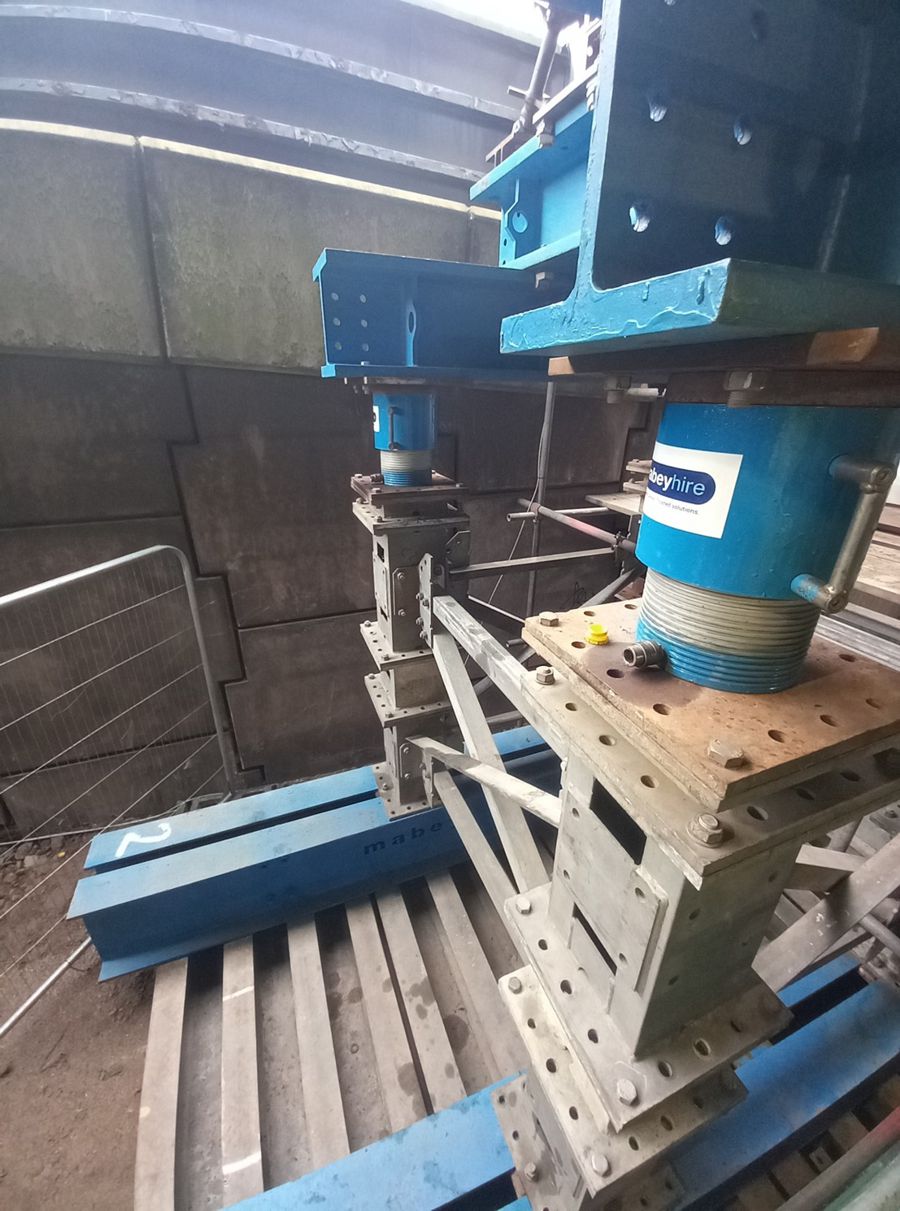
Temporary works can make or break a bearing replacement scheme. The bridge deck must be supported securely while the bearings are removed and replaced, and the temporary support system must cope with complex loading conditions. Mabey Hire worked closely with Balfour Beatty to design, supply and install a bespoke temporary propping and jacking scheme, using Mat 125, Mass 25 and Mass 50 props.
The supplier’s hymat jacks were supplied and installed in clusters of four to deliver the necessary load capacity. That clustered approach speaks to the need for controlled load distribution and redundancy, ensuring the system could maintain stability even under changing conditions.
The engineering challenge wasn’t only vertical load. The scheme had to deal with lateral forces as well. Project teams faced increased bearing loads beyond those considered in the original design, concentrated loads during jacking operations, and high lateral forces. The propping scheme needed to take 300 tonnes vertically while also satisfying transverse loads of 35 tonnes.
To meet those requirements, Mabey Hire fabricated a bespoke cradle arrangement around the bridge columns. In practical terms, this kind of adaptation is often where temporary works specialists earn their keep. Off-the-shelf solutions rarely align perfectly with the geometry and constraints of an existing structure, especially one built to older standards and sitting within a complex urban environment.
Keeping the city moving while working under it
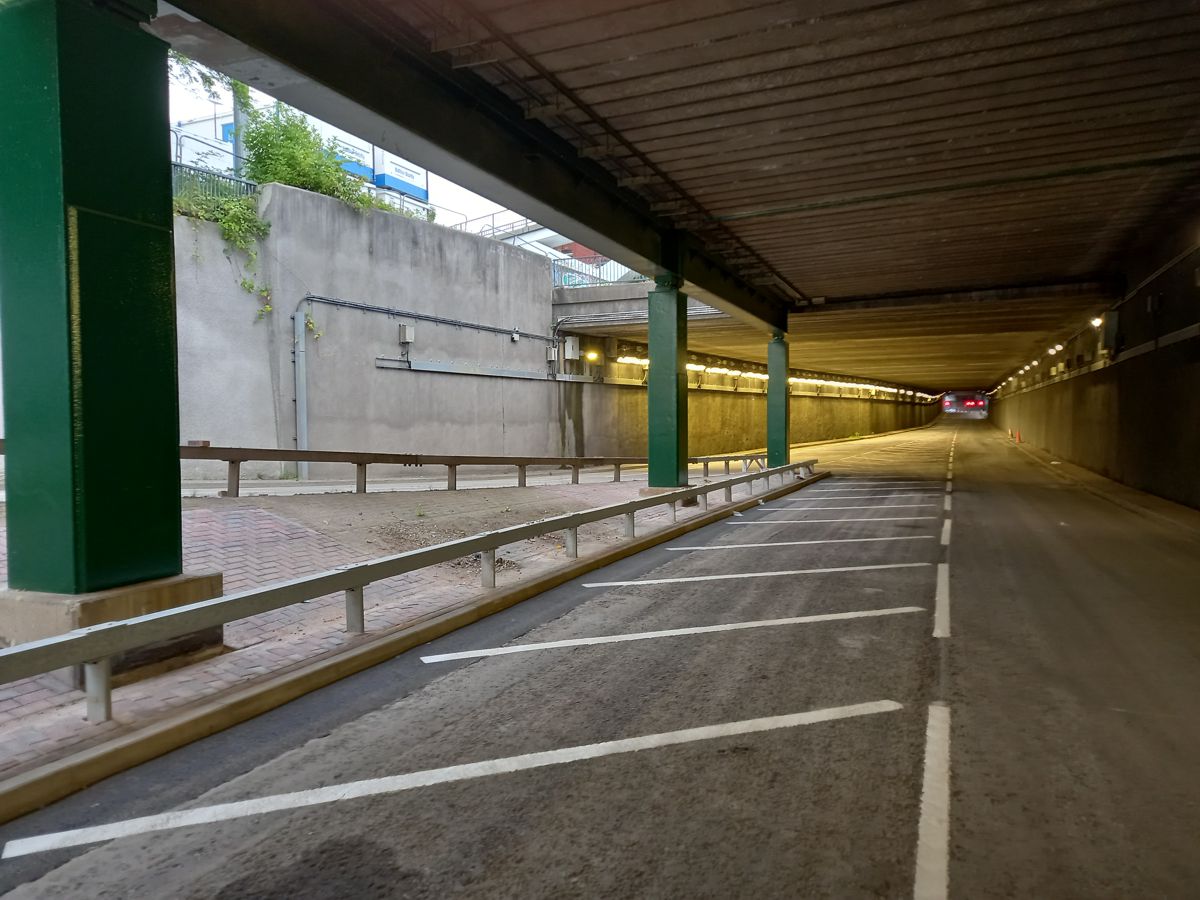
One of the most demanding aspects of the Marsh Lane scheme was logistical rather than structural. The New York Road Flyover sits above a major junction and carries heavy flows of traffic on the city ring road. Heavy plant, equipment and machinery needed access, but space beneath and around the structure was limited.
The delivery team also had to maintain traffic as a high priority. That meant the temporary propping scheme had to take up minimal space and align with the road layout, ensuring the route could remain open.
This is where infrastructure maintenance becomes a balancing act between engineering ambition and public reality. A perfectly engineered plan is useless if it ignores the operational constraints of the network. In this case, the need to minimise disruption shaped the entire delivery strategy, from the sequencing of the eight phases through to the compact design of the temporary works.
Real-time movement control with monitoring down to 1/100th of a millimetre
If the jacking operation was the high-wire act of the project, monitoring was the safety harness that made it possible. Additional structural monitoring sensors were installed to track movement throughout the jacking process, helping ensure that the bridge remained within safe tolerance.
Daniel Barnes highlighted the stakes: “To avoid damage to the deck expansion joints, it was imperative that we did not exceed the 2mm tolerances during the jacking operations. What’s more, to minimise disruption to the public, the bridge remained open during the entire work programme (with the exception of the delicate and highly precise jacking and de-jacking operations). As such, it was essential that we had constant insight into the bridge’s structural condition.
“To assist with this, Mabey Hire installed specialist monitoring equipment that could measure to within 1/100thof a millimetre – just about as precise as civil engineering can get.”
That level of precision isn’t simply an impressive technical detail. It speaks to risk reduction, confidence in execution, and the ability to make informed decisions quickly. Monitoring accuracy at that scale helps teams detect subtle changes early, confirm that lifting is happening evenly, and prevent cumulative errors from creeping into the process.
Mabey Hire also supplied wireless sensors and loggers to monitor vertical movement during the works. Magnetised to steel beams near individual bearings, the sensors could be removed and relocated to the next group of bearings. This relocation capability is particularly valuable in phased replacement projects, allowing monitoring equipment to move with the workfront without extensive reinstallation time.
Why “one-stop shop” delivery models keep gaining traction
In infrastructure maintenance, coordination risk is often as significant as engineering risk. Every additional interface between suppliers, designers, installers and contractors introduces potential delays and miscommunication. That’s why integrated delivery models, where one supplier can provide equipment, engineering expertise and installation support, are increasingly attractive.
Daniel Barnes explained why Mabey Hire was selected: “The Marsh Lane Scheme is part of a wider contract that we have been working on since 2020. With many of the highway bridges, tunnels and retaining walls in this area built in the 60s and 70’s, a lot of them are reaching the age where significant maintenance work is required. We’d worked with Mabey Hire on the similar Regent Street Flyover project, which was completed in 2020-22, and so we knew they would be up to the task.
“Perhaps the biggest value of working with Mabey Hire is its one-stop-shop service and comprehensive offering. You benefit from their engineering knowledge, hire of specialist equipment and their dedicated in-house installation team. Having this guidance and expertise available in-house is a big attraction. You can trust in their honesty and certainty of delivery.”
That repeat engagement also points to a wider truth about infrastructure frameworks and long-term maintenance contracts. When delivery partners prove capable under pressure, asset owners and main contractors are more likely to bring them back, not just for convenience but because familiarity can reduce risk and speed up mobilisation.
A blueprint for maintaining aging urban highway structures
The Marsh Lane Bearing Replacement Scheme is local in location but global in relevance. Cities across Europe and North America are confronting the same challenge: bridges and elevated roads built in the mid-to-late twentieth century are now aging at scale, at a time when traffic volumes, freight demands and public expectations are higher than ever.
What the Leeds scheme demonstrates is that successful renewal doesn’t always require dramatic reconstruction. Sometimes it’s about targeted interventions, carefully designed temporary works, and the smart use of monitoring to provide certainty in uncertain conditions. The fact that the bridge deck was lifted by just 2mm says a lot about the level of care involved. The fact that the monitoring could measure movement down to 1/100th of a millimetre says even more.
With over 60 years’ experience in temporary works, Mabey Hire operates in a sector that rarely gets headlines, yet is fundamental to keeping infrastructure safe while critical works are carried out. Projects like this show how monitoring and temporary works engineering can work together, turning what might otherwise be a high-risk operation into a controlled and deliverable programme.
In Leeds, the result is a flyover that can continue carrying the city’s daily movement, backed by better insight, improved bearing performance, and a maintenance strategy that treats data as an asset rather than an afterthought.