EU and EIB Finance Cabo Verde’s Sustainable Port Transformation
Cabo Verde’s future has always been tied to the sea. For an island nation spread across the Atlantic, ports aren’t simply logistics assets, they’re the connective tissue that holds communities together, keeps shelves stocked, moves people between islands, and underpins tourism and trade. That reality is now shaping one of the most significant infrastructure investment packages the country has seen in recent years, with the European Union and the European Investment Bank (EIB Global) committing a combined concessional financing package worth around €148 million to modernise Cabo Verde’s maritime backbone.
At the centre of the announcement is a €34 million EU investment grant, managed by EIB Global, which will help finance the rehabilitation and expansion of Cabo Verde’s main ports and its primary shipyard. This grant complements €114 million in EIB financing signed in 2024 with the Republic of Cabo Verde, creating a blended, long-term investment structure aimed at delivering practical upgrades while accelerating the country’s decarbonisation and climate resilience ambitions.
For the global construction and infrastructure ecosystem, the significance goes well beyond a single national project. Cabo Verde’s upgrade programme reflects a wider shift in how ports are being redesigned worldwide: cleaner energy at the quay, stronger resilience against extreme weather, smarter logistics capability, and infrastructure that supports regional trade corridors. The Cabo Verde Blue Economy Sustainable Ports Facility, described as a flagship Global Gateway initiative, positions the country not just as a destination, but as a more competitive and sustainable node in Atlantic connectivity.
Ports as Critical National Infrastructure for an Island Economy
In mainland countries, a delayed road project can disrupt traffic and supply chains. In Cabo Verde, the stakes are often higher. Maritime transport is a critical lifeline across the archipelago, enabling inter-island movement of goods, services, and people. When port capacity is constrained or infrastructure is ageing, the effects ripple quickly into daily life, raising costs, complicating logistics, and reducing reliability for everything from essential imports to public services.
That’s why this financing package is framed around connectivity, resilience, and emissions reduction at the same time. Upgraded ports can shorten turnaround times for cargo and passenger vessels, improve berth availability, and accommodate larger ships safely. In practice, those improvements translate into smoother inter-island trade, more predictable schedules, and a better experience for both local businesses and international carriers.
It’s also a play for long-term competitiveness. Cabo Verde has long pursued economic growth through tourism and trade integration. Yet both depend heavily on infrastructure performance. Efficient ports reduce friction for cruise operations, improve cargo handling and storage, and support the fishing sector, all of which feed directly into national income and employment.
A Blended EU-EIB Package Designed to Deliver Long-Term Value
The new EU grant, managed by EIB Global, is designed to strengthen the viability of strategic port investments that might otherwise be difficult to finance at scale. By combining EU grant support with EIB lending, Cabo Verde gains access to a concessional financing structure that spreads cost and risk while maintaining the ability to invest decisively.
Taken together, the €34 million grant and the €114 million EIB financing signed in 2024 bring the total package to around €148 million. For infrastructure investors and policymakers, that number matters, not because it’s flashy, but because it’s large enough to fund meaningful port engineering works: breakwaters, quay extensions, modernised terminals, and energy systems.
This blended approach also reflects how international development finance is increasingly structured for climate-aligned infrastructure. Rather than funding individual assets in isolation, institutions are bundling projects into wider programmes that modernise systems end-to-end. In Cabo Verde, that means ports, shipyard capability, and energy upgrades moving forward together, rather than in a piecemeal fashion.
Porto Grande in Mindelo as a Strategic Anchor Project
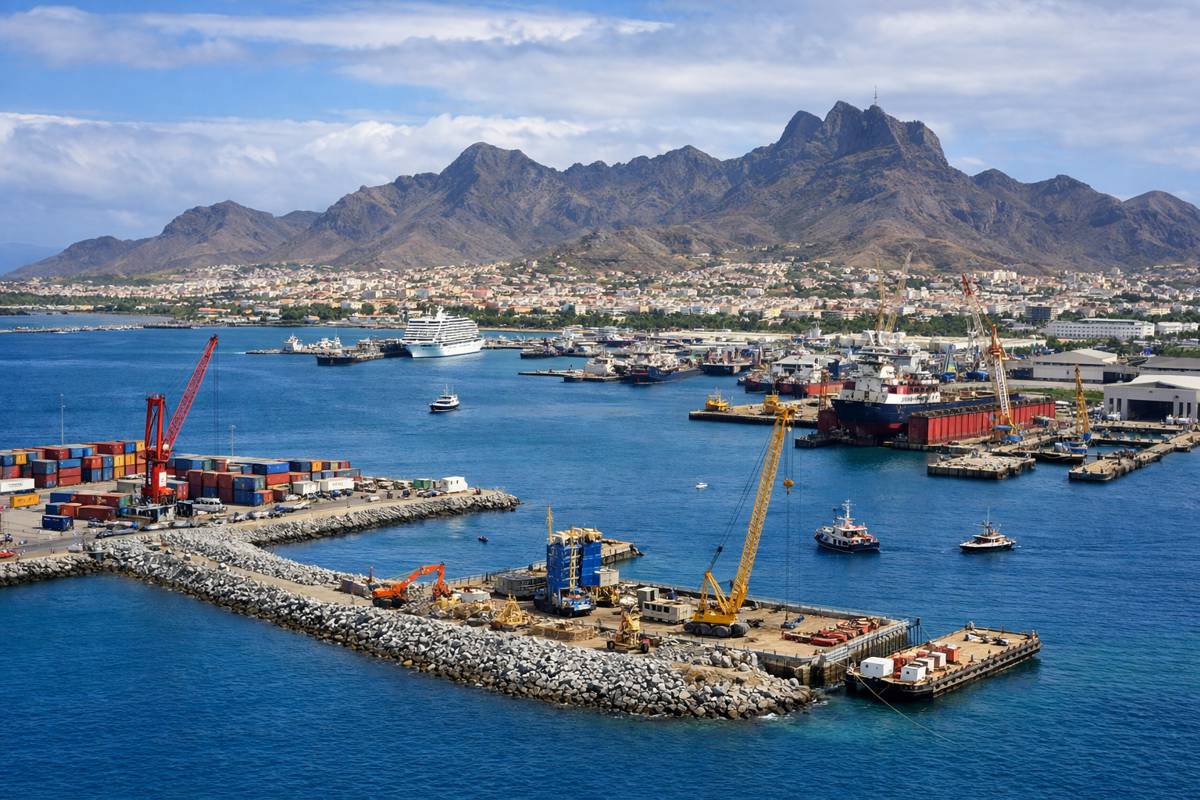
One of the most significant upgrades will take place at Porto Grande in Mindelo, where expansion is planned to improve both scale and operational flexibility. The programme includes a new breakwater and quay, along with enlarged container handling capacity and modernised infrastructure serving cargo and fisheries.
Those details point to a familiar challenge in modern port development: accommodating different users without compromising efficiency. Cargo operations require predictable flow, robust quayside capability, and safe handling zones. Fisheries depend on quality handling conditions and reliable infrastructure that supports landing, storage, and onward distribution. In small economies, these activities often share space, so modernisation is as much about improving layout and operational safety as it is about building more concrete and steel.
Mindelo also features prominently in the programme’s environmental investments. The installation of onshore power supply at the Mindelo cruise terminal is one of the clearest signals that this isn’t simply a capacity expansion plan. Shore power infrastructure allows vessels to plug into land-based electricity while at berth, reducing the need to run onboard generators. Alongside solar energy systems planned across several ports, it suggests Cabo Verde is targeting measurable emissions reductions as part of its maritime future.
Modernisation in Palmeira and Porto Novo to Improve Network Performance
Beyond Mindelo, the programme includes the modernisation of Palmeira Port, enabling it to receive larger vessels and improve environmental management. Practical improvements are also planned for safer and more efficient fish landings, directly supporting local fishers and the broader value chain.
For construction and infrastructure professionals, Palmeira stands out because the benefits are multi-layered. Increased vessel capacity is not only about trade volume, it’s also about flexibility in shipping operations. Larger vessels can mean fewer calls for the same cargo movement, which may help reduce costs and congestion. At the same time, improved environmental management can strengthen compliance and reduce operational risk, increasingly important in a sector facing tighter regulatory scrutiny.
The programme also supports the expansion of Porto Novo Port, aimed at strengthening inter-island and international maritime connectivity. In a dispersed island economy, strengthening network connectivity is often more valuable than focusing solely on a single “big” gateway port. If smaller ports operate more efficiently and handle modern vessels safely, the national logistics network becomes more resilient and less dependent on one or two critical points of failure.
Shipyard Rehabilitation and Industrial Capability Through CABNAVE
The package is not limited to ports. The rehabilitation of CABNAVE, Cabo Verde’s main shipyard, is in the pipeline, alongside potential investments in the port of Praia.
Shipyards play a strategic role that’s easy to underestimate. In maritime nations, local ship repair and maintenance capability reduces downtime for fleets, improves safety outcomes, and keeps value within the national economy. It can also support regional servicing, particularly if neighbouring routes or operators see advantages in using a capable and well-managed Atlantic facility.
From an industrial technology perspective, shipyard upgrades can also become a pathway for workforce development and improved technical standards. Modern facilities require more than cranes and dry docks. They increasingly rely on digital maintenance processes, stricter environmental controls, and higher safety management systems. If CABNAVE modernisation progresses alongside port upgrades, Cabo Verde strengthens the full lifecycle capability of its maritime sector rather than treating it as separate silos.
Decarbonising Port Operations Through Shore Power and Solar
While the programme’s core is infrastructure rehabilitation and expansion, its environmental elements are not token additions. Onshore power supply at the Mindelo cruise terminal and solar energy systems across several ports represent tangible moves toward lower-emission port operations.
Ports are increasingly recognised as hotspots for local air pollution and greenhouse gas emissions due to vessel auxiliary engines, cargo equipment, and surrounding road transport. Shore power reduces emissions at berth, particularly in passenger terminals where cruise vessels can remain docked for long periods. Solar installations, meanwhile, can provide low-carbon electricity for terminal systems and operations, improving energy resilience and reducing operating costs over time.
The environmental case is also a competitiveness case. Investors, insurers, and global shipping operators are sharpening their expectations of port performance and sustainability. By modernising port energy systems and enabling cleaner operations, Cabo Verde aligns itself with a future maritime economy where emissions and efficiency are increasingly linked to market access.
Why This Matters to Global Gateway and Regional Trade Corridors
The programme is fully aligned with the EU–Cabo Verde Multiannual Indicative Programme 2021–2027 and the Team Europe Initiative “To Green Cabo Verde”. It also supports the Praia–Dakar–Abidjan multimodal corridor identified by the EU as a strategic link under Global Gateway.
In policy terms, this places Cabo Verde inside a larger connectivity and investment narrative, where infrastructure is treated as a long-term geopolitical and economic partnership rather than a short-term development project. Global Gateway initiatives aim to build sustainable, secure transport and digital links between regions, and ports are often central to these efforts because they sit at the intersection of trade, mobility, and industrial resilience.
At national level, the investments contribute to Cabo Verde’s Strategic Plan for Sustainable Development (2022–2026), particularly by improving blue economy infrastructure and supporting inclusive, climate-resilient growth. That alignment matters because it strengthens long-term continuity: the project isn’t operating in a vacuum, but as part of a multi-year national plan connected to international financing and delivery frameworks.
Connectivity, Cohesion, and Services Beyond the Waterfront
One of the strongest themes in the announcement is that port infrastructure delivers benefits far inland from the quayside. Inter-island connectivity supports territorial and social cohesion, and better maritime links can improve access to essential services, especially in dispersed communities.
That perspective was captured by EIB Vice-President Ambroise Fayolle, who highlighted the transformational role of the investment: “This investment for sustainable ports will transform how Cabo Verde connects its islands, serves its communities, and trades with the world. It shows how EIB Global and the European Union are working together to deliver lasting impact, improving connectivity and strengthening resilience across the islands.”
The EU’s position also framed ports as instruments of cohesion and service delivery rather than purely economic assets. Sylvie Millot, EU Ambassador to Cabo Verde, said: “This strategic investment is modernising key ports and the country’s main shipyard, strengthening inter-island connectivity — a true lifeline for the Cabo Verdean population — while promoting territorial and social cohesion, access to healthcare, educational services, and the country’s overall economic growth.”
Those statements underline a point infrastructure professionals know well but don’t always say out loud: transport upgrades become social infrastructure in practice. Better port reliability supports food supply chains, strengthens emergency logistics, and reduces isolation for island communities. The return is measured not just in throughput, but in resilience and quality of life.
A Blue Economy Play With Real Commercial Weight
Cabo Verde has positioned the blue economy as a growth pathway, and this programme is designed to make that strategy workable on the ground. Ports are central to connectivity, competitiveness, trade, tourism, and regional integration, and improving them can unlock broader economic activity across fishing, logistics, and services.
H.E. Olavo Correia, Deputy Prime Minister and Minister of Finance of Cabo Verde, linked the investment directly to global value chains and growth potential: “The blue economy, and ports in particular, are central pillars of this strategy, given their importance for connectivity, competitiveness, trade, tourism and Cabo Verde’s integration into regional and global value chains. This funding demonstrates that we are talking about an economy with real growth potential, capable of participating actively and competitively in the global economic system. But above all, it demonstrates that our partners believe in our ability to transform investment into concrete results for people”
For international investors watching frontier markets, this kind of financing package sends a clear signal. Cabo Verde is not only receiving external support, it is implementing a structured, multi-project infrastructure programme designed to deliver predictable outcomes. In a world where infrastructure finance is increasingly linked to delivery confidence and climate alignment, that matters.
Building a Resilient Maritime Future for Cabo Verde
The bigger story here is that Cabo Verde is using port upgrades to strengthen national resilience at a time when climate risk, energy volatility, and global supply chain disruption are forcing governments to rethink essential infrastructure. Breakwaters and quays may sound like traditional civil engineering, but their role is increasingly strategic: they protect operations against more extreme coastal conditions and support reliability as weather patterns become less predictable.
At the same time, cleaner port operations and improved handling capacity help ensure the maritime network can grow without locking in outdated, high-emission systems. If the upgrades deliver as intended, Cabo Verde stands to gain a maritime sector that is more efficient, better connected, and aligned with a low-carbon future, while maintaining the practical focus needed for an island economy.
Through EU Global Gateway investments of more than €400 million in Cabo Verde, the EU is backing projects that strengthen digital connectivity, accelerate the energy transition, and unlock the blue economy. The sustainable ports facility sits firmly within that trajectory, building the kind of infrastructure that supports trade and tourism while helping a small island nation strengthen its role as a resilient regional hub.