Africa’s Green Economy Summit 2026 Targets Bankable Climate Infrastructure
Africa’s climate story has never been short on ambition. Across the continent, governments, development institutions, and private sector leaders have spent the better part of a decade building strategies for decarbonisation, resilience, and sustainable growth. Yet the hard truth is that ambition alone doesn’t lay transmission lines, modernise ports, upgrade roads, or deliver clean water to fast-growing cities.
What’s changed recently is the tone of the conversation. With budgets under pressure and concessional funding becoming harder to secure, the focus is shifting from announcements and frameworks to the practical work of delivery. In other words, the question isn’t whether Africa should pursue green development. It’s how quickly the continent can turn plans into projects that are structured, financed, and ready for implementation.
That pressure is reflected in the Africa Climate Finance Tracking Report 2025, which suggests climate finance flows currently cover only around a quarter of Sub-Saharan Africa’s annual needs. In plain terms, there’s a sizeable delivery gap, and it’s widening at a time when climate risks, energy constraints, and water stress are becoming more intense, more frequent, and more expensive.
Africa’s Green Economy Summit (AGES) 2026 will take place in Cape Town from 24–27 February 2026, framed under the theme “From Ambition to Action: Scaling Investment in Africa’s Green and Blue Solutions.” It is positioned as a summit designed for investors, project developers, policymakers, and delivery partners who are trying to do the unglamorous but vital work of moving viable green infrastructure to financial close and then, crucially, onto the ground.
Why the Investment Conversation Has Become Urgent
For infrastructure professionals and policymakers, the challenge is familiar: what looks compelling on paper can unravel quickly when exposed to the realities of permitting, procurement, grid constraints, currency risk, or a missing regulatory detail. And for investors, even those with strong ESG mandates, the deal still has to pencil out.
Africa’s share of global climate finance remains disproportionately low relative to its needs, even as the continent sits on some of the world’s most compelling clean energy and critical resource opportunities. This imbalance is increasingly difficult to reconcile with the economic reality of climate disruption. Floods that wash away roads, droughts that strain water systems, and heatwaves that reduce labour productivity don’t just damage communities, they trigger material losses across the construction, logistics, manufacturing, and mining value chain.
At the same time, the financial environment is becoming less forgiving. Higher borrowing costs, tighter risk appetites, and competition for private capital mean green investment decisions are being scrutinised in ways that go far beyond good intentions. For project sponsors, that’s forcing a shift toward stronger project preparation, more transparent risk allocation, and clearer revenue models. For governments, it raises the stakes around regulatory certainty and credible delivery pipelines.
In that context, AGES 2026 is pitching itself as a platform where climate ambition meets financial realism, and where stakeholders can talk about what needs fixing, not just what needs funding.
From Pledges to Projects That Can Actually Reach Financial Close
Global climate forums often generate headlines, but they don’t always generate projects that are investable. In practice, the decisions that determine whether an energy project gets built, or a climate-resilient water system moves forward, are shaped by financing structures, bankability thresholds, and risk management mechanisms.
AGES 2026 is explicitly designed around those decision points. The summit’s agenda, as described by organisers, will focus on where capital is moving, where it is stalling, and which projects have a realistic pathway to implementation. That includes the fundamentals that can make or break projects, such as regulatory clarity, risk allocation, and investment readiness across different sectors and markets.
Emmanuelle Nicholls, Group Director – Green Economy at VUKA Group, framed the summit’s intent bluntly, arguing that the real work happens where capital decisions are made, not where commitments are announced. As she put it: “Global climate discussions often focus on commitments and coordination, but delivery ultimately depends on where capital decisions are made. Africa’s Green Economy Summit creates a space to examine which projects, in which markets, are ready to meet today’s financial realities and move toward implementation.”
That positioning matters, because the bottleneck for Africa’s green transition is not always a shortage of ideas. In many markets it’s the absence of structured, financeable deals with credible counterparties, workable timelines, and investment-grade frameworks. It’s a pragmatic view, but frankly, pragmatism is what the sector needs right now.
The Real Bottleneck Is Financial Structuring, Not Project Concepts
Behind closed doors, most investors will say the same thing: they can’t invest in what they can’t underwrite. Even projects with strong development impact can struggle if the financing package doesn’t reflect local realities, whether that’s demand uncertainty, tariff pressure, political risk, or limitations in local capital markets.
Teboho Makhabane, Head of ESG and Impact at Sanlam Investments, highlighted this structural barrier directly: “The real constraint is not a lack of projects, but a lack of financing structures that can meet projects where they are. Platforms like AGES matter because they bring the right partners together to design innovative finance solutions that can unlock viable projects, deliver real economic impact, and generate sustainable returns.”
That statement lands because it reflects what contractors, EPCs, and project developers see in the field. It’s not uncommon for feasibility work to be done, technology choices to be sound, and demand drivers to be clear, yet the deal fails to progress because the financing architecture isn’t aligned with risk realities. The gap can be as simple as currency mismatch, or as complex as unclear procurement frameworks, lack of credit enhancement, or off-taker risk.
The emphasis on “meeting projects where they are” is also a nod to the diversity of African markets. The same template simply won’t work across every regulatory environment, currency regime, and investment ecosystem. Instead, the work becomes about building finance solutions that are flexible enough to unlock delivery, without distorting the economics so much that projects become unsustainable later on.
Cape Town as a Strategic Stage for the Green and Blue Economy
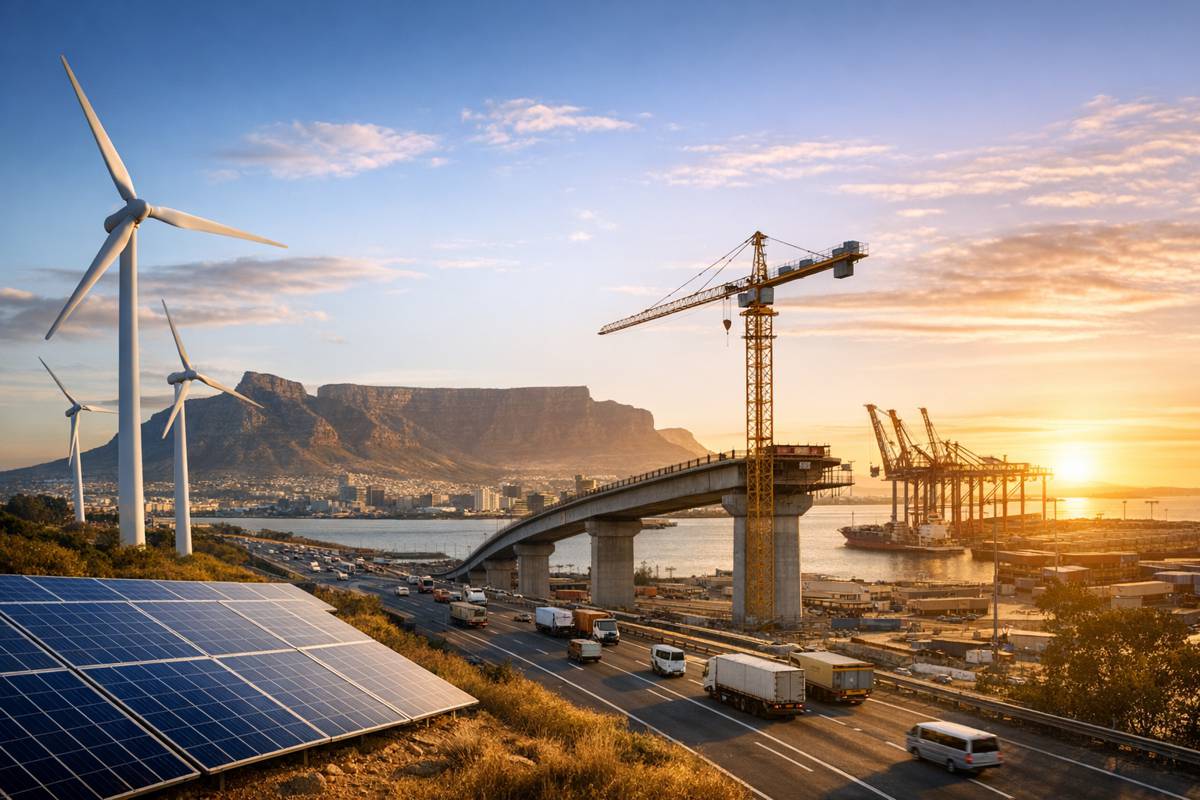
The choice of Cape Town is also more than logistical convenience. South Africa remains a bellwether for energy transition debates across the continent, balancing industrial scale, grid constraints, and rapid demand growth with a policy environment that is actively evolving. Meanwhile, the Western Cape has positioned itself as a hub for investment promotion, clean technology, and export-linked manufacturing.
For the “blue economy” component of the summit, a coastal city setting is fitting. Africa’s blue economy potential spans ports, coastal resilience infrastructure, marine logistics, offshore renewable energy, and sustainable aquaculture, all of which increasingly intersect with the realities of climate adaptation. Sea-level rise, storm surges, and infrastructure vulnerability aren’t theoretical issues for coastal economies, they’re budget and asset-management problems right now.
AGES 2026, in that sense, is placing green and blue infrastructure in the same delivery conversation: decarbonisation, industrial development, and climate resilience all tied together through investment logic. That linkage matters for policymakers and investors alike because it shifts the narrative away from “environment versus growth” and towards “competitiveness through resilience.”
The African Union Returns to Reinforce Continental Delivery Mechanisms
One of the defining elements of AGES 2026 is the African Union’s return as host organisation. In a continent where capital is mobile but trust can be fragile, the role of credible continental mechanisms becomes more important, not less. Political alignment, cross-border coordination, and standardisation efforts can make the difference between fragmented pilot projects and scalable investment pipelines.
The summit will also host the AU–Green Recovery Action Plan (AU-GRAP) Grand Finale Roundtable, marking the conclusion of Phase I of the programme. According to the summit outline, that session will reflect on the outcomes of five Green Investment Roundtables while setting the direction for Phase II implementation.
For market participants, the key question will be whether these mechanisms can accelerate real project delivery, rather than just expanding strategy documents. If Phase II can translate momentum into investable pipelines and improved coordination, the AU’s presence could serve as an anchor for confidence, particularly for international partners navigating diverse national contexts.
Tracking Global Capital Flows Without the Spin
Another notable voice connected to the summit is Barbara Buchner, Global Managing Director at the Climate Policy Initiative, who pointed to the uneven distribution of climate finance and the importance of understanding where money is actually moving. She said: “We can only close the climate and nature finance gap if we understand the real movements of capital, both the momentum and the constraints. There is progress, but it is uneven, and finance is still not reaching the regions and sectors that need it most. An objective view of where global climate finance is heading and how it aligns with broader development goals is essential for unlocking investment at scale and helping Africa effectively deploy capital to meet its ambitious goals.”
The message here is straightforward: Africa doesn’t need more vague optimism. It needs a hard-eyed view of the finance landscape, including where capital is constrained and why. That kind of clarity is valuable because it helps project sponsors, governments, and delivery partners focus effort on what actually moves deals forward, whether that’s credit enhancement, blended finance, guarantees, project preparation facilities, or regulatory adjustments.
For construction and infrastructure stakeholders, this is the difference between a market filled with interesting announcements and a market that can sustain long-term delivery pipelines.
A Curated Pipeline of 50+ Projects Built for Investor Scrutiny
Perhaps the most commercially significant feature of AGES 2026 is its Investment Pitch and Showcase, which will present a curated pipeline of over 50 vetted African projects. The sectors listed span the most investable and fast-evolving parts of the green transition:
Renewable energy and battery storage are obvious anchors, but the pipeline also includes climate-resilient water systems, electric mobility, waste-to-value solutions, circular manufacturing, climate-smart agriculture, and resilience technologies.
This isn’t just a menu of sustainability themes. These categories represent real infrastructure demand with direct implications for procurement, contracting, engineering design, and long-term operations. They also offer multiple entry points for private capital, from utility-scale investment to distributed and municipal models, to industrial decarbonisation and circular supply chains.
From a project finance perspective, the phrase “vetted pipeline” matters. It suggests a level of screening beyond aspirational concepts. For investors, that’s the difference between having a conversation and having a deal flow. For contractors and technology providers, it signals a potential rise in near-term opportunities across EPC work, grid integration, storage deployment, water infrastructure upgrades, and next-generation mobility systems.
A Coalition of Partners Shaping the Investment Agenda
AGES 2026 is supported by an expanding coalition of partners spanning investment, development, and implementation networks. The list includes Sanlam Investments, Standard Bank, UNOPS, UNEP, FSD Africa, Wesgro, the City of Cape Town, Polyco, KULU Eco Services, the Digital Impact Alliance (DIAL), AFD and Atlantis Special Economic Zone.
This mix matters because delivery takes more than capital. It takes procurement and delivery capability, policy support, local financing channels, implementation partners, and often, a mechanism to blend development priorities with investor expectations.
Institutions like UNOPS and UNEP bring a development and implementation lens. Financial players like Standard Bank and Sanlam represent real-world capital pathways. Local entities such as the City of Cape Town and Wesgro ground the conversation in investable, place-based development. And industrial platforms like Atlantis Special Economic Zone signal how green investment can connect to manufacturing capacity, jobs, exports, and industrial resilience.
The challenge, of course, is alignment. Partnerships only deliver impact when stakeholders share timelines, risk tolerance, and performance expectations. Yet the fact that these groups are showing up in the same arena suggests a broader recognition that Africa’s green transition is no longer a side conversation. It’s becoming a central investment and infrastructure story.
Moving From Climate Strategy to Construction Reality
AGES 2026 arrives at a moment where the green economy narrative is maturing. The conversation is moving beyond aspiration and into the daily grind of building investable projects that can withstand scrutiny, secure financing, and move into delivery.
For the global construction and infrastructure ecosystem, the significance of the summit is not merely that it gathers the right people in one room. It is that it places investment readiness at the core of the conversation, where it arguably should have been all along.
If AGES 2026 succeeds, it will help narrow the gap between climate ambition and real-world delivery, not through grand declarations, but through a sharper focus on bankability, project pipelines, and the practical mechanics of financing. And in today’s climate economy, that’s not just helpful, it’s essential.