Northern Powerhouse Rail’s £45 Billion Blueprint for the North
After years of political noise, shifting plans and regional frustration, the UK Government has pushed Northern Powerhouse Rail (NPR) back towards the centre of national infrastructure policy, announcing a multi-billion-pound investment programme designed to reshape rail connectivity across the North of England.
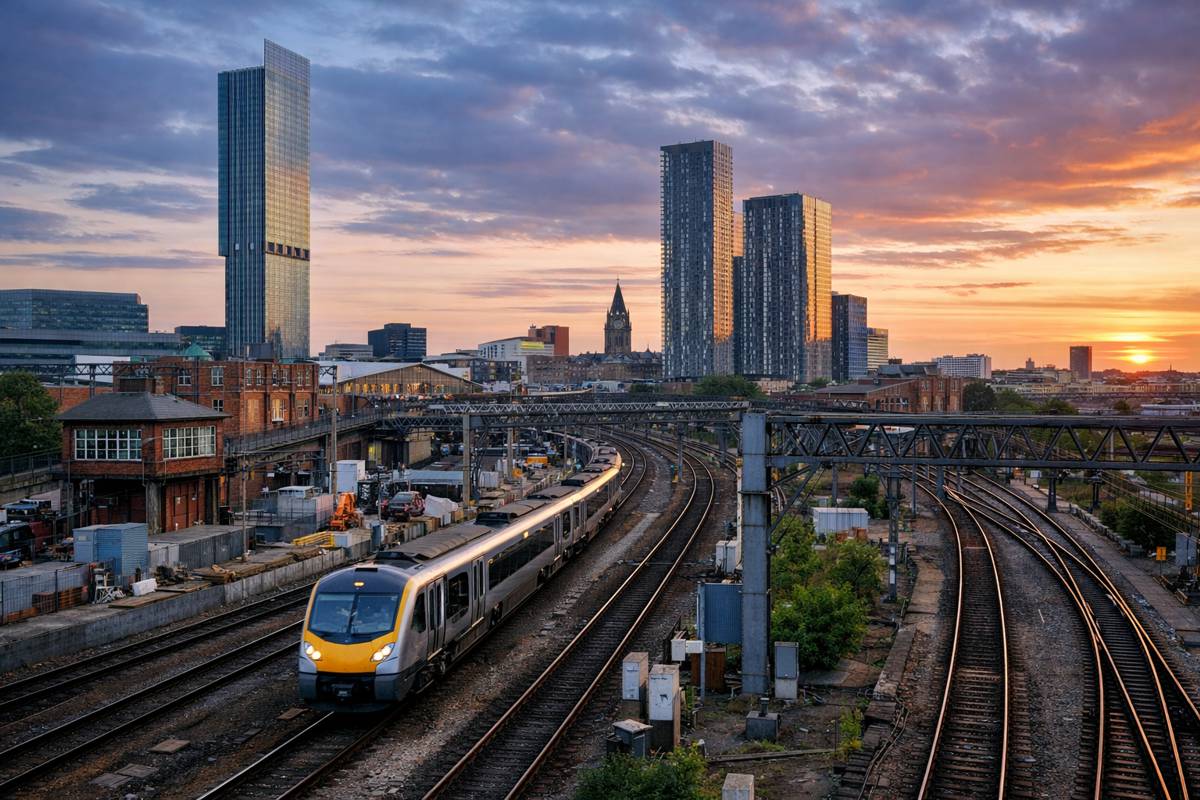
Working with Transport for the North (TfN) and Network Rail, the programme aims to strengthen the economic spine between Liverpool, Manchester, Leeds and surrounding city regions, improving journey times, capacity and reliability in corridors that have long been regarded as critical, but chronically constrained.
The scale is significant. The government has positioned the programme at around £45 billion in planned improvements, delivered in three phases, with Yorkshire prioritised first and construction expected to follow design and development activity later in the decade.
Why Northern Powerhouse Rail Matters Beyond Faster Trains
Northern Powerhouse Rail isn’t just a transport announcement. It is, in many respects, an industrial policy signal dressed up as a rail plan, aimed at shifting how people and businesses move between the North’s major economic centres. For construction professionals and investors, what matters isn’t only which routes get upgraded, but whether the scheme finally delivers the kind of predictable programme pipeline that the sector can plan around.
Across the UK, rail capacity is under pressure from a complicated mix of commuter demand, intercity travel, rail freight ambitions, ageing assets, and the need to decarbonise. Northern England has often experienced that squeeze more sharply because east-west connectivity has historically lagged behind north-south routes. NPR, in its original form, was intended to tackle that imbalance at scale, tying the major cities together with faster and more frequent links.
That ambition has been repeatedly tested by politics and affordability. Previous plans for a new high-speed corridor stretching across the North were reduced in scope during the Conservative government’s 2021 Integrated Rail Plan, a decision that sparked strong criticism in northern city regions.
Even so, the latest government framing positions NPR as a generational upgrade, built around both new infrastructure and major enhancements to existing corridors. The challenge now is delivering a credible sequence of enabling works that translates into real capacity and resilience, rather than simply moving congestion from one bottleneck to another.
The £45bn Plan and the Three-Phase Delivery Strategy
The government’s approach divides delivery into three phases, which is a practical acknowledgement that major rail investment needs to be staged. That’s not only because of cost and approvals, but because the operational railway has to keep running while work is being carried out.
According to the programme outline, Yorkshire is prioritised in phase one, with early proposals including electrification of key routes, a new station in Bradford, and upgrades at Leeds, York and Sheffield, along with a proposed new station at Rotherham, subject to approval of a business case.
Phase two shifts the centre of gravity towards Greater Manchester, including a plan for a new rail line linking Manchester Piccadilly, Manchester Airport and Liverpool.
The final phase, expected in the 2040s, includes the construction of a new railway line between Bradford and Huddersfield, a corridor that matters because it sits within a wider set of Transpennine connectivity constraints.
This is, on paper, a programme built to deliver a mix of “quick wins” and big structural shifts. In reality, it places huge weight on project development discipline, because the early phases will shape the value for money, delivery confidence, and political backing for the later ones.
Early Funding Lands, But Construction Comes Later
The government has allocated £1.1 billion for the design and preparatory stages, putting the near-term emphasis on development rather than immediate construction.
That funding is an important marker, but it also highlights a reality that stakeholders across the supply chain will be watching closely: construction is not expected to begin until after 2030.
For the construction sector, long lead times can be both a risk and an opportunity. They’re a risk because momentum can evaporate if priorities shift again. They’re an opportunity because they allow for better engineering design, utilities planning, land strategy, and procurement packaging, especially on schemes where constrained city-centre footprints and operational rail interfaces can rapidly inflate costs.
If the programme is to hold credibility, the period between now and 2030 has to be more than consultation. It needs visible progress: route development, environmental work, station concepts, governance structures, and clear sequencing that makes the programme investable.
Yorkshire First and the Bradford Station That Could Change the Network
Bradford has long been cited as one of the UK’s largest cities without the kind of rail connectivity its population and economic position would suggest it should have. The new NPR proposals bring Bradford back into focus with a plan for a new through station, a move that is as operationally important as it is symbolic.
At present, rail services typically terminate at Bradford Interchange, a layout that forces trains to reverse out before continuing their journeys, adding time and complexity and creating knock-on risks across wider timetables.
A through station changes that dynamic. Instead of treating Bradford as the end of the line, it becomes part of a flowing corridor, enabling more direct services and offering the potential to reduce journey times while improving reliability. Local leadership has been campaigning for that shift for years, and the new NPR emphasis suggests that argument has finally landed at national level.
For infrastructure investors and commercial stakeholders, Bradford’s station proposal is also a place-making lever. New stations can reshape development patterns, alter commercial land values and, in the best case, unlock regeneration in ways that aren’t always possible through rolling stock upgrades alone.
Electrification and Station Upgrades as Productivity Infrastructure
Electrifying key routes is a practical move in a rail system that is under increasing pressure to decarbonise while also improving performance. Electrification typically supports better acceleration, potentially improving timetabling and increasing capacity on busy routes, while also reducing reliance on diesel traction.
At the same time, station upgrades in Leeds, York and Sheffield indicate that NPR is being framed as a network upgrade rather than a single corridor scheme.
Stations are where passenger experience and operational resilience collide. Platforms, concourses, signalling interfaces and track approaches can all become system constraints if demand rises without supporting capital works. Modernisation is rarely glamorous, but it’s often where the measurable benefits sit: reduced dwell times, improved accessibility, better interchange, and more robust performance during disruption.
From a construction delivery perspective, working in and around live stations is high-stakes. It demands detailed possession planning, stakeholder coordination, and realistic programme sequencing. It also creates opportunities for specialist contractors in civils, MEP, digital rail systems, and safety-critical delivery.
Greater Manchester and the Case for a Manchester Airport Link
Phase two shifts the scheme’s centre towards Greater Manchester, including the proposed new line connecting Manchester Piccadilly, Manchester Airport and Liverpool.
That corridor matters commercially because it connects multiple economic ecosystems: the Liverpool City Region, Manchester’s city-centre employment base, and Manchester Airport as a national transport asset. Airports don’t just move passengers, they move labour, investment, and global connectivity, and they tend to magnify the value of dependable rail links.
If delivered well, a route of this nature can also reduce pressure on congested parts of the existing network by creating alternative paths and improving timetable robustness. But it’s not a simple engineering exercise. It requires integration with existing services, property and land issues, environmental constraints, and the realities of building new alignments in dense urban areas.
For the supply chain, this is where major civils, structures, complex signalling and systems integration will likely concentrate, particularly if the scheme aims to avoid simply adding traffic into already constrained nodes.
Long-Term Delivery Into the 2040s and the Bradford–Huddersfield Link
The third phase includes a new railway line between Bradford and Huddersfield, likely delivered in the 2040s.
Long-range phases can appear remote, but in major rail planning they often reflect the complexity of what’s being proposed. A new line isn’t just track in a corridor, it’s geometry, earthworks, structures, land acquisition, environmental mitigation, and long-term operational strategy. The earlier phases will need to build both political confidence and technical justification for that scale of intervention.
For construction and infrastructure markets, long time horizons can still be valuable if they translate into stable pipelines. A credible 2040s phase, even if distant, encourages longer-term skills investment, manufacturing planning and capability building, particularly across electrification, civils, geotechnical works and digital railway systems.
Credibility Is a Deliverable Too
No major UK rail scheme exists in a vacuum, and NPR’s modern history is a case study in how political direction can shape infrastructure reality. In 2021, the NPR vision was scaled back under the Integrated Rail Plan, changing expectations around how much new high-speed infrastructure would actually be built.
For northern city regions, this wasn’t an abstract disagreement. It affected business cases, regional development expectations, and confidence in government follow-through. The current programme therefore has to rebuild trust, not through rhetoric, but through delivery discipline and transparent milestones.
That means not only announcing a headline figure, but setting out procurement strategies, phasing logic, how interfaces with existing upgrades will be managed, and how the programme will handle the real-world complexity of working on an operational railway.
What NPR Means for Contractors, Suppliers and Investors
The programme points to a broad mix of project types: electrification packages, station builds, station upgrades, new lines, and long-term corridor enhancements. For the construction sector, that translates into varied opportunities across design, civils, power, systems and digital delivery.
For investors and commercial stakeholders, the key question will be where the measurable benefits land first. Faster rail links between major northern cities can support labour mobility and productivity, but the wider economic impact depends on integration with local transport, station connectivity, and development strategy around the upgraded network.
It’s also a reminder that infrastructure programmes of this size are never solely about transport. They influence construction employment, regional supply chains, skills pipelines, and the resilience of UK logistics networks, particularly where improved rail reliability can support freight capacity and modal shift ambitions.
What the government has put forward is a framework. The industry will judge it by the next stage: whether that framework becomes a buildable pipeline with stable funding, coherent governance and realistic timelines.