Adaptive Ultrasonic Imaging Redefines Concrete Infrastructure Inspection
Across the global construction and infrastructure sector, the condition of ageing concrete assets has become a strategic concern rather than a routine maintenance issue. Roads, bridges, tunnels and elevated structures are carrying heavier traffic loads, facing more extreme weather, and being asked to perform far beyond their original design life.
To address this non-destructive testing has shifted from a specialist discipline into a core component of asset management, risk mitigation and long-term capital planning. Yet despite decades of progress, inspecting concrete remains stubbornly difficult.
Unlike steel or homogeneous composites, concrete is a complex, heterogeneous material. Aggregates such as stone, sand, chalk, slate and even iron-rich materials interact unpredictably with sound waves, scattering and absorbing energy in ways that blur internal images. For infrastructure owners and engineers, that limitation has real consequences, from missed internal cracking to conservative repair decisions that inflate costs.
New research published in Applied Physics Letters now points to a meaningful step forward. A collaboration between Tohoku University, Los Alamos National Laboratory, and Texas A&M University has produced a high-resolution, auto-frequency-adaptive 3D ultrasonic imaging system designed specifically for highly attenuative materials like concrete. The work addresses a long-standing problem in nondestructive testing and, crucially, does so in a way that aligns with the operational realities of infrastructure inspection.
Why Conventional Ultrasonic Testing Falls Short
Most ultrasonic inspection systems rely on a narrow band of frequencies. Engineers select a transducer tuned to a specific frequency based on prior assumptions about the material under inspection. In relatively uniform materials, this approach works well. In concrete, it rarely does.
As ultrasonic waves travel through concrete, their energy is progressively lost. Some frequencies are absorbed by the cement matrix, others are scattered by coarse aggregates, and still others are reflected unpredictably at interfaces within the material. The result is an uneven signal where the most informative frequencies may never reach the receiver. Operators are then left with partial data, reduced contrast between defects and sound material, and images that are difficult to interpret with confidence.
This uncertainty forces trade-offs. Lower frequencies penetrate deeper but provide less spatial resolution. Higher frequencies offer sharper images but may be entirely attenuated before reaching the far side of a thick structural element. In practice, inspectors often resort to trial and error, swapping transducers or repeating scans in the hope of capturing usable data. That process is time-consuming, inconsistent and ill-suited to large-scale infrastructure programmes.
A Broadband Approach to Ultrasonic Imaging
The system developed by the international research team takes a fundamentally different approach. Rather than committing to a single ultrasonic frequency, it uses a broadband ultrasonic wave that spans a wide range of frequencies. This wave is introduced into the concrete, allowing the material itself to determine which frequencies survive the journey.
As Yoshikazu Ohara, one of the study’s authors, explains: “In our approach, the ultrasonic wave is broadband, using a wide range of ultrasonic frequencies rather than operating around a single, fixed frequency. The receiver is capable of accepting an even broader range of frequencies. By automatically adapting the frequency to the material, our system improves the contrast between defects and background material in concrete.”
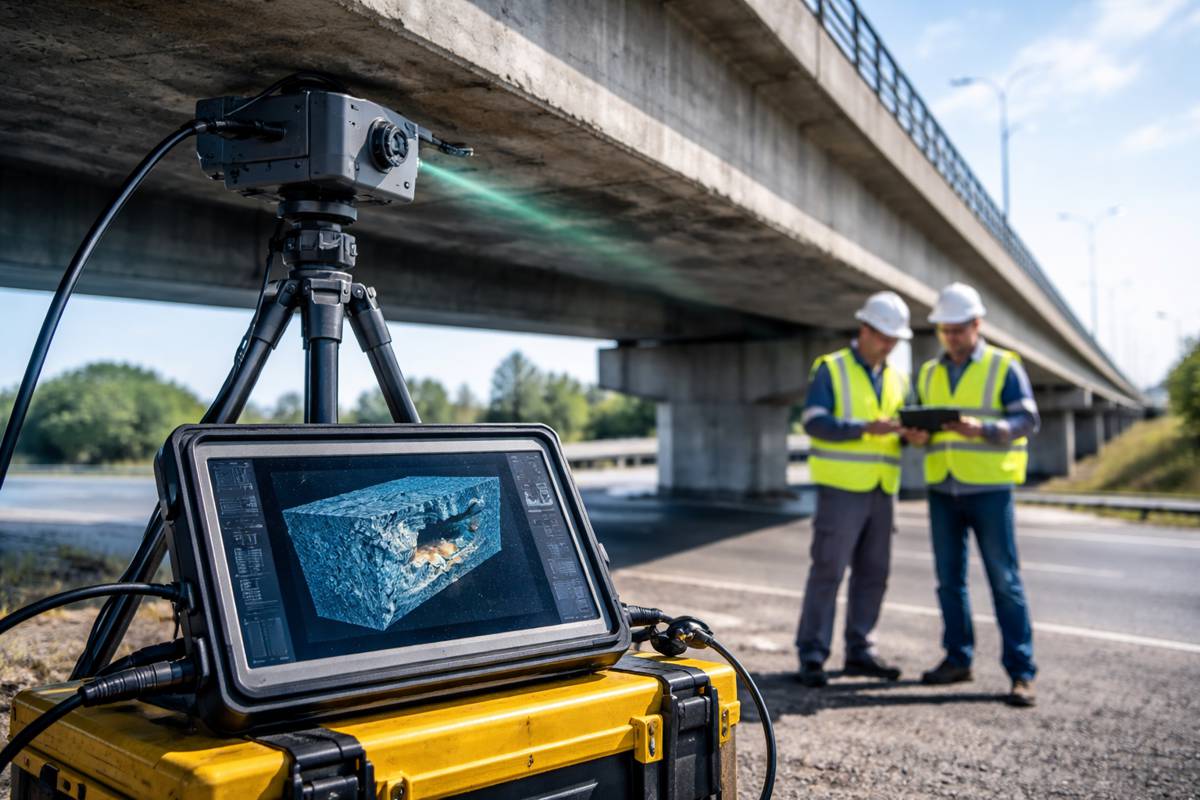
Instead of filtering the signal at the source, the system relies on a laser Doppler vibrometer to capture whatever frequencies emerge from the concrete. This optical receiver does not require physical contact with the surface and is capable of detecting a wide spectrum of ultrasonic responses. The implication is significant: even if most frequencies are scattered or absorbed, those that survive are still recorded and used in the final image.
Removing Manual Tuning From the Equation
One of the most practical advances of the system lies in what it eliminates. Traditional ultrasonic inspection often demands extensive manual tuning. Inspectors must decide which transducer to use, adjust frequencies based on experience, and recalibrate when moving between structures with different compositions or thicknesses.
In the new system, that step disappears. As Ohara notes: “No manual tuning is needed. As the concrete filters out certain frequencies, the laser Doppler vibrometer simply captures whatever frequencies remain. Unlike conventional systems, we don’t have to swap transducers or adjust the frequency beforehand. The system adapts automatically.”
For field deployment, this matters. Infrastructure inspection is increasingly carried out under tight time constraints, often in live traffic environments or remote locations. Reducing setup time and operator intervention not only improves efficiency but also lowers the risk of inconsistent results caused by human judgement. An adaptive system offers a more repeatable, scalable approach suited to network-level assessments.
Turning Complex Signals Into Usable 3D Images
Capturing broadband ultrasonic data is only part of the challenge. Interpreting it requires sophisticated processing to separate meaningful reflections from background noise. The research team addressed this by adapting imaging algorithms developed in earlier work, refining them specifically for broadband ultrasonic signals.
The result is a high-resolution three-dimensional image that reveals both the shape and location of internal defects. Cracks, voids and delaminations can be visualised in context, showing how they extend through the structure rather than appearing as ambiguous two-dimensional artefacts.
For maintenance planning, this spatial clarity is critical. As Ohara explains: “For a repair planner or field technician, this provides concrete information: how deep the defect is from the surface, how large it is, and how it extends in three dimensions. This makes it possible to plan repairs more efficiently. The method gives a clear 3D map of internal damage that can be directly used for maintenance and repair decisions.”
Implications for Asset Management and Lifecycle Planning
Beyond the technical achievement, the broader significance of the research lies in how it supports data-driven infrastructure management. Governments and asset owners worldwide are under pressure to extend the life of existing structures while controlling capital expenditure. Accurate condition data is the foundation of that strategy.
High-resolution 3D imaging enables more targeted interventions. Instead of broad, precautionary repairs, engineers can focus on specific zones of damage, reducing material use, labour costs and disruption. Over time, this precision supports predictive maintenance models, allowing defects to be monitored before they reach a critical state.
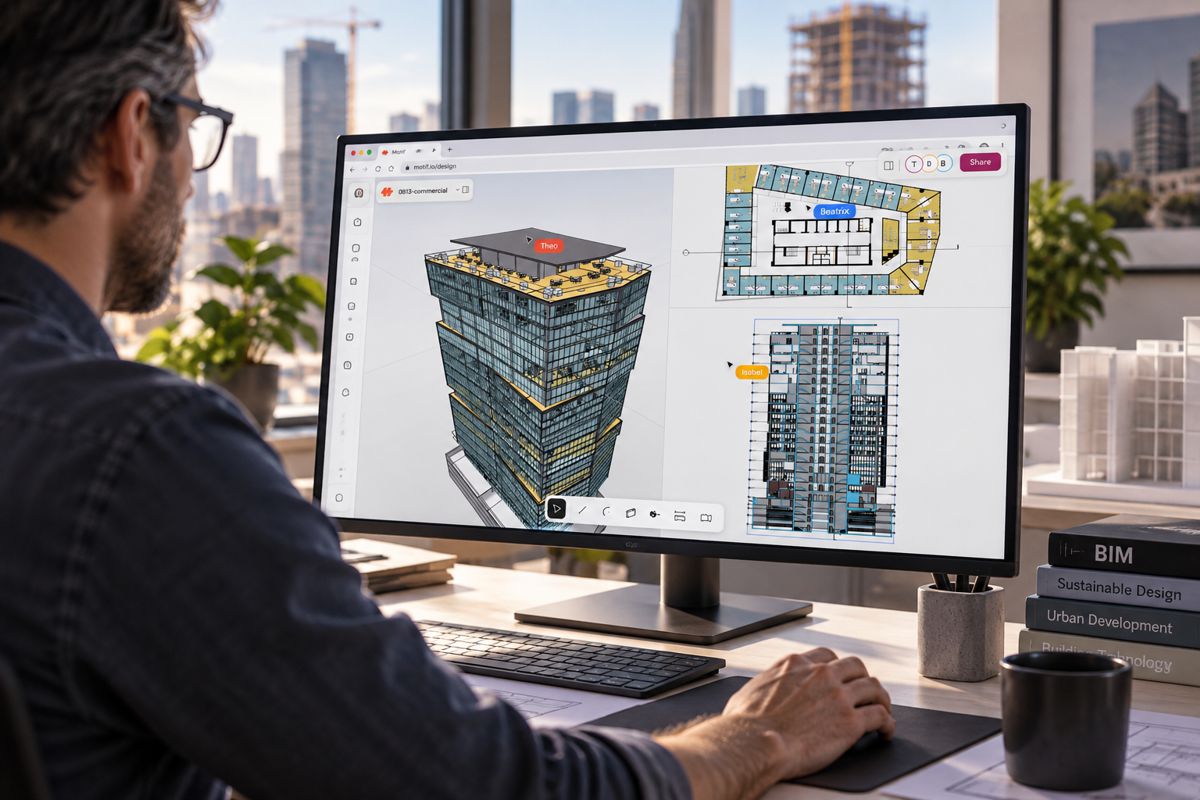
The approach also aligns with digital asset management trends. Detailed internal condition data can be integrated into digital twins of bridges or road structures, improving the accuracy of deterioration models and informing long-term investment decisions. As infrastructure agencies increasingly adopt performance-based maintenance contracts, reliable inspection data becomes a commercial as well as a technical asset.
Challenges of Scaling From Lab to Field
While the research demonstrates clear promise, scaling the system for widespread field use will require further development. Laser Doppler vibrometers, for example, are sensitive instruments that must operate reliably in outdoor environments subject to dust, vibration and variable lighting. Integrating such equipment into rugged, mobile inspection platforms will be an important next step.
There is also the question of inspection speed. Large infrastructure assets require rapid scanning to minimise closures and inspection costs. Translating high-resolution laboratory imaging into efficient field workflows will depend on advances in automation, data processing speed and user-friendly visualisation tools.
That said, the core principle of auto-frequency adaptation directly addresses one of the most persistent barriers in concrete inspection. By allowing the material to dictate which frequencies are useful, the system sidesteps the guesswork that has long constrained ultrasonic testing.
A Step Change for Concrete Inspection
The research by Yuto Fujikawa, Yoshikazu Ohara and Timothy J. Ulrich – Auto-frequency-adaptive 3D ultrasonic phased-array imaging system for highly attenuative materials, marks an important milestone in non-destructive testing, signalling a shift in how inspection technologies are conceived. Rather than forcing complex materials to conform to rigid testing parameters, adaptive systems respond dynamically to real-world conditions.
For the construction and infrastructure sector, that philosophy could prove transformative.
As concrete assets continue to age and maintenance budgets tighten, the ability to see clearly inside structures without invasive testing is no longer a luxury. It is a prerequisite for safe, resilient and economically sustainable infrastructure.