Precision Over Power Redefining Modern Demolition
Across the global construction landscape, demolition is undergoing a quiet but decisive shift. What was once framed as a blunt, high-impact phase at the start of a project has become a technically demanding discipline in its own right, governed by safety constraints, urban sensitivity, environmental performance and commercial pressure. In 2025, that evolution became increasingly visible on job sites across Southern Europe and France, where selective demolition, material recovery and controlled deconstruction set the tone for a new operational baseline.
At the centre of that shift sits MB Crusher, whose demolition pulverisers were deployed not as secondary attachments but as primary working tools. From dense historic city centres to industrial sites with zero tolerance for collateral damage, these projects highlight why demolition now carries strategic weight far beyond clearing space. It shapes programme certainty, carbon exposure, logistics costs and community acceptance, all before the first new foundation is poured.
Rather than following a single narrative, the most telling lessons of 2025 emerged from contrast. Different geographies, different constraints and different scales, yet a shared requirement for control, adaptability and precision that increasingly defines professional demolition in mature construction markets.
Urban Regeneration Where Margins for Error Disappear
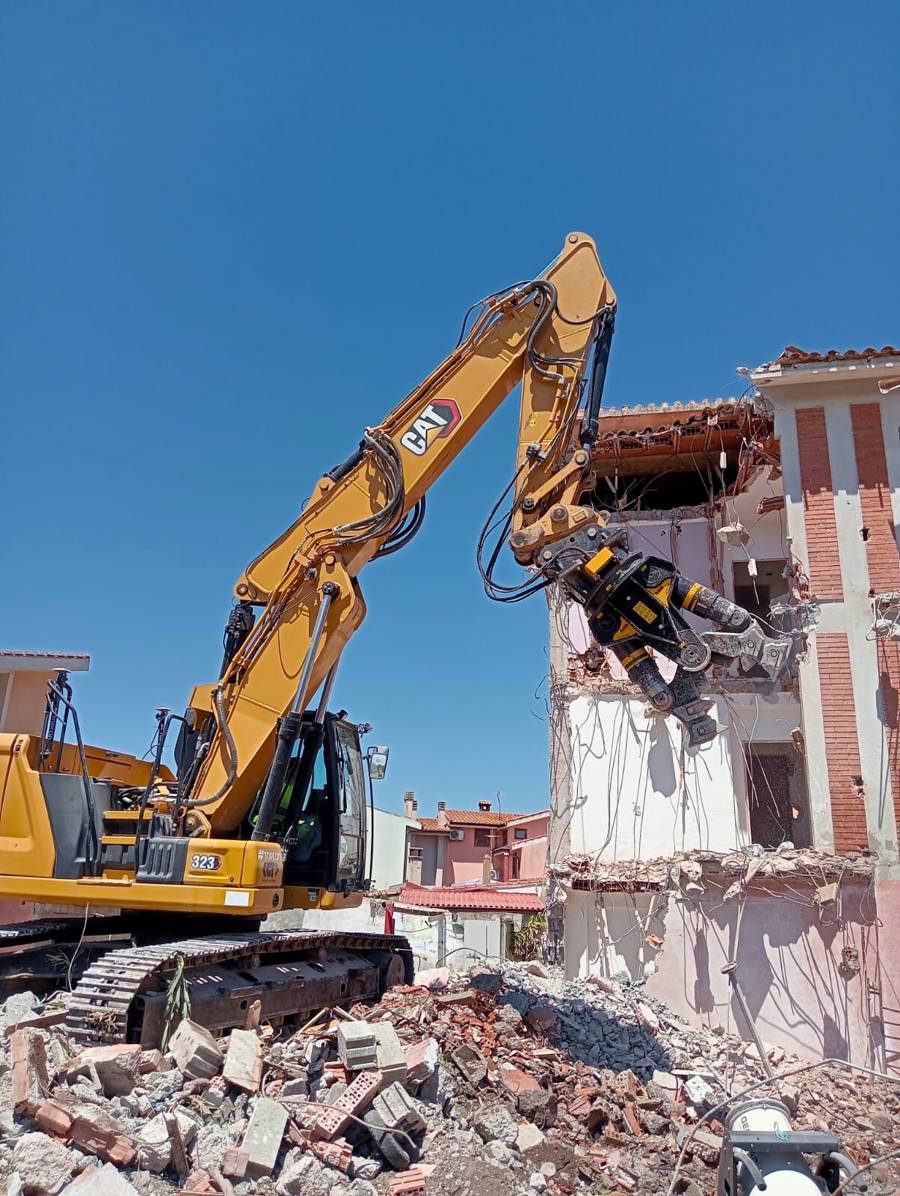
In urban regeneration schemes, demolition is often the most delicate phase of the entire project lifecycle. Structural instability, adjacent buildings and public scrutiny compress the margin for error to near zero. That reality was evident in Sassari, Sardinia, during the redevelopment of the Sacro Cuore district, where a three-storey building on Via Mascagni had to be dismantled within a tightly constrained urban envelope.
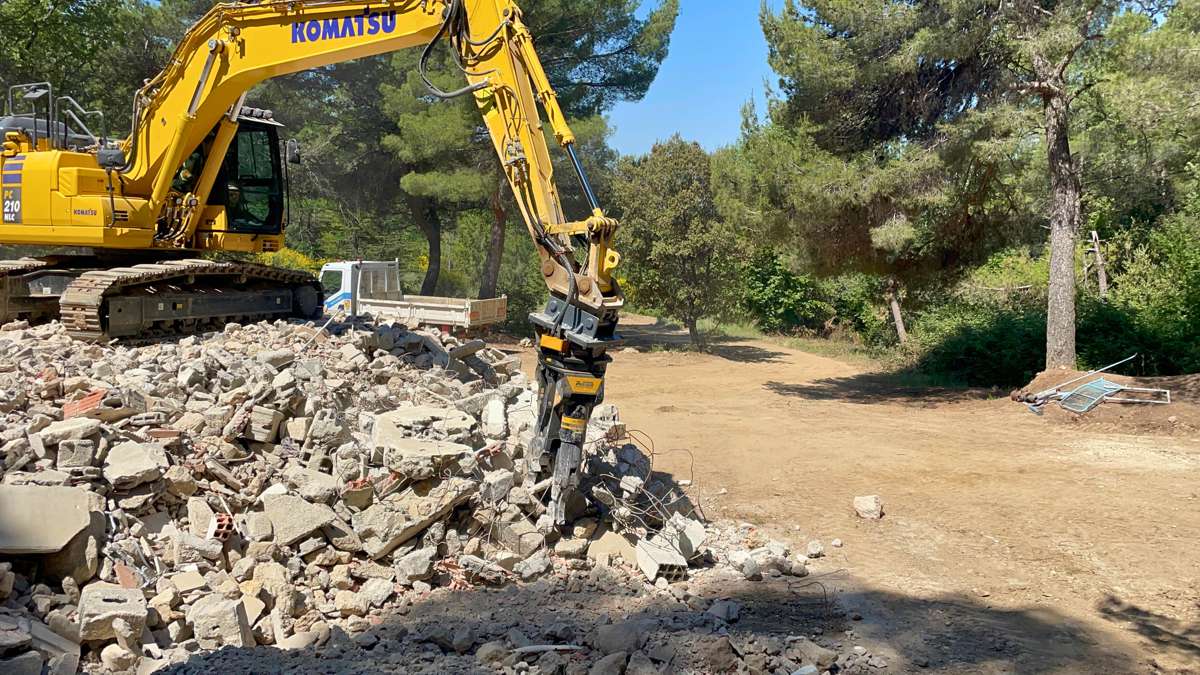
The demolition was executed using a Caterpillar 323 excavator equipped with the MB-PT1650 demolition pulveriser. The building was taken down progressively from the top floor downwards, with each slab, beam and column removed under continuous operator control. This approach avoided uncontrolled collapse and reduced vibration transfer to neighbouring structures, a critical factor in built-up environments.
From an engineering perspective, the pulveriser’s consistent closing-force sensitivity allowed the operator to adjust grip pressure in real time, matching the resistance of each structural element. Combined with a Hardox steel body, the attachment maintained structural rigidity while enabling precision handling. In practice, this translated into safer workflows, fewer interruptions and a predictable demolition sequence aligned with the wider regeneration programme.
City-Centre Demolition Under Spatial Constraint
A very different but equally demanding scenario unfolded in Belpasso, on the slopes of Mount Etna, where demolition took place in the heart of the town centre. Limited working space, narrow access routes and continuous public presence placed severe constraints on machine repositioning and material handling.
Using the same excavator and pulveriser configuration, operators relied heavily on the MB-PT1650’s continuous 360-degree rotation to access structural elements without repeatedly moving the base machine. Beams, slabs and vertical elements were dismantled sequentially, with the attachment rotating into position rather than forcing spatial compromises on site.
The inclusion of integrated rebar-cutting blades and interchangeable teeth meant that demolition, separation and material sorting occurred simultaneously. Reinforcement was cut cleanly at source, reducing secondary handling and eliminating the need for additional processing equipment. Commercially, this approach reduced labour hours and simplified logistics, while operationally it lowered site congestion, a persistent challenge in town-centre construction.
Time-Critical Deconstruction in Historic Neighbourhoods
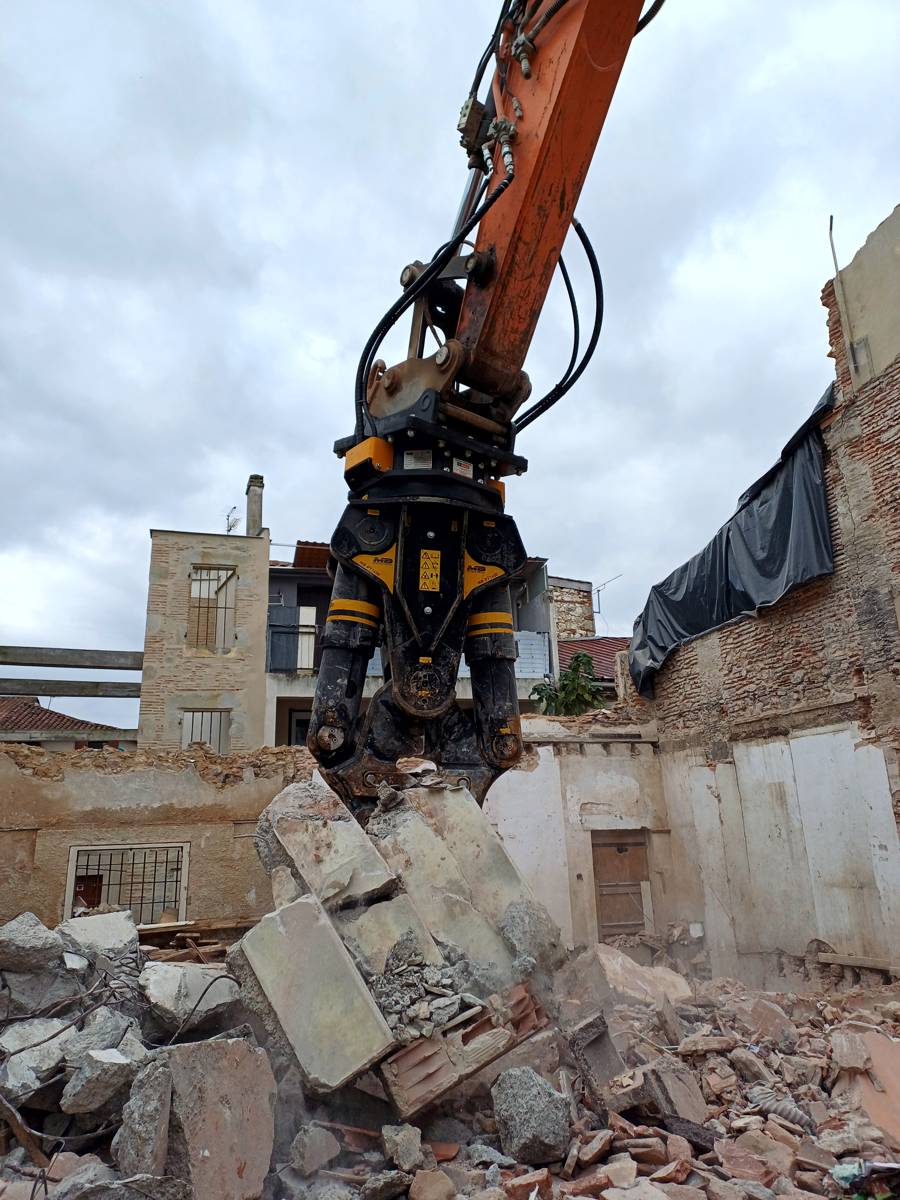
Speed, when paired with control, can redefine the viability of urban regeneration projects. In Villeneuve-sur-Lot, southern France, demolition formed a central component of the Cieutat district renewal programme, where historic surroundings and residential proximity placed strict limits on noise, dust and vibration.
Contractor Artebat selected a short-radius Doosan 235 LCR excavator paired with the MB-PT1650, a configuration tailored for confined urban settings. The short tail swing reduced risk to adjacent structures, while the pulveriser’s hydraulic management system delivered consistent power regardless of load variation.
The building was dismantled element by element, with interchangeable kits allowing rapid adaptation as the structure changed. Floors, walls and load-bearing elements were removed in a controlled sequence, allowing the entire demolition to be completed within days rather than weeks. For residents, disruption was minimised. For the contractor, programme certainty improved, reinforcing the commercial value of precision-led demolition strategies.
Heavy Industrial Demolition With Zero Tolerance for Damage
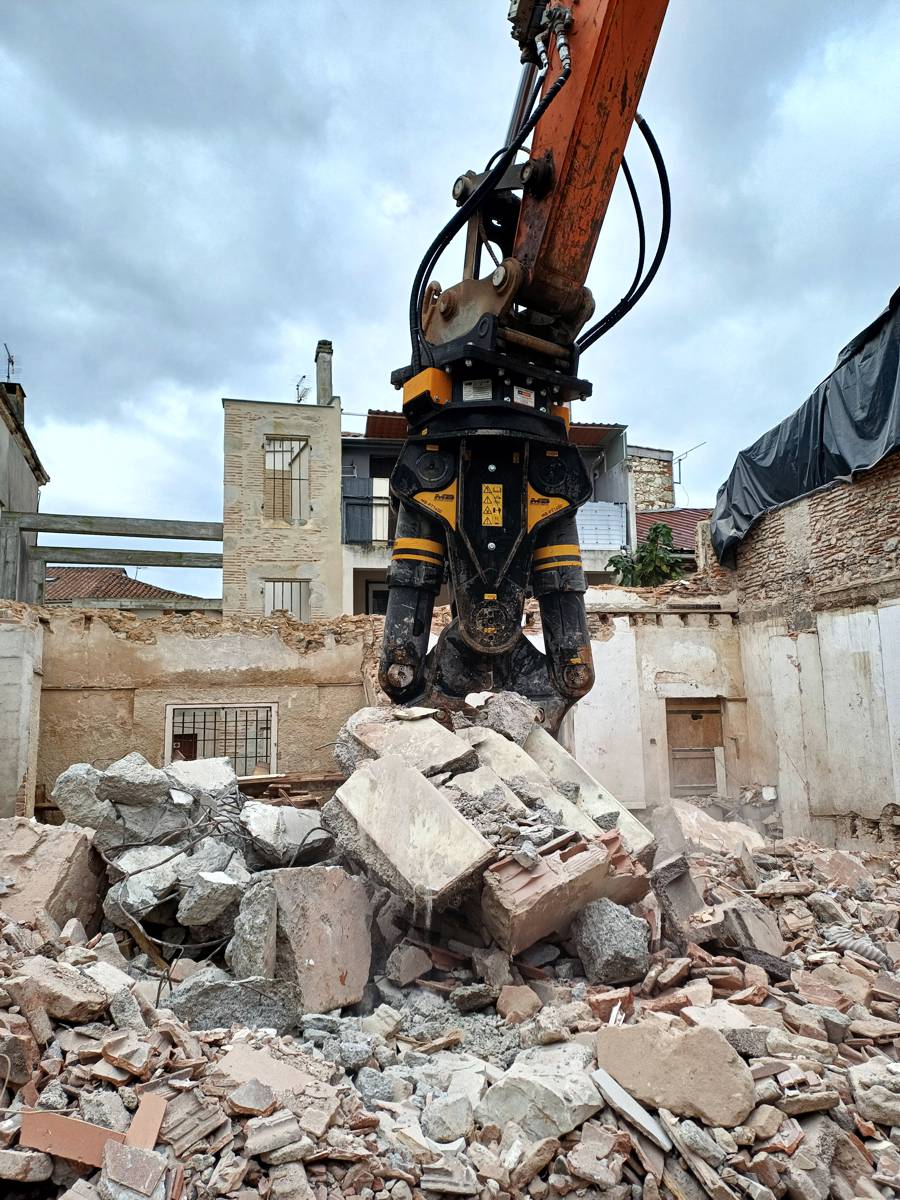
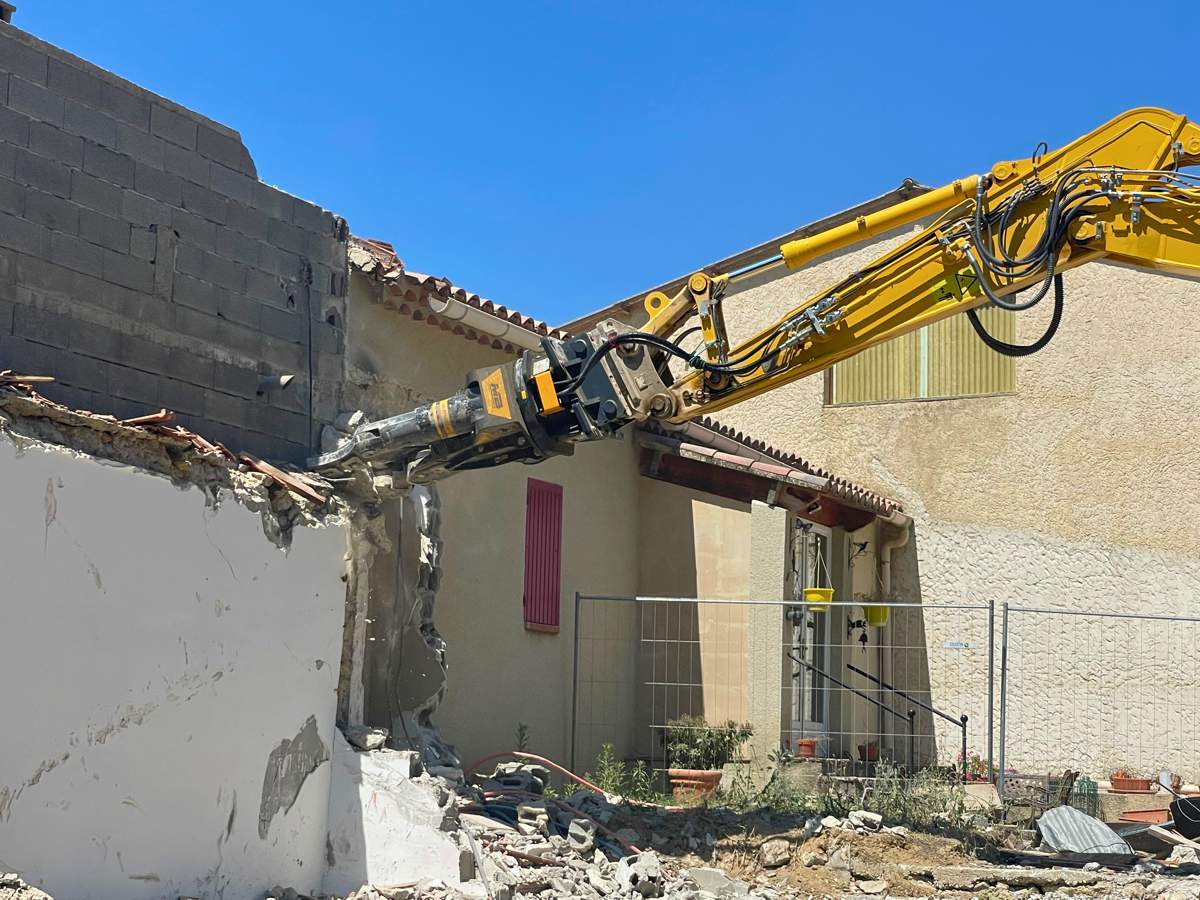
Not all demolition challenges are defined by proximity to the public realm. In Vaucluse, France, the task was to remove a two-storey industrial building physically attached to an inhabited house. The requirement was absolute: no structural damage, no stress transfer and no remedial works to the adjoining property.
Using an MB-PT1650, each structural element was individually gripped, isolated and removed with millimetric accuracy. Rather than relying on fracture or collapse, the process resembled surgical extraction, with load paths carefully managed throughout. This level of control prevented unintended stress from propagating into the neighbouring structure.
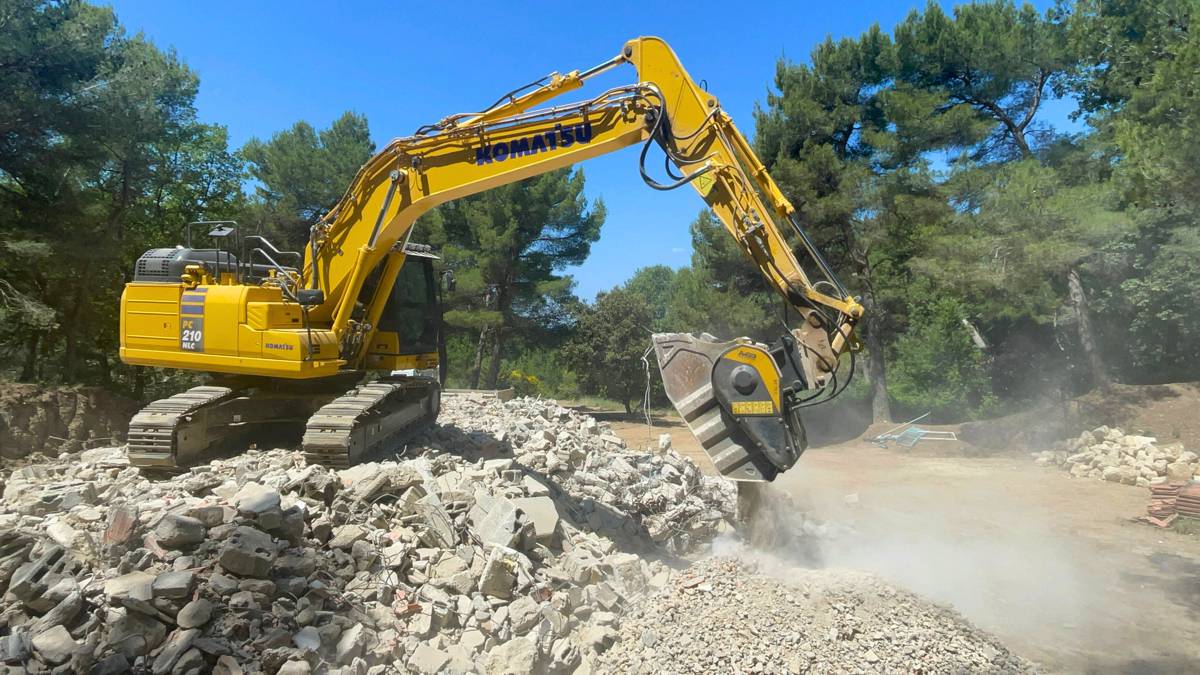
Once demolition was complete, the same excavator was used to crush the resulting material on site. This eliminated the need for off-site transport, reducing vehicle movements, fuel consumption and associated emissions. The ability to combine demolition and material processing within a single machine cycle illustrates how attachment-led workflows can support both sustainability targets and cost control in industrial projects.
Small-Scale Demolition With Complex Geometry
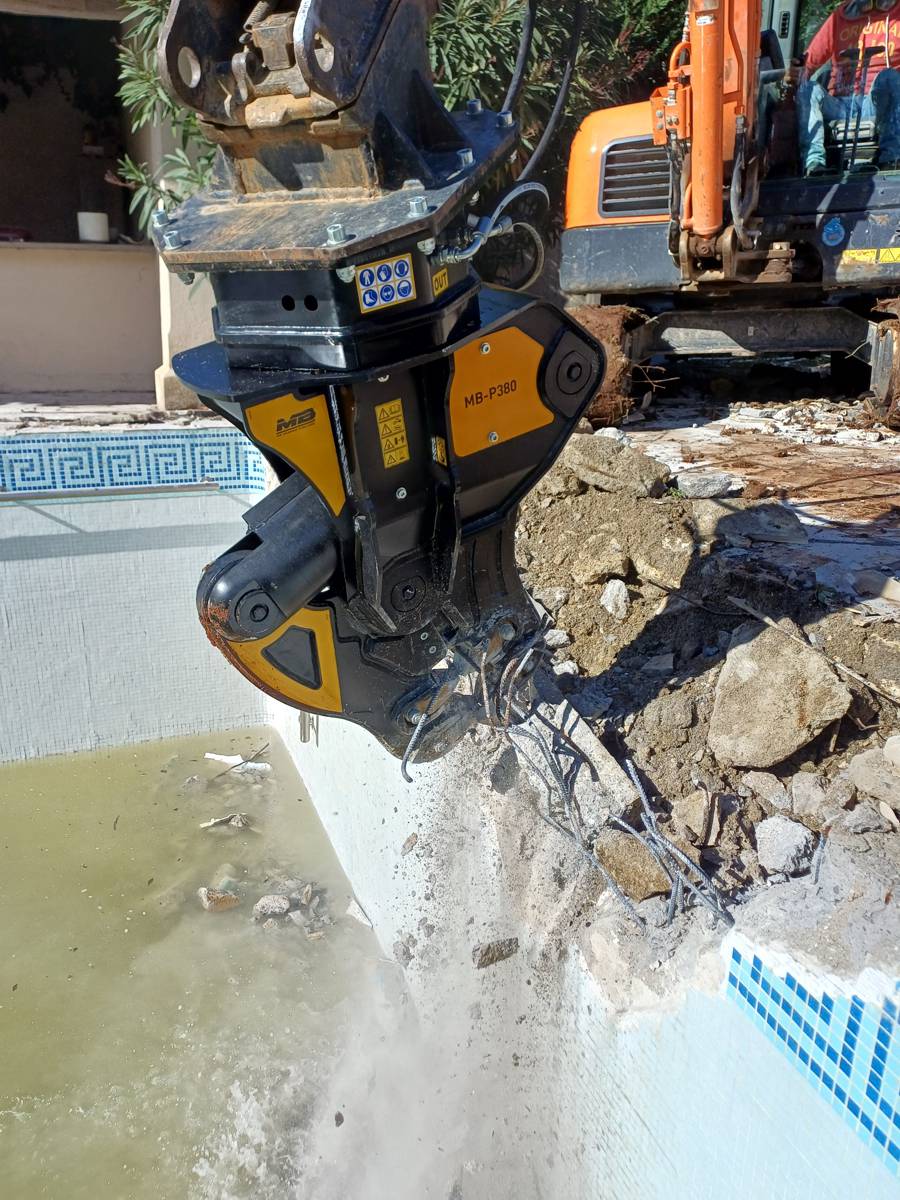
Winter renovation projects often expose a different set of challenges, particularly where demolition involves irregular structures and constrained access. In France, the removal of an ageing concrete swimming pool marked the first phase of a wider refurbishment programme.
Mounted on a compact Doosan DX62, the MB-P380 demolition pulveriser was selected for its suitability in tight spaces and sensitive environments. The pool’s irregular geometry and variable concrete thickness demanded continuous adjustment of grip force and attack angle. Rather than applying uniform pressure, the operator modulated power incrementally, dismantling the structure piece by piece.
This approach prevented vibration transmission to surrounding buildings and underground services, a critical consideration in renovation contexts. The project demonstrated that effective demolition is not a function of scale alone. Control, adaptability and operator feedback remain decisive, even on comparatively small sites.
Interior Demolition and the Rise of Selective Deconstruction
One of the most persistent misconceptions in construction is that demolition only occurs outdoors. In reality, a growing proportion of demolition activity now takes place inside existing buildings, particularly in residential and mixed-use refurbishment projects.
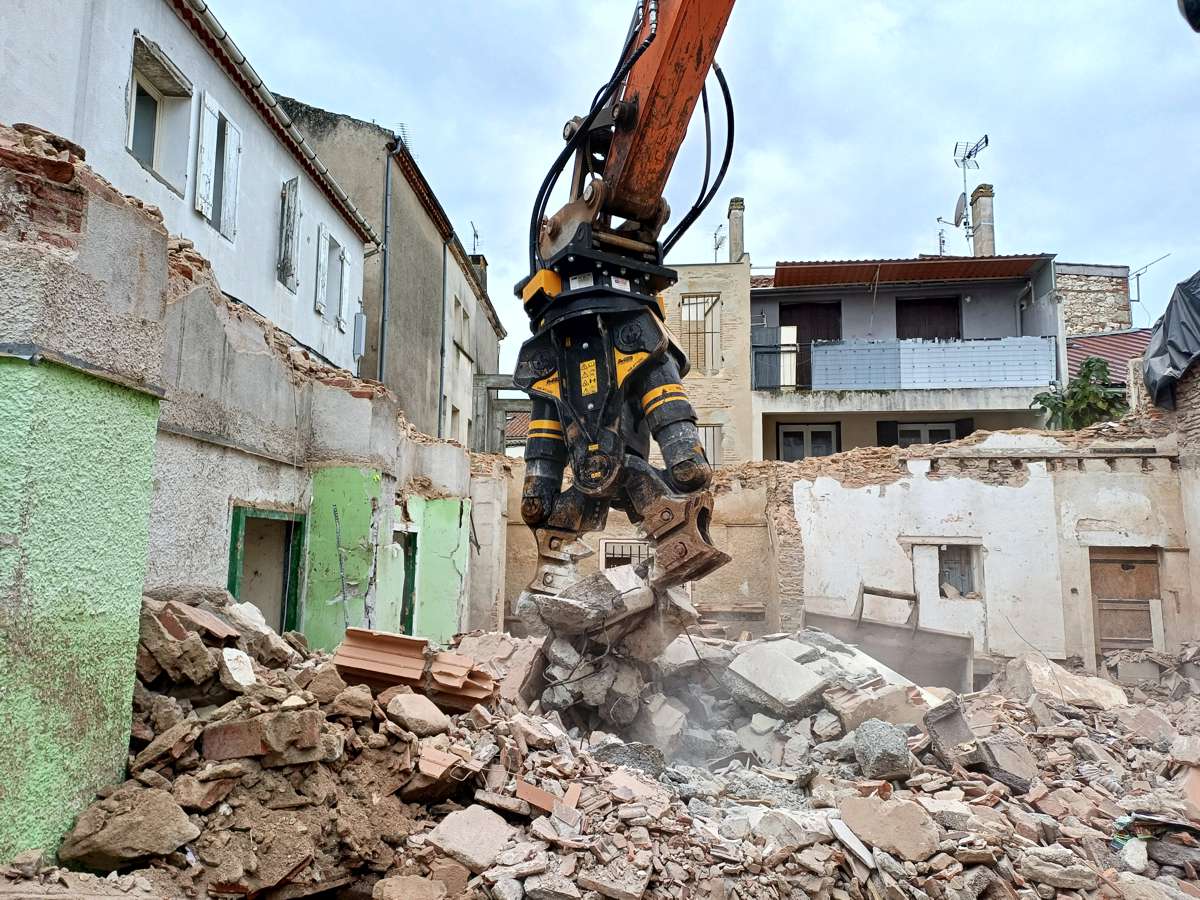
In an Italian interior demolition project, the objective was to remove floors and internal structures while preserving perimeter walls and maintaining overall building stability. Working room by room, the demolition pulveriser was used to apply progressive force, fragmenting and removing material without inducing vibration or structural compromise.
This selective approach reflects broader industry trends. As cities prioritise refurbishment over replacement, demolition increasingly involves subtraction rather than erasure. Tools that allow controlled deconstruction, rather than wholesale destruction, are becoming essential to delivering safe, compliant and commercially viable projects.
Why Controlled Demolition Matters to the Global Industry
Taken together, these projects illustrate a broader industry reality. Modern demolition sits at the intersection of safety regulation, urban policy, environmental performance and commercial efficiency. Poorly executed demolition introduces programme risk, inflates costs and damages public trust. Conversely, controlled, selective demolition creates downstream value across the entire project lifecycle.
Attachment-led solutions, such as demolition pulverisers capable of gripping, cutting, separating and crushing, align closely with this shift. They reduce reliance on multiple machines, simplify logistics and enable material recovery at source. For contractors, this translates into fewer interfaces, lower operating costs and greater flexibility. For policymakers and planners, it supports quieter, cleaner and safer urban construction environments.
As 2025 drew to a close, the evidence from the field was unambiguous. Demolition is no longer about hitting hard. It is about knowing where, when and how to apply force, and when restraint delivers the better outcome.
The projects completed over the past year offer a clear signal of what lies ahead. As 2026 begins, new sites, new constraints and new expectations will continue to push demolition towards greater precision, higher accountability and deeper integration with sustainable construction practices.