Turning Data into Decisions with a Security Operations Control Centre
Across global infrastructure networks, the definition of security has shifted well beyond perimeter fences and controlled access points. Today’s critical environments rely on a steady flow of data from travel movements, operational facilities, digital systems, and human activity, all of which must be interpreted in real time. For organisations overseeing thousands of employees across multiple geographies, the ability to turn fragmented data into actionable intelligence has become a defining operational capability rather than a supporting function.
Within this evolving landscape, control rooms have emerged as the nerve centres of modern enterprise resilience. They’re no longer passive monitoring hubs. Instead, they function as dynamic decision environments where situational awareness, collaboration, and rapid judgement converge. As industries ranging from construction and infrastructure to energy and logistics become increasingly interconnected, the importance of these command centres continues to grow, influencing everything from business continuity to workforce safety.
Aker Security has refined its approach to operational oversight, investing in technologies that enable more effective aggregation and visualisation of data. The organisation’s latest control room development reflects a broader industry recognition that managing complexity demands smarter integration rather than more information.
The New Role of the Global Security Operations Centre
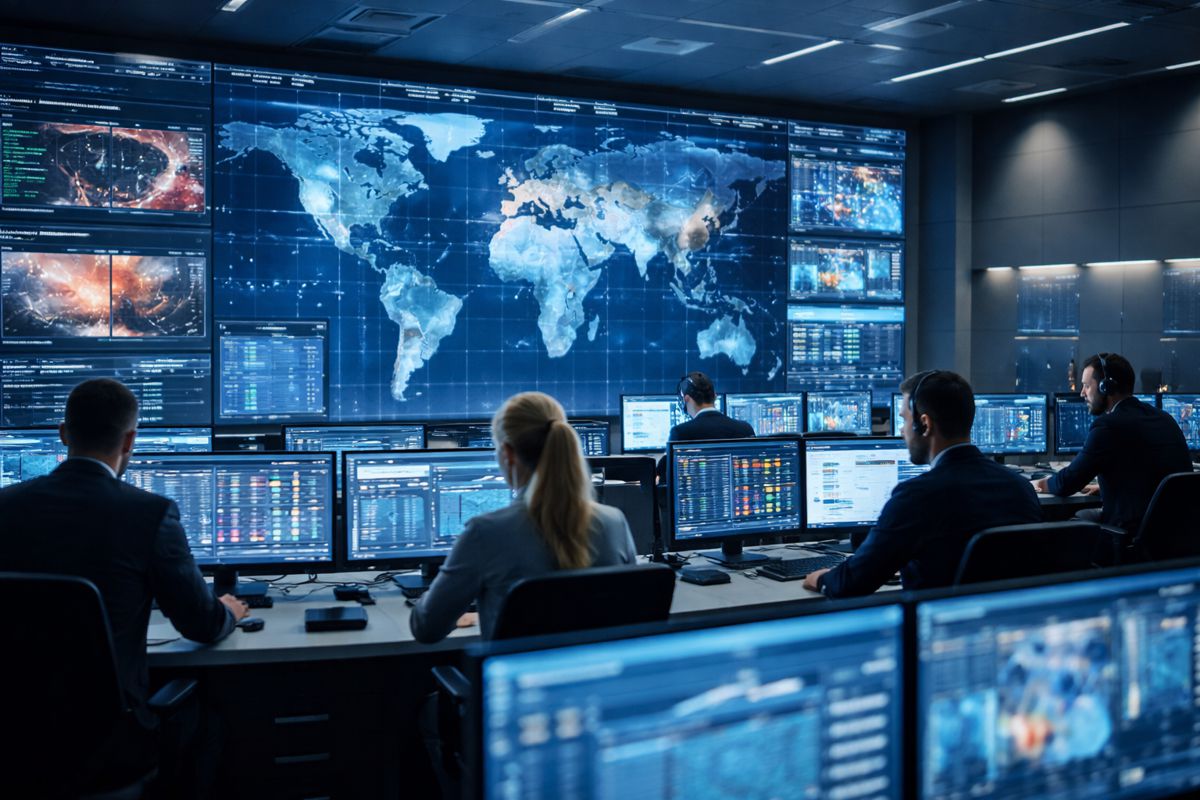
At the heart of Aker Security’s operational framework sits its Global Security Operations Center, commonly referred to as the GSOC. Designed for continuous, around the clock functionality, the GSOC handles multiple layers of monitoring responsibilities, from global incident tracking to crisis response coordination. Its purpose extends beyond simple observation. Instead, it acts as a collaborative platform where information becomes the foundation for coordinated action.
Security oversight for a workforce numbering in the thousands presents a constant stream of variables. Travel security concerns, geopolitical developments, localised disruptions, and internal risk factors all intersect, often with little warning. In these conditions, operators must synthesise information from diverse systems while maintaining clarity under pressure. The GSOC’s design reflects this operational reality, ensuring that both analysts and decision makers can work from a shared understanding of unfolding events.
According to Tonje Evensen Bråthen, Head of the GSOC at Aker Security, the priority was to ensure that technology would support existing workflows rather than disrupt them. She explains the rationale behind the project: “We approached Cyviz because we needed a solution that could bring everything together on a single platform, while at the same time supporting the way we actually work operationally.”
This emphasis on operational alignment signals a broader shift in how organisations approach control room design. Rather than forcing teams to adapt to rigid technological systems, modern solutions increasingly focus on flexibility and human centred usability.
Aggregating Complexity Into Clear Insight
One of the core challenges facing any global security operation lies in consolidating diverse streams of information without overwhelming users. From travel data and incident reports to communication channels and advisory updates, the sheer volume of inputs can hinder decision making if not structured effectively. Aker Security’s GSOC addresses this challenge through a platform developed by Cyviz, a company known for designing systems tailored to high pressure environments.
The platform enables data from multiple sources to be displayed in a format that supports role based interpretation. Analysts, supervisors, and strategic leaders can each access views that correspond to their responsibilities, ensuring relevance without sacrificing detail. This approach mirrors a growing recognition across industries that situational awareness must be scalable to different levels of decision authority.
Bråthen highlights the practical benefits observed since implementation: “We work with the Cyviz system in the GSOC on a daily basis. It gives us a better overview and allows us to use the information we already have far more effectively.”
This ability to maximise existing information resources has implications beyond operational efficiency. For infrastructure organisations, where data is often dispersed across multiple departments, better integration can reduce redundancy while strengthening resilience. It also reinforces accountability, as decisions can be traced back to shared data environments rather than isolated interpretations.
Collaboration as the Cornerstone of Crisis Management
In critical situations, the difference between confusion and clarity often comes down to how well teams collaborate. Control rooms have traditionally struggled with fragmented communication channels, leading to delays or inconsistent responses. Aker Security’s GSOC design places collaboration at the centre of its operational philosophy, ensuring that stakeholders can engage in real time without technical barriers.
The visual layout of the control room encourages shared situational awareness. Large displays provide common reference points, enabling multiple teams to interpret data simultaneously. This shared visibility reduces the likelihood of miscommunication, particularly during high stress incidents where rapid coordination is essential.
Industry research into crisis management consistently points to communication breakdowns as one of the leading causes of delayed responses. By integrating collaborative tools directly into the operational environment, organisations can mitigate these risks. In sectors such as construction and infrastructure, where disruptions can have cascading economic effects, this capability holds considerable value.
Moreover, collaborative control room environments foster a culture of proactive problem solving. When operators can visualise trends and anomalies collectively, they’re more likely to identify emerging risks before they escalate. This predictive dimension aligns with broader technological shifts towards data driven risk management.
Designing for Adaptability in an Uncertain Future
Threat landscapes evolve quickly, influenced by geopolitical tensions, technological developments, and societal changes. Control rooms built for static conditions often struggle to adapt, requiring costly upgrades or complete redesigns. Aker Security’s GSOC was developed with adaptability as a guiding principle, allowing the organisation to adjust workflows and technological components without starting from scratch.
Bråthen underscores the importance of this flexibility: “The flexibility of the Cyviz solution allows us to continue developing the control room over time and evolve alongside the technology.”
This forward looking perspective reflects a broader industry understanding that resilience depends on scalability. Infrastructure operators increasingly recognise that systems must accommodate new data sources, regulatory requirements, and operational models. By investing in adaptable platforms, organisations can extend the lifespan of their control room infrastructure while maintaining relevance.
Flexibility also supports innovation. As artificial intelligence and predictive analytics become more prevalent, control rooms will likely integrate automated insights alongside human judgement. Platforms capable of evolving with these technologies will position organisations to leverage emerging capabilities without operational disruption.
Broader Implications for Infrastructure Security
The developments within Aker Security’s GSOC offer insights relevant to the wider infrastructure sector. As construction projects grow in scale and complexity, the need for integrated security oversight becomes more pronounced. Major infrastructure initiatives often involve international partnerships, remote operations, and digital dependencies, all of which introduce additional risk factors.
Control rooms that aggregate and contextualise information can serve as strategic assets rather than operational necessities. They enable organisations to maintain continuity during disruptions, safeguard personnel, and protect reputational integrity. For policymakers and investors, these capabilities represent indicators of organisational maturity and resilience.
Furthermore, the integration of collaborative technology into security operations aligns with global trends towards digital transformation. Infrastructure stakeholders increasingly prioritise transparency and data driven governance, recognising that effective oversight supports both safety and financial performance.
Building Confidence Through Shared Awareness
Ultimately, the success of any security operation depends on trust. Employees must feel confident that risks are being managed effectively, while leaders require assurance that decisions are informed by accurate data. Control rooms that facilitate shared awareness contribute to this confidence by making information accessible and actionable.
The GSOC at Aker Security exemplifies how technology can enhance human decision making without overshadowing it. By focusing on usability, adaptability, and collaboration, the organisation has created an environment where operators can respond to complex situations with clarity.
As industries continue to navigate uncertainty, the ability to synthesise information quickly will remain a competitive advantage. Control rooms designed for integration rather than isolation will likely become standard practice across sectors where safety and operational continuity are paramount.
In an era defined by rapid change, the evolution of security operations centres signals a broader shift towards resilience driven by insight. Organisations that invest in these capabilities position themselves not only to respond to today’s challenges but also to anticipate tomorrow’s complexities.