Strategic Investment Set to Reshape Serbia’s Road Infrastructure
Across Europe, road networks are quietly being redefined as strategic national assets rather than passive conduits for traffic. Serbia is no exception. With freight flows intensifying across the Western Balkans and mobility expectations rising well beyond major cities, the condition of local and national roads has become a matter of economic competitiveness, public safety and climate resilience. Against this backdrop, a €150 million financing package from European Investment Bank marks a significant intervention in how Serbia safeguards and upgrades its road infrastructure.
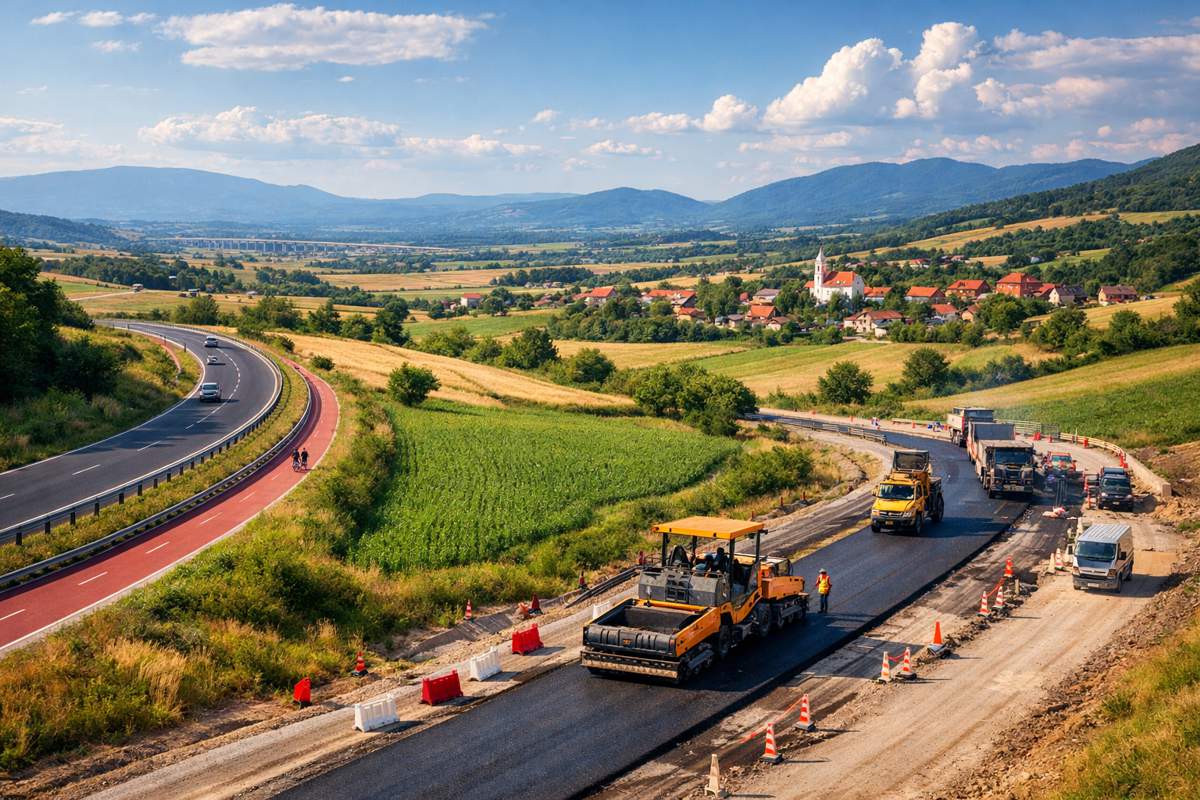
The programme will finance the reconstruction and upgrade of approximately 540 kilometres of local and national roads across the country. While that headline figure may appear modest beside motorway megaprojects, its strategic importance lies elsewhere. These roads form the connective tissue between industrial zones, agricultural regions, border crossings and urban centres. Improving them brings immediate benefits to businesses, communities and logistics operators alike, while reducing long term maintenance liabilities for the state.
Importantly, the investment is framed not as a simple resurfacing exercise but as a comprehensive modernisation aligned with European Union standards. By addressing safety, climate resilience and environmental performance in parallel, the project reflects a broader shift in infrastructure financing towards lifecycle value rather than short term gains.
Integrating Serbia into European Transport Corridors
For Serbia, geography is both an advantage and a responsibility. Sitting at the crossroads of Southeast and Central Europe, the country plays a growing role in regional supply chains and transit corridors. Upgrading the core road network strengthens this role by improving connectivity within the country and linking more effectively to neighbouring markets.
The financing supports Serbia’s efforts to remove bottlenecks that constrain the movement of passengers and freight. Improved road geometry, better drainage, safer junctions and upgraded surfaces all contribute to more predictable journey times and reduced vehicle operating costs. For logistics operators, even marginal gains in reliability can translate into meaningful commercial benefits.
Speaking on the strategic intent of the investment, Damien Sorrell, Head of the EIB Regional Hub for the Western Balkans, emphasised its wider economic relevance: “The project supports smart, sustainable and safe transport, removes bottlenecks, and integrates Serbia’s network into regional and EU corridors. These improvements will boost socioeconomic development by increasing accessibility, facilitating trade, and supporting businesses nationwide.”
Such integration is particularly important as Serbia continues to align its infrastructure frameworks with EU norms, both technically and institutionally. Road standards, safety audits and resilience planning increasingly mirror European practice, helping domestic contractors and authorities build experience that travels well beyond national borders.
Road Safety as a Socioeconomic Priority
Road safety remains one of the most tangible measures of infrastructure quality, and one with immediate human consequences. Serbia, like many countries in the region, has made progress in reducing serious accidents, yet local roads still present elevated risks, particularly for vulnerable users.
The EIB backed programme places strong emphasis on pedestrian and cyclist safety. Planned measures include upgraded pedestrian crossings, protective barriers near schools, improved signage, new sidewalks and the development of dedicated cycling lanes. These interventions may not carry the visual impact of a new expressway, but they often deliver the highest return in social value.
Local roads frequently serve mixed traffic, combining cars, heavy vehicles, cyclists and pedestrians in constrained corridors. Improving their safety profile supports everyday mobility, from children travelling to school to workers commuting between towns. It also encourages active transport, aligning with broader European objectives around health and emissions reduction.
Crucially, these safety improvements are embedded within a national framework rather than treated as isolated pilots. That consistency helps ensure that standards are applied evenly across regions, reducing disparities between urban and rural areas.
Climate Resilience and Network Protection
Climate change is no longer a theoretical consideration for road authorities. More frequent extreme weather events, including heatwaves and intense rainfall, are already placing stress on pavement structures, drainage systems and slopes. Serbia’s road network, much of it built decades ago, is particularly exposed to these pressures.
This programme incorporates climate resilience as a core design criterion. Sections of the network most vulnerable to flooding, erosion or thermal stress have been prioritised for intervention. Improved materials, better drainage and more robust structural solutions are intended to extend asset life while reducing emergency maintenance costs.
The approach builds on analytical work carried out through the JASPERS advisory programme, supported by European Union funding, which assessed climate risks across the network. Rather than spreading resources thinly, the project targets those sections where failure would have the greatest economic and social impact.
This method reflects a growing recognition among financiers and governments alike that resilience is inseparable from sustainability. A road that fails prematurely carries not only financial costs but also environmental ones, through repeated reconstruction and disrupted mobility.
Building on Previous Rehabilitation Efforts
The current investment does not stand alone. It builds directly on earlier EIB Global support for Serbia’s Road Rehabilitation and Safety initiative, which enabled the modernisation of more than 900 kilometres of national roads. Together, these programmes represent a sustained effort to address historic underinvestment in secondary infrastructure.
That continuity matters. Contractors, designers and public agencies develop institutional memory through repeated delivery, improving quality and efficiency over time. It also allows standards to evolve incrementally, rather than being reinvented for each project.
For Serbia, this steady pipeline of work supports domestic construction capacity while encouraging the adoption of modern practices in asset management, procurement and supervision. Over time, such capabilities strengthen the entire infrastructure ecosystem, from ministries to municipalities.
National Development and Investment Attractiveness
From the government’s perspective, upgrading local and national roads is inseparable from broader economic strategy. While highways and express roads often dominate headlines, secondary networks determine how evenly growth is distributed across a country.
Serbia’s First Deputy Prime Minister and Minister of Finance, Siniša Mali, highlighted this point: “In addition to highways and express roads, of which ten are currently under construction, we are also upgrading local road infrastructure, because we want to have safer and more modern roads in all parts of Serbia, in every town. The construction of transport infrastructure, roads and railways has a positive impact on economic activity, and through the efficient implementation of such projects, we are recording faster economic growth. In this way, we also attract new investors, create new industrial zones, and Serbia becomes an even more attractive investment destination.”
For investors, road quality influences decisions around site selection, workforce mobility and supply chain resilience. A reliable secondary network can tip the balance in favour of regional locations, easing pressure on major cities while supporting balanced development.
European Support and Technical Assistance
Beyond the loan itself, the project benefits from a €1.4 million grant under EIB Global’s Economic Resilience Initiative. This funding supports project preparation and implementation, helping ensure that designs, procurement processes and supervision meet high technical standards.
The involvement of the EU Delegation further reinforces alignment with European policies and best practice. EU Ambassador to Serbia Andreas von Beckerath underscored the broader significance of the programme: “This project provides a significant upgrade to Serbia’s national and local road infrastructure, with a strong focus on unlocking regional socioeconomic potential and addressing the needs of citizens and businesses. Supported by EU funded technical assistance, it delivers safer, more resilient and smarter roads, aligned with European standards, benefiting communities and the economy across the country.”
Such layered support reduces delivery risk while strengthening institutional capacity within Serbian authorities. Over time, that capability becomes as valuable as the physical assets themselves.
Addressing the Scale of Rehabilitation Needs
While the programme represents a major step forward, it also highlights the scale of the challenge. According to Serbia’s Minister of Construction, Transport and Infrastructure Aleksandra Sofronijević, the rehabilitation needs of state and local roads range between 500 and 1,000 kilometres.
She noted the wider developmental implications: “The actual need for the rehabilitation of state and local roads ranges from 500 to 1 000 km, and this project will help achieve that goal. A good road network is key to development, as it contributes to increased population mobility, higher employment, faster flows of goods and passengers, greater attractiveness for business investments, and stimulation of tourism development,”
Tourism, in particular, stands to benefit from safer and more reliable access to regional destinations. For rural areas, improved roads can mean the difference between seasonal isolation and year round economic participation.
Why This Investment Matters Beyond Serbia
Viewed in isolation, a €150 million road programme might seem routine. In context, however, it reflects how infrastructure finance is evolving across Europe’s periphery. The focus on safety, resilience and network preservation mirrors priorities increasingly seen across EU member states.
For the global construction and infrastructure sector, Serbia’s programme offers a case study in how secondary roads are being repositioned as strategic assets. Contractors, consultants and technology providers involved in such projects gain experience that is transferable across regions facing similar challenges.
Ultimately, the value of this investment lies not only in kilometres upgraded, but in the standards it embeds and the momentum it creates. By treating local and national roads as foundations for sustainable growth rather than afterthoughts, Serbia is reinforcing its role within the European transport landscape.