Unlocking Ultra-High Temperature Geothermal at Scale
Geothermal energy has long been discussed as one of the few renewable resources capable of delivering continuous, baseload power without the intermittency challenges associated with wind or solar. Yet, for decades, the sector has struggled to move beyond a relatively narrow geographic and geological footprint. That context makes the latest appraisal drilling results from Fervo Energy particularly significant for the global construction, infrastructure and energy ecosystem.
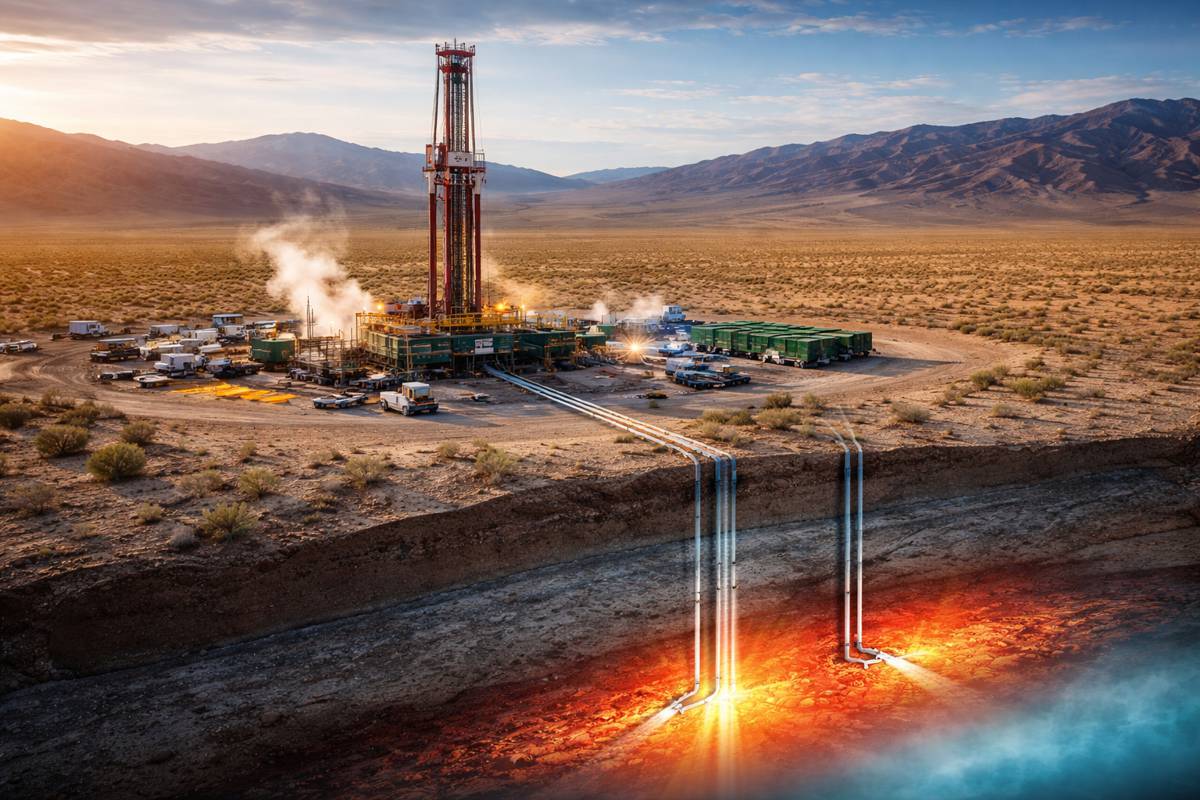
At a newly identified greenfield site known as Project Blanford in Millard County, Utah, Fervo has confirmed subsurface temperatures exceeding 291°C (555°F) at a depth of roughly 11,200 feet. Those figures comfortably surpass the thresholds typically required for commercial geothermal power generation. More importantly, the results point to a multi-gigawatt-scale resource potential, according to independent analysis completed using the newly acquired appraisal data.
For infrastructure investors, utilities and policymakers seeking reliable, carbon-free power that can be deployed at industrial scale, the implications go well beyond a single well or project. Blanford provides further evidence that enhanced geothermal systems can be engineered, replicated and scaled using modern drilling techniques, advanced analytics and data-driven exploration strategies borrowed from the oil and gas sector.
Blanford and the Infrastructure Economy
The infrastructure sector increasingly depends on dependable low-carbon electricity to support electrified transport, digital infrastructure, advanced manufacturing and energy-intensive construction processes. While renewables have expanded rapidly, grid stability remains a concern in many regions, particularly as fossil-fuelled baseload generation is retired.
Geothermal offers a rare combination of attributes that align closely with infrastructure needs. It operates continuously, has a small surface footprint and produces power with minimal lifecycle emissions. The challenge has always been finding and developing resources that are hot enough, accessible enough and economically viable outside of traditional volcanic zones.
Project Blanford directly addresses that challenge. The appraisal well not only confirmed ultra-high temperatures but did so in under 11 days, a drilling timeline more commonly associated with high-performance oil and gas operations. That level of execution efficiency signals growing maturity in geothermal drilling practices and suggests a pathway to lower development costs as projects scale.
From a commercial perspective, independent confirmation of multi-gigawatt resource potential changes the conversation. It reframes geothermal not as a niche contributor but as a serious contender within future energy portfolios, capable of supporting regional grids and large infrastructure programmes.
AI-Driven Exploration as a Differentiator
The appraisal results were announced during remarks at the 51st Stanford Geothermal Workshop, where Fervo’s Co-Founder and Chief Technology Officer, Dr Jack Norbeck, outlined how artificial intelligence and advanced subsurface analytics are reshaping geothermal exploration.
Rather than relying on conventional exploration heuristics, Fervo applied proprietary AI-driven models to identify a novel play concept within a hot sedimentary basin. These models integrated geophysical data, drilling performance metrics and thermal gradients to optimise well placement and drilling design before the rig ever arrived on site.
Temperature logs from the appraisal well place Blanford above the 95th percentile for deep geothermal gradients across the western United States. That statistical context matters. It demonstrates that the resource quality is exceptional not just in isolation, but relative to a broad regional dataset, validating the effectiveness of AI-enhanced exploration techniques.
Dr Norbeck captured the strategic significance of this approach: “Fervo’s exploration strategy has always been underpinned by the seamless integration of cutting-edge data acquisition and advanced analytics. This latest ultra-high temperature discovery highlights our team’s ability to detect and develop EGS sweet spots using AI-enhanced geophysical techniques.”
For the wider construction and infrastructure sector, this signals a shift in how subsurface resources can be identified and de-risked. Techniques once confined to hydrocarbons are now being repurposed to accelerate clean energy deployment.
Expanding the Geological Playbook for Enhanced Geothermal
Historically, enhanced geothermal development has focused heavily on hard crystalline rock such as granite, often requiring complex stimulation techniques and presenting higher drilling costs. Fervo’s earlier projects validated EGS development in metamorphic and igneous formations, gradually expanding the geological envelope considered viable.
Blanford takes that expansion a step further. The target reservoir comprises sedimentary formations including sandstones, claystones and carbonates. These rock types are generally easier and faster to drill than granite, with lower bit wear and improved rates of penetration.
That distinction is far from academic. Drilling costs account for a substantial portion of geothermal project expenditure. Sedimentary reservoirs open the door to more cost-effective development, improving project economics and broadening the range of locations where EGS can be deployed.
Globally, sedimentary basins are far more widespread than high-grade crystalline formations. If similar temperature profiles can be identified elsewhere using advanced analytics, the accessible geothermal resource base could expand dramatically, reshaping long-term energy planning in multiple regions.
Continuous Performance Gains Through Deployment-Led Innovation
Blanford did not emerge in isolation. It represents the latest milestone in a multi-year trajectory of incremental, deployment-led improvement across Fervo’s project portfolio. Earlier developments delivered resource temperatures of around 365°F at Project Red and approximately 400°F at Cape Station. Each step provided operational data that informed subsequent designs.
Exceeding 291°C (555°F) at Blanford underscores how iterative learning, combined with longer laterals and larger wellbore diameters, is translating into tangible performance gains. Higher temperatures directly improve thermodynamic efficiency at the power plant level, increasing electricity output per well and improving overall project economics.
For infrastructure stakeholders, these gains matter because they directly affect scalability. Higher-output wells mean fewer surface installations, reduced land use and lower per-megawatt capital costs, all of which align with planning constraints faced by large infrastructure projects.
De-Risking Development Through Early Appraisal
Beyond temperature confirmation, the appraisal programme included a successful diagnostic fracture injection test. This validated the ability to stimulate the target formation and provided critical data on reservoir permeability and stress regimes.
Such tests play a crucial role in de-risking future development wells. They inform stimulation design, well spacing and long-term reservoir management strategies, reducing uncertainty before capital-intensive full-field development begins.
Independent assessment of the appraisal data adds further credibility, particularly for institutional investors and lenders who increasingly demand third-party verification before committing capital. In an energy market shaped by cautious financing and heightened scrutiny, that external validation is a meaningful step towards bankability.
Implications for Policy and Grid Planning
As governments accelerate decarbonisation targets, the need for dispatchable, low-carbon power sources is becoming increasingly urgent. Grid-scale batteries and hydrogen remain important parts of the mix, but both face cost, efficiency and infrastructure hurdles at scale.
Geothermal, by contrast, integrates relatively smoothly into existing grid architectures. Projects like Blanford strengthen the case for geothermal to be included more prominently in national energy strategies, capacity markets and long-term infrastructure planning.
For policymakers, the emergence of AI-enabled exploration and sedimentary EGS development suggests that previous assessments of geothermal potential may be overly conservative. Updating resource maps, permitting frameworks and support mechanisms could unlock faster deployment and greater private investment.
Building Confidence in Geothermal at Scale
Taken together, the Blanford appraisal results reinforce a broader narrative emerging within the geothermal sector. Advanced drilling, data analytics and execution discipline are converging to make geothermal more predictable, more scalable and more commercially attractive.
For construction and infrastructure professionals, this evolution matters because energy availability increasingly shapes project feasibility, cost structures and long-term resilience. Reliable geothermal power supports electrified equipment fleets, digital construction platforms and energy-intensive materials production without adding volatility to the grid.
Blanford is not simply a technical achievement. It is a signal that enhanced geothermal is moving closer to mainstream infrastructure relevance, supported by engineering rigour rather than geological luck.