Large Scale Soy Pavement Trial Transforming Rural Infrastructure in Iowa
Across 24 miles of rural northeast Iowa, a quiet but significant shift in infrastructure technology has taken place. What might have appeared to passing motorists as routine resurfacing work was, in fact, one of the most ambitious demonstrations of bio-based pavement technology yet undertaken in the United States. At its heart was a deceptively simple idea: replace petroleum-derived asphalt modifiers with polymers derived from soybean oil.
The large-scale trial spanned 8.6 miles of County Road C14 south of West Union, alongside additional stretches of B45 and X28 in Clayton County and nearly half a mile of Washington Street in Volga. Collectively, the projects integrated soybean-based binders and rejuvenators into both cold in-place recycled pavement and hot-mix asphalt. The technology, developed by engineers at Iowa State University and commercialised through their spinout SoyLei Innovative Products, represents more than a materials tweak. It signals a potential recalibration of how local road networks are maintained, funded and decarbonised.
Replacing Crude Oil with Crops
The scale of the Iowa demonstration was substantial. Engineers estimate that between 12,000 and 15,000 bushels of soybeans were incorporated into the paving works, offsetting the need for more than 40,000 barrels of crude oil. In an era when infrastructure owners face mounting pressure to reduce embodied carbon, that substitution alone commands attention.
Globally, asphalt production remains heavily dependent on petroleum refining by-products. According to the International Energy Agency, road construction and maintenance contribute significantly to lifecycle emissions in transport infrastructure, not only through vehicle use but through materials extraction, processing and transport. Replacing petroleum-based modifiers with agricultural feedstocks does not eliminate emissions altogether, but it diversifies supply chains and introduces renewable content into a sector long reliant on fossil derivatives.
As Eric Cochran summarised in his project overview: “By replacing petroleum-derived asphalt modifiers with soybean oil polymers, the project effectively turned soybeans into part of the road.” That observation captures both the technical shift and its symbolic weight. It is no longer far-fetched to view agricultural output as an input to transport infrastructure.
How the Soy Pavement Process Works
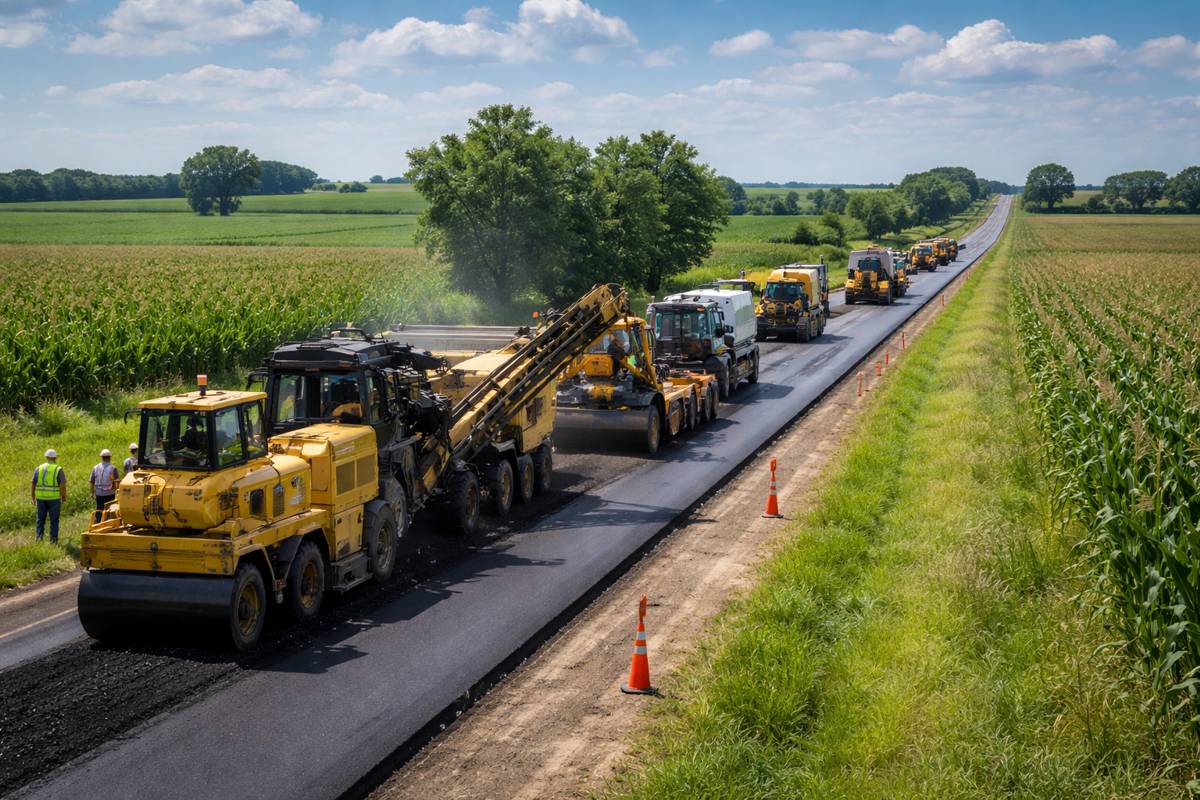
On County Road C14, the paving operation unfolded with military precision. A tanker truck led the convoy, supplying asphalt emulsion infused with soy-based binders. Behind it, a sequence of specialised machines removed the top four inches of ageing asphalt, pulverised it and conveyed the material forward for treatment.
The process, known as cold in-place recycling, allows existing pavement to be milled, mixed with emulsifiers and polymers, and relaid without the need to haul large volumes of new aggregate. In this case, soy oil polymers replaced conventional petroleum modifiers in the mix. The reconstituted material was then laid back onto the stripped roadway, forming a new base layer that was compacted before being capped with hot-mix asphalt containing additional soy-based binder.
Cold in-place recycling has been widely recognised by transportation agencies as a cost-effective and environmentally preferable rehabilitation technique. The US Federal Highway Administration notes that recycling existing pavement can reduce material hauling, lower greenhouse gas emissions and cut construction times. By integrating bio-based polymers into this established method, the Iowa project built on proven engineering rather than gambling on untested theory.
Performance and Durability in Rural Conditions
Rural Iowa presents a testing ground that few laboratory simulations can replicate. Roads endure harsh freeze-thaw cycles, agricultural traffic loads and seasonal snowploughing. For county engineers, performance matters more than novelty.
Joel Fantz, the Fayette County engineer, identified three operational benefits from the project. Soy in the hot-mix asphalt is expected to reduce cold-weather cracking. Soy in the recycled pavement base reduced reliance on additional materials. Meanwhile, a soy-based sprayed rejuvenator should extend pavement life and protect striping.
Fantz offered a candid assessment: “The quality was excellent. Time will tell – but it could turn out to be the best hot-mix asphalt we have ever constructed in Fayette County.” That endorsement is noteworthy not because it promises perfection, but because it reflects measured professional judgement.
In Clayton County, engineer Casey Stickfort observed that the finished roads show no noticeable cracking and provide an even surface for snowplough operations. Darker pavements also dry more quickly, improving winter safety. These practical attributes are precisely what local authorities prioritise.
From Research Bench to Commercial Roadway
The technology did not emerge overnight. Cochran and Christopher Williams have spent approximately 15 years developing and refining soy-based biopolymers designed to enhance asphalt flexibility and longevity. Translating academic research into market-ready product, however, requires more than a good formula.
Fantz, who has served on the Iowa Highway Research Board, understands the gap between laboratory success and field acceptance. For a new material to gain traction, it must offer higher quality, longer service life or lower costs. Equally important, it must integrate seamlessly into existing project specifications and construction workflows.
That transition was supported by a coalition of partners. In response to a fiscal year 2023 federal funding opportunity, the researchers worked with local leaders in Fayette and Clayton counties and Volga. The proposal secured $4 million in Community Project Funding through the office of U.S. Rep. Ashley Hinson, contributing to a total project cost of $7 million. Additional backing came from the Iowa Department of Transportation, the Asphalt Paving Association of Iowa, Mathy Construction Co., and agricultural groups including the Iowa Soybean Association and the United Soybean Board.
Williams reflected on the trust placed in the university team: “They put their trust in Iowa State to deliver. And I think we delivered a great product.” The statement underscores the collaborative risk-sharing that often defines successful infrastructure pilots.
Economic Implications for Agriculture and Infrastructure
Beyond performance metrics, the soy roads initiative intersects with broader economic strategy. The United States is one of the world’s largest soybean producers, with Iowa consistently ranking among the top states for output. Developing higher-value applications for soy derivatives can stabilise farm incomes and reduce exposure to volatile export markets.
From an infrastructure funding perspective, incorporating domestically produced agricultural inputs may also enhance supply chain resilience. The COVID-19 pandemic and subsequent geopolitical tensions exposed vulnerabilities in global materials supply. Diversifying asphalt modifiers away from purely petroleum-based inputs could buffer local agencies against oil price fluctuations.
Moreover, bio-based binders align with growing interest in sustainable procurement. Many public sector clients are embedding environmental criteria into tender evaluations. Materials that demonstrably reduce reliance on fossil resources can strengthen bids, particularly where lifecycle analysis forms part of project scoring.
Low Risk Innovation in Public Works
One of the most striking aspects of the Iowa projects is the perception of low risk among participating counties. Stickfort highlighted two decisive factors: substantial external funding and confidence that the soy-based product posed minimal downside compared with conventional alternatives.
In Volga, the stakes were particularly high. Mayor Elaine Follon described Washington Street as a barrier to economic vitality. “The main street through the town’s business district was putting a huge damper on new business development and creating problems for existing businesses.” Limited tax base meant that replacing the deteriorating road without external support would have been financially daunting.
Follon’s verdict was unequivocal: “I don’t think anyone here gave a second thought to this being a risk due to new research. For us, it’s a miracle.” For small municipalities, the opportunity to access cutting-edge technology with federal backing can feel transformative rather than experimental.
A Model for Scalable Bio Based Infrastructure
The Iowa demonstration does not, on its own, redefine global road construction. What it does offer is a template for incremental decarbonisation rooted in familiar practices. Rather than discarding established paving techniques, the project embedded renewable chemistry within them.
That approach mirrors broader trends in sustainable materials development. Around the world, researchers are exploring lignin-based binders, recycled plastic modifiers and biochar additives. The key to widespread adoption lies in compatibility with existing plant, specifications and contractor skill sets.
If soy-based polymers continue to perform under real-world conditions, other states and countries with significant agricultural capacity may take note. Rural road networks, often constrained by tight budgets yet extensive in mileage, could prove fertile ground for further trials.
In practical terms, the Iowa roads now offer a living laboratory. As freeze-thaw cycles, heavy vehicles and routine maintenance play out over coming years, engineers will gather data that either reinforces or challenges early optimism. Either way, the experiment has moved beyond theory.
What is clear is that the line between farm and highway is no longer as distinct as it once was. In northeast Iowa, soybeans are not merely transported along rural roads. They have become part of the pavement itself, subtly reshaping the conversation about what sustainable infrastructure can look like in practice.