Connected Intersections Move From Reactive Repairs To Predictive Operations
Across developed and emerging economies alike, intersections remain one of the most critical points in any transport network. A motorway closure attracts headlines, yet a single faulty signal controller in an urban corridor can quietly paralyse logistics, disrupt bus timetables, increase crash risk and trigger emissions spikes within minutes. Modern cities now depend on thousands of signalised junctions functioning continuously, not just safely but efficiently.
Traffic signals are no longer isolated roadside devices. They sit at the intersection of transport policy, climate targets and economic productivity. The International Transport Forum has repeatedly linked congestion delays to measurable GDP loss in major urban regions, while safety authorities attribute a substantial share of urban collisions to signal timing or malfunction issues. In short, maintaining signal infrastructure is not a maintenance task alone, it is operational infrastructure management.
Historically, however, agencies have managed signals reactively. A fault occurs, a complaint arrives, a technician drives across town and diagnosis begins at the cabinet door. That workflow wastes labour hours, vehicle mileage and often prolongs downtime. The digital transformation of infrastructure is steadily dismantling that approach.
The Industry Shift Toward Remote Infrastructure Intelligence
Transport operators worldwide are adopting remote diagnostics across roads, rail and utilities. From bridge structural health monitoring to connected street lighting, infrastructure managers increasingly expect systems to report their own condition rather than wait for inspection cycles. Signal networks have lagged slightly behind due to fragmented hardware ecosystems and legacy installations, but the demand is unmistakable.
Urban traffic systems now form part of wider smart mobility strategies. Connected vehicle pilots, adaptive traffic control and transit priority all depend on reliable signals. A failure is no longer a localised inconvenience. It undermines corridor-level optimisation. That reality has pushed agencies toward platforms capable of aggregating operational data across large networks.
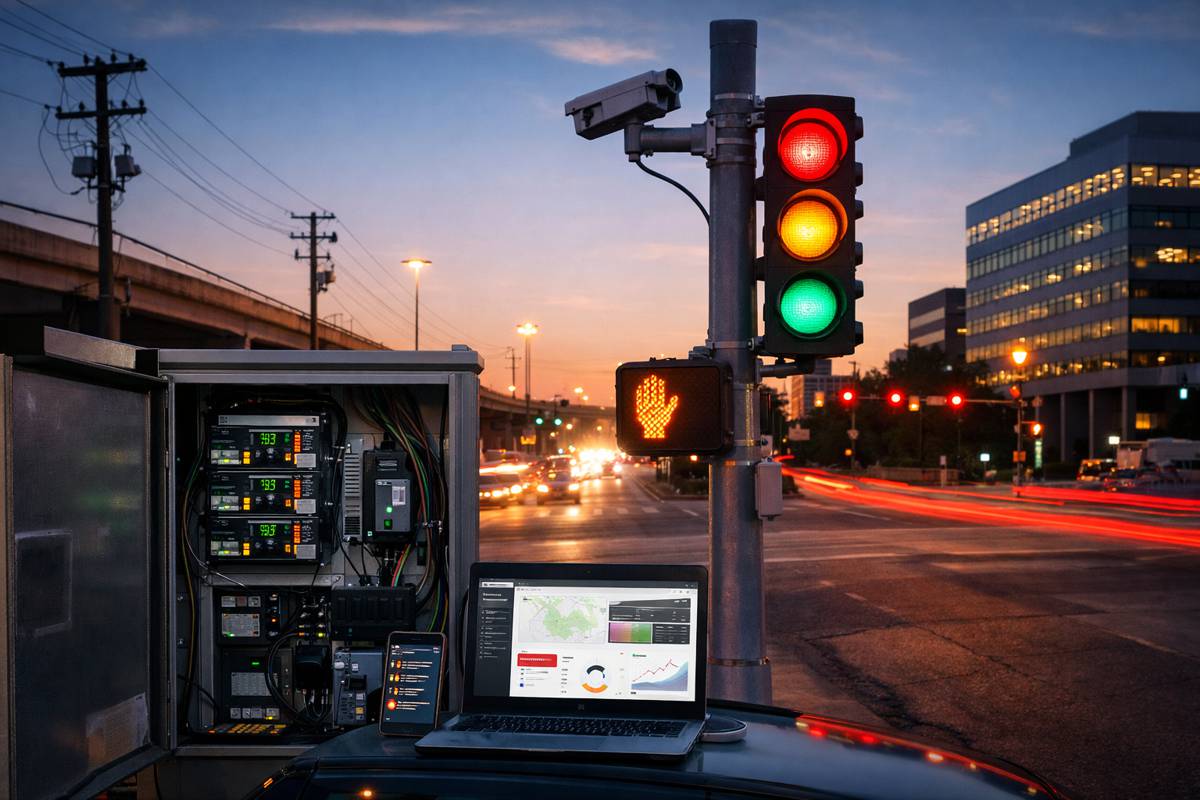
The latest step in that transition comes with the introduction of SYO™, a connected monitoring ecosystem from Synapse ITS designed specifically to unify signal device data and diagnostics within a single operational environment.
Turning Signal Alerts Into Operational Decisions
Rather than simply notifying technicians that a device has failed, the platform aims to explain why and how urgently intervention is required. That difference may appear subtle, yet operationally it is significant. Maintenance crews typically spend considerable time travelling to confirm issues before performing actual repairs.
Geoff Wilcox, CEO of Synapse ITS, said: “With SYO, we are taking the next step in Synapse’s evolution by moving beyond individual products and delivering a true, connected ecosystem.”
He added: “This is about driving meaningful innovation that gives our customers clearer insight into their operations, faster response to issues, and greater confidence in how they manage critical infrastructure every day.”
By consolidating diagnostics, alerts and device history into one interface accessible via smartphone, tablet or desktop, technicians can evaluate conditions before dispatch. The concept mirrors predictive maintenance trends seen in industrial equipment and rail signalling, where remote analysis reduces unnecessary site visits.
Integrating Eberle Design Signal Monitors Into A Scalable Network
The system connects compatible Eberle Design signal monitors into a shared environment capable of supporting networks ranging from small municipal deployments to thousands of intersections. In practical terms, this transforms standalone cabinets into nodes within a wider operational dataset.
Instead of treating each intersection as an independent asset, agencies gain a network perspective. Patterns become visible. Recurring faults at specific locations can be analysed against environmental factors, configuration settings or component lifecycles. Over time, maintenance shifts from incident response toward condition-based servicing.
Josh LittleSun, Chief Technology Officer at Synapse ITS, explained: “We are focused on embedding deeper intelligence into every layer of our technology.”
He continued: “SYO points to a future where data leads to more practical insights, putting our expertise directly in the hands of technicians and supervisors and raising the standard for how traffic infrastructure is maintained.”
Operational Efficiency And Reduced Field Visits
One of the clearest benefits lies in reducing unnecessary truck rolls. Transport agencies often dispatch technicians simply to determine whether a reported issue is genuine, intermittent or already resolved. Each journey consumes staff time, fuel and vehicle wear, all while diverting crews from higher priority work.
The platform provides text and email alerts along with access to detailed device logs and status information remotely. That capability allows teams to verify faults, prepare correct replacement parts and prioritise urgent safety issues over minor anomalies.
For large metropolitan authorities, these efficiencies scale rapidly. A reduction of even a small percentage in site visits can translate into substantial operational savings across hundreds of intersections. Equally important, response times improve because crews travel only when intervention is necessary and arrive prepared.
Improving Uptime And Roadway Safety
Signal downtime has direct safety implications. When a signal enters flash mode or loses coordination, drivers must rely on judgement rather than predictable control. Crash risk increases, particularly for pedestrians and cyclists at complex junctions.
By providing earlier awareness and clearer diagnosis, agencies can restore normal operation more quickly. Faster restoration contributes not only to safety but also to smoother traffic flow. Congestion triggered by malfunctioning signals often persists long after repairs due to residual queue build-up, so quicker intervention produces disproportionate benefits.
Connected monitoring also helps supervisors understand recurring reliability issues. If certain components repeatedly fail under temperature extremes or voltage irregularities, maintenance strategies can be adjusted. That feeds into asset lifecycle planning rather than simply reacting to faults.
Positioning Within The Wider ITS Ecosystem
Synapse ITS brings together multiple transportation technology brands including Polara, Carmanah, Eberle Design, Diablo Controls and Availed. The combined portfolio spans pedestrian accessibility devices, solar traffic equipment, signal monitoring and parking guidance systems. Integrating operational data across such components reflects a broader industry trajectory toward platform-based infrastructure management.
Globally, transport authorities increasingly seek interoperability rather than siloed systems. The European Commission’s Cooperative ITS strategy and similar programmes in North America and Asia all emphasise shared data environments. A monitoring ecosystem capable of consolidating device intelligence aligns with those policy directions.
From intersections to highways and crosswalks to parking facilities, agencies aim to understand infrastructure behaviour as a unified network. In that context, connected signal monitoring becomes not merely a maintenance tool but part of traffic operations strategy.
From Smart Cities To Practical Maintenance
The term smart city often evokes futuristic imagery, yet most operational improvements emerge from incremental efficiency gains. Reducing unnecessary site visits, shortening repair times and improving asset awareness may lack glamour, but they deliver measurable value immediately.
Transport departments operate under constrained budgets while facing growing mobility demand. Solutions that improve workforce productivity without major infrastructure replacement are particularly attractive. By leveraging existing signal monitors and layering intelligence on top, agencies can modernise operations without rebuilding intersections.
The shift also changes workforce dynamics. Technicians transition from purely mechanical troubleshooting toward data-assisted diagnostics. Supervisors gain oversight across the network rather than relying solely on field reports. Decision making becomes evidence based rather than anecdotal.
Infrastructure Maintenance Enters The Data Era
Road infrastructure is gradually adopting operational practices long standard in aviation and energy networks. Continuous monitoring, remote diagnostics and predictive maintenance reduce disruption and improve reliability. Traffic signals, once simple electromechanical devices, now join that transformation.
As cities prepare for connected vehicles and automated mobility, signal reliability will become even more critical. Vehicles relying on signal phase and timing data require confidence that the underlying hardware functions correctly. Monitoring platforms that enhance uptime therefore contribute to readiness for future mobility systems.
SYO is now available, marking another step in the gradual integration of roadside hardware into digital operational ecosystems. While the technology itself targets maintenance workflows, its implications extend across safety, efficiency and transport planning. The evolution of infrastructure increasingly depends not on building more assets, but on understanding the ones already installed.