Smart Steel Revives Ageing Bridges With Heat Activated Reinforcement
Across Europe, North America and parts of Asia, infrastructure owners are confronting a difficult reality. Much of the bridge network built during the mid twentieth century is now reaching the end of its original design life. In the United States alone, Federal Highway Administration data shows tens of thousands of bridges classified as structurally deficient, while several European countries face similar ageing portfolios built during post war expansion programmes.
The economic consequences are substantial. Replacing bridges outright is expensive, disruptive and politically sensitive. Urban crossings often carry utilities, rail connections and heavy commuter traffic, making demolition and reconstruction a last resort. As a result, the industry has shifted toward life extension rather than replacement, placing rehabilitation technologies at the centre of transport policy.
Traditional strengthening approaches typically rely on external post tensioning, steel plating or fibre reinforced polymer laminates. While effective, these systems often require complex anchoring hardware, significant installation time and ongoing maintenance. Engineers have therefore been searching for methods that not only strengthen bridges but actively restore their structural behaviour.
That search has led to a new generation of smart materials capable of altering the internal stress state of existing concrete structures. Recent research in Switzerland demonstrates that bridges may soon be repaired not only by adding material, but by activating it.
Ultra High Performance Concrete Meets Shape Memory Steel
Researchers at the Swiss Federal Laboratories for Materials Science and Technology have combined ultra high performance fibre reinforced concrete with iron based shape memory alloy reinforcement bars to create a strengthening layer that actively prestresses existing bridge decks.
Ultra high performance fibre reinforced concrete, commonly abbreviated as UHPFRC, is already known within the sector for its exceptional density, low permeability and high compressive strength. When applied as a thin overlay on bridge deck slabs, it provides waterproofing and significantly increases load capacity. Many European rehabilitation projects already use it to protect ageing reinforced concrete from water ingress and corrosion.
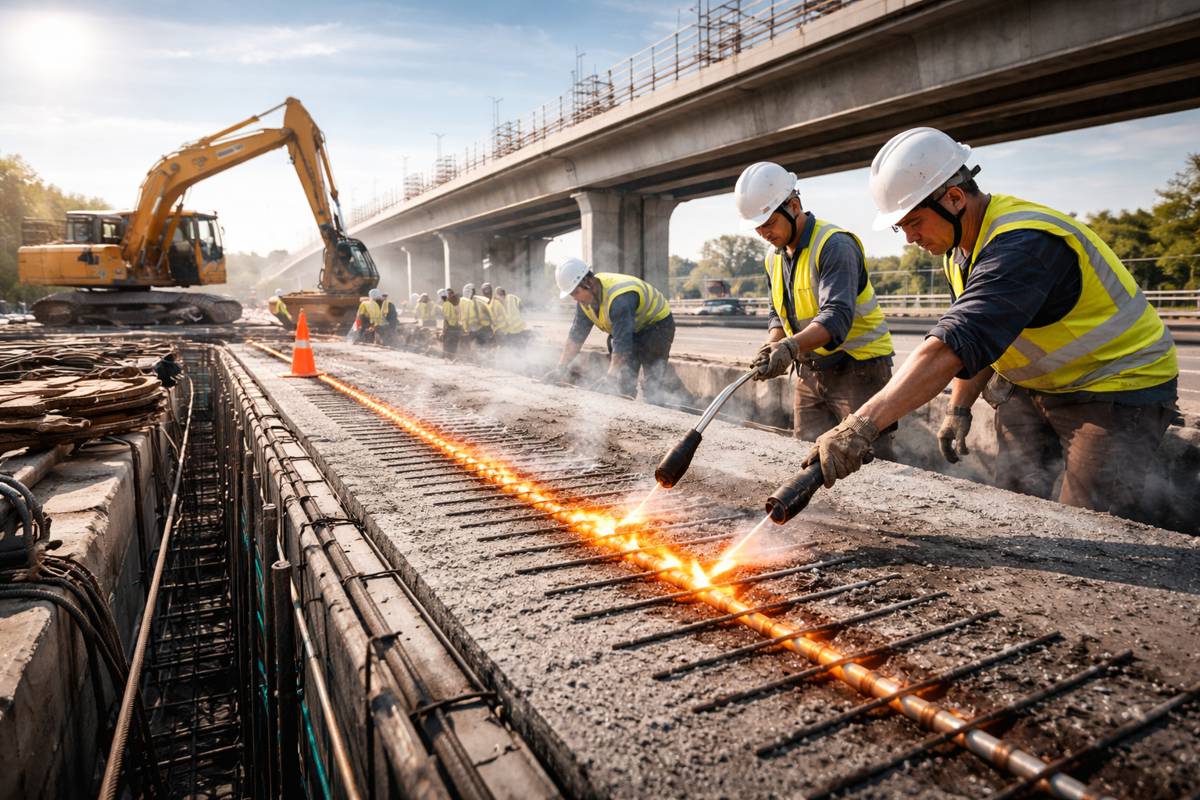
The innovation lies in replacing conventional steel reinforcement inside that overlay with shape memory alloy bars. Unlike ordinary reinforcement, these bars are installed in a pre stretched condition and later heated to roughly 200°C after placement.
Once heated, the alloy attempts to return to its original shape. Because it is anchored within the concrete, it cannot contract freely. Instead, internal compressive forces develop within the structure itself, introducing prestress without hydraulic jacks or tensioning systems.
Angela Sequeira Lemos, leading the investigation, describes the concept clearly: “The beauty of this strengthening system is its simplicity. You anchor the bars, heat them up, and they do the rest themselves.”
In practical terms, the structure becomes tighter, stiffer and less prone to cracking immediately after activation.
How Shape Memory Steel Changes Structural Behaviour
Iron based shape memory alloys rely on a reversible transformation within their atomic crystal structure. The alloy contains elements such as manganese, silicon and chromium. When mechanically stretched, its internal structure shifts into a deformed state. Heating triggers a return to its original configuration.
Because the bars are restrained by surrounding concrete, recovery strain cannot occur. Instead, compressive stress transfers into the surrounding material through the anchorage zones. The effect resembles prestressing but without external tendons.
This internal stress field closes cracks and can slightly lift sagging components. In reinforced concrete bridges, cracking is often the precursor to corrosion, which accelerates deterioration. By closing cracks immediately after installation, the system interrupts the damage cycle before it progresses.
Unlike external strengthening systems, the mechanism is embedded and protected from weather, impact and vandalism. That alone could significantly reduce lifecycle maintenance requirements, a major concern for asset managers responsible for national transport networks.
Large Scale Structural Testing Under Realistic Conditions
To evaluate the technology, researchers conducted full scale experiments using five metre concrete slabs representing cantilevered bridge decks. One slab remained untreated to serve as a reference, while the others received strengthening layers combining UHPFRC with either conventional reinforcement or shape memory alloy bars.
Before strengthening, the slabs were deliberately cracked to simulate actual bridge deterioration. This detail is important because laboratory tests on pristine elements often fail to represent real structures already suffering fatigue and shrinkage cracking.
After installation, the shape memory bars were heated, activating the recovery process. Observers recorded immediate closure of cracks and removal of residual deformation during activation.
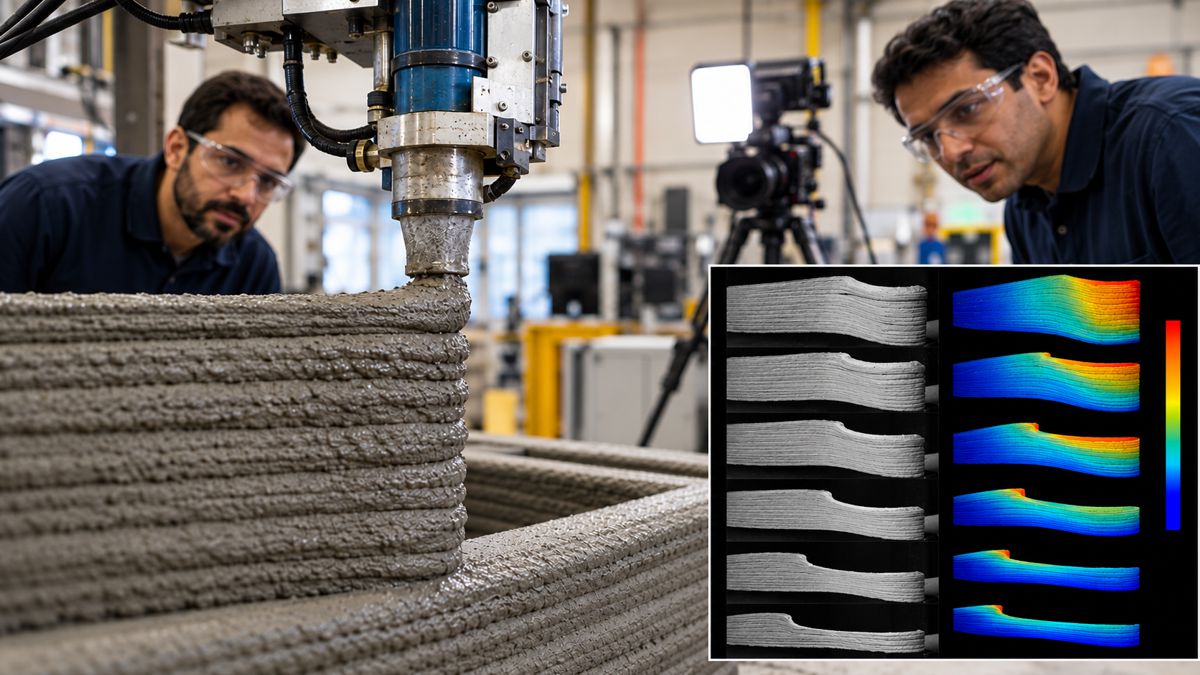
The team monitored structural behaviour using optical crack tracking cameras and fibre optic sensors embedded along the reinforcement. Christoph Czaderski explains the measurement approach: “We use sensors that work similarly to fiber optic cables in telecommunications. However, instead of sending encoded data through the fibers, we analyze the backscattered light. This allows us to see exactly how the bars are deforming.”
Continuous monitoring allowed comparison between traditional strengthening and the new method under simulated traffic loading.
Doubling Load Capacity and Improving Durability
Both strengthening methods significantly improved structural capacity. The load bearing resistance of reinforced slabs increased by at least a factor of two compared with the untreated specimen.
However, the performance difference emerged under service conditions rather than ultimate strength testing. The shape memory reinforced slabs demonstrated greater stiffness, delayed permanent deformation and better crack control during repeated loading cycles.
Angela Sequeira Lemos summarised the outcome: “We were able to show that our system not only works, but can actually revitalize existing bridges.”
For infrastructure owners, that distinction matters. Bridges rarely fail from a single overload event. Instead, deterioration accumulates slowly under daily traffic. A system that controls deformation and cracking therefore addresses the primary mechanism behind long term deterioration.
Where the Technology Makes Commercial Sense
At present, the materials remain relatively expensive. The system is therefore aimed at bridges where conventional reinforcement techniques approach their limits, particularly heavily deformed structures or those requiring waterproofing and structural upgrade simultaneously.
In dense urban areas, replacement costs can exceed rehabilitation costs by an order of magnitude once traffic disruption and utility relocation are included. Under those circumstances, extending service life even by two decades can deliver major economic value.
The approach may also apply beyond transport infrastructure. Flat roofs, balconies and other thin concrete elements that require compact strengthening solutions could benefit from an internal prestressing method without bulky anchorage hardware.
The research project, supported by Innosuisse and developed with the University of Applied Sciences of Eastern Switzerland, the spin off company re fer and the Swiss Cement Industry Association, is now seeking a real bridge demonstration. Field implementation is the crucial step before industry adoption.
A Shift Toward Active Infrastructure Materials
The broader significance lies in the transition from passive to active materials in civil engineering. For decades, structural strengthening has relied on adding capacity. This technology introduces the ability to actively modify internal stress states after construction.
As digital monitoring and fibre optic sensing become more common, structures may soon integrate responsive materials capable of adjusting behaviour over time. Combined with structural health monitoring, activation could be timed to compensate for creep, shrinkage or damage accumulation.
If field trials confirm laboratory results and manufacturing costs decrease with scale, the concept could influence bridge asset management strategies worldwide. Rather than planning replacement cycles around deterioration curves, authorities could intervene periodically with restorative strengthening layers.
The industry has long discussed smart infrastructure in terms of sensors and data. This development suggests the next step may involve materials themselves becoming structural actuators.