Revolution Concrete Mixers Returns to US Manufacturing with Iowa Expansion
Across North America, concrete has quietly become one of the most sensitive indicators of construction health. Infrastructure pipelines are expanding, logistics corridors are being modernised, and energy transition projects are accelerating. Yet projects rarely stall because concrete does not exist. They stall because it does not arrive on time, in specification, or at predictable cost.
Equipment availability plays a surprisingly central role in that equation. Ready mix fleets operate on tight cycles where vehicle uptime directly dictates daily output. When mixer production slows, the effect travels quickly through contractors, suppliers and ultimately project schedules. Industry studies from associations such as the American Concrete Institute and National Ready Mixed Concrete Association consistently point to logistics reliability as a major determinant of project efficiency, particularly in high volume pours where delay windows are measured in minutes rather than hours.
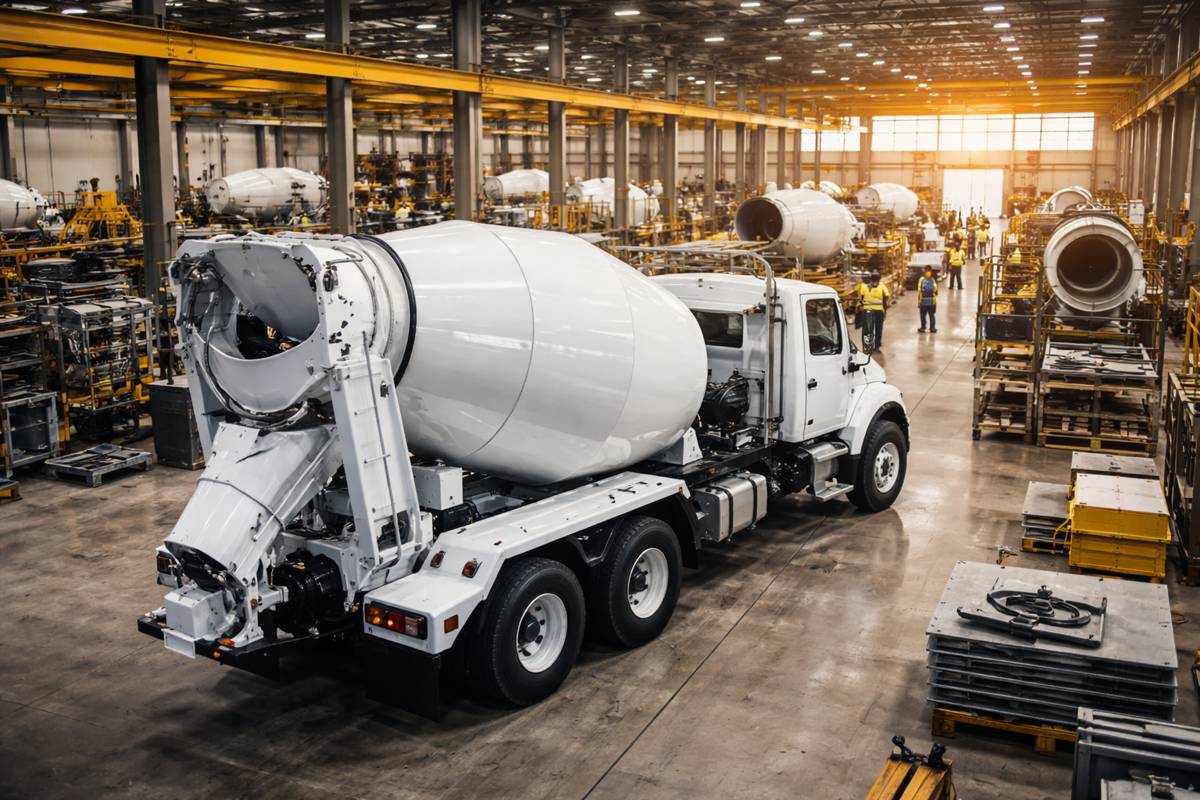
Revolution Concrete Mixers and London Machinery are expanding manufacturing in the United States with a new facility in Waverly, Iowa. The move increases continental production capacity and shortens delivery lead times, both of which have become critical in an era defined by supply chain fragility and regional sourcing strategies.
Why Local Production Matters More Than Ever
The construction sector spent much of the past decade optimising global supply chains. The pandemic, transport disruption and geopolitical trade tensions reshaped that logic almost overnight. Contractors now prioritise regional availability over lowest theoretical cost, particularly for equipment that affects operational continuity.
Concrete mixers fall into that category. They are not optional plant equipment. They are operational infrastructure. If a replacement drum or drive component is unavailable, batching plants cannot maintain production schedules and concrete quality begins to degrade due to extended haul times.
By reopening US manufacturing, the company aims to stabilise delivery timelines for American contractors while maintaining output from its London, Ontario facility. The combined footprint expands North American production and reduces cross border dependency risks, something many fleet operators increasingly factor into procurement decisions.
Bob Monchamp, President of Revolution Concrete Mixers and London Machinery, explained the commitment: “We made our customers a promise two years ago that we would be back manufacturing in the U.S., and we keep our promises. This expansion strengthens our ability to deliver for our customers while reinforcing our long-term commitment to this market. We are proud to start up this facility not only to support our customers’ growth, but also to make a positive impact in the Waverly community.”
The Waverly Facility and Its Industrial Role
The Iowa site represents the company’s fourth US location and marks its return to domestic mixer manufacturing. Rather than constructing a new building, the project involves transforming an existing industrial facility into a purpose built production environment. Engineers are reconfiguring the plant specifically for mixer assembly, drum production and component manufacturing.
This approach reflects a broader manufacturing trend across North America. Repurposing industrial buildings reduces lead times and capital expenditure while supporting regional economic regeneration. The strategy is increasingly common in equipment manufacturing where floor space, logistics access and workforce availability matter more than architectural modernity.
The Waverly operation will produce complete mixers, replacement drums and parts for distribution across the United States. The decision to include component production alongside finished units is particularly significant. Spare parts availability frequently determines fleet uptime more than vehicle age, and ready mix operators depend heavily on rapid replacement capability.
Bryan Datema, Executive Vice President of Engineering, Innovation and Product Performance, highlighted the operational logic: “This new facility isn’t just a strategic move; it’s a reflection of our belief in this market and in the future we’re building across North America. Our customers are growing, and we are growing with them. When we expand capacity, we strengthen supply chains, improve reliability, and create the foundation for continued innovation.”
Rear Discharge Mixers and Fleet Productivity
Rear discharge mixers occupy a specific niche in North American concrete operations. Unlike front discharge configurations common in some regions, they emphasise mechanical simplicity and lower acquisition cost, which appeals to fleet operators managing large volumes of standardised deliveries.
Operational uptime depends on consistent drum geometry, drive components and hydraulic systems. Replacement drums form a major aftermarket segment because fleets often extend chassis life beyond the lifespan of mixing equipment. That makes domestic production strategically valuable. Shipping large steel drums internationally is costly and time consuming, often exceeding the downtime tolerance of busy plants.
By manufacturing both mixers and parts domestically, the company positions itself within a broader trend toward lifecycle support rather than one time equipment supply. Contractors increasingly evaluate suppliers on service continuity rather than purchase price alone.
Workforce and Regional Industrial Policy
The expansion also aligns with wider industrial policy across the United States and Canada, where advanced manufacturing and domestic production are being actively encouraged. Skilled labour availability has become a deciding factor in facility location, particularly in specialised fabrication industries.
Local authorities in Waverly emphasised the workforce aspect. Connie Tolan, Planning and Development Specialist for the city, stated: “We’re grateful that Revolution Concrete Mixers chose Waverly for this significant investment. Projects like this are made possible by the strength of our workforce, our quality of life, and the area’s long-standing manufacturing heritage.”
James W. Bronner, City Administrator, added: “Revolution Concrete Mixers’ investment is significant for our community and builds on the strong manufacturing environment Waverly has historically provided. The project will create quality jobs and provide lasting benefits for our residents. We appreciate the company’s confidence in Waverly and look forward to supporting their long-term success.”
State level agencies also highlighted manufacturing competitiveness. Debi Durham, Director of the Iowa Economic Development Authority and Iowa Finance Authority, noted: “Revolution Concrete Mixers’ decision to expand in Waverly underscores Iowa’s leadership in advanced manufacturing and our state’s ability to support companies that are shaping the future of industry. Iowa’s highly skilled workforce continues to be a competitive advantage for companies seeking to innovate and deploy cutting-edge technologies. We’re proud to partner with the company as they bring new investment, advanced manufacturing capabilities, and high-quality job opportunities to the region. Their commitment to Iowa will help drive sustained economic growth and reinforce our reputation as a place where forward-thinking manufacturers can thrive.”
A Two Country Manufacturing Strategy
The company now manufactures in both the United States and Canada, an uncommon position among rear discharge mixer builders. Maintaining dual country production offers operational resilience. Weather events, trade disruptions or transport bottlenecks in one region no longer halt continental supply.
From an infrastructure perspective, that redundancy matters. Ready mix concrete is the backbone material of highways, bridges, water treatment plants and energy facilities. Equipment delays ripple through public works budgets and contractor availability. Governments increasingly value suppliers capable of maintaining production continuity across borders.
The approach also mirrors broader reshoring patterns seen across heavy equipment sectors. Manufacturers are not abandoning global supply chains, but they are building regional production buffers to stabilise delivery timelines and protect project schedules.
Long Term Implications for Infrastructure Delivery
The significance of this expansion lies less in the opening of a factory and more in what it represents. Construction productivity has struggled globally for decades, with many studies including McKinsey Global Institute research identifying equipment logistics and supply uncertainty as persistent inefficiencies.
Concrete equipment availability rarely attracts headlines, yet it underpins almost every civil project. A delayed paver or excavator can be substituted. Delayed concrete delivery cannot. Once a pour is scheduled, everything else revolves around it.
By increasing North American mixer manufacturing capacity and parts availability, the company reduces a small but critical bottleneck in project delivery reliability. Contractors gain predictable fleet support, producers maintain output consistency and infrastructure programmes face fewer cascading delays.
The expansion therefore reflects a quiet shift in construction economics. Reliability is replacing theoretical efficiency as the dominant procurement factor. Manufacturers that can guarantee availability rather than simply competitive pricing are becoming strategic partners in project execution.