Certifiable Hybrid Electric Propulsion Moves Closer To Commercial VTOL Flight
In advanced aviation circles, the conversation has quietly shifted. It is no longer primarily about aerodynamics, autonomy or even airframe design. Instead, propulsion integration has emerged as the decisive hurdle separating promising prototypes from certifiable aircraft. That is precisely where the engineering collaboration between Odys Aviation and Motion Applied sits within the broader aerospace landscape.
Hybrid electric vertical take-off and landing aircraft promise range far beyond battery-only eVTOL designs while maintaining dramatically lower emissions than conventional turbine aircraft. For logistics operators, defence planners and regional transport developers, that balance is critical. Pure electric aircraft struggle with range and payload, while conventional turboprops face mounting pressure from sustainability regulation and urban noise restrictions. Hybrid systems therefore occupy a commercially realistic middle ground.
Yet historically, hybrid aviation programmes have stumbled at system integration rather than component performance. Turbines, generators, inverters and controllers often come from different development philosophies. When stitched together late in the design cycle, small incompatibilities cascade into certification delays. The Odys and Motion Applied collaboration directly addresses that systemic problem by building propulsion as a unified architecture rather than a collection of subsystems.
A propulsion architecture designed for certification from day one
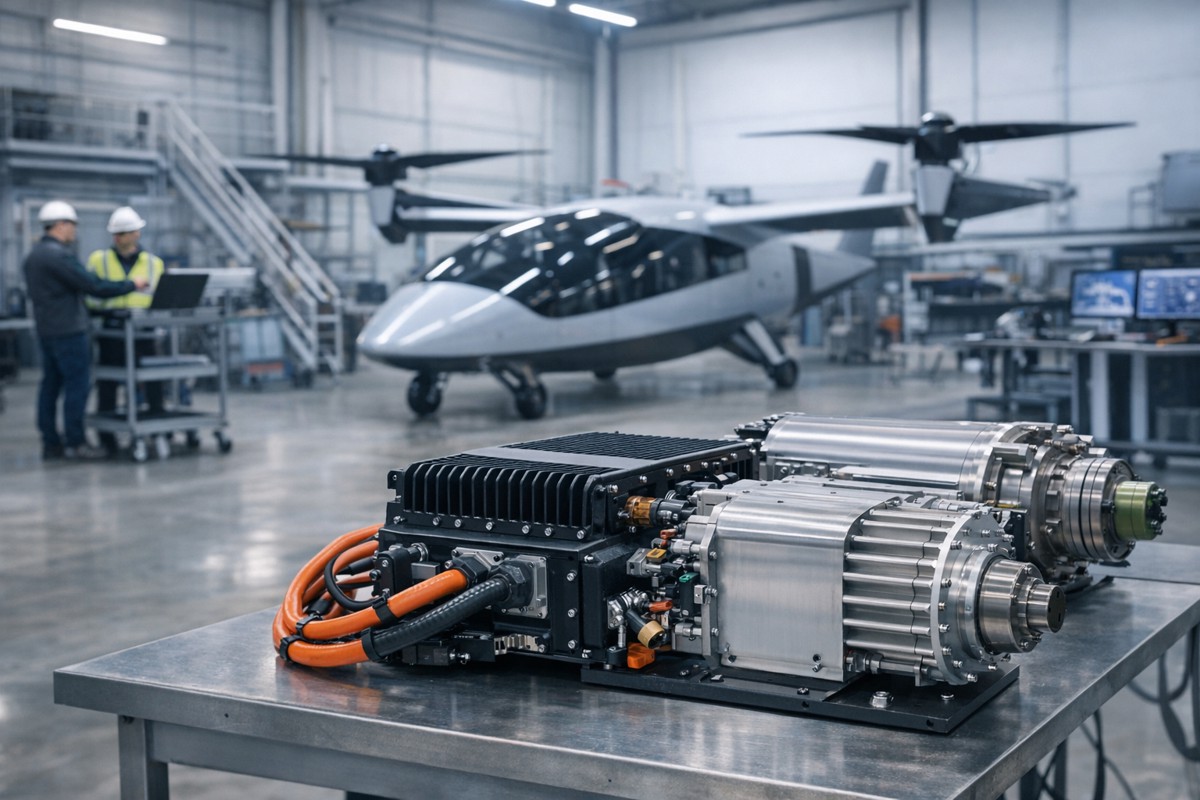
The partnership centres on integrating Motion Applied’s silicon carbide inverter platform, the AMPEX MCU-600, with Odys Aviation’s high speed generator units. On paper that sounds incremental. In certification practice, it is not. Aviation authorities do not certify components in isolation. They certify behaviour under failure conditions, redundancy logic and operational predictability across thousands of edge cases.
The companies have therefore focused on closed loop coordination between turbine, generator and inverter rather than peak efficiency metrics alone. Their architecture enables multi winding fault isolation, graceful degradation and continued operation under single path failures. In other words, the aircraft does not merely shut down when something goes wrong. It transitions into a safe operating mode.
That capability matters enormously for real world deployment. Urban air mobility corridors, defence missions and remote logistics flights all operate far from convenient landing zones. A propulsion system that maintains controlled operation during faults transforms operational risk calculations. For regulators, it moves hybrid aircraft closer to the reliability expectations historically associated with turbine aviation.
Embedded control software becomes the real differentiator
Modern aircraft increasingly depend on software as much as mechanical engineering. The collaboration’s centrepiece is Motion Applied’s embedded hybrid coordination stack integrated directly into Odys’ hybrid controller. Rather than treating software as a supervisory layer, the design tightly couples electrical and mechanical behaviour.
The result is a turbine-generator-inverter closed loop control system capable of dynamic response to changing flight conditions. During vertical lift, cruise transition and forward flight, power demand fluctuates rapidly. Coordinated control allows the propulsion system to adapt instantly while maintaining stable output.
From a certification perspective, software-level redundancy management is just as important. The architecture supports continued controlled operation even during fault scenarios. That aligns with the aviation principle of fail operational rather than fail safe. Instead of switching off, the aircraft keeps flying safely with reduced capability.
Samir Maha, CEO of Motion Applied, explained the philosophy behind the approach: “Hybrid-electric aviation will only succeed if every element of the propulsion system is developed together with absolute clarity of purpose,
“Our partnership with Odys Aviation reflects that mindset. By combining our inverter platform with their advanced generator technology, we are building the foundation for flight-ready hybrid propulsion that raises the bar for performance and safety across the industry.”
Silicon carbide electronics reshape aircraft efficiency
The use of silicon carbide power electronics deserves particular attention. SiC semiconductors operate at higher temperatures and switching frequencies than traditional silicon components, reducing cooling requirements and improving electrical efficiency. In automotive and industrial sectors, SiC adoption has already accelerated in electric vehicles and renewable energy inverters.
In aviation, the benefits are amplified. Lower heat generation means smaller cooling systems and less weight. Higher switching frequency allows smaller passive components. Together, those changes directly influence aircraft payload capacity and range.
By integrating a production proven inverter platform, the programme also reduces development uncertainty. Aviation certification programmes frequently fail due to untested electronics behaving unpredictably under vibration, altitude and temperature variation. Leveraging an existing hardware foundation limits unknown variables during flight testing.
James Dorris, CEO of Odys Aviation, highlighted this integration-first philosophy: “At Odys, we believe hybrid propulsion must be architected from the ground up as a unified system, not assembled from loosely connected components,
“Motion Applied brings a proven SiC inverter platform and embedded control stack that integrates seamlessly with our hybrid controller. Together, we are accelerating the path to a certifiable, resilient propulsion system as we move toward first aircraft deliveries.”
Packaging and thermal management quietly determine aircraft viability
Aircraft propulsion discussions often focus on power density, yet packaging and thermal predictability frequently determine programme success. The AMPEX platform provides defined mechanical packaging and clear cooling boundaries. That sounds mundane but prevents cascading redesigns during system validation.
In many aerospace programmes, late discovery of thermal hotspots forces structural redesign, affecting centre of gravity and flight characteristics. Predictable thermal performance allows engineers to validate aircraft level behaviour earlier in the development cycle. It reduces the likelihood of expensive redesign phases just before certification testing.
For operators, reliability during long missions matters more than peak performance. Hybrid aircraft must sustain continuous operation in variable climates ranging from hot deserts to high altitude cold conditions. A predictable cooling architecture significantly improves operational confidence.
Why hybrid VTOL matters beyond urban air mobility
Odys Aviation positions its aircraft as dual use platforms for logistics, defence and passenger transport. That positioning reflects a broader industry shift. While urban air taxis receive the most publicity, the strongest commercial demand may come from regional and industrial operations.
Remote infrastructure projects, offshore installations and humanitarian logistics all require reliable medium range air transport without runway dependence. Hybrid VTOL aircraft combine helicopter flexibility with fixed wing cruise efficiency. Compared to helicopters, they promise lower fuel consumption and reduced maintenance complexity due to fewer mechanical transmissions.
Defence organisations are particularly interested in extended range vertical lift platforms. Hybrid propulsion allows longer missions with lower thermal signature than conventional rotorcraft. Logistics companies meanwhile see potential for regional cargo distribution where building airports is impractical.
Industry context and the path to first deliveries
The global advanced air mobility sector has matured from concept demonstrations into certification races. Several battery electric eVTOL manufacturers target short urban routes, typically under 100 kilometres. Hybrid aircraft target significantly longer distances, making them closer substitutes for regional aviation rather than taxi services.
Odys Aviation was founded in 2021 by engineers from aerospace, automotive and defence backgrounds. That cross sector expertise reflects a broader trend where electrification knowledge increasingly comes from automotive and energy industries rather than traditional aviation suppliers. Partnerships like the one with Motion Applied demonstrate the convergence of those engineering cultures.
By aligning electrical, mechanical and embedded systems early, the companies aim to avoid the late integration pitfalls that delayed many first generation eVTOL programmes. The strategy prioritises certifiability over prototype performance headlines, a shift regulators have repeatedly encouraged across the industry.
Implications for infrastructure and transport networks
Hybrid VTOL aircraft influence more than aviation. They affect transport planning and infrastructure deployment. Long range vertical lift platforms could connect remote construction sites, mining operations and offshore energy installations without permanent runways.
For policymakers, hybrid aircraft offer a practical decarbonisation step without requiring full electrification infrastructure. They can operate using conventional aviation fuel during early adoption phases while gradually integrating sustainable aviation fuels or alternative energy sources.
For investors, propulsion reliability directly affects operational economics. Aircraft downtime erodes business models quickly. A propulsion system capable of controlled operation under fault conditions reduces operational risk and insurance costs, making commercial adoption more viable.
A turning point for practical advanced aviation
The collaboration between Odys Aviation and Motion Applied does not introduce a new aircraft category. Instead, it addresses the underlying engineering barrier preventing advanced aircraft from entering routine service. By treating propulsion as a coordinated system rather than modular components, the programme targets certification readiness rather than demonstration capability.
Hybrid aviation will likely expand gradually through logistics and specialised transport before mass passenger adoption. Reliable propulsion integration determines how quickly that transition occurs. If successful, architectures like this could define the template future hybrid aircraft programmes follow.
The shift may appear technical, even subtle. Yet in aviation, reliability engineering has always determined which innovations become everyday transport and which remain prototypes.