Designing Metals That Refuse to Fail
Across construction, transport and energy systems, catastrophic failure rarely comes from a single overload. Bridges don’t collapse because of one truck, aircraft don’t fracture because of one flight, and wind turbine towers don’t crack after one storm. Instead, failure creeps in quietly through repeated stress cycles, a process engineers call fatigue.
Fatigue remains one of the most stubborn engineering challenges because it hides at scales traditional design methods cannot easily predict. Structures are usually sized against static strength, meaning the maximum load they can bear once. Yet most real infrastructure lives in a world of repetition. Every passing vehicle, temperature change, vibration or pressure pulse subtly rearranges atoms inside a material. Eventually microscopic cracks form, then grow, then suddenly become visible damage.
That gap between predictable strength and unpredictable lifetime has enormous economic consequences. According to multiple industry lifecycle studies from aerospace, rail and offshore energy sectors, fatigue accounts for a substantial proportion of maintenance cost, inspection regimes and premature component replacement. Engineers have long known how to build strong materials. Building durable materials over decades of cyclic loading has proved far more elusive.
Researchers at the Grainger College of Engineering at the University of Illinois Urbana Champaign now suggest the problem may have been approached from the wrong direction. Instead of trying to stop deformation entirely, they focused on controlling how deformation spreads inside the metal.
The Atomic Behaviour That Triggers Cracks
When metals are repeatedly loaded, their internal structure does not simply spring back into place. Each cycle causes irreversible rearrangement of atoms known as plastic deformation. Over time this deformation accumulates in highly concentrated microscopic regions. These regions become preferred locations where fatigue cracks begin.
Project lead Jean Charles Stinville explained the practical significance: “Transportation, space and energy all create environments where there is risk for fatigue, presenting a challenge to both safety and sustainability.”
The paradox is well known to materials engineers. Alloys designed to withstand extremely high static loads often perform worse under repeated loading. Their internal microstructures concentrate strain into narrow bands. Those bands accelerate damage accumulation rather than preventing it.
Traditional alloy design therefore faces a trade off. Increase strength and risk shorter life. Improve durability and sacrifice structural capacity. For infrastructure owners managing bridges, aircraft fleets, pipelines or offshore platforms, that compromise drives inspection schedules, monitoring technology adoption and high maintenance budgets.
The Illinois researchers approached the problem differently. Instead of trying to eliminate deformation, they attempted to distribute it.
Spreading Damage Instead of Concentrating It
The team demonstrated that fatigue resistance can be dramatically improved if plastic deformation remains small and evenly spread throughout the material rather than intensely localised. They describe the phenomenon as dynamic plastic delocalisation.
At first glance the idea sounds intuitive. If stress is shared across the entire structure, no single microscopic region accumulates enough damage to initiate a crack. The challenge lay in proving it experimentally at atomic scales.
Conventional measurement techniques force a compromise between resolution and observation area. Engineers can either observe tiny regions in detail or view large regions without detail. Fatigue mechanisms require both simultaneously.
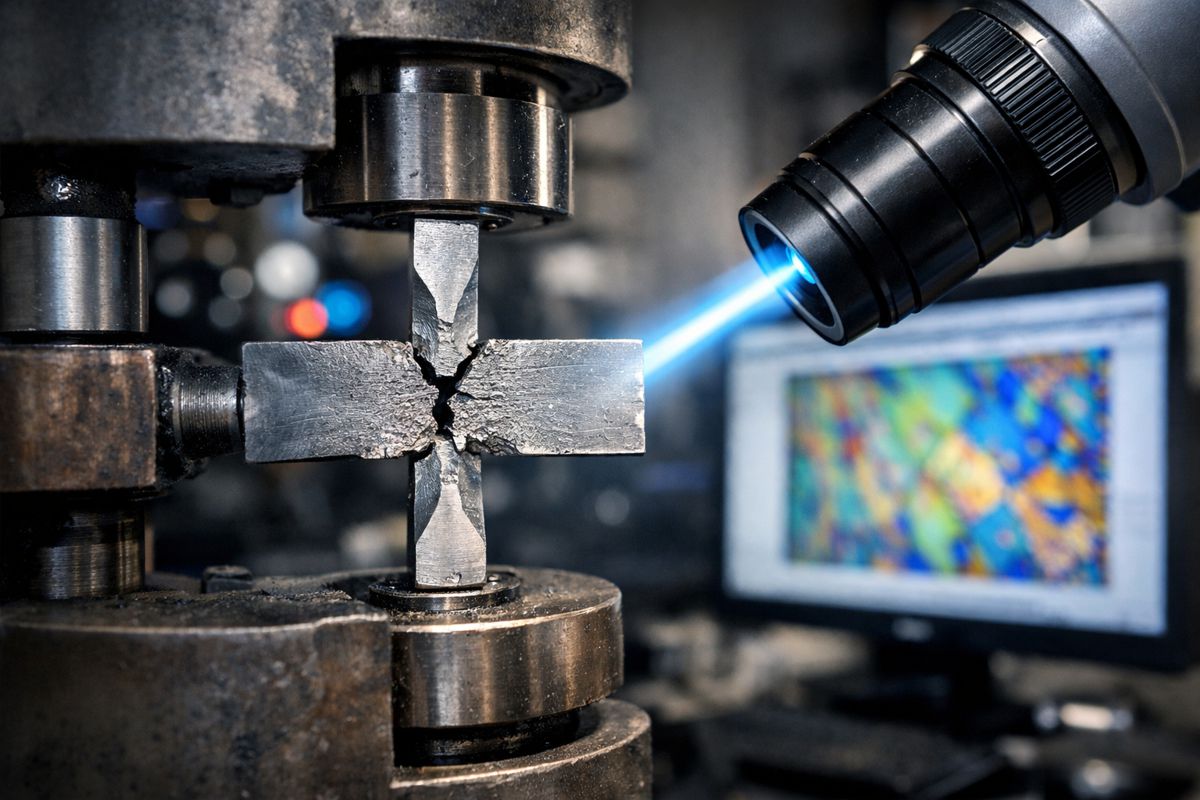
To overcome this limitation, the researchers developed high throughput automated high resolution digital image correlation capable of mapping deformation over wide areas while preserving microscopic detail. This allowed them to directly observe distributed deformation patterns across large material surfaces.
The measurements revealed that certain alloy structures naturally spread deformation across many small zones instead of concentrating it into a few intense bands. Mechanical testing showed these materials exhibited greatly enhanced fatigue resistance.
Linking Chemistry to Lifetime Performance
Observing the behaviour was only half the story. Understanding why it occurred required theoretical modelling.
The team collaborated with researchers led by mechanical science and engineering professor Huseyin Sehitoglu to analyse how chemistry and atomic ordering influence deformation behaviour. Using density functional theory and ab initio molecular dynamics simulations, they identified how specific atomic arrangements encourage uniform plasticity.
In practical terms this means fatigue life can now be engineered deliberately rather than discovered experimentally after manufacturing. Alloy chemistry can be designed to activate distributed deformation during loading.
Stinville described the implication clearly: “Now that the fundamental mechanism has been identified, we can design new alloys chemistry that activates it to produce fatigue resistant alloys.”
For the materials sector, this shifts fatigue resistance from a property to be tested into a property to be designed.
Why Infrastructure Industries Care
The significance extends far beyond laboratory metallurgy. Many modern infrastructure systems operate in environments where fatigue dictates maintenance schedules and operational risk.
Transport infrastructure provides obvious examples. Rail tracks experience millions of wheel passes. Aircraft fuselages undergo pressurisation cycles every flight. Highway bridges flex continuously under traffic and temperature variations. Offshore wind turbines endure constant oscillating loads from wind and waves.
In each case, failure rarely arises from insufficient strength. Instead, repeated microscopic damage gradually reaches a tipping point. Engineers compensate through conservative design margins, inspections and periodic replacement.
Improved fatigue resistant alloys could extend inspection intervals, reduce material weight and improve safety margins simultaneously. That combination matters for sustainability. Fewer replacements mean less material extraction, lower embodied carbon and reduced downtime.
High temperature and radiation environments amplify the importance further. Nuclear reactors, space systems and next generation energy facilities push materials beyond traditional limits. Stinville noted these applications specifically require enhanced fatigue resistance because damage mechanisms accelerate under extreme conditions.
Economic Impact Across Construction and Energy
From a commercial perspective, fatigue life directly influences total cost of ownership. Infrastructure owners rarely pay only for initial construction. They pay for decades of inspection, repair and replacement.
Consider bridge bearings, crane components or rotating plant equipment. Their replacement often requires lane closures, shutdowns or safety exclusions. The cost of disruption frequently exceeds the cost of the component itself.
Materials that distribute deformation rather than localise it could lengthen service intervals dramatically. Even modest improvements scale rapidly across national networks of assets. Rail networks spanning tens of thousands of kilometres, for example, perform continuous grinding and replacement programmes largely driven by fatigue cracking.
Energy infrastructure faces similar pressures. Wind turbine gearboxes and towers suffer cyclic loading that drives maintenance campaigns worldwide. Fatigue resistant alloys may not eliminate monitoring, but they could significantly delay degradation onset.
The research therefore aligns closely with global infrastructure strategies prioritising lifecycle performance rather than lowest initial cost.
A Shift in Materials Engineering Philosophy
Historically, metallurgy has pursued strength through barriers to deformation. Hardening mechanisms, precipitation strengthening and grain refinement all attempt to restrict atomic motion. The Illinois findings suggest durability may require the opposite philosophy.
Allow controlled deformation but ensure it spreads everywhere.
Instead of blocking motion, alloys can guide motion. By engineering chemical composition and atomic ordering, deformation becomes distributed rather than concentrated. The material still carries load, but without accumulating local damage.
This approach mirrors modern structural engineering strategies where redundancy prevents collapse. Just as load paths in a bridge distribute stress across multiple members, atomic scale load paths distribute strain across the material.
It represents a conceptual shift from resisting change to managing it.
From Discovery to Deployment
The work, published in Nature Communications under the title Dynamic Plastic Deformation Delocalization in FCC Solid Solution Metals, establishes the mechanism rather than a commercial alloy. However the path to application is clear.
Next generation alloys can now be engineered with fatigue performance as a primary design target. Aerospace and energy industries typically adopt such materials first due to high lifecycle costs and strict safety requirements. Construction and transport sectors often follow once manufacturing scales and standards develop.
Adoption will depend on manufacturability, weldability and compatibility with existing fabrication methods. Yet because the mechanism relies on chemistry and structure rather than exotic processing, integration into existing alloy families appears feasible.
In practical terms, engineers may soon specify materials not only by strength and corrosion resistance but also by deformation distribution behaviour.
Toward Longer Lasting Infrastructure
Infrastructure durability increasingly shapes sustainability policy. Governments and asset owners now prioritise resilience and lifecycle emissions over initial build cost. Materials that extend service life contribute directly to that objective.
The Illinois research offers a rare advance in a field often characterised by incremental improvement. By identifying a controllable atomic mechanism behind fatigue resistance, it opens the door to deliberately engineered longevity.
For transport networks, energy systems and industrial plant, the implication is simple but profound. Structures may one day last longer not because they are stronger, but because they deform more intelligently.