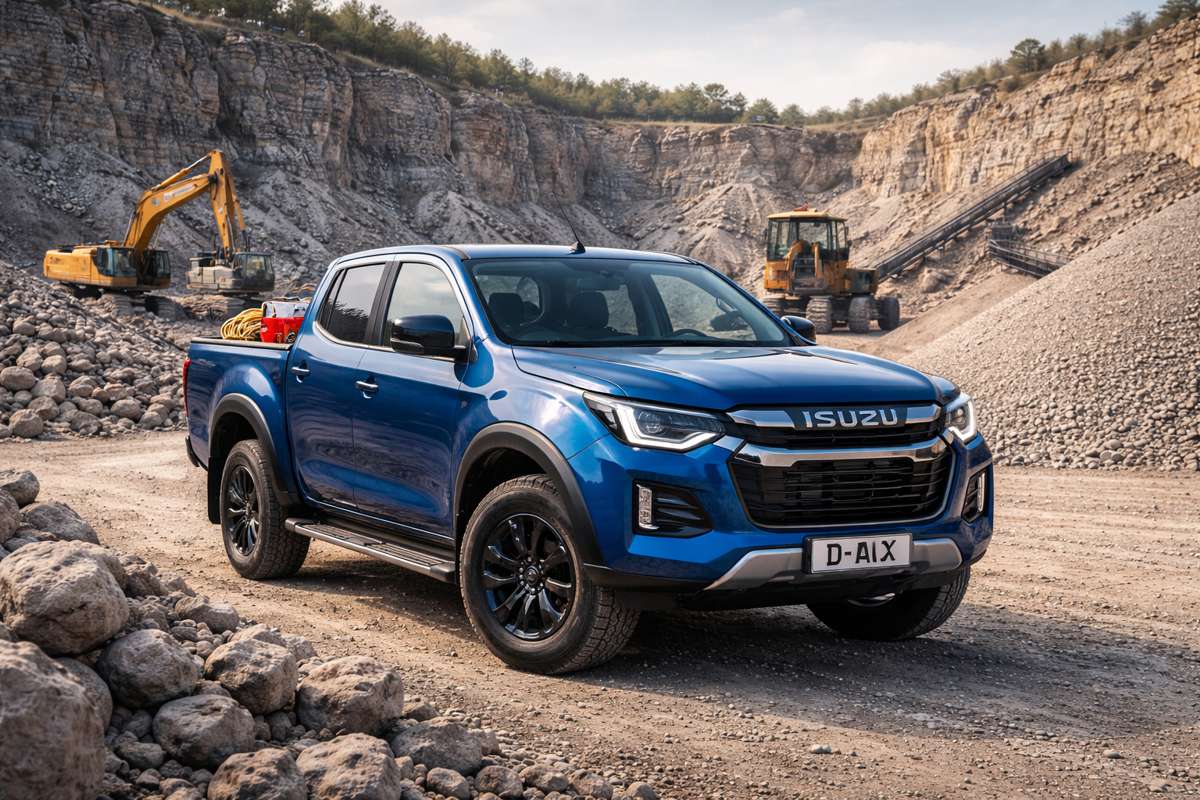
New Isuzu D Max Delivers More Torque For Real World Demands
The latest iteration of the Isuzu D-Max arrives at a time when the European pick-up market is navigating tighter emissions standards, rising operational costs, and a growing expectation for passenger-car comfort in commercial vehicles. Set to debut at the Commercial Vehicle Show in April, with deliveries beginning in July, the updated model reflects a measured response to these pressures rather than a radical redesign.
At its core sits a new 2.2-litre turbo diesel engine, replacing the long-standing 1.9-litre unit. This is not simply an increase in displacement. Instead, it signals a recalibration of performance priorities, with a focus on torque delivery, drivability under load, and compliance with Euro 6 emissions standard requirements. For contractors, fleet managers and rural operators, that balance between compliance and capability is becoming harder to achieve, making incremental engineering improvements more valuable than headline-grabbing reinventions.
The timing of the launch is also telling. With infrastructure investment programmes continuing across the UK and Europe, demand for dependable light commercial vehicles remains resilient. Pick-ups like the D-Max occupy a niche that bridges site mobility, logistics support, and off-road access, particularly in sectors such as utilities, construction, and agriculture. In that sense, the latest update is less about chasing trends and more about maintaining relevance in a working environment that rarely stands still.
Briefing
- New 2.2-litre diesel engine replaces the previous 1.9-litre unit, improving torque and efficiency
- Eight-speed automatic transmission introduced to enhance drivability and load handling
- Payload and towing capacities remain at 1 tonne and 3.5 tonnes respectively
- Expanded model range includes a new Extended Cab variant aimed at practical load flexibility
- Safety and driver assistance systems upgraded, including a standard Driver Monitoring System
A Powertrain Designed Around Real-World Load Demands
The introduction of a 2.2-litre turbo diesel engine represents a calculated move rather than a dramatic departure. While smaller displacement engines have dominated recent years in response to emissions pressures, real-world usage has often exposed their limitations under sustained load. By increasing capacity, Isuzu appears to be addressing that gap without stepping outside regulatory constraints.
The engine delivers up to 400 Nm of torque, a figure that aligns with the expectations of operators regularly towing plant equipment or transporting materials. In practical terms, torque remains the defining metric for commercial pick-ups, particularly in low-speed, high-load scenarios such as site access roads or uneven terrain. The addition of an eight-speed automatic transmission further supports this focus, offering smoother power delivery and reduced strain during stop-start operations.
Across the broader industry, there has been a gradual shift towards refining diesel rather than abandoning it outright in this segment. While electrification continues to advance in urban fleets, the infrastructure, range limitations and payload constraints still present barriers for heavy-duty pick-up applications. As a result, incremental diesel improvements, especially those that enhance efficiency and durability, remain commercially significant.
Retaining Capability While Refining Efficiency
Despite the introduction of a new engine and transmission, the D-Max retains its established capability benchmarks. A one-tonne payload and a 3.5-tonne towing capacity continue to define its operational envelope, ensuring compatibility with industry-standard trailers and equipment.
What has changed is the approach to efficiency. The adoption of low rolling resistance tyres from Dunlop reflects a broader trend across commercial fleets, where marginal gains in fuel consumption can translate into meaningful cost savings over time. At the same time, improvements in wet grip address safety considerations that are increasingly scrutinised in fleet procurement decisions.
This dual focus on efficiency and safety is becoming a baseline expectation rather than a differentiator. Fleet operators are under pressure to reduce emissions and operating costs while maintaining compliance with safety standards and duty-of-care obligations. Vehicles that can deliver incremental improvements across all three areas are more likely to secure long-term contracts.
A Range Strategy Built Around Practical Flexibility
The updated model range reflects a clearer segmentation strategy. Single Cab, Extended Cab and Double Cab configurations remain, but the introduction of a higher-specification Extended Cab variant adds a new layer of flexibility. For operators who prioritise load space over passenger capacity, this configuration offers a practical compromise without sacrificing equipment levels.
The decision to streamline the range also suggests a response to customer purchasing behaviour. Rather than offering a broad and potentially confusing selection of trims, the revised line-up focuses on combinations that align with common use cases. This approach simplifies procurement while allowing manufacturers to optimise production and supply chains.
Interior updates, including revised seat materials and layouts, indicate an ongoing shift towards improving driver comfort. While this may seem secondary in a commercial context, the reality is that many operators spend extended periods behind the wheel. Improved ergonomics and material quality can have a direct impact on productivity and fatigue, particularly in sectors where long-distance travel or remote site access is routine.
Safety and Visibility Move Further Up the Agenda
Safety systems have moved from optional extras to core requirements in modern commercial vehicles, and the latest D-Max reflects that shift. The inclusion of a Driver Monitoring System as standard aligns with wider regulatory and industry trends aimed at reducing driver fatigue and distraction.
Higher trim levels introduce additional visibility tools, including a 360-degree surround view camera. In environments such as construction sites or confined urban areas, improved visibility can significantly reduce the risk of collisions with equipment, structures or personnel. These systems are increasingly being factored into insurance assessments and fleet safety policies.
The integration of such technologies also highlights the convergence between commercial and passenger vehicle standards. Features once associated with premium cars are now filtering into working vehicles, driven by both regulatory pressure and user expectation.
Design Updates Reflect Function Over Form
Externally, the changes are evolutionary rather than transformative. A revised front grille, updated lighting signatures and new alloy wheel designs give the vehicle a more contemporary appearance without altering its fundamental identity. The introduction of a new metallic paint option for higher trims adds a degree of visual differentiation, though it is unlikely to influence purchasing decisions in the commercial segment.
These design adjustments serve a functional purpose as much as an aesthetic one. Improved lighting performance contributes to visibility and safety, while incremental aerodynamic refinements can support fuel efficiency. In a market where vehicles are often judged on durability and reliability rather than styling, such changes are best understood as part of a broader package rather than standalone features.
Industry Context
The European pick-up segment has undergone a period of consolidation, with several manufacturers reducing their presence or exiting entirely. This has created an environment where established models with a reputation for reliability can strengthen their position, provided they continue to evolve in line with regulatory and operational demands.
Within this landscape, the D-Max has built its reputation on durability and straightforward engineering. The latest update does not attempt to reposition the vehicle but instead reinforces those attributes while addressing emerging requirements. For infrastructure projects, utilities and rural industries, consistency often carries more weight than novelty.
“We’re delighted to formally present the much-anticipated 2.2-litre Isuzu D-Max, with an all-new powertrain, design enhancements and additional features. The New Isuzu D-Max continues to deliver on its strong reputation, stepping up a level to combine its highly versatile load-carrying and towing capabilities both on and off road. As well as the increased torque enabled by the 2.2-litre engine, The New Isuzu D-Max retains and builds upon its exceptional reliability in commercial and rural environments.” said Alan Able, Managing Director at Isuzu UK.
Pricing is expected to start from £33,495 CVOTR, with full specifications confirmed at the Birmingham launch event. Pre-orders are already open, indicating a level of confidence in demand ahead of the official unveiling.
A Working Vehicle for a Changing Market
The updated D-Max illustrates a broader trend within the commercial vehicle sector, where incremental improvements are often more valuable than disruptive changes. As emissions regulations tighten and operational demands evolve, manufacturers are focusing on refining existing platforms to meet new expectations.
For construction and infrastructure professionals, the relevance of such updates lies in their cumulative impact. Improved torque delivery, enhanced safety systems, and marginal gains in efficiency may not attract headlines individually, but together they contribute to a vehicle that is better suited to the realities of modern site operations.
In that sense, the latest D-Max does not attempt to redefine the segment. Instead, it reinforces a familiar formula, adjusting it carefully to remain fit for purpose in an industry where reliability, capability and cost control continue to take precedence.