VINCI Leads Major Overhaul of Prague Wastewater Infrastructure
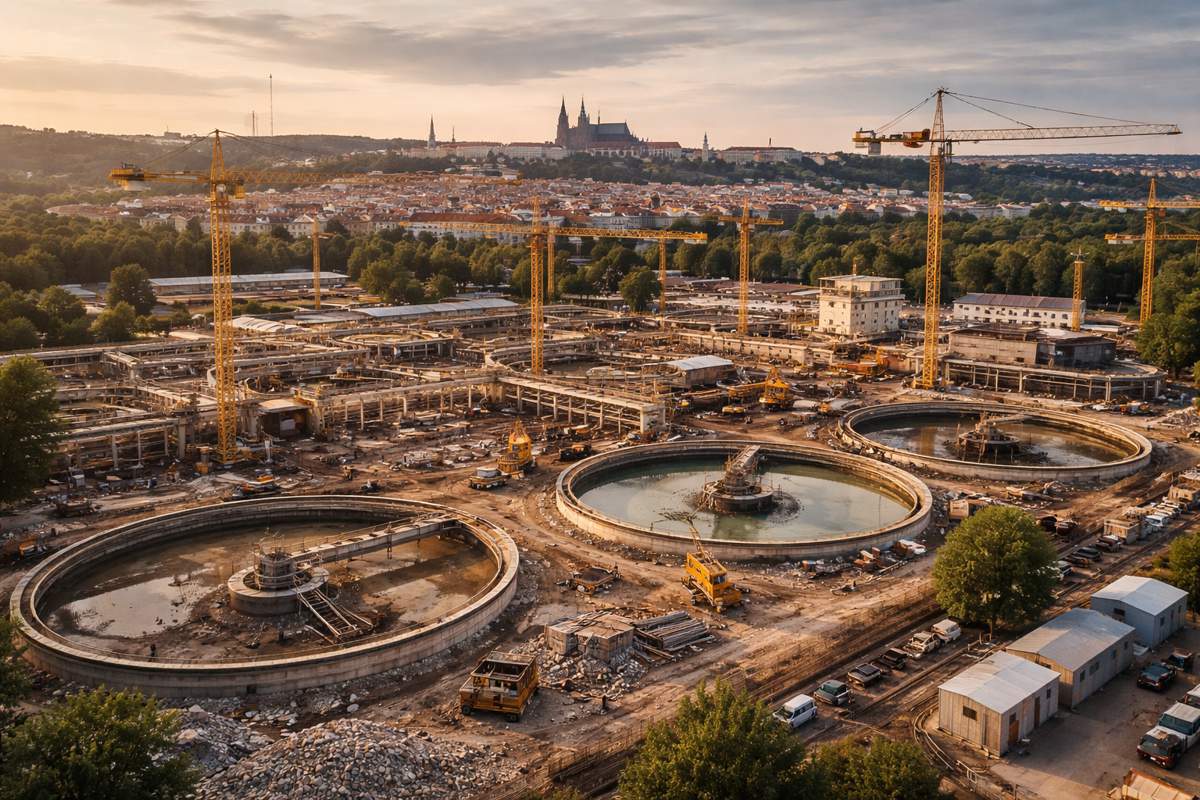
Prague is preparing for one of the most significant upgrades to its core infrastructure in decades, with a €192 million contract awarded to a consortium led by VINCI Construction. The project will modernise the Czech capital’s central wastewater treatment plant, a facility that has served the city for more than half a century and now requires extensive renewal to meet contemporary environmental and operational standards.
This is no routine refurbishment. The works involve dismantling ageing systems, demolishing and reconstructing 40 structures, and introducing new treatment technologies across the site. Scheduled to begin in October 2026 and running for 43 months, the project reflects the increasing urgency facing cities across Europe to upgrade legacy infrastructure that was never designed for modern population pressures, regulatory frameworks, or sustainability expectations.
At its core, the project speaks to a broader shift in infrastructure strategy. Water treatment facilities, once considered static utilities, are now being reimagined as dynamic, energy-conscious systems that must balance environmental compliance, operational efficiency, and long-term resilience. Prague’s investment signals a clear recognition that water infrastructure sits at the centre of urban sustainability.
Briefing
- €192 million contract awarded to a consortium led by VINCI Construction
- 40 structures to be demolished and rebuilt, with major upgrades to treatment systems
- Eight settling tanks to be reconstructed and four refurbished
- Project duration of 43 months starting October 2026
- Focus on improving water quality and reducing energy consumption
Rebuilding a Critical Urban Asset
The central wastewater treatment plant in Prague has been operational for over 50 years, placing it firmly in the category of ageing infrastructure now under scrutiny across Europe. Facilities of this era were built to standards that, while robust for their time, fall short of today’s environmental regulations and technological capabilities.
Urban growth has compounded the issue. Prague’s population has expanded steadily, alongside increased industrial activity and tourism. This has led to higher volumes of wastewater, placing additional strain on systems originally designed for far lower throughput. The result is a growing mismatch between demand and capability.
The planned works go well beyond superficial upgrades. By demolishing and rebuilding 40 structures, the project effectively resets the facility’s operational baseline. This approach allows engineers to integrate modern treatment technologies from the ground up, rather than attempting to retrofit outdated systems that can limit efficiency gains.
Such large-scale reconstruction projects are becoming more common across Europe, particularly in cities where post-war infrastructure is reaching the end of its lifecycle. The European Commission has repeatedly highlighted water infrastructure as a priority sector, with directives such as the Urban Waste Water Treatment Directive pushing municipalities towards higher standards of treatment and environmental protection.
Modern Treatment Technologies Take Centre Stage
A key component of the upgrade lies in the introduction of advanced water treatment technologies. While the specific systems have not been detailed, industry trends suggest a move towards more efficient biological treatment processes, improved filtration methods, and enhanced nutrient removal capabilities.
Modern wastewater treatment plants increasingly incorporate technologies such as membrane bioreactors, advanced oxidation processes, and digital monitoring systems. These innovations allow operators to achieve higher levels of purification while using less energy and fewer chemicals.
Energy optimisation is a central theme. Wastewater treatment is inherently energy-intensive, often accounting for a significant portion of a municipality’s electricity consumption. By integrating newer technologies, the Prague facility aims to reduce its energy footprint while maintaining or improving treatment performance.
This aligns with broader European decarbonisation goals. The water sector has been identified as a key area for emissions reduction, with many utilities exploring energy recovery solutions such as biogas production from sludge. While not explicitly stated, projects of this scale often include provisions for energy generation or recovery, contributing to a more circular approach to resource management.
Structural Transformation of Core Systems
Among the most notable elements of the project is the overhaul of the plant’s settling tanks. Eight of the 20 tanks will be completely rebuilt, while four will undergo refurbishment. These structures play a crucial role in separating solids from treated water, making them fundamental to the plant’s overall performance.
Rebuilding settling tanks is a complex undertaking. It requires careful sequencing to ensure that the facility can continue operating throughout the construction period. In many cases, temporary systems or phased construction approaches are used to maintain treatment capacity while sections of the plant are taken offline.
The decision to rebuild rather than repair a significant portion of these tanks reflects their critical importance. New designs can improve hydraulic efficiency, reduce maintenance requirements, and enhance overall reliability. This, in turn, contributes to more consistent treatment outcomes and lower operational costs over time.
Beyond the tanks, the reconstruction of 40 structures suggests a comprehensive reconfiguration of the site. This may include process buildings, pumping stations, and ancillary infrastructure, all of which must be integrated into a cohesive system capable of meeting future demands.
Managing Environmental Impact During Construction
Large infrastructure projects inevitably carry environmental risks, particularly when they involve demolition and reconstruction on an operational site. The Prague project incorporates measures aimed at minimising its environmental footprint during construction.
Material reuse is a central element of this strategy. By recycling materials on site, the project reduces the need for new raw materials and limits the volume of waste sent to landfill. This approach is increasingly common in major infrastructure projects, reflecting both environmental considerations and cost efficiencies.
Water management during construction is another critical factor. The use of rainwater and recycled water helps to reduce demand on local water supplies and ensures that construction activities do not place additional strain on the very resource the facility is designed to manage.
Such measures are not merely optional enhancements. Environmental performance is now a key criterion in public infrastructure projects across Europe, driven by regulatory requirements and public expectations. Contractors are expected to demonstrate not only technical competence but also a commitment to sustainable practices.
VINCI’s Expanding Role in Central Europe
The project further consolidates the position of VINCI Group as a major player in Central Europe. Through its various subsidiaries, the group has established a strong presence in the Czech Republic, generating over €1.2 billion in revenue in 2025.
In addition to construction activities, VINCI operates in the country through VINCI Energies and VINCI Concessions. The latter holds the public-private partnership contract for the D4 motorway, known as Via Salis, highlighting the group’s involvement across multiple infrastructure sectors.
This integrated presence allows VINCI to leverage expertise across construction, energy systems, and infrastructure management. In projects such as the Prague wastewater upgrade, this can translate into more coordinated delivery and the potential for innovative solutions that draw on capabilities from different parts of the organisation.
The Czech Republic itself has become an increasingly attractive market for infrastructure investment. With a stable economy and access to European funding mechanisms, the country has been able to pursue a steady programme of upgrades across transport, energy, and water sectors.
A Signal of Changing Infrastructure Priorities
The scale and scope of the Prague wastewater treatment upgrade reflect a broader shift in how infrastructure is valued and managed. Water systems, once largely invisible to the public, are now recognised as critical assets that underpin public health, environmental protection, and economic activity.
Climate change is adding another layer of complexity. Increased rainfall variability, more frequent extreme weather events, and rising temperatures all place additional stress on water infrastructure. Modern facilities must be designed not only for current conditions but also for a more uncertain future.
Investment in wastewater treatment also has direct implications for compliance with environmental standards. Poorly treated wastewater can lead to pollution of rivers and waterways, with consequences for ecosystems and human health. Upgrading facilities helps to mitigate these risks and supports broader environmental objectives.
Prague’s decision to invest €192 million in its central treatment plant is therefore about more than maintaining an existing asset. It represents a commitment to modernising essential infrastructure in line with contemporary expectations, ensuring that the city can continue to grow while safeguarding its environmental resources.
Delivering Long-Term Value Through Modernisation
As the project moves towards its planned start in October 2026, attention will increasingly turn to execution. Delivering such a complex upgrade within a live operational environment presents significant challenges, from maintaining treatment capacity to managing logistics and minimising disruption.
Yet the potential benefits are substantial. Improved treatment performance, reduced energy consumption, and enhanced reliability all contribute to long-term value for the city and its residents. For investors and policymakers, the project offers a clear example of how targeted infrastructure investment can address multiple objectives simultaneously.
In the wider context, Prague’s wastewater upgrade stands as a reminder that infrastructure renewal is not optional. Across Europe and beyond, ageing systems must be replaced or modernised to meet the demands of the 21st century. Projects of this scale will continue to shape the construction and infrastructure landscape for years to come.