Building the Moon From the Ground Up With Autonomous Machines
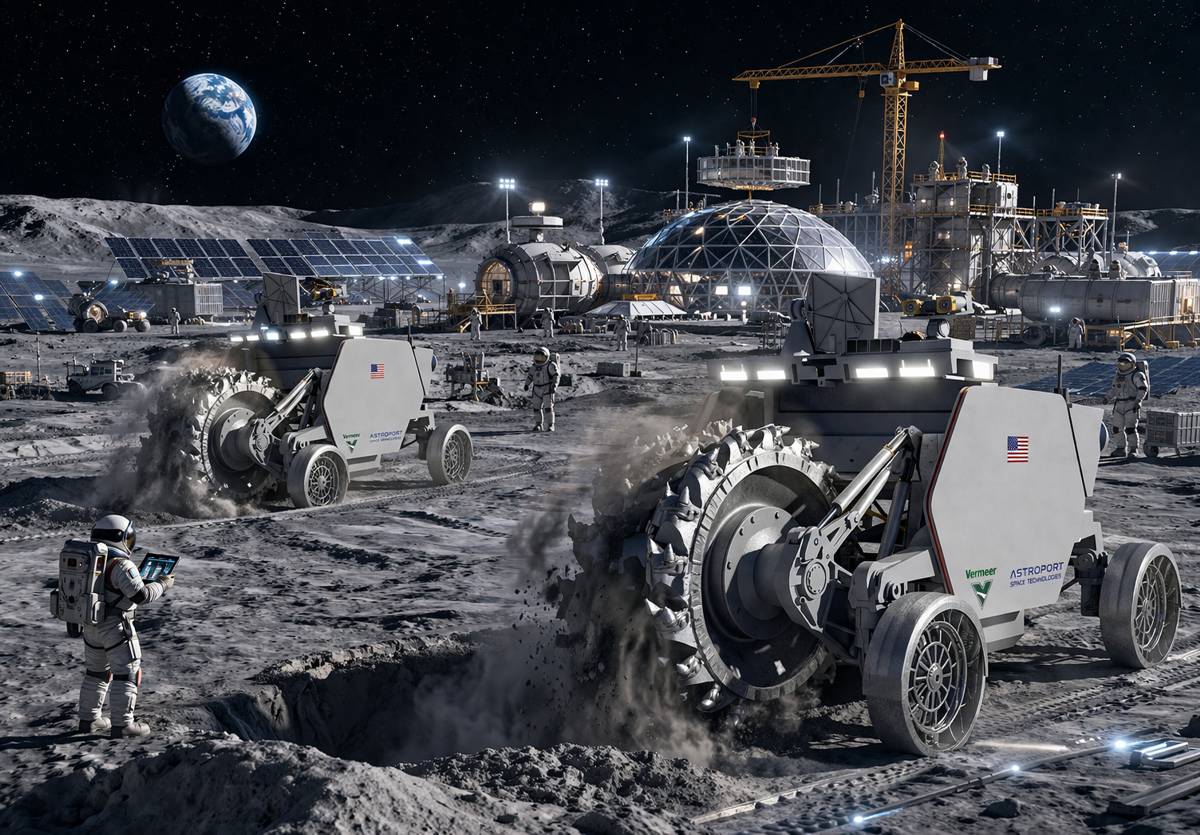
The next phase of space exploration is shifting from flags and footprints to something far more practical. Infrastructure. Roads, landing pads, trenches, foundations and protective systems will define whether a sustained human presence beyond Earth is viable. The announcement from Astroport Space Technologies and Vermeer Corporation signals a notable shift, bringing together terrestrial heavy equipment expertise and emerging space construction technologies.
Unveiled at the ASCE Earth & Space 2026 conference, the collaboration centres on developing autonomous construction machinery designed specifically for the Moon’s hostile environment. Rather than reimagining construction from scratch, the partnership leans on decades of proven industrial engineering and adapts it for one of the most extreme job sites imaginable. It is a pragmatic move that aligns with growing international ambitions to establish permanent lunar infrastructure within this decade.
Briefing
- Astroport and Vermeer are collaborating to develop autonomous lunar construction machinery
- The focus is on adapting surface mining equipment using modular robotic tool systems
- Technologies will address low gravity, temperature extremes and abrasive lunar regolith
- Prototype testing will take place at Vermeer’s facilities in the United States
- The work supports NASA ambitions for a sustained lunar presence by 2030
Heavy Equipment Meets Space Engineering
At its core, this partnership reflects a convergence of two very different engineering domains. Vermeer brings decades of experience in high-torque machinery used in surface mining, trenching and agricultural operations. Astroport, meanwhile, specialises in robotic autonomy and the handling of lunar regolith, the fine, abrasive material that covers the Moon’s surface.
Bridging these disciplines is not a simple matter of scaling down or modifying existing machines. Lunar construction demands a rethink of how equipment interacts with its environment. On Earth, mass and weight provide stability and traction. On the Moon, where gravity is roughly one-sixth of Earth’s, those same assumptions no longer hold. Machines must operate with reduced ground force while maintaining precision and durability under extreme conditions.
The collaboration tackles this challenge through Astroport’s Universal Tool Implement Payload Adapter, a modular system designed to enable interchangeable tools on robotic platforms. This approach allows a single machine to perform multiple tasks, from excavation to surface preparation, without requiring entirely separate units. It is a design philosophy that mirrors trends already emerging in terrestrial construction, where flexibility and efficiency are increasingly prioritised.
Rethinking Construction for Low Gravity Environments
Adapting heavy machinery for lunar use involves more than structural adjustments. The Moon presents a combination of environmental factors rarely encountered together. Temperature swings can exceed 250 degrees Celsius between lunar day and night. The absence of atmosphere exposes equipment to radiation and micrometeoroid impacts. Meanwhile, regolith behaves unpredictably, acting both as a fine dust and a compacted surface.
Traditional equipment relies heavily on weight to stabilise cutting and excavation processes. In a low-gravity environment, engineers must compensate through alternative means such as anchoring systems, modified cutting techniques and enhanced control algorithms. The integration of autonomous systems becomes critical, allowing machines to respond dynamically to conditions without direct human intervention.
This is where Vermeer’s experience in automation intersects with Astroport’s robotics expertise. By combining high-torque cutting and trenching technologies with advanced control systems, the partnership aims to deliver machines capable of performing essential “dirt work” tasks remotely. These include preparing landing zones, constructing protective berms and supporting the installation of energy infrastructure.
The Industrial Backbone of a Lunar Economy
The significance of this development extends well beyond individual machines. Infrastructure is the foundation of any functioning economy, whether on Earth or in space. Without reliable construction capabilities, plans for lunar habitats, resource extraction and energy generation remain theoretical.
Recent policy direction from the United States has reinforced this reality, emphasising the need for a robust space industrial base. Agencies such as NASA have outlined ambitions to establish sustained operations on the Moon by 2030, with programmes like Artemis driving international collaboration and private sector involvement.
For those ambitions to materialise, construction must move from experimental prototypes to scalable, repeatable systems. The introduction of industrial-grade machinery adapted for lunar conditions represents a step towards that goal. It suggests that the industry is beginning to treat off-world construction not as a novelty, but as a serious engineering discipline.
From Surface Mining to Lunar Excavation
Surface mining offers a useful analogue for lunar construction. Both environments involve large-scale material movement, challenging terrain and the need for durable, high-performance equipment. Vermeer’s portfolio includes machines designed to cut through rock, manage overburden and operate continuously in demanding conditions.
Translating these capabilities to the Moon involves modifying both hardware and operational strategies. Cutting tools must withstand the abrasive nature of regolith, which can degrade materials rapidly. Mechanical systems must operate without the benefit of lubrication methods that rely on atmospheric conditions. Electronics must endure radiation exposure while maintaining reliability.
The decision to begin with a surface miner application is therefore a logical starting point. It allows the partnership to focus on a well-understood class of machinery while addressing the unique constraints of the lunar environment. Lessons learned from this initial phase are likely to inform broader equipment development, including trenchers, graders and other essential construction tools.
Autonomous Systems and Remote Operations
Human labour on the Moon will be limited, particularly in the early stages of infrastructure development. This places a premium on autonomous systems capable of performing complex tasks with minimal oversight. Advances in robotics, artificial intelligence and remote sensing are making this increasingly feasible.
Astroport’s expertise in robotic autonomy plays a central role here. By integrating sensors, control systems and adaptive algorithms, machines can operate with a degree of independence that reduces the need for constant human input. This is particularly important given the communication delays between Earth and the Moon, which can complicate real-time control.
Testing these systems on Earth provides an opportunity to refine performance before deployment. Vermeer’s facilities will serve as a proving ground, allowing engineers to simulate operational scenarios and validate equipment under controlled conditions. While no Earth-based environment can fully replicate the Moon, iterative testing remains essential to reducing risk.
Supporting Energy and Habitat Infrastructure
Construction on the Moon is not an end in itself. It underpins a broader ecosystem that includes energy generation, habitation and resource utilisation. One area of growing interest is the deployment of nuclear power systems, which require robust shielding and stable foundations to operate safely.
Autonomous construction machinery could play a key role in preparing sites for such installations, building protective barriers and ensuring structural integrity. Similarly, the development of landing pads is critical to managing the impact of rocket exhaust on the lunar surface, which can eject high-velocity debris and damage nearby equipment.
By addressing these foundational requirements, the Astroport and Vermeer collaboration contributes to a chain of capabilities that extends from initial site preparation to long-term operational stability. It highlights the interconnected nature of infrastructure development, where each component supports a wider system.
A Commercial Pathway Beyond Government Programmes
While government agencies remain central to lunar exploration, the role of private companies is expanding rapidly. The emergence of a cislunar economy, encompassing activities in the space between Earth and the Moon, depends on commercial participation and investment.
Companies like Astroport are positioning themselves as providers of specialised construction and materials solutions, targeting both public and private clients. Vermeer’s involvement adds industrial credibility, demonstrating that established equipment manufacturers see potential in this emerging market.
The commercial implications are significant. If autonomous construction systems can be developed and deployed effectively, they could enable a range of activities, from resource extraction to infrastructure services. This, in turn, creates opportunities for supply chains, logistics and support industries, extending the reach of the construction sector beyond Earth.
Engineering the Future of Off-World Construction
The collaboration between Astroport and Vermeer does not represent a finished solution. It is an early step in what will likely be a long and iterative process of development. Yet it offers a glimpse of how the construction industry might evolve as it expands into new environments.
By combining established engineering principles with emerging technologies, the partnership reflects a broader trend towards integration and adaptability. It suggests that the future of construction, whether on Earth or the Moon, will depend on the ability to merge disciplines, rethink assumptions and apply practical solutions to complex challenges.
As lunar ambitions continue to gather pace, the need for reliable, scalable construction capabilities will only grow. The machines being developed today may well become the workhorses of tomorrow’s off-world infrastructure, quietly shaping the foundations of a new industrial frontier.