Hyundai Mobis Mobility Convergence Technologies set for CES 2026
Hyundai Mobis will unveil more than 30 next‑generation mobility convergence technologies at CES 2026 in Las Vegas between 6 and 9 January. Rather than hosting a public‑facing technology showcase, the company has opted for a private exhibition aimed at strengthening relationships with key automotive clients from North America and other international markets. The objective is to make CES a highly effective business platform rather than a simple product display.
The private format is designed to create an environment where senior executives can hold longer and more meaningful discussions. Hyundai Mobis has secured a dedicated meeting floor on level three of the West Hall at the Las Vegas Convention Center, which will serve as a focused venue for demonstrations, collaboration talks and technical exploration. This strategy also reflects the intensifying competition across the global automotive supply chain, where efficiency, electrification and digital user experience are driving faster development cycles.
Executives from several multinational automakers, including procurement and technology leads, have confirmed their attendance. Their participation signals a growing appetite for advanced mobility electronics, intelligent chassis safety and smart cockpit integration, where Hyundai Mobis has developed a competitive leadership position.
Highlight Technologies for Global Markets
Two flagship systems will anchor the Hyundai Mobis showcase at CES 2026. The upgraded M.VICS 7.0 integrated cockpit platform represents a major step forward in cabin intelligence, while the X‑by‑Wire system introduces electronic steering and braking without mechanical connections.
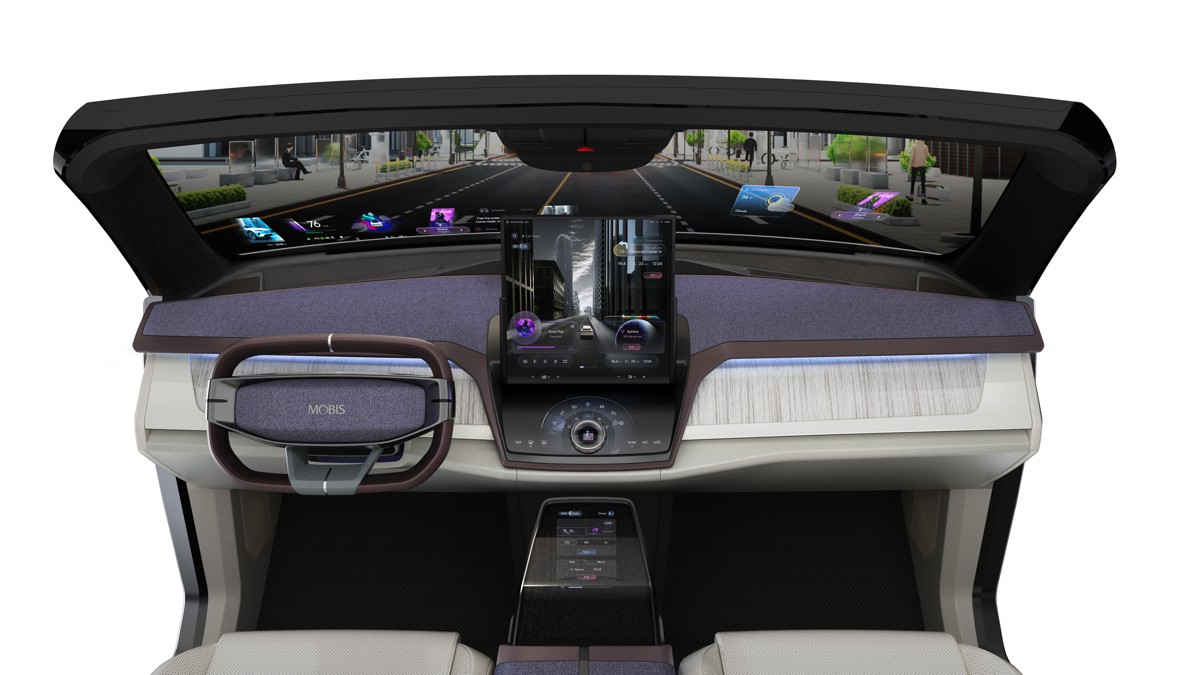
M.VICS remains one of Hyundai Mobis’s most important cockpit platforms. Its 7.0 upgrade combines advanced infotainment, holographic display features and UI enhancements. The platform incorporates a vertically expandable 18.1‑inch large display that blends into the cabin architecture without sacrificing ergonomics. Drivers also gain access to a redesigned centre‑console interface designed to feel natural and intuitive.
One of the most notable updates is the holographic windshield display, which projects driving information directly onto the glass. This next‑generation concept allows a driver to focus on the road without having to glance down at instrument clusters or digital panels.
The second centrepiece is the X‑by‑Wire integrated control solution, which combines electronic steering and braking into a single high‑precision controller. The absence of a mechanical connection allows the system to optimise dynamic handling, reduce vehicle mass and simplify powertrain architecture. The safety profile adds redundancy: if an electronic steering fault occurs, the braking system is capable of safely managing the vehicle. Several global suppliers, including companies working on steer‑by‑wire platforms for autonomous vehicles, are racing to improve similar solutions, further emphasising the system’s strategic value.
CES Innovation Award Recognition
The holographic windshield display (HWD) featured within M.VICS 7.0 received a CES 2026 Innovation Award in the advanced mobility category from the Consumer Technology Association (CTA). The award is granted to technologies that demonstrate outstanding engineering quality, market potential and safety relevance.
HWD has been developed in partnership with German optics specialist Zeiss. It is the world’s first holographic display technology capable of transforming an entire front windshield into a dynamic, ultra‑large digital display surface. The key advancement lies in the holographic film architecture, which allows crisp visibility under different lighting conditions without distracting a driver.
With HWD, all essential driving information appears directly on the glass: speed, navigational cues, hazard alerts and autonomous assistance indicators. Passengers can see separate content, including entertainment and gaming, without interfering with the driver’s field of view. This dual‑experience cabin concept aligns with rising demand for personalised in‑vehicle infotainment and next‑generation mobility interiors.
A Hyundai Mobis spokesperson explained the strategic vision: “We are co‑developing holographic windshield technology with several global customers to accelerate refinement and integration. We aim for mass production by 2029 and expect HWD to become one of our core strategic offerings.”
Growth in Electronics and Electrification Systems
Beyond cockpit systems, Hyundai Mobis will present a wide portfolio of electronic control solutions, electrification components and intelligent chassis technologies. Highlights include:
- Augmented‑reality head‑up display systems
- Low‑power display platforms
- Cost‑efficient high‑performance EV drive units
- Integrated chassis safety and electronic control systems
These solutions fit into a broader industry transition toward electrified mobility, connected interiors and safety‑centric control architectures. Automakers are investing heavily across these categories to support advanced driver assistance, shared mobility and autonomous driving.
According to industry analysts, global demand for steer‑by‑wire and brake‑by‑wire systems is expected to accelerate sharply between 2026 and 2032 as electrified platforms become mainstream. Fully electronic chassis architectures also support modular manufacturing and autonomous vehicle stability, strengthening the commercial case for solutions like Hyundai Mobis X‑by‑Wire.
Strategic International Expansion
Hyundai Mobis intends to expand its global OEM business pipeline through exhibitions, roadshows and targeted technology showcases. CES remains a key strategic venue for strengthening international partnerships, especially with automakers focused on electrification and long‑term safety innovation.
In parallel, the company expects to increase the share of overseas OEM sales within its component business to 40 percent by 2033. North America and Europe will remain priority markets, supported by increasing adoption of electrified platforms, connected cockpit solutions and intelligent chassis systems. Industry research estimates that electronic cockpit platforms and AR‑HUD technologies will see a compound annual growth rate of more than 18 percent this decade, driven by connected mobility, EV user experience and safety legislation.
Hyundai Mobis’s portfolio positions the company as a competitive partner in this evolving market, particularly as automotive manufacturers demand high‑reliability systems capable of supporting autonomous navigation, smart cabin personalisation and future‑proof electrification.
A Growing Innovation Landscape
Mobility convergence is reshaping vehicle design and user experience at a rapid pace. Cabin intelligence, AR‑supported visualization, centralised safety control and electronic chassis systems are replacing decades of mechanical legacy. Hyundai Mobis is scaling this transformation across multiple technology domains, ensuring interoperability and modularity without increasing system complexity.
Integrated cockpit systems like M.VICS 7.0 also support OTA (over‑the‑air) updates, allowing automotive customers to continuously refine UX, navigation, system diagnostics and digital services. Holographic head‑up displays are expected to introduce new commercial opportunities in in‑vehicle advertising, subscription infotainment and personalised navigation assistance.
Hyundai Mobis’s acceleration at CES 2026 indicates a long‑term investment cycle built around digital mobility, cabin intelligence and global collaboration. As vehicle electrification and autonomous driving converge, immersive interior environments and fail‑safe electronic control architectures will become defining features of next‑generation mobility.
Driving Tomorrow’s Mobility
Hyundai Mobis is placing its technology roadmap firmly at the centre of the automotive transformation. Its commitment to cockpit integration, electronic control and display innovation shows that the company is positioning itself as a key supplier for global OEMs preparing for an era of safer, more connected and electrified vehicles.
CES 2026 will offer the market a detailed preview of how these solutions will shape driving, user experience and mobility convergence over the coming decade.