GenPresso Redefines Professional Design Workflows
Recon Labs Inc. has chosen a prominent global stage to introduce its AI design agent platform, GenPresso, to the international market. The official unveiling is scheduled for CES 2026 in Las Vegas, a fitting venue given the event’s long-standing reputation as a launchpad for technologies that go on to shape entire industries. For Recon Labs, this moment represents more than a product announcement. It marks a strategic shift in how artificial intelligence is positioned within professional design workflows.
Rather than presenting AI as a novelty or a shortcut, the company is framing GenPresso as infrastructure. It is designed to sit alongside professional designers, absorbing intent, learning preferences, and managing complexity that often slows creative teams. In an era where generative tools are plentiful but frequently inefficient, this distinction matters. Many designers have found that existing platforms demand constant prompting and reworking. GenPresso aims to remove that friction by acting as an intelligent agent rather than a passive generator.
From Generative Tool to Design Agent
At the heart of Recon Labs’ strategy is a clear critique of the current generative AI landscape. While image, text, and 3D generation tools have advanced rapidly, they often rely on trial and error to reach professional-grade outcomes. Designers are left juggling prompts, versions, and disconnected tools, which can undermine productivity rather than enhance it.
GenPresso has been built to address that gap. Instead of responding to isolated commands, the platform interprets broader creative goals and manages the workflow end to end. Planning, creation, iteration, and refinement are treated as a continuous process. By learning how individual designers work, the system adapts over time, reducing the need to restate preferences or correct outputs repeatedly.
This approach aligns with a broader trend in enterprise AI, where agent-based systems are increasingly favoured over single-task models. In design, where context and continuity are essential, the shift from tool to agent could prove especially significant.
The Three Pillars That Shape GenPresso
Personalised AI Design Intelligence
The first pillar of GenPresso is its personalised AI design agent. This component focuses on understanding the habits, preferences, and decision-making patterns of each user. Colour choices, layout tendencies, composition styles, and revision behaviours are all analysed to improve future outputs.
Over time, this learning process increases the success rate of detailed adjustments. Designers spend less time correcting minor inconsistencies and more time making meaningful creative decisions. The system also recommends workflow paths that align with individual working styles, whether a designer prefers rapid prototyping or careful, incremental refinement.
Node-Based Canvas for Structured Creativity
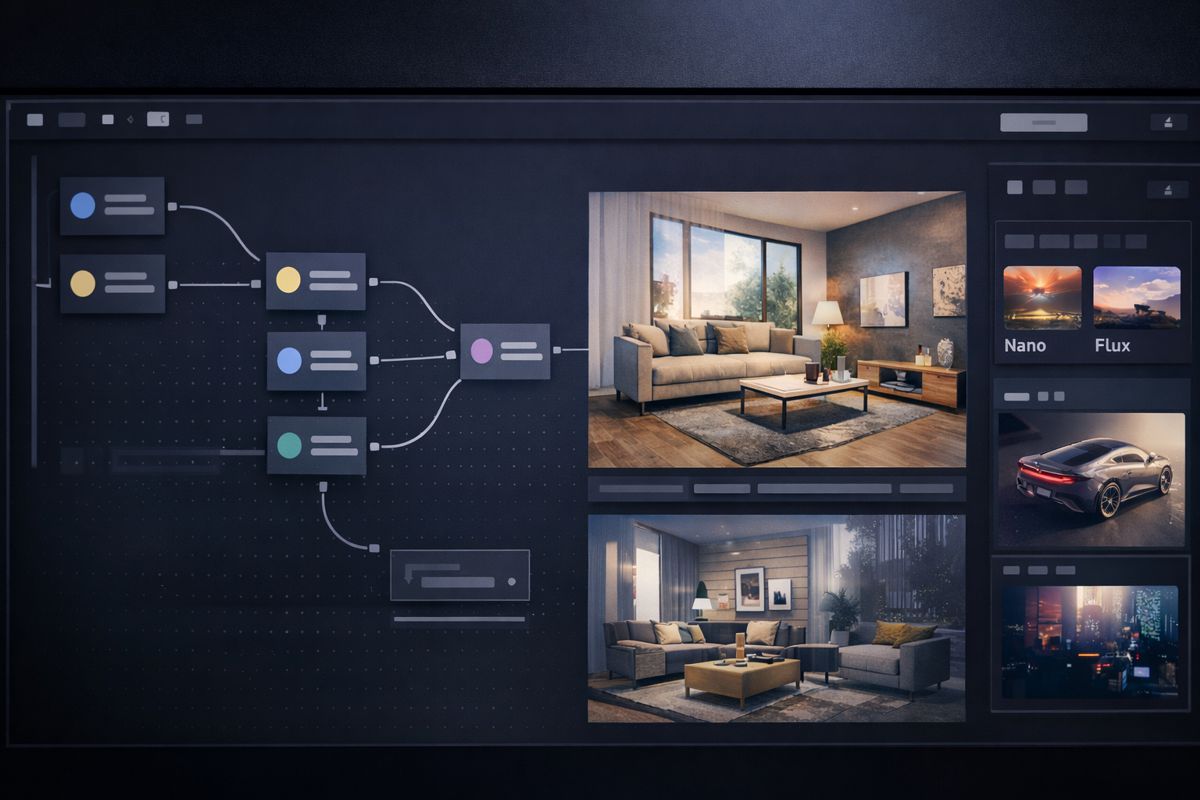
The second pillar is a node-based canvas that allows designers to connect text, image, and 3D inputs into structured workflows. This visual approach to process management is particularly valuable for complex projects where multiple branches and versions need to be explored in parallel.
By keeping iteration history and design logic within a single interface, GenPresso reduces the cognitive load associated with managing complexity. Designers can revisit earlier decisions, compare alternatives, and trace how a concept evolved without leaving the platform. For studios working on commercial projects with multiple stakeholders, this level of clarity can translate directly into time and cost savings.
Integrated AI Model Ecosystem
The third pillar is an integrated AI model platform that brings together a wide range of advanced models under a unified credit system. Users can access and compare outputs from tools such as Nano Banana, Flux 2, Kling O1, Hailuo 2.3, and Sora 2, alongside major large language models, without maintaining separate subscriptions.
This consolidation addresses a common pain point in the creative sector. Subscription sprawl has become both expensive and inefficient. By enabling side by side comparison within a single environment, GenPresso allows designers to choose the most suitable model for each task while keeping costs predictable.
Addressing Professional Designer Pain Points
Professional designers operate under constraints that are often underestimated by consumer-focused AI tools. Deadlines are tight, revisions are frequent, and outputs must meet exacting standards. A visually striking result is not enough if it cannot be refined, documented, and reproduced.
GenPresso’s architecture reflects an understanding of these realities. The platform is designed to support:
- Consistent output quality across iterations
- Clear version control and audit trails
- Collaboration within and across design teams
- Integration with downstream production requirements
By embedding these considerations into the core system, Recon Labs positions GenPresso as a practical solution rather than an experimental add-on.
Global Expansion as a Strategic Priority
For 2025 and beyond, Recon Labs has identified global expansion as a central objective. The introduction of GenPresso at CES 2026 is a deliberate move to engage international partners, media, and enterprise customers in one of the world’s most competitive technology arenas.
The company is already executing a phased global roadmap, supported by research and development collaborations with South Korea’s Ministry of Trade, Industry and Energy. These projects focus on building AI pipelines that reflect the realities of professional design work, rather than abstract academic models.
Such public sector collaboration is increasingly common in advanced technology development, particularly in regions seeking to strengthen their creative and manufacturing ecosystems. For Recon Labs, it also provides a pathway to scale with credibility and institutional backing.
Bridging Design and Manufacturing
One of the most ambitious elements of Recon Labs’ vision is its push towards full stack Design to Manufacturing workflows. Through partnerships with Korean manufacturing and design leaders, including Narnia Labs, Hyundai Livart, and Coptic, operating under the Breezm brand, the company aims to connect creative intent directly with production processes.
This integration has significant implications for industries such as furniture, consumer products, and industrial design. By reducing the gap between concept and manufacture, companies can shorten development cycles, reduce errors, and respond more quickly to market demand.
As manufacturing becomes increasingly digital, the ability to carry design intelligence through to production is emerging as a competitive advantage. GenPresso is being positioned as a key enabler of that transition.
Leadership Perspective on AI as a Partner
Recon Labs’ leadership has been clear in its messaging around GenPresso’s role. Rather than replacing designers, the platform is intended to augment their capabilities and remove repetitive burdens.
Seonghoon Ban, CEO of Recon Labs, framed this vision clearly: “GenPresso is designed to scale globally by adapting to how designers actually work. By showcasing our technology at CES 2026, we aim to demonstrate how AI can transition from a simple tool to a true design partner that links creativity directly to production.”
This emphasis on partnership reflects a growing consensus in creative industries. AI adoption is most successful when it respects professional expertise and enhances, rather than undermines, human judgement.
CES 2026 as a Strategic Showcase
CES remains one of the few global events capable of bringing together technology developers, manufacturers, investors, and policymakers in a single space. For Recon Labs, exhibiting at the Venetian Expo places GenPresso in front of an audience that understands both innovation and commercialisation.
Visitors will find the company at Level 2 of the Venetian Expo, within Halls A to D, at Booth 50523. The demonstration focus is expected to centre on real world workflows, highlighting how GenPresso manages complexity across text, image, and 3D design tasks.
Such practical demonstrations are likely to resonate with enterprise decision makers who are increasingly wary of overpromised AI solutions.
Export Support and Commercial Targets
Recon Labs’ international ambitions are being supported by an export promotion programme organised by South Korea’s Ministry of Science and ICT, alongside the National IT Industry Promotion Agency. This backing underscores the strategic importance placed on creative technology exports within the national innovation agenda.
From a commercial perspective, the company has set clear targets. By 2027, Recon Labs is aiming to exceed 10,000 paid subscribers and achieve annual recurring revenue of 5 million US dollars. While ambitious, these goals reflect confidence in the platform’s relevance to professional markets.
Setting the Direction for AI Driven Design
As AI continues to mature, the distinction between novelty and necessity is becoming sharper. Tools that fail to integrate with real workflows risk being sidelined, regardless of their technical sophistication. GenPresso enters the market with a clear focus on professional relevance, scalability, and integration.
By aligning agent based AI, structured workflow management, and a consolidated model ecosystem, Recon Labs is positioning itself at the intersection of creativity and production. The debut at CES 2026 is unlikely to be the final word, but it sets a clear marker for how AI design platforms may evolve in the years ahead.