LG’s AI Vision for Intelligent Mobility at CES 2026
LG Electronics is preparing to showcase an ambitious leap forward in vehicle intelligence at CES 2026, unveiling a fully immersive experiential space shaped by the company’s concept of Affectionate Intelligence. The exhibit offers a rare opportunity to see how artificial intelligence can transform the cabin environment into a more intuitive and human-centred space, enhancing safety, comfort and personalisation across every seat.
At the heart of the demonstration is an integrated suite of in-vehicle solutions, bringing together transparent displays, advanced sensing capabilities and on-device AI. This fusion sits under LG’s AI-Defined Vehicle architecture, a strategic framework that reflects the company’s vision for vehicles that can understand and adapt to the people inside them.
The innovations showcased have been recognised with the CES 2026 Best of Innovation Award in the In-Vehicle Entertainment category. It marks the first time LG’s Vehicle Solution Company has secured this top honour, underscoring the accelerating influence of human-focused AI in next-generation mobility.
A New Generation Of Mobility Displays
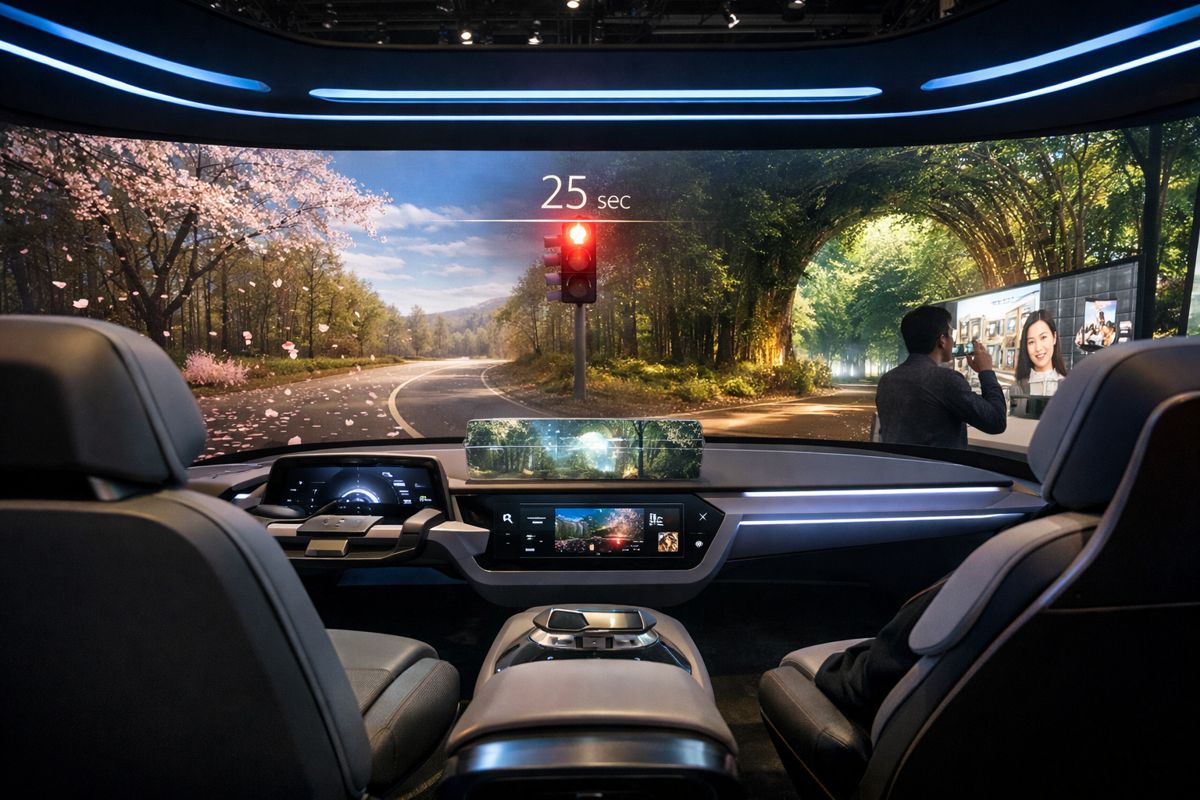
One of the centrepieces of the experience is the Mobility Display Solution, which transforms the entire windshield into a transparent OLED interface. Visitors to the exhibit will be able to explore how AI selects and presents the most relevant information based on context, reducing cognitive load while enhancing clarity.
The system demonstrates how traffic-related details can be surfaced only when needed. When a vehicle approaches a signal, for instance, AI places the remaining wait time above the light, allowing drivers to process information with minimal distraction.
The display becomes even more expressive in autonomous driving mode. Instead of leaving occupants to stare at a static horizon, the system uses environmental data to generate vivid scenes that mirror or enhance surroundings. Tunnel passages become virtual forest pathways, while tree-lined roads prompt cascades of digital cherry blossom petals across the windshield. The result is a meditative, near-virtual-reality environment that reflects the increasing convergence of mobility and digital experience design.
Advanced Vision AI For Safer, More Empathetic Cabins
LG’s Automotive Vision Solution represents another key highlight, focusing on real-time in-cabin sensing to improve safety and contextual responsiveness. Powered by the company’s Automotive Vision System, the platform uses AI to analyse posture, gaze, gesture, clothing colour and attention levels, enabling the vehicle to understand occupant behaviour with a high degree of nuance.
The system can track subtle visual cues to extend the range of interactive features. Eye tracking and gesture control allow occupants to select content or request information without physical controls. Anamorphic display graphics enhance visual depth, creating a cohesive visual environment that reacts naturally to user behaviour.
One scenario featured at the showcase illustrates how the technology can enrich autonomous driving experiences. If a passenger looks at an advertisement on a passing building, gaze recognition can trigger related content on the in-cabin display. The seamless movement from observation to personalised information represents a notable shift in how vehicles could support entertainment, retail engagement and contextual discovery.
The broader value of advanced in-cabin sensing continues to attract industry attention. Road safety researchers have increasingly highlighted the importance of understanding cognitive load, distraction and behavioural patterns inside the cabin. LG’s implementation reflects a growing trend among OEMs to integrate real-time behavioural intelligence into next-generation vehicle platforms.
Personalised Entertainment With Memory And Real-Time Context
The third major solution highlighted at CES 2026 is LG’s In-Vehicle Entertainment Solution, a platform designed to personalise entertainment and communication throughout the journey.
AI plays a central role by recognising scenery outside the vehicle and linking it with user-generated memories. When the system identifies a familiar location, it can surface old photos tied to that place on interior window displays. These shared memories can be sent instantly to family members through integrated video calling, bridging physical and digital connection during travel.
For longer journeys, the system recommends content aligned with individual preferences, supporting a more relaxed travel experience. LG also demonstrates real-time sign-language translation for situations where passengers encounter staff or roadside assistance teams using sign language. In such cases, the system converts gestures into on-screen text, enabling inclusive and barrier-free communication.
These features illustrate the broader industry movement toward deeply personalised and emotionally aware in-cabin experiences. As autonomous and assisted driving technologies mature, cabin space is increasingly becoming a digital environment designed for productivity, wellness and entertainment.
Industry Momentum Behind AI-Defined Vehicles
LG emphasises that many of these AI systems are already being deployed in production vehicles through partnerships with leading global OEMs. The accelerating adoption of in-cabin sensing, in particular, reflects a wider shift toward integrated safety ecosystems driven by real-time behavioural understanding.
Eun Seok-hyun, president of the LG Vehicle Solution Company, outlines the company’s strategic direction with clear intent. He stated: “We are bringing our future mobility vision to life by embedding AI across our solutions — many of which, including in-cabin sensing, are already in production with global OEMs.” He added: “By accelerating these innovations to market, we aim to pioneer the era of AI-driven vehicles in the years ahead.”
This alignment with the broader mobility sector sits against a backdrop of increasing investment in intelligent vehicle architecture. Research published by global automotive consultancies indicates that AI-enabled vehicle features, particularly those involving cabin personalisation and behavioural analytics, are expected to grow rapidly through 2030.
A Look Ahead To CES 2026
LG’s AI-powered in-vehicle solutions will be presented at the company’s CES 2026 booth at the Las Vegas Convention Center from 6 to 9 January. The booth, located at #15004, will allow attendees to explore each experiential zone first-hand. Early previews suggest strong interest from automotive manufacturers, technology providers and mobility investors keen to understand how Affectionate Intelligence could influence the next wave of cabin design.
The exhibition also places LG firmly within the emerging competitive landscape of AI-defined mobility, where cabin intelligence is set to become as central to differentiation as drivetrain technology, connectivity ecosystems or powertrain innovation.
Driving Meaningful Experiences In Future Mobility
LG’s latest innovations reflect a turning point for intelligent vehicle interiors. The focus is shifting from conventional infotainment towards a more holistic understanding of occupant needs, interactions and emotional context.
Through Affectionate Intelligence, the showcase at CES 2026 demonstrates how vehicles may evolve into adaptive environments capable of anticipating and responding to human behaviour in increasingly meaningful ways.