LG Positions AI at the Core of Mobility at CES 2026
Global mobility technology leader LG Electronics is preparing to lift the curtain on its latest automotive innovation at CES 2026 in Las Vegas. From 6 to 9 January, the company will unveil the LG AI Cabin Platform, a generative artificial intelligence powered solution designed to redefine how drivers and vehicles interact. Built to run on automotive high-performance computing systems and powered by Qualcomm Technologies’ Snapdragon Cockpit Elite, the platform signals LG’s intent to push beyond the boundaries of the software-defined vehicle and into what it describes as the AI-defined vehicle era.
Rather than treating artificial intelligence as a background feature, LG is positioning it at the very heart of the driving experience. The AI Cabin Platform is designed to interpret context, understand behaviour, and respond in real time. In doing so, LG aims to move the in-vehicle experience from reactive to proactive, creating a digital cockpit that adapts continuously to both driver and environment.
From Software-Defined to AI-Defined Vehicles
The unveiling at CES 2026 will mark the first public demonstration of the AI Cabin Platform, hosted within the LG Vehicle Solution Company’s private showcase. Visitors will experience a fully realised digital cockpit built around the platform and gain a preview of what LG calls the AI-defined vehicle, or AIDV. This concept represents a clear step beyond the software-defined vehicle model that has dominated automotive technology discussions in recent years.
According to Seok-hyun Eun, President of the LG Vehicle Solution Company, the shift reflects a deeper transformation in how mobility technology is conceived and delivered. In his words: “Based on our proven technology and global trust, LG will continue expanding partnerships with innovators like Qualcomm Technologies to drive future mobility beyond the SDV to the AIDV.” He added: “With the LG AI Cabin Platform, we are creating mobility that not only understands drivers, but responds proactively to their needs and preferences, making every journey uniquely personal.”
These statements underline LG’s belief that intelligence, not just software, will define the next generation of vehicles. The focus is no longer solely on functionality, but on anticipation and adaptability.
Generative AI at the Core of the Cabin
At the technical level, the LG AI Cabin Platform applies a suite of generative AI models directly to the company’s in-vehicle infotainment system. These include vision language models, large language models, and image generation models, all working in concert to interpret data, generate responses, and personalise the user experience.
This approach reflects broader trends across the technology sector, where generative AI is increasingly being deployed to manage complex, context-rich interactions. Within a vehicle, that complexity is amplified. The system must interpret visual cues, driver behaviour, road conditions, and user preferences, all while operating within strict safety and performance constraints. LG’s platform is designed to meet those demands without relying on constant cloud connectivity.
On-Device Intelligence and Data Security
One of the platform’s defining features is its reliance on on-device processing. Leveraging the high-performance compute capabilities of the Snapdragon Cockpit Elite, all AI calculations are performed within the vehicle itself. This removes the need for continuous communication with external servers and delivers several tangible benefits.
First, latency is reduced, enabling faster and more stable responses. In safety-critical scenarios, even minor delays can have serious consequences, so real-time performance is essential. Second, data privacy and security are significantly enhanced. By keeping sensitive information within the vehicle, LG’s approach reduces exposure to cloud-related vulnerabilities and aligns with growing regulatory and consumer expectations around data protection.
This emphasis on local processing mirrors developments seen elsewhere in the automotive sector, where edge computing is increasingly favoured for advanced driver assistance systems and autonomous functions.
Real-Time Awareness and Proactive Assistance
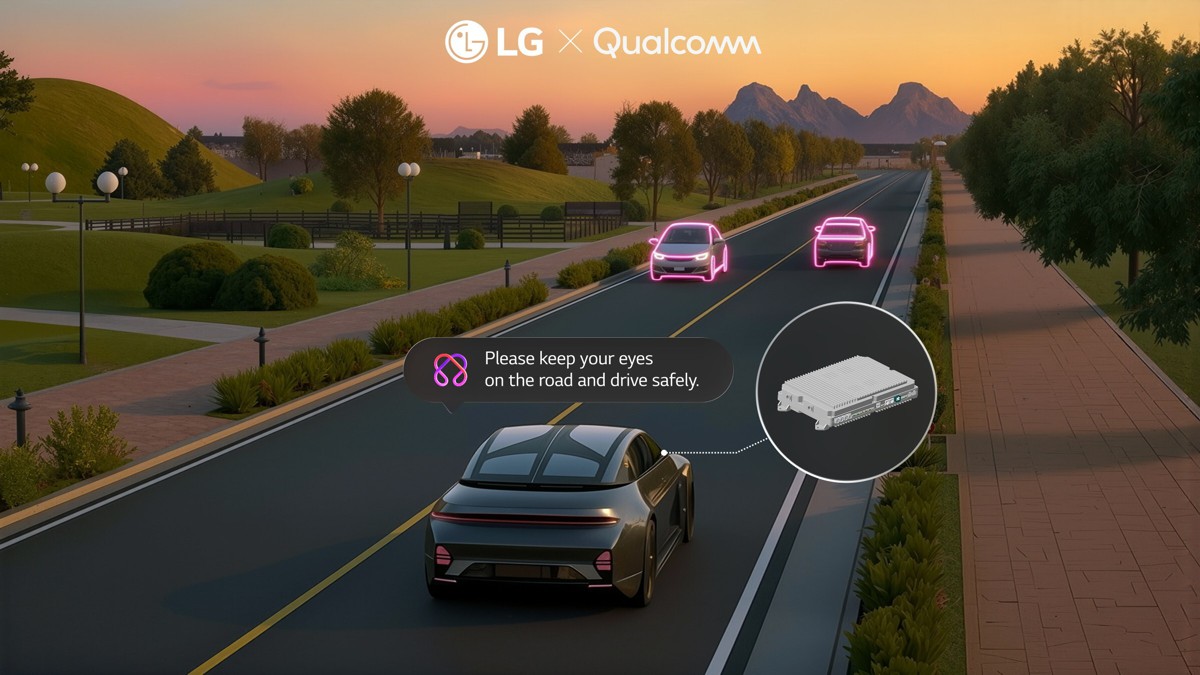
The LG AI Cabin Platform continuously analyses the driving environment and the driver’s condition using data from both internal and external vehicle cameras. By combining visual inputs with behavioural analysis, the system can identify potential risks and intervene in a timely, context-aware manner.
For instance, if a nearby vehicle begins merging and the platform determines that the driver has not yet noticed the manoeuvre, it can issue a tailored alert. Rather than a generic warning tone, the system delivers a natural language prompt: “A car is merging ahead. Please keep your eyes on the road and drive safely.” This personalised approach is intended to reduce cognitive load while improving situational awareness.
Such capabilities place the AI Cabin Platform at the intersection of infotainment and safety. While not positioned as a replacement for advanced driver assistance systems, it complements them by focusing on human perception and response.
Adaptive Interfaces and Context-Aware Infotainment
Beyond safety, LG is using generative AI to rethink how infotainment systems look and feel. The platform can generate customised user interfaces that adapt dynamically to external conditions and driver preferences. This moves the cabin environment away from static screens and towards a more immersive, responsive experience.
An illustrative example involves music playback during adverse weather. If the system detects snowy conditions during an evening drive, it can generate a matching visual background for the infotainment display, such as softly falling snow under streetlights or a winter village scene. At the same time, it may offer a contextual suggestion: “It’s a beautiful snowy night. Shall I recommend some winter-themed songs?”
While these features may seem subtle, they reflect a broader shift towards emotional and experiential design in vehicle interiors. Automakers and suppliers alike are recognising that differentiation increasingly comes from software-driven experiences rather than mechanical specifications alone.
Building on LG and Qualcomm Collaboration
The AI Cabin Platform does not emerge in isolation. It builds on a deepening collaboration between LG and Qualcomm Technologies, which was prominently showcased at CES 2025. Earlier this year, the two companies unveiled a high-performance computing platform that integrates in-vehicle infotainment and advanced driver assistance systems into a single control unit.
Based on Qualcomm Technologies’ Snapdragon Ride Flex System-on-Chip, the platform consolidated multiple vehicle functions into one controller. This architecture was widely praised for delivering both cost efficiency and high performance, addressing a key challenge for automakers seeking to balance innovation with production realities.
The AI Cabin Platform represents a natural evolution of this work, extending the benefits of integrated computing into the realm of generative AI and human-centred interaction.
Human-Centred Innovation as a Strategy
At the organisational level, the launch underscores the strategic direction of the LG Vehicle Solution Company. Positioned as a trusted technology partner to the automotive industry, the division focuses on delivering intelligent, human-centred solutions that span hardware, software, and systems integration.
Its portfolio includes head units, displays, connectivity solutions, ADAS vision systems, and software platforms designed for software-defined vehicles. In recent years, LG has further diversified its capabilities to include automotive lighting systems, e-powertrain technologies, and cybersecurity solutions. This breadth allows the company to address the vehicle as an integrated system rather than a collection of discrete components.
The stated mission of “Driving Better Future Mobility” is reflected in the AI Cabin Platform’s emphasis on understanding, anticipation, and personalisation.
Industry Context and Broader Implications
The debut of the LG AI Cabin Platform comes at a time when the automotive industry is grappling with rapid technological convergence. Artificial intelligence, high-performance computing, and user experience design are increasingly intertwined, reshaping expectations around what vehicles should offer.
Regulators and policymakers are also paying closer attention to in-vehicle data use, driver monitoring, and human-machine interaction. Solutions that combine advanced functionality with strong privacy safeguards are likely to gain favour, particularly in markets with stringent data protection frameworks.
For industry investors, the platform highlights the growing value of software and AI capabilities within the automotive supply chain. Suppliers that can deliver scalable, secure, and differentiated digital experiences are well positioned as vehicles continue their transformation into connected, intelligent systems.
CES 2026
As CES 2026 approaches, LG’s AI Cabin Platform is set to be one of the more closely watched mobility technology unveilings. Its emphasis on on-device generative AI, proactive assistance, and adaptive interfaces speaks directly to the challenges and opportunities facing modern vehicle design.
While widespread deployment will depend on automaker adoption and integration timelines, the platform offers a clear vision of where in-vehicle experiences are heading. Intelligence is no longer confined to discrete functions. Instead, it permeates the cabin, shaping how drivers perceive, interact with, and ultimately trust their vehicles.
In that sense, LG’s move beyond the software-defined vehicle towards an AI-defined future may prove to be less a conceptual shift and more an inevitability.