AI Meets Physics for Surface-Wave Seismic Imaging
Surface-wave seismic methods have long been a cornerstone of near-surface investigation, valued for their ability to link wave dispersion directly to subsurface structure. By exploiting the natural relationship between frequency and depth, engineers and geophysicists can infer shear-wave velocity profiles that underpin everything from foundation design to seismic hazard assessment. Yet despite their widespread use, traditional surface-wave workflows remain slow, labour-intensive, and heavily dependent on expert judgement.
Manual dispersion picking, iterative inversion, and repeated parameter tuning have become familiar bottlenecks. These constraints limit scalability and make it difficult to deploy surface-wave techniques in dense monitoring networks or time-critical engineering contexts. Against this backdrop, artificial intelligence has stepped into the frame, promising automation, speed, and consistency. Still, as many practitioners have discovered, faster results are not always better results.
A growing body of research now suggests that the real challenge is not whether AI can accelerate seismic analysis, but whether it can do so without compromising physical reliability. This tension between efficiency and interpretability lies at the heart of a recent review examining how artificial intelligence is reshaping surface-wave seismic methods.
Artificial Intelligence Enters the Seismic Workflow
A comprehensive review published in Big Data and Earth System brings together researchers from Zhejiang University of Technology, Zhejiang University, and Anhui University of Science and Technology to assess the state of AI-driven surface-wave analysis. The paper surveys advances across the entire processing chain, from automated dispersion extraction to deep-learning-based inversion, physics-guided modelling, and explainable artificial intelligence.
Rather than focusing solely on performance metrics, the authors set out to answer a more fundamental question. Can AI-based methods reproduce the physical relationships that underpin surface-wave propagation, or are they merely exploiting statistical patterns in the data? This distinction matters. In engineering and environmental applications, decisions based on seismic models carry real-world consequences, and misplaced confidence in black-box predictions can be costly.
The review positions artificial intelligence not as a replacement for classical seismic theory, but as a powerful complement. When used thoughtfully, AI has the potential to remove long-standing practical barriers while preserving the physical insights that give surface-wave methods their credibility.
Automating Dispersion Analysis at Scale
One of the most significant contributions of artificial intelligence lies in dispersion analysis. Traditionally, identifying dispersion curves from seismic records requires experienced analysts to interpret complex time–frequency patterns. The process is slow, subjective, and difficult to standardise across large datasets.
Deep learning models have now demonstrated the ability to extract dispersion information automatically, even from noisy or highly heterogeneous data. Convolutional neural networks, in particular, can recognise subtle spectral features that would be challenging to identify consistently by hand. Once trained, these models process vast volumes of seismic records in a fraction of the time required by manual workflows.
This shift has profound implications for large-scale surveys and continuous monitoring systems. Dense arrays and distributed acoustic sensing networks generate data at a pace that would overwhelm traditional processing pipelines. Automated dispersion analysis makes it feasible to harness these datasets in near real time, opening new possibilities for urban monitoring, infrastructure assessment, and environmental observation.
Rapid Inversion Without Iteration
Beyond dispersion picking, artificial intelligence has also transformed the inversion stage of surface-wave analysis. Classical inversion methods rely on iterative optimisation, adjusting model parameters repeatedly until simulated dispersion curves match observations. While robust, these approaches are computationally expensive and sensitive to initial assumptions.
Neural networks trained on synthetic or field datasets can learn direct mappings from dispersion measurements to shear-wave velocity profiles. Once trained, these models produce inversion results almost instantaneously. The speed advantage is striking, enabling large-scale imaging campaigns that would previously have been impractical.
However, the review cautions against equating speed with reliability. Fast inversion is only valuable if the resulting models remain physically meaningful. Without careful design, AI-driven inversion can introduce artefacts or obscure uncertainty, particularly in depth ranges where surface-wave sensitivity is inherently limited.
Where Black Boxes Fall Short
A central contribution of the review is its comparison between data-driven sensitivity patterns derived from neural networks and classical seismic sensitivity kernels. By analysing network-derived Jacobians, the authors reveal how different AI models attribute importance to various depth–frequency relationships during inversion.
In some cases, these sensitivities align well with established physical theory. In others, discrepancies emerge. Certain models appear to rely on statistical correlations present in training data rather than on the underlying physics of wave propagation. This mismatch can lead to misleading interpretations, especially in poorly constrained zones at depth.
Such findings underscore a broader concern within the geophysical community. Black-box models may perform well on benchmark datasets yet fail to generalise across geological settings. Without interpretability, users have little insight into when and why an AI model might be wrong.
Physics-Guided Learning as a Way Forward
To address these limitations, the review highlights the growing role of physics-guided and physics-informed AI approaches. Rather than allowing networks to learn purely from data, these methods embed physical constraints, governing equations, or geological priors directly into model architecture or training objectives.
By incorporating known relationships between frequency, wavelength, and depth sensitivity, physics-guided models improve stability and reduce the risk of non-physical solutions. The result is a class of AI tools that remain computationally efficient while respecting the principles that underpin seismic interpretation.
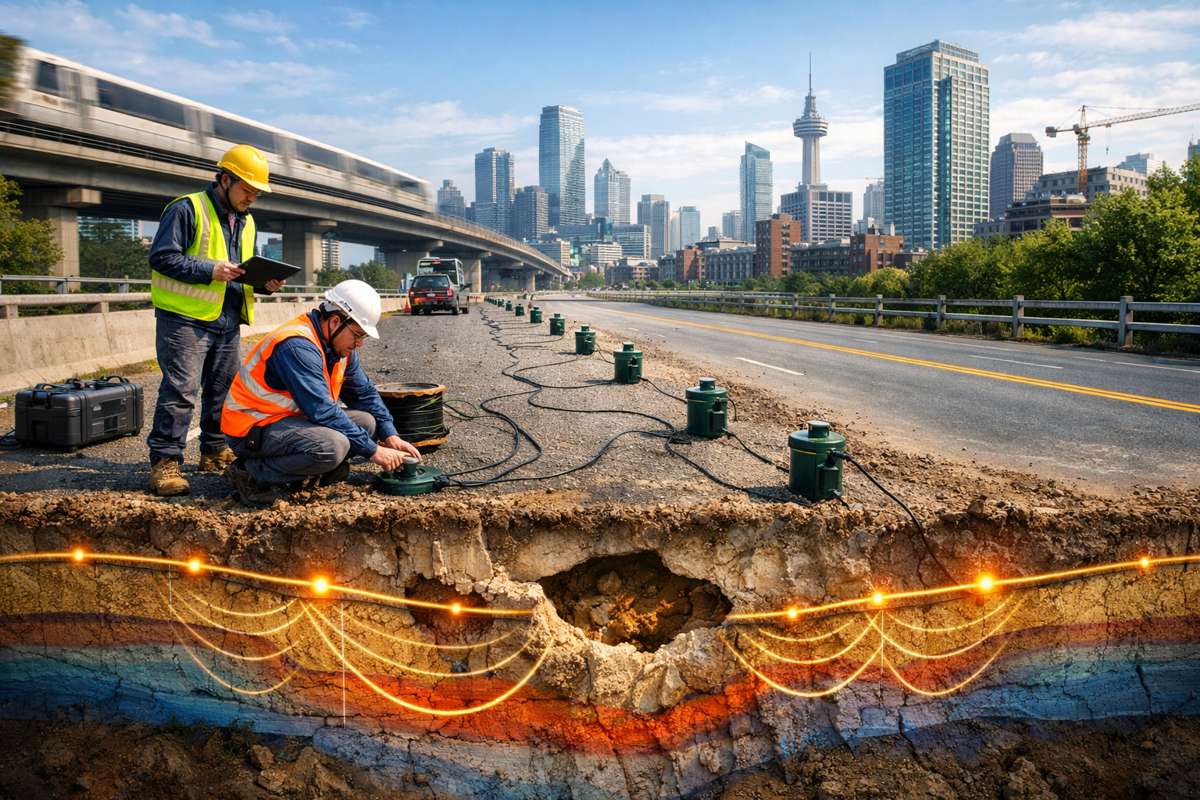
The authors present a compelling case study in which AI-assisted feature analysis is used to identify subsurface karst cavities from shear-wave velocity models. Compared with manual inspection, the AI-supported approach offers greater objectivity and consistency, particularly in complex geological environments. Crucially, the model’s behaviour can be interpreted in light of physical expectations, enhancing user confidence.
Interpretability Becomes a Design Requirement
The review makes clear that interpretability is no longer an optional add-on for AI-based seismic methods. It is a design requirement. Understanding how and why a model produces its results is essential for risk-sensitive applications such as infrastructure planning, hazard mitigation, and groundwater management.
As the authors observe: “AI has clearly changed what is computationally possible in seismic imaging, but accuracy alone is not enough. Without physical consistency, fast results can still be misleading. Our comparison between data-driven and physical sensitivities shows why interpretability must become a core component of AI-based inversion. Physics-guided learning offers a practical path forward, allowing AI models to remain efficient while preserving the fundamental relationships that govern wave propagation.”
This emphasis reflects a broader shift in applied AI research, where transparency and trust are increasingly valued alongside performance.
Implications for Engineering and Earth Science
Physics-guided AI surface-wave methods could reshape a wide range of applications. In urban environments, faster and more reliable subsurface imaging supports seismic hazard assessment, tunnel design, and foundation engineering. For infrastructure networks, near-real-time analysis enables condition monitoring and early warning systems.
Environmental and hydrogeological studies also stand to benefit. Improved resolution and automation facilitate groundwater monitoring, contaminant tracking, and land subsidence analysis. When combined with distributed sensing technologies, AI-driven workflows could deliver continuous insights into subsurface dynamics.
Equally important is the role of interpretable AI in managing uncertainty. By revealing sensitivity patterns and confidence limits, physics-informed models help practitioners avoid overconfidence in automated outputs and make better-informed decisions.
From Experimental Tools to Routine Practice
The review concludes on a pragmatic note. While challenges remain, the trajectory is clear. As standardised datasets expand and physically informed architectures mature, AI-driven surface-wave seismic methods are moving from experimental innovation toward routine application.
Success will depend not on replacing established theory, but on integrating it more effectively with modern computational tools. In doing so, the seismic community can harness the speed of artificial intelligence without sacrificing the physical insight that has long underpinned trustworthy interpretation.
Supported by funding from the National Natural Science Foundation of China and the Zhejiang Provincial Natural Science Foundation, the study provides a timely roadmap for researchers and practitioners navigating this evolving landscape. It suggests that the future of seismic imaging lies not in choosing between data and physics, but in bringing the two into closer, more productive alignment.