Aeva and NVIDIA Strengthening Autonomous Vehicle Stack at CES
At CES 2026 in Las Vegas, Aeva has reached a defining moment in its evolution from an advanced sensing innovator to a core supplier within the global autonomous vehicle ecosystem. The company announced that its Frequency Modulated Continuous Wave 4D LiDAR technology has been selected for the NVIDIA DRIVE Hyperion autonomous vehicle reference platform. In practical terms, this places Aeva’s sensing hardware and perception capabilities at the heart of one of the automotive industry’s most influential development architectures.
For original equipment manufacturers increasingly committed to software defined vehicles, platform choices are rarely cosmetic. They reflect long-term bets on safety, scalability, and technological resilience. Being selected for DRIVE Hyperion signals confidence not only in Aeva’s hardware, but also in its ability to support production-grade systems across passenger and commercial vehicles. It is a move that reinforces the growing convergence between high-performance computing, advanced sensing, and perception software as the foundations of automated mobility.
Understanding NVIDIA DRIVE Hyperion’s Role
NVIDIA DRIVE Hyperion has been designed as an open and modular reference platform, aimed squarely at accelerating the safe deployment of higher levels of vehicle automation. Rather than offering a single fixed configuration, Hyperion provides OEMs and mobility developers with a validated baseline that can be adapted to different vehicle architectures, markets, and regulatory frameworks.
At its core, Hyperion integrates a comprehensive sensor suite, typically including a LiDAR sensor, multiple radar units, cameras, ultrasonics, and external microphones. These inputs are processed through NVIDIA Drive AGX Thor, paired with the NVIDIA DriveOS operating system, to enable Level 3 and Level 4 automated driving functions. The platform is intended to reduce development friction by ensuring that sensors, compute, and software operate cohesively from the outset, allowing manufacturers to focus on differentiation rather than basic system integration.
Why Sensing and Perception Sit at the Centre
As automated driving capabilities advance beyond driver assistance, sensing and perception shift from being supportive technologies to becoming mission critical. Vehicles operating at Level 3 and above must interpret their environment with consistency and precision under a wide range of conditions. That requirement places extraordinary pressure on sensor performance, data integrity, and perception algorithms.
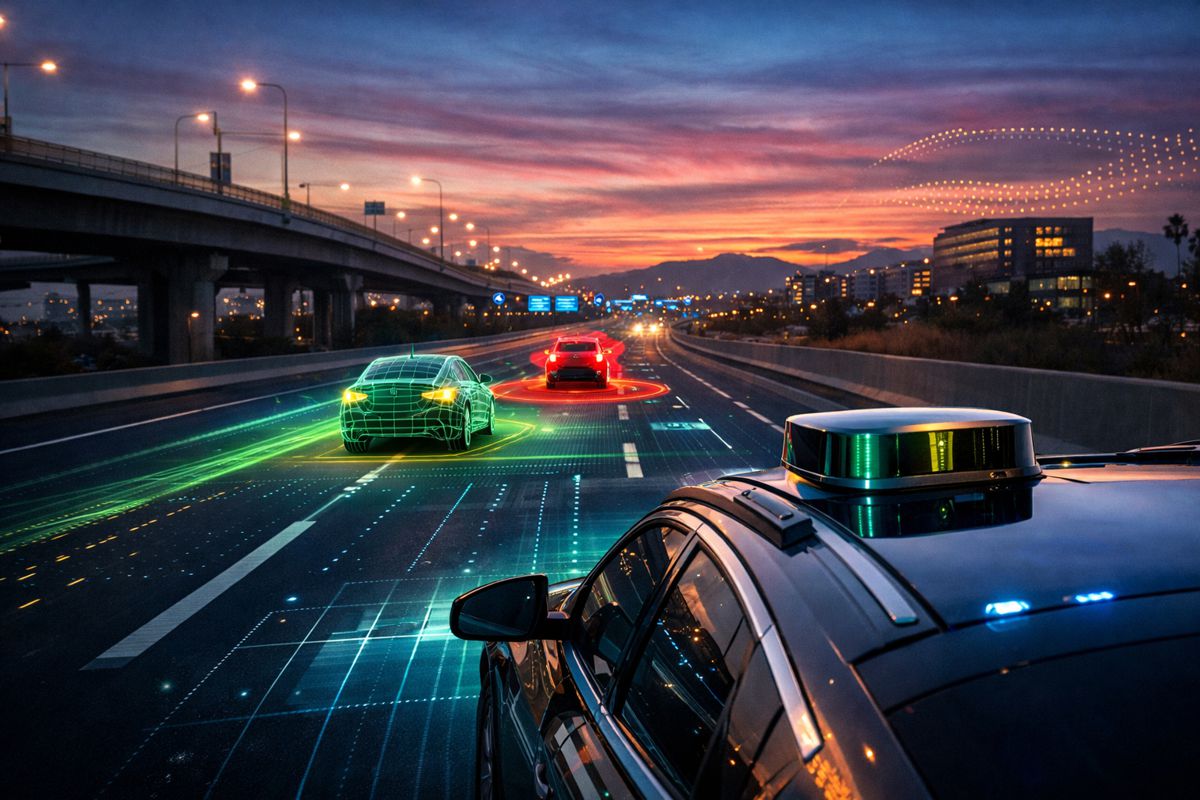
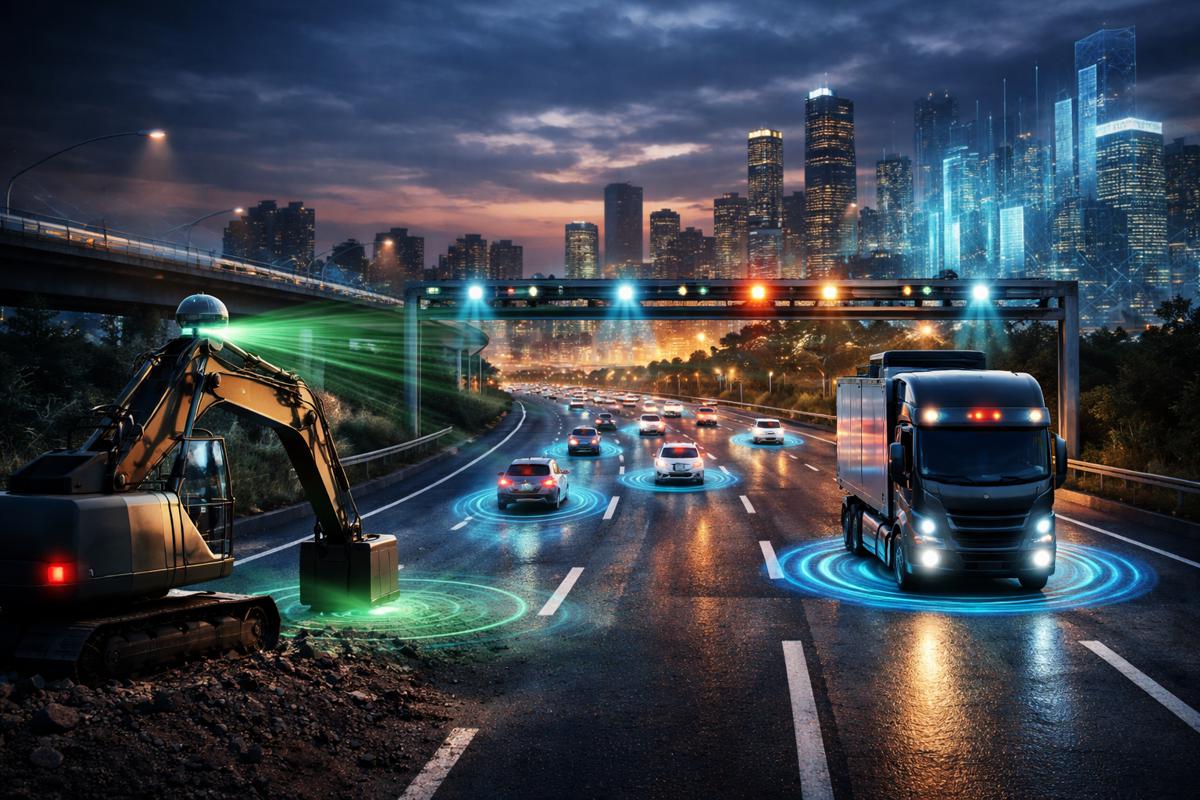
Aeva’s selection reflects this reality. Its 4D LiDAR adds a dimension that conventional time-of-flight systems cannot natively provide. In addition to three-dimensional spatial data, Aeva’s sensors deliver instant velocity measurements on a per-point basis. This capability allows vehicles to understand not just where objects are, but how they are moving, in real time. The result is higher confidence detection, more stable object tracking, and improved long-range performance in both daylight and low-visibility conditions.
Aeva’s FMCW Advantage Explained
Frequency Modulated Continuous Wave LiDAR has long been discussed as a promising alternative to pulsed LiDAR approaches. Aeva has been among the first companies to bring FMCW into an automotive-ready, scalable product architecture. Unlike traditional systems that measure distance based on the time it takes for a laser pulse to return, FMCW LiDAR continuously modulates the laser signal, enabling simultaneous measurement of range and velocity.
This approach delivers several practical benefits for autonomous vehicle applications. It improves immunity to interference from other LiDAR systems, enhances performance in challenging weather, and supports longer detection ranges without sacrificing resolution. Combined with Aeva’s silicon photonics LiDAR-on-Chip architecture, the technology is engineered for automotive-grade reliability and high-volume manufacturability, addressing two of the most persistent barriers to widespread deployment.
Executive Perspective on the Hyperion Selection
For Aeva’s leadership, the announcement represents validation of years of development effort and strategic positioning within the automotive supply chain. As Soroush Salehian, Co-Founder and Chief Executive Officer of Aeva, explained: “As a growing number of leading OEMs build their next-generation software-defined vehicles on the NVIDIA DRIVE platform, sensing and perception technology becomes a foundational requirement for enabling Level 3 and higher automated driving. We’re honored that Aeva’s 4D LiDAR is the LiDAR sensor for the Hyperion vehicle platform. This represents the strength of our technology, supporting its adoption by a growing list of global OEMs.”
The emphasis on software-defined vehicles is telling. OEMs are increasingly moving away from rigid hardware-centric development models, favouring architectures that can evolve through software updates over a vehicle’s lifecycle. In this context, sensors must deliver consistent, high-quality data that can support future perception and automation features not yet fully defined.
Building on a European Production Win
The Hyperion selection follows Aeva’s earlier announcement of a global production win with a top European passenger vehicle manufacturer. Together, these developments point to growing momentum in both the passenger and commercial vehicle segments. Rather than remaining confined to pilot programmes or niche applications, Aeva’s technology is moving decisively toward series production.
For OEMs, this trajectory matters. Selecting a sensor supplier is not only about performance on the test track, but also about confidence in long-term supply, quality assurance, and integration support. Aeva’s expanding footprint suggests a company aligning its technology roadmap with the operational realities of global vehicle manufacturing.
Collaboration Toward 2028 Production Programmes
Aeva and NVIDIA have confirmed that they will collaborate closely to integrate Aeva’s FMCW perception platform into DRIVE Hyperion, with the explicit goal of supporting production vehicle programmes targeted for 2028. This timeline reflects the extended development cycles typical of high-level automated driving systems, particularly those intended for deployment at scale.
Such collaboration goes beyond simple hardware inclusion. It involves aligning perception software, validation workflows, and safety frameworks with NVIDIA’s compute and operating system stack. By working together at the platform level, both companies aim to reduce integration risk for OEMs and provide a clearer pathway from development to homologation.
Implications Beyond Passenger Vehicles
While much of the attention around DRIVE Hyperion focuses on passenger cars, the platform’s relevance extends into commercial vehicles and emerging mobility sectors. Freight transport, logistics fleets, and specialised service vehicles stand to benefit from robust perception systems capable of operating reliably over long duty cycles.
Aeva’s technology is also positioned for use beyond road vehicles. Its FMCW perception platform supports applications in robotics, factory automation, and smart infrastructure, sectors where precise velocity and spatial data can enhance safety and operational efficiency. This cross-sector applicability strengthens the business case for continued investment in FMCW-based sensing.
CES 2026 and the Broader Ecosystem
At CES 2026, Aeva is showcasing its full portfolio of FMCW perception solutions at booth 6919 in the West Hall of the Las Vegas Convention Center. The company’s presence extends into partner exhibits as well, including demonstrations with LG Innotek and AGC, underscoring the collaborative nature of today’s mobility technology ecosystem.
Trade shows such as CES have become less about spectacle and more about signalling strategic alignment. Aeva’s visibility across multiple stands reflects its integration into a broader network of suppliers and technology partners working toward common automation goals.
Seeing the Road Ahead
The inclusion of Aeva’s 4D FMCW LiDAR in NVIDIA DRIVE Hyperion is more than a headline announcement. It represents a convergence of sensing innovation, high-performance computing, and software-defined vehicle design. For OEMs navigating the complex path to Level 3 and Level 4 automation, such platform-level integrations offer a measure of clarity in an otherwise fragmented landscape.
As production targets move toward the latter part of the decade, the emphasis will increasingly fall on technologies that can deliver consistent performance at scale. Aeva’s progress suggests that FMCW LiDAR, once considered experimental, is rapidly maturing into a cornerstone of next-generation automated mobility.