MATTER and Niron Magnetics Bring Variable Flux Motors to CES
Electric mobility has spent the better part of a decade wrestling with a contradiction. Performance expectations continue to rise, yet the materials underpinning many electric drivetrains remain environmentally costly and geopolitically fragile. Against that backdrop, the collaboration between MATTER and Niron Magnetics marks a notable inflection point for the two wheeler sector, and arguably for electric propulsion more broadly. Their joint work on a rare earth free Variable Flux Motor architecture signals a practical attempt to move beyond incremental gains and address structural weaknesses in today’s EV supply chains.
Rather than chasing marginal efficiency improvements, the partnership focuses on rethinking the magnetic heart of the electric motor. Rare earth elements have long been treated as unavoidable, but they come with a heavy environmental footprint and price volatility that manufacturers can neither ignore nor easily manage. By aligning MATTER’s vehicle platform expertise with Niron Magnetics’ Iron Nitride technology, the two companies are testing whether high performance electric motorcycles can be delivered without compromise and without reliance on constrained global resources.
Strategic Context for Rare Earth Independence
The dependence on rare earth materials has become a strategic concern for governments and manufacturers alike. Mining and processing these elements is energy intensive, environmentally damaging, and heavily concentrated in a small number of regions. For electric vehicle producers, this creates a vulnerability that extends well beyond raw material pricing into long term production planning and national industrial policy.
MATTER’s decision to explore rare earth free motor technology reflects a wider shift in thinking across the EV sector. Rather than treating material dependency as a fixed cost of electrification, manufacturers are beginning to question the assumption itself. The collaboration with Niron Magnetics is positioned as an exploratory but deliberate step towards technological independence, particularly relevant for India’s rapidly expanding electric two wheeler market where scale, affordability, and domestic capability matter as much as outright performance.
Iron Nitride Magnets and a Different Magnetic Equation
At the core of this initiative lies Niron Magnetics’ Iron Nitride permanent magnet technology. Unlike conventional neodymium based magnets, Iron Nitride contains no rare earth elements, yet it is engineered to deliver the magnetic performance required for demanding traction motor applications. This is not a laboratory curiosity but a manufacturing focused technology designed with scalability in mind.
The significance of Iron Nitride extends beyond material substitution. Magnet performance dictates motor size, thermal behaviour, and efficiency across operating conditions. By offering a viable alternative to rare earth magnets, Iron Nitride opens the door to motor architectures that were previously constrained by cost or supply considerations. For vehicle manufacturers, that flexibility can translate into more robust design choices and fewer trade offs between sustainability and capability.
Variable Flux Motors Explained
Variable Flux Motors differ fundamentally from traditional permanent magnet motors. Conventional designs are locked into a fixed magnetic field strength, forcing engineers to balance low speed torque against high speed efficiency. Improve one, and the other tends to suffer. VFMs challenge that compromise by allowing the magnetic flux to be adjusted dynamically during operation.
In practical terms, this adaptability means a motor can deliver strong torque during acceleration while maintaining high efficiency at cruising speeds. For electric motorcycles operating in mixed urban and highway conditions, that balance is critical. Stop start traffic demands responsiveness, while longer runs expose weaknesses in thermal management and energy consumption. VFMs aim to address both ends of the performance envelope without resorting to oversized components or complex mechanical solutions.
Relevance for Electric Two Wheelers
Electric motorcycles occupy a unique space within the EV landscape. Riders expect immediate acceleration, precise control, and predictable behaviour in dense traffic environments. At the same time, packaging constraints are tighter than in passenger cars, and thermal margins are less forgiving. Any motor technology targeting this segment must therefore deliver performance and efficiency within a compact, reliable form factor.
By combining Variable Flux Motor designs with Iron Nitride magnets, the MATTER and Niron Magnetics collaboration targets precisely these challenges. Improved torque delivery enhances rideability in city conditions, while efficiency gains across speed ranges contribute directly to extended riding range. Thermal stability, often an overlooked limitation in high performance electric motorcycles, also benefits from the ability to manage magnetic flux dynamically rather than relying solely on cooling capacity.
CES 2026 Prototype as Proof of Intent
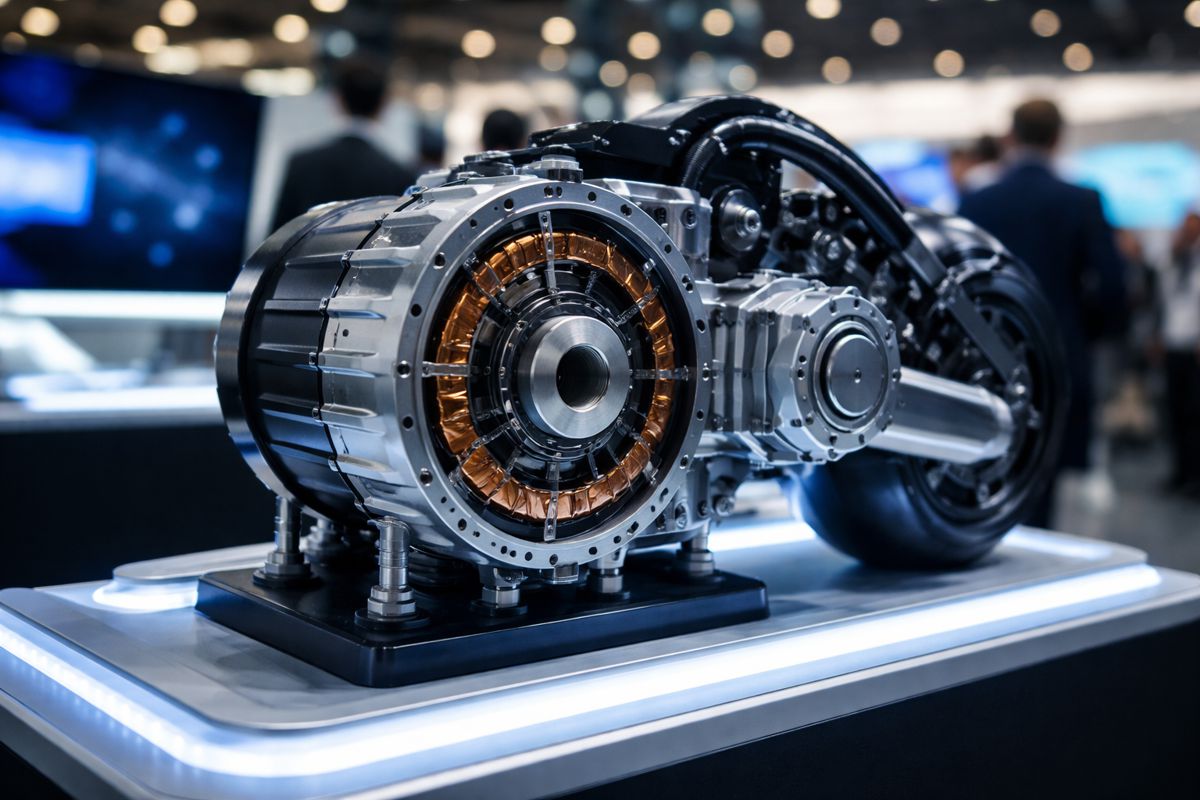
The unveiling of the first prototype at CES 2026 provided a tangible demonstration of what this collaboration aims to achieve. Rather than presenting a conceptual model, the prototype was framed as a functional exploration of reliable high power motor technology engineered without compromise. It signalled a shift from theoretical discussion to applied engineering.
As part of the ongoing exploratory process, both companies are assessing measurable improvements in acceleration, efficiency, torque delivery, and overall riding range. These metrics are not abstract benchmarks but direct indicators of rider experience and commercial viability. While production timelines were not disclosed, the prototype suggests that rare earth free Variable Flux Motors are moving closer to real world deployment.
MATTER’s Platform Level Approach
MATTER brings to the collaboration a track record of integrated powertrain development. Its experience in liquid cooled systems, in house gearbox design, and intelligent vehicle electronics provides a platform capable of absorbing and amplifying motor level innovation. Rather than treating the motor as an isolated component, MATTER’s approach considers how propulsion, control software, and mechanical systems interact under real operating conditions.
This systems level thinking is particularly important for Variable Flux Motors, where control strategies play a central role in unlocking performance. Intelligent management of magnetic flux, thermal load, and power delivery requires close integration between hardware and software. MATTER’s emphasis on in house engineering capability positions it to explore these interactions without the constraints of off the shelf architectures.
Industry Perspectives from the Collaboration
Leadership commentary from both organisations underscores the strategic ambition behind the project. Prasad Telikapalli, Founder and Group CTO of MATTER, framed the collaboration in terms of future readiness and technological independence, stating: “MATTER’s pursuit has always been to build future ready electric mobility solutions that deliver unmatched performance while strengthening India’s technological independence. Niron Magnetics’ Iron Nitride technology represents a step change in what electric motors can achieve, and together we see the opportunity to redefine propulsion for two wheelers globally.”
From the company’s executive leadership, Mohal Lalbhai, Founder and Group CEO of MATTER, emphasised the broader implications for innovation capacity, noting: “Innovation driven systems have the power to eliminate every constraint the industry once accepted as normal. By integrating Niron Magnetics’ Iron Nitride VFM technology into our platform, we are dismantling the barriers that limited how fast, how reliably, and how innovatively India could move.”
Niron Magnetics’ perspective highlights the production scale potential of the technology. Jonathan Rowntree, CEO of Niron Magnetics, commented: “Working with MATTER allows us to demonstrate how Iron Nitride can unlock new frontiers in high performance e mobility. MATTER’s technology first approach and deep understanding of powertrain engineering ideally position them to help us bring rare earth free magnet innovation to production scale applications.”
Implications for the Global EV Ecosystem
The timing of this collaboration is not incidental. Global electrification is accelerating, yet the supply chains underpinning that transition remain exposed to disruption. Rare earth materials sit at the centre of that risk profile. Efforts to diversify sourcing help, but they do not eliminate the underlying environmental and geopolitical challenges.
By advancing a rare earth free motor solution that does not sacrifice performance, MATTER and Niron Magnetics are contributing to a more resilient EV ecosystem. If scalable, such technologies could reduce exposure to material shocks, stabilise long term costs, and lower the environmental burden associated with magnet production. For policymakers, this aligns with broader goals around industrial sovereignty and sustainable manufacturing.
Looking Beyond Two Wheelers
While the immediate focus is electric motorcycles, the underlying principles of Variable Flux Motors and Iron Nitride magnets extend well beyond this segment. Commercial vehicles, industrial drives, and even grid scale applications face similar trade offs between efficiency, performance, and material dependency. Success in the two wheeler market could therefore serve as a proving ground for wider adoption.
The collaboration also illustrates how cross border partnerships can accelerate innovation. Combining an Indian electric mobility platform with advanced magnet technology developed elsewhere creates a pathway for global competitiveness without defaulting to established supply chains. That model may become increasingly common as manufacturers seek both resilience and differentiation in a crowded EV market.
Redefining the Boundaries of Electric Propulsion
What ultimately distinguishes this initiative is its refusal to accept long standing limitations as inevitable. Rare earth dependency, performance trade offs, and thermal constraints have shaped electric motor design for decades. Variable Flux Motor architectures paired with Iron Nitride magnets challenge those assumptions directly.
As the exploratory phase progresses, the industry will be watching closely to see whether the promised gains translate into production ready solutions. If they do, the MATTER and Niron Magnetics collaboration may come to be seen not as an isolated experiment but as an early marker of a broader shift in how electric propulsion is conceived and delivered.