Motive Unveils Edge AI Dashcam Plus For Fleet Safety at CES
Road safety has reached a point where incremental upgrades are no longer enough. Across mature and emerging markets alike, fleets are contending with rising traffic density, distracted driving, skills shortages, tighter compliance regimes, and the ever present pressure to do more with less.
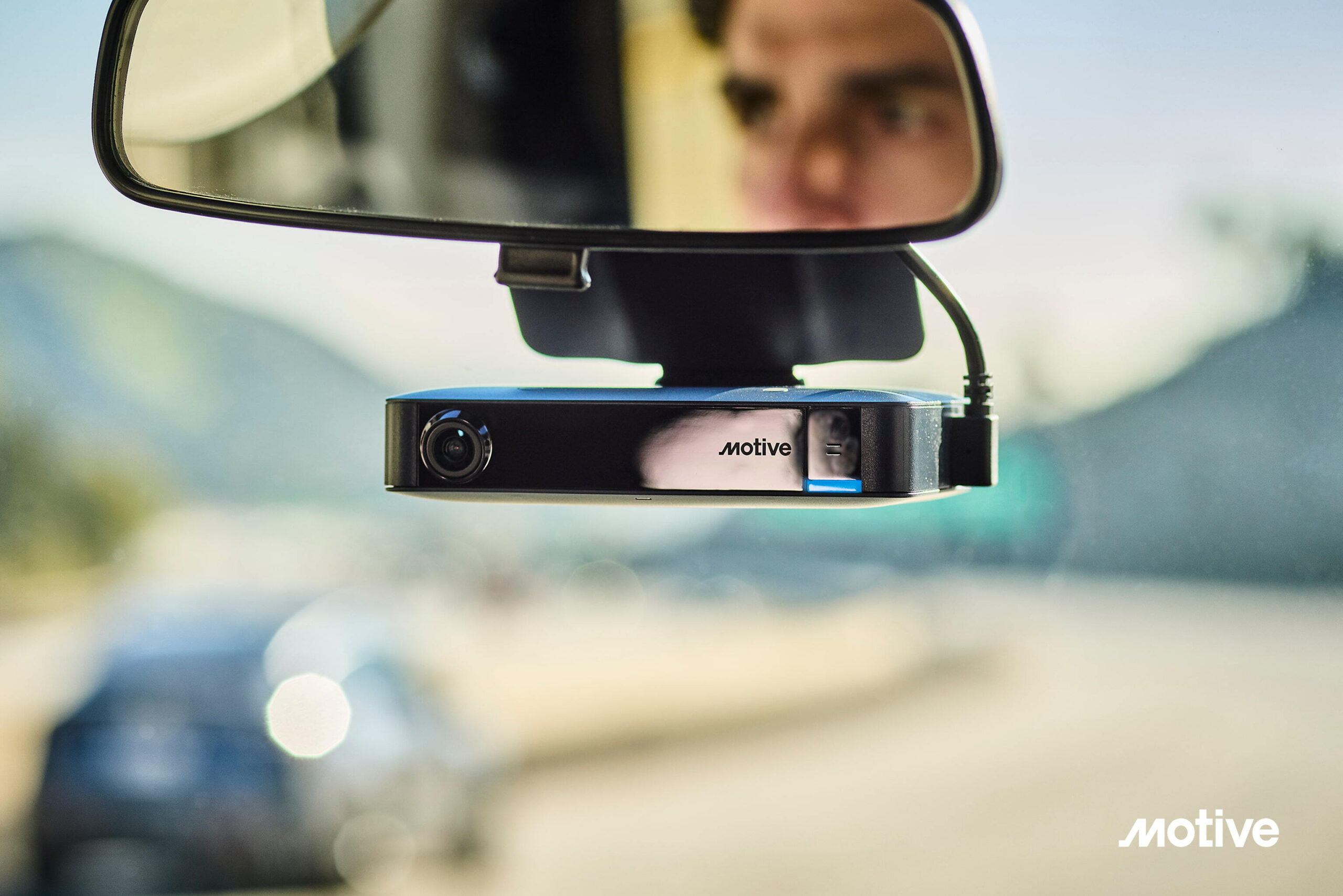
Motive has just introduced AI Dashcam Plus, positioning it not as another in cab camera, but as a shift towards proactive, edge based safety intelligence for physical operations.
In 2024 alone, the UK recorded more than 128,000 roadway casualties, with almost 30,000 incidents classified as serious or fatal. Those numbers underline a hard truth. Reactive safety systems, limited fields of view, delayed alerts, and unreliable hardware are failing organisations when seconds matter most. The argument for smarter, faster, and more reliable on vehicle intelligence has become difficult to ignore.
A Platform Built for Real Time Decisions
AI Dashcam Plus has been designed around one central idea: decisions about risk should be made where the risk exists. By running advanced artificial intelligence models directly on the device, rather than relying on cloud processing alone, the system aims to detect hazards earlier and act faster. At its core sits the Qualcomm Dragonwing QCS6490 processor, delivering roughly three times the AI compute of many leading dash cams currently deployed in fleets.
That additional processing headroom is not a marketing flourish. It allows the device to run more than 30 high precision AI models simultaneously. In practice, this means broader detection of unsafe behaviours, improved accuracy, and fewer false alerts. For drivers, that translates into warnings that feel timely and credible rather than intrusive. For fleet managers, it means cleaner data and greater confidence in the interventions they make.
Stereo Vision Changes the Equation
One of the most significant departures from conventional dash cam design is the introduction of dual forward facing stereo vision. Instead of relying on a single lens to infer distance, AI Dashcam Plus uses two synchronised road facing cameras to create depth perception that mirrors human vision. The system can judge distance, closing speed, and relative motion with far greater precision.
This approach directly improves core safety functions such as forward collision warnings, lane swerving detection, and close following alerts. Rather than reacting late to perceived threats, the system can identify risk earlier, when there is still time to correct behaviour. In congested urban environments or at motorway speeds, that margin can be the difference between a near miss and a serious collision.
Detecting What Others Miss
Beyond vision alone, AI Dashcam Plus leans heavily into sensor fusion. Video and audio feeds are combined with telematics data, GPS, and dual motion sensors to build a more complete picture of what is happening around and within the vehicle. This multi modal approach enables detection of complex events that simpler systems routinely miss.
For example, the sound profile of breaking glass can trigger alerts for a potential break in, while subtle vibration patterns can help confirm low severity collisions that might otherwise go unreported. These capabilities extend the value of the dash cam beyond driver behaviour into asset protection and incident verification, areas of growing importance for commercial operators.
Automated Number Plate Recognition in the Real World
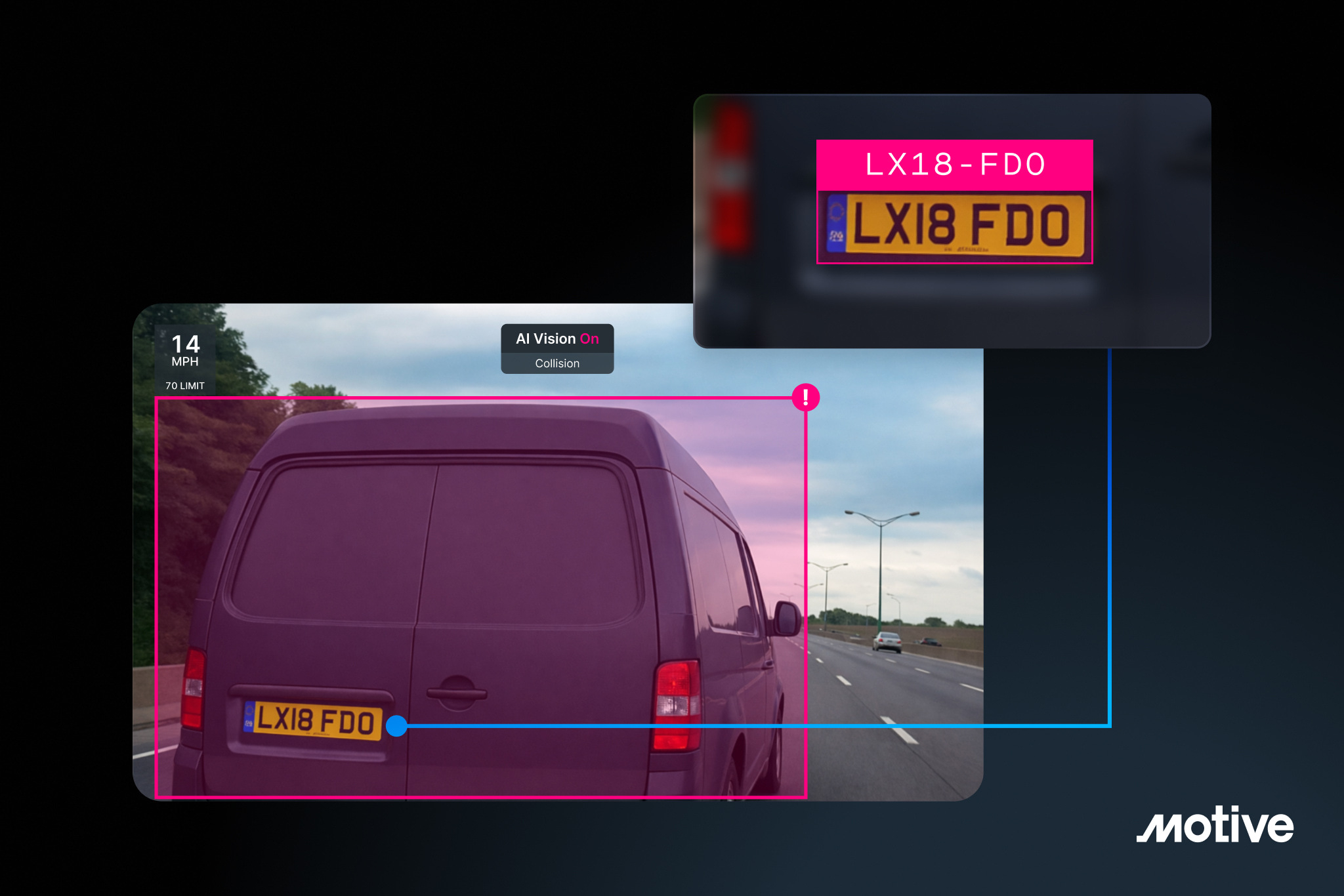
AI Dashcam Plus also introduces automated number plate recognition using a dedicated 1440p zoom lens with a narrow field of view. Unlike basic implementations that struggle in poor conditions, this configuration is designed to capture readable plates from long distances, in motion, and in adverse weather.
For fleets, this can prove invaluable in the aftermath of hit and run incidents, theft, or disputed events. Clear, verifiable evidence speeds up investigations, supports insurers, and, critically, helps exonerate drivers when they are not at fault. In an era where liability and reputational risk loom large, that capability carries real operational weight.
From Cameras to Conversations
Technology alone does not prevent accidents. Communication, when handled well, remains one of the most effective safety tools available. AI Dashcam Plus integrates live, hands free two way calling directly into the device, allowing drivers and managers to connect instantly without compromising safety.
Drivers can speak to managers using voice activated controls, while managers can reach drivers directly through the Motive dashboard or fleet app. This opens the door to timely check ins around fatigue, severe weather, route changes, or emerging vehicle issues. It also gives drivers a safe way to report problems, request directions, or respond to concerns without reaching for a phone.
Voice as a Safety Interface
The introduction of an AI voice assistant further reinforces the hands free philosophy. With a simple voice command, drivers can save critical footage, check remaining journey time, or locate nearby service stations. These interactions keep eyes on the road and hands on the wheel, addressing one of the most persistent causes of distraction in modern driving.
AI driven automations extend that concept into fleet wide efficiency. Automated alerts can prompt drivers to address time sensitive issues such as critical fault codes or excessive idling, helping organisations reduce both safety risks and operating costs. Over time, these small interventions can compound into meaningful performance gains.
Reliability as a Design Principle
In safety critical systems, reliability is not optional. One of the more pragmatic design choices behind AI Dashcam Plus is its unified hardware architecture. By combining the AI dash cam and vehicle gateway into a single device, installation time can be cut by nearly half. Fewer components also mean fewer failure points, reducing downtime and ongoing maintenance overheads.
This integration has a direct impact when incidents occur. Improved connectivity and unified hardware help ensure that critical collision footage uploads successfully, even if a cable becomes disconnected. When evidence is needed most, the system is designed to deliver.
Built on a Modern Software Foundation
AI Dashcam Plus runs on an Android based platform, providing a mature and secure framework for voice, audio, connectivity, and AI services. This choice enables rapid feature deployment without constant hardware refresh cycles. Over the air updates can introduce new AI models, refine existing ones, and improve performance as algorithms evolve.
The architecture also allows the system to optimise workloads across the processor’s CPU, GPU, and dedicated AI accelerators. As a result, latency is reduced and responsiveness improved with each update. Dual SIM, multi carrier connectivity further strengthens reliability by maintaining 4G coverage even in rural or hard to reach areas.
A Shift Towards Proactive Safety
The launch of AI Dashcam Plus reflects a broader change in how fleets think about safety. Rather than analysing incidents after they occur, organisations are increasingly looking to prevent them altogether. That shift was captured by Motive co founder and chief executive Shoaib Makani, who said: “Collision rates and related costs remain unacceptably high around the world. Organisations need AI powered driver safety solutions that can perceive and respond in real time. We’ve added three times more compute, created the first AI dash cam with stereo vision, and added hands free communication, all in one system, so organisations can detect more risks and act faster. This isn’t just a new product; it reflects a shift toward proactive, AI driven road safety.”
Industry partners have echoed that sentiment. Erick Hong, head of smart home and life at Qualcomm Technologies, noted: “Motive’s AI Dashcam Plus shows how on device AI can transform road safety at scale. Built on the Qualcomm Dragonwing QCS6490, it delivers the concurrency, responsiveness, and reliability fleets need running numerous AI models at the edge with lower latency. We’re proud to collaborate with Motive to help organisations detect risks sooner, communicate instantly, and keep drivers and communities safer.”
Evidence From the Field
Claims of improved safety carry more weight when backed by data. Since 2023, Motive’s AI dash cam technology is estimated to have helped prevent more than 170,000 accidents and saved around 1,500 lives in North America. A 2023 study commissioned by Motive and conducted by the Virginia Tech Transportation Institute found that the system alerted drivers to four unsafe driving behaviours two to four times more often than competing AI dash cams.
On average, customers using Motive’s AI dash cam reported an 80 percent reduction in collisions and a 63 percent reduction in accident related costs. These figures help explain why interest in AI driven safety platforms continues to grow, particularly among large fleets operating at scale.
Safety, Accountability, and the Future Fleet
Analysts see this trend accelerating. Beatriz Minamy, principal analyst at S and P Global Market Intelligence, observed: “Improving driver and vehicle safety is among the top three priorities for truckload carriers globally when adopting new technologies, according to the 451 Research Supply Chain Digital Transformation Survey 2025. AI powered solutions that enable real time coaching, automated in cab alerts for unsafe behaviours and proactive risk detection are becoming central to how fleets strengthen safety and accountability.”
As regulatory scrutiny intensifies and public expectations around road safety rise, technologies that can demonstrate measurable impact will stand apart. AI Dashcam Plus sits squarely within that movement, combining edge AI, advanced sensing, and human centred communication into a single platform. For fleets seeking to move beyond reactive compliance and towards genuinely safer operations, that combination may prove difficult to ignore.