From Protection to Prediction with Intelligent Infrastructure Coatings
Across the global construction and infrastructure landscape, the ability to understand how assets behave in real time has become a strategic concern rather than a technical curiosity. Bridges, tunnels, industrial facilities, vehicle structures and transport networks are ageing under increasing loads, harsher climates and tighter safety expectations.
Yet structural health monitoring at scale remains stubbornly difficult. Conventional sensors are often rigid, intrusive, expensive to install and poorly suited to complex geometries or hostile outdoor environments. As a result, much of the world’s critical infrastructure still operates with limited visibility into how damage accumulates over time.
New research published in Advanced Nanocomposites points to a potential shift in how this challenge is addressed. Rather than attaching discrete sensors to structures, a research team has developed a spray-applied sensing coating that turns the structure itself into a monitoring surface. The work outlines a polyurea-based nanocomposite coating reinforced with covalently functionalised graphene nanoplatelets, designed to provide both mechanical protection and reliable, real-time strain and damage sensing.
For infrastructure owners, transport authorities and automotive manufacturers, the significance lies not in incremental sensor improvements but in the possibility of deploying monitoring at scale. A coating that can be sprayed onto real structures, withstand long-term weather exposure and deliver stable electrical sensing could reshape how asset condition is assessed across entire networks.
Why Conventional Monitoring Falls Short
Structural health monitoring has long promised earlier intervention, lower lifecycle costs and improved safety. In practice, deployment has been uneven. Traditional strain gauges, fibre optic systems and embedded sensors often struggle once projects move beyond laboratory conditions. Installation can be labour-intensive, calibration sensitive and maintenance demanding. More critically, these systems rarely adapt well to curved surfaces, joints, welds or retrofitting scenarios, which are common in real infrastructure.
Environmental durability adds another layer of complexity. Sensors exposed to moisture, ultraviolet radiation, temperature cycling and corrosion often degrade faster than the structures they monitor. In transport and automotive applications, vibration, impact and rapid loading introduce further challenges. As a result, monitoring solutions that work well in controlled tests may fail prematurely in the field.
These limitations explain why many infrastructure owners still rely heavily on periodic visual inspections and conservative maintenance schedules. While digital twins, AI-driven analytics and predictive maintenance frameworks continue to advance, their effectiveness is constrained by the quality and coverage of physical data. Without scalable, durable sensing at the material level, the data gap remains.
A Coating That Combines Protection and Sensing
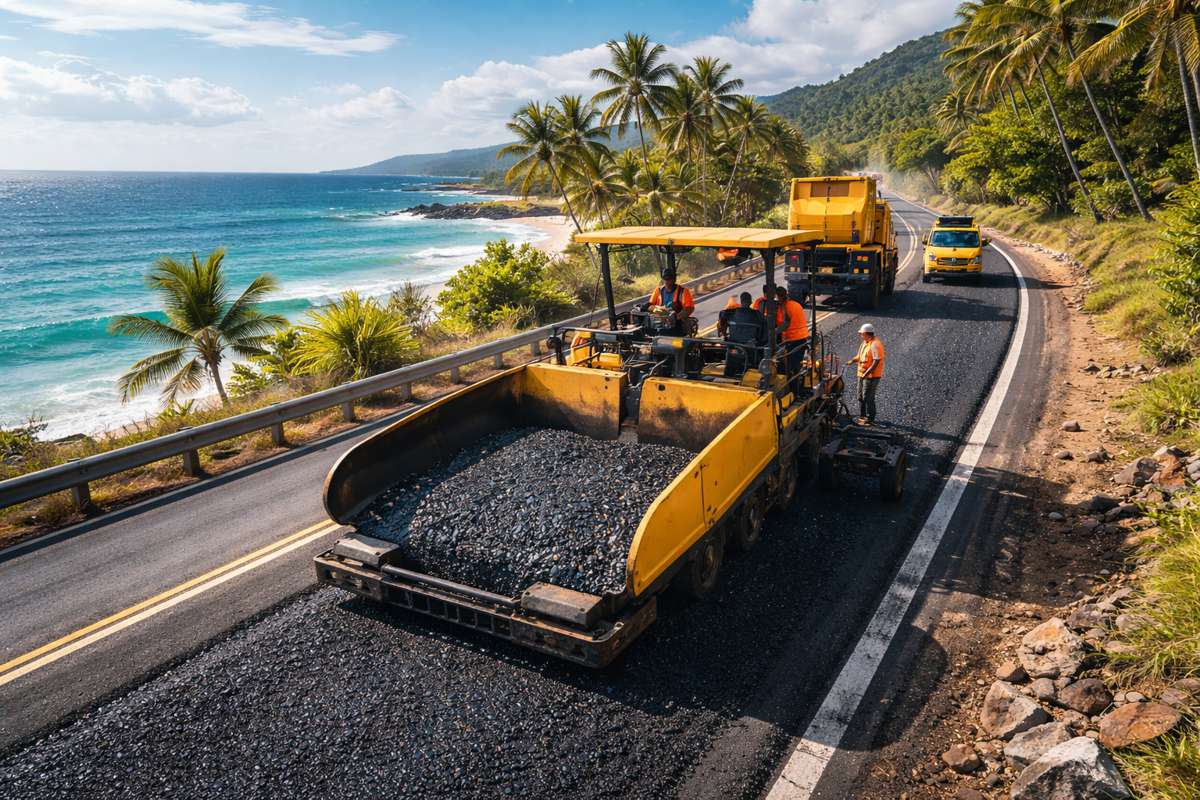
The approach described in the study centres on a two-component spray polyurea coating, a material already familiar to construction and industrial sectors for its fast curing, toughness and protective properties. Polyurea coatings are widely used for waterproofing, corrosion protection and impact resistance on bridges, pipelines and industrial structures. By integrating sensing capability directly into this established coating technology, the research addresses adoption barriers head on.
The innovation lies in reinforcing the polyurea matrix with graphene nanoplatelets that have been covalently functionalised using an HDIT trimer. This molecular modification allows the graphene fillers to disperse uniformly and chemically integrate into the polyurea network during rapid spray application. The result is a stable conductive network embedded within a mechanically robust coating.
According to the research team, this integration is crucial. Spray application involves fast gelation, which has historically made it difficult to form consistent conductive pathways using nanofillers. The covalent functionalisation effectively anchors the graphene within the polymer microstructure, strengthening hydrogen bonding and preventing agglomeration that would otherwise compromise sensing performance.
Bridging Processability and Performance
One of the persistent trade-offs in sensing coatings has been the balance between ease of application, long-term durability and reliable electromechanical behaviour. Coatings that perform well electrically may be difficult to apply at scale or degrade rapidly outdoors. Conversely, durable protective coatings often lack consistent sensing sensitivity.
The study suggests that this trade-off can be overcome. As corresponding author Qingshi Meng, professor of aerospace engineering at Shenyang Aerospace University, explains: “Our work introduces a spray-applied polyurea-based nanocomposite sensing coating that integrates covalently functionalized graphene nanoplatelets into a two-component polyurea matrix—improving processability for scalable deployment, enhancing weatherability for long-term outdoor service, and establishing a robust conductive network that delivers strong, reliable resistive sensing.”
This combination matters because scalability is often the deciding factor between promising research and practical deployment. Infrastructure owners are unlikely to adopt monitoring technologies that require bespoke installation or frequent recalibration. A spray-on solution that aligns with existing protective coating workflows could be integrated into construction, refurbishment and maintenance programmes with minimal disruption.
Mechanical Toughness Meets Electrical Stability
Beyond processability, the research highlights the mechanical resilience of the sensing coating. Polyurea is valued for its toughness, adhesion and resistance to abrasion and chemicals. By reinforcing this matrix at the molecular level, the coating retains these protective qualities while adding sensing functionality.
The conductive network formed by the functionalised graphene operates at a low percolation threshold, meaning reliable electrical pathways are achieved without excessive filler content. This is significant because high filler loadings can compromise flexibility and adhesion. The study reports that the coating maintains strong strain sensitivity while withstanding mechanical loading, environmental exposure and corrosion conditions representative of real-world service.
From an infrastructure perspective, this opens the door to coatings that do more than protect surfaces. They could continuously report on strain accumulation, crack initiation or impact damage across large areas, providing early warning signals long before visible deterioration appears.
Implications for Infrastructure Asset Management
For transport agencies and asset owners, the potential implications extend well beyond materials science. Continuous, distributed sensing could support a shift from reactive maintenance to condition-based strategies. Rather than relying on fixed inspection intervals, operators could prioritise interventions based on measured structural response and emerging damage patterns.
This aligns with broader trends in digital infrastructure management. As BIM models evolve into operational digital twins, the demand for reliable, real-time data from physical assets continues to grow. A sensing coating that conforms to complex geometries and operates outdoors over long periods could feed directly into these digital systems, improving predictive accuracy and decision-making.
In regions facing climate stress, heavier traffic loads or ageing asset portfolios, such capability could translate into tangible cost savings and safety improvements. Early detection of strain anomalies or localised damage allows targeted repairs, reducing the risk of sudden failures and extending asset life.
Automotive and Mobility Applications
While infrastructure forms a major focus, the research also carries implications for automotive and mobility sectors. Vehicle structures increasingly rely on lightweight materials and complex geometries, particularly as electrification and advanced safety requirements reshape design priorities. Monitoring strain and damage in these structures is challenging, especially in components exposed to vibration, moisture and thermal cycling.
A spray-applied sensing coating could be used during manufacturing or refurbishment to monitor fatigue, impact damage or deformation over a vehicle’s service life. For commercial fleets, such data could inform maintenance planning and improve safety compliance. In emerging mobility platforms, including autonomous vehicles, structural integrity monitoring could complement sensor redundancy strategies.
The dual role of protection and sensing is particularly relevant here. Coatings that resist corrosion and environmental degradation while simultaneously providing structural feedback reduce the need for separate systems, simplifying design and maintenance.
Encouraging a New Class of Multifunctional Coatings
The researchers note that their work is intended to encourage broader exploration of molecularly engineered nanofillers in functional coatings. Rather than treating sensing as an add-on, this approach integrates electrical functionality into the material’s fundamental structure.
As Meng observes: “Until now, scalable strain-sensing coatings have often faced a trade-off between easy spray processing, long-term weather resistance, and reliable electromechanical performance. By using covalently functionalized graphene to build a stable conductive network within a sprayable polyurea, we show these requirements can be met simultaneously.”
For the construction and infrastructure ecosystem, this signals a potential shift in how monitoring technologies are conceived. Instead of installing sensors onto structures, the structure’s surface can become the sensor, applied using familiar techniques and materials.
Research Context and Future Outlook
The study builds on growing interest in nanocomposite materials for smart infrastructure applications. Graphene-based fillers have been explored extensively for sensing, but challenges around dispersion, durability and scalability have limited adoption. By addressing these challenges through chemical functionalisation and integration with established coating systems, the research advances the conversation from laboratory feasibility to field relevance.
External research continues to underline the scale of the opportunity. Global infrastructure spending remains under pressure to deliver greater resilience and sustainability from existing assets. Technologies that enable earlier intervention and data-driven maintenance are increasingly viewed as essential rather than optional.
While further validation under diverse field conditions will be required, the work demonstrates a credible pathway towards multifunctional coatings that meet the practical demands of infrastructure and automotive deployment. Supported by national and provincial research funding in China, the study also reflects broader investment trends in smart materials and infrastructure resilience.
A Step Towards Smarter Surfaces
What ultimately distinguishes this development is its alignment with real-world constraints. Harsh environments, complex geometries and the need for scalable application are not afterthoughts but central design considerations. By combining mechanical protection with stable, real-time sensing in a spray-applied coating, the research offers a pragmatic route towards smarter surfaces across infrastructure and transport systems.
As asset owners grapple with ageing networks and rising performance expectations, such approaches could help close the gap between digital ambition and physical reality. The ability to monitor strain and damage continuously, without fundamentally changing construction or maintenance practices, may prove to be one of the more quietly transformative advances in the push towards resilient, data-driven infrastructure.