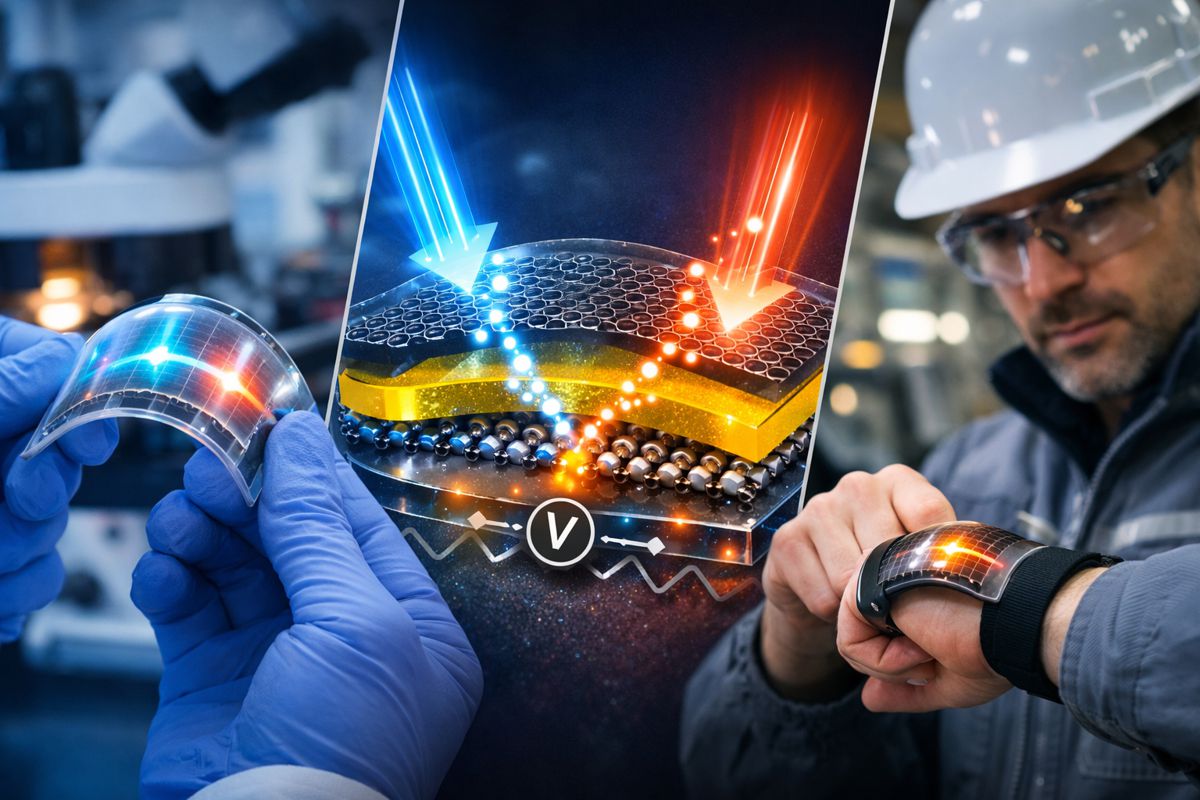
Electrically Tuneable Flexible Photodetectors for Smart Infrastructure
Flexible photodetectors are quietly becoming indispensable across modern infrastructure systems. From structural health monitoring embedded in transport networks to wearable safety systems on construction sites, the need for sensors that bend without breaking while maintaining precise optical performance has never been clearer. Traditional rigid photodetectors, for all their reliability, struggle once deformation enters the equation. Mechanical strain can introduce signal instability, shorten operational lifespan, and complicate integration into curved or soft surfaces that increasingly define modern infrastructure environments.
At the same time, most flexible photodetector designs still depend on external optical filters or multi layer components to differentiate wavelengths. That reliance introduces bulk, reduces optical efficiency, and limits how seamlessly sensors can be embedded into compact or adaptive systems. In sectors where millimetres matter and reliability is non negotiable, these constraints add up quickly. The challenge facing researchers has therefore centred on developing flexible photodetectors that deliver intrinsic wavelength selectivity without adding complexity.
Recent research emerging from Xi’an Jiaotong University suggests that electrically tuneable spectral control may offer a viable solution. Published in Microsystems & Nanoengineering, the study introduces a flexible, gate controlled photodetector capable of dynamically shifting its spectral sensitivity while maintaining performance under mechanical bending. The implications stretch far beyond laboratory curiosity and point toward a new generation of intelligent sensing platforms for infrastructure, construction, and industrial systems.
Why Wavelength Selectivity Matters for Infrastructure Systems
In infrastructure applications, spectral discrimination is not a luxury feature. It underpins accurate environmental sensing, material monitoring, and safety diagnostics. For instance, wavelength selective photodetection enables more precise detection of surface contamination, structural stress indicators, and atmospheric conditions that influence transport safety. In rail and highway environments, spectral sensing can help distinguish between materials, detect wear patterns, and enhance machine vision systems used in autonomous inspection vehicles.
Yet conventional solutions often rely on layered optical filters that introduce inefficiencies. Each additional component increases the chance of signal loss while adding weight and thickness that limit flexibility. In wearable technologies used by construction workers, this can translate into reduced comfort and reliability. In embedded infrastructure sensors, it complicates installation and maintenance while increasing long term operational costs.
The appeal of an electrically tuneable photodetector lies in its ability to adapt in real time without mechanical intervention. Instead of swapping filters or relying on multiple detectors, a single device can shift its peak response through electrical control. That flexibility opens the door to multi functional sensing platforms capable of adapting to different monitoring needs over time. In large scale infrastructure networks, where adaptability often determines long term viability, this capability could prove transformative.
The Science Behind Electrically Tuneable Photodetection
The research centres on asymmetric van der Waals heterostructures composed of graphene, molybdenum disulfide, and single walled carbon nanotubes fabricated on a flexible polymer substrate. Two dimensional materials have long attracted attention for their tuneable electronic properties and strong interactions with light, yet their use in electrically controlled spectral differentiation has remained largely theoretical until now.
The breakthrough stems from engineering asymmetry into the device architecture. Heterojunctions at opposite ends of the MoS₂ channel are deliberately designed with different work function offsets. One interface pairs graphene with MoS₂, while the other combines carbon nanotubes with MoS₂. This configuration creates unequal built in electric fields, producing an internal potential gradient that suppresses thermally excited carriers under low bias conditions.
That internal asymmetry is not just an academic detail. It directly contributes to reduced dark current and improved detectivity. Compared with symmetric designs, the architecture enhances specific detectivity by nearly an order of magnitude. In practical terms, this means clearer signals, lower noise levels, and greater reliability when deployed in real world environments where conditions are rarely ideal.
Electrical Gating Unlocks Dynamic Spectral Control
Perhaps the most striking aspect of the device is its gate voltage controlled spectral response. By adjusting the gate voltage, researchers can shift the Fermi level of MoS₂, effectively determining which heterojunction dominates photocarrier separation. This mechanism enables real time switching between peak responses at different wavelengths without altering the physical structure of the device.
Under positive gate bias, the graphene MoS₂ junction becomes more influential, enhancing sensitivity at shorter wavelengths around 450 nanometres. Conversely, applying a negative gate bias strengthens the MoS₂ nanotube junction, increasing responsiveness to longer wavelengths near 635 nanometres. The reported responsivity reaches up to 40.3 A/W, while specific detectivity peaks at 1.3 × 10¹¹ Jones.
For infrastructure monitoring systems, this level of adaptability offers clear advantages. A single sensor could, in principle, handle multiple detection tasks that previously required several devices. This reduces hardware redundancy, lowers installation costs, and simplifies maintenance schedules. More importantly, it introduces the possibility of adaptive sensing networks that evolve alongside changing operational demands.
Mechanical Durability Supports Real World Deployment
Flexibility alone does not guarantee usability. Sensors deployed in construction, transport, or industrial settings must withstand repeated mechanical stress without performance degradation. The study’s mechanical testing demonstrates that optoelectronic characteristics remain stable under repeated bending, reinforcing the viability of the approach for real world applications.
This durability is particularly relevant for wearable technologies used in safety monitoring. Devices integrated into clothing or protective equipment must endure constant movement while delivering consistent performance. Similarly, sensors embedded in bridges, tunnels, or transport vehicles experience continuous vibration and strain. A photodetector capable of maintaining wavelength selectivity and sensitivity under such conditions addresses one of the most persistent barriers to flexible electronics adoption.
From a commercial perspective, mechanical reliability also influences lifecycle costs. Infrastructure stakeholders increasingly prioritise technologies that minimise maintenance disruptions and maximise operational longevity. A sensor platform that delivers both adaptability and durability aligns well with these expectations, especially in sectors where downtime carries significant financial implications.
Eliminating Optical Filters Simplifies System Design
One of the most compelling aspects of the research lies in its ability to remove the need for additional optical components. Traditional wavelength selective photodetectors often depend on filters that introduce complexity and reduce efficiency. By leveraging asymmetric interfacial band engineering, the new device achieves spectral selectivity through electrical control alone.
This simplification has practical benefits across multiple sectors. In compact imaging systems used for infrastructure inspection, reducing component count allows for lighter, more portable devices. In environmental monitoring, fewer components translate into lower energy consumption and improved reliability. Across industrial applications, streamlined sensor architectures reduce manufacturing complexity and open pathways to scalable production.
The ability to extend this strategy to broader wavelength ranges also holds promise. Researchers note that integrating other two dimensional semiconductors could expand spectral coverage, creating versatile platforms capable of addressing diverse sensing needs. For industries investing in long term digital transformation, such scalability is particularly attractive.
Implications for Construction and Transport Technology
Electrically tuneable, wavelength selective photodetectors could influence several areas of construction and transport technology. In structural health monitoring, adaptive sensors may help identify material fatigue or surface degradation with greater precision. In autonomous inspection systems, dynamic spectral control can enhance machine vision capabilities, improving detection accuracy under varying lighting conditions.
Transport infrastructure could also benefit from enhanced environmental sensing. Photodetectors capable of switching wavelengths may support advanced traffic monitoring systems, detect atmospheric changes that influence road safety, and improve visibility assessments in challenging weather conditions. As infrastructure networks become increasingly data driven, the role of adaptable sensing technologies is expected to grow.
For policymakers and investors, developments in flexible optoelectronics represent more than incremental progress. They signal a shift toward infrastructure systems that are not only resilient but intelligent. Technologies that combine flexibility, sensitivity, and spectral intelligence align closely with broader goals of sustainability, efficiency, and safety in global infrastructure development.
A Framework for Reconfigurable Optoelectronic Design
Beyond its immediate applications, the asymmetric heterostructure strategy introduced in this research provides a broader design framework for reconfigurable optoelectronic devices. By demonstrating that wavelength selectivity can be achieved through electrical control rather than mechanical components, the study opens new avenues for innovation in flexible electronics.
Future developments may explore integration with other sensing modalities, creating multi functional platforms capable of monitoring light, temperature, and mechanical stress simultaneously. Such convergence would further reduce hardware redundancy while enhancing data quality. In infrastructure systems where real time information supports critical decision making, these advancements carry significant potential.
As digital transformation continues to shape construction and transport industries, adaptable sensor technologies are poised to play a central role. The ability to tailor performance dynamically without altering physical structures aligns with emerging priorities around sustainability, cost efficiency, and operational resilience. This research therefore represents not only a technical achievement but a glimpse into the future of intelligent infrastructure systems.