CABEI Deepens Strategic Investment in the Dominican Republic’s Infrastructure
The scale of multilateral development finance flowing into the Dominican Republic has grown steadily in recent years, and the latest figures from the Central American Bank for Economic Integration underline just how significant that relationship has become. By the end of 2025, the Bank had approved 21 operations in the country totalling more than US$2.9 billion, with cumulative disbursements exceeding US$1.5 billion.
Those numbers are more than headline figures, they signal a structured programme of capital deployment across water, energy, health, transport and productive development, sectors that collectively shape the Dominican Republic’s competitiveness and resilience. In a region where infrastructure gaps remain a constraint on growth, this level of sustained financing carries strategic weight.
Infrastructure as the Foundation of Economic Competitiveness
Infrastructure remains one of the most powerful levers of economic transformation in emerging markets. According to the Inter-American Development Bank and the World Bank, Latin America and the Caribbean must invest between 3.5 and 5 percent of GDP annually in infrastructure to close service gaps and sustain productivity gains. The Dominican Republic, one of the fastest growing economies in the Caribbean over the past decade, is no exception.
Within this context, CABEI’s portfolio in the country is clearly aligned with long-term structural needs. Resources have been directed towards large-scale infrastructure and social investment projects that address water security, agricultural productivity, public health and economic inclusion. Rather than isolated interventions, the operations form part of a broader development architecture designed to reduce vulnerability and expand opportunity.
From a construction and engineering standpoint, this translates into sustained project pipelines, complex hydraulic works, complementary civil infrastructure and associated procurement chains. In other words, it is capital that feeds directly into the regional construction ecosystem.
Water Security and Climate Resilience at the Core
Among the most commercially and socially significant approvals during 2025 was the US$80.9 million investment for the Southwest Region Multiple Aqueduct Project, known as ASURO. The scheme targets improved drinking water access in the provinces of Barahona, Bahoruco and Independencia, areas historically exposed to both social and climate vulnerability.
Water infrastructure is often underestimated in macroeconomic discussions, yet it sits at the intersection of public health, agricultural output and climate resilience. The United Nations has repeatedly warned that water scarcity and inadequate sanitation remain development bottlenecks across Latin America, particularly in rural and peri-urban communities. By focusing on service coverage, quality and continuity, the ASURO project aims to address systemic weaknesses rather than patchwork deficiencies.
More than 580,000 people are expected to benefit directly from the improvements. For engineers and contractors, the implications are clear. Strengthening water intake systems, distribution networks and storage facilities requires specialised hydraulic design, resilient materials and robust operational planning. For policymakers, meanwhile, the project forms part of a broader strategy to safeguard water resources against intensifying climate variability.
Monte Grande and the Multipurpose Infrastructure Model
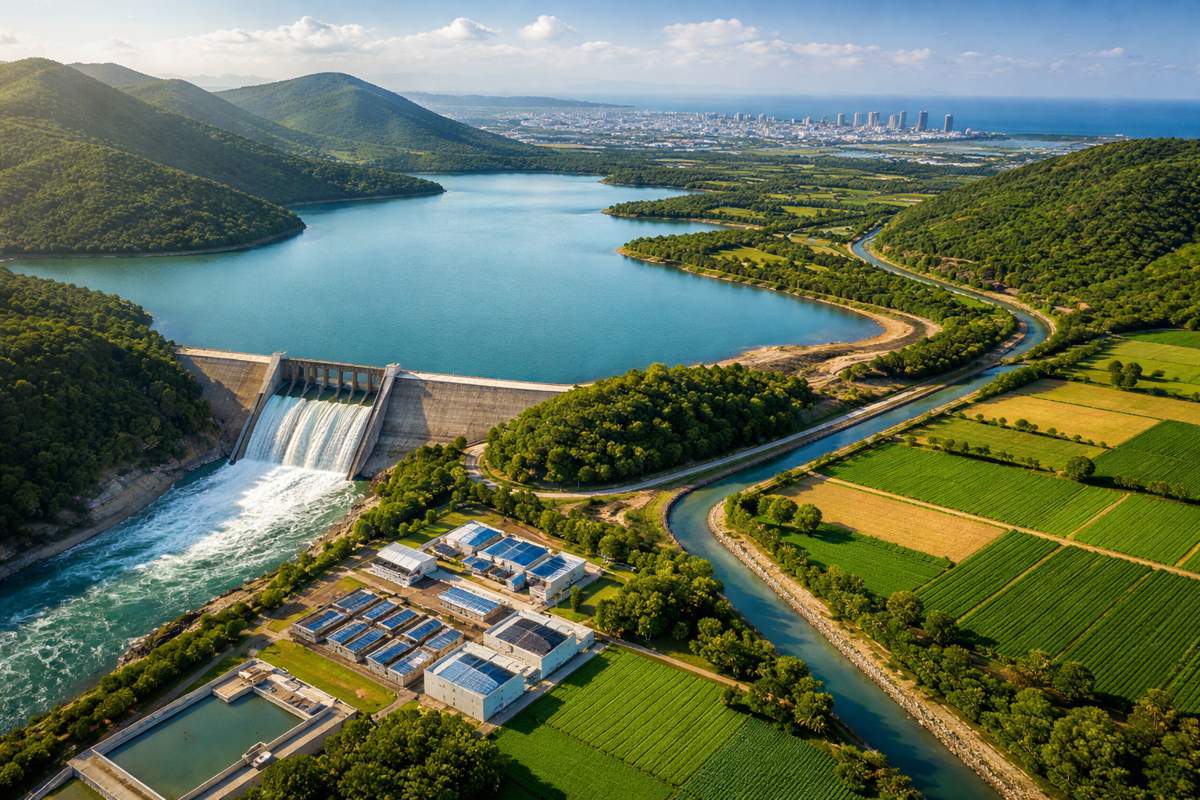
Complementing the new aqueduct investment is the Monte Grande Multipurpose Dam Project, already in operation in the southern region of the country. The dam benefits 51 communities and represents a classic example of multipurpose infrastructure, delivering water security, flood control and agricultural irrigation within a single integrated asset.
Multipurpose dams are increasingly viewed as essential components of climate adaptation strategies. By regulating river flows and improving irrigation reliability, they help buffer agricultural systems against extreme weather events. In economies where food security remains a political and economic priority, that buffering capacity is not a luxury but a necessity.
The complementary works currently under way for Monte Grande are intended to maximise the use of stored water for irrigation. Enhanced irrigation networks, in turn, can increase crop yields, stabilise rural incomes and reduce reliance on food imports. For the construction sector, such complementary works often involve secondary canals, pumping stations and rural access improvements, each representing additional layers of economic activity.
Financing the Productive Fabric and MSMEs
Large-scale infrastructure attracts attention, yet sustainable growth also depends on the vitality of micro, small and medium-sized enterprises. In the Dominican Republic, MSMEs account for a substantial share of employment and economic output, making access to finance a persistent policy priority.
CABEI’s approval of a US$100 million Global Credit Line for Banco Popular Dominicano is therefore commercially significant. The facility is designed to expand financing access, with particular emphasis on women and housing solutions. In practical terms, this creates liquidity for small businesses operating in construction supply chains, local services and housing-related trades.
Financial inclusion has long been linked to broader economic resilience. The World Bank’s Global Findex data shows that improved access to credit correlates with higher levels of enterprise formation and income stability. For the construction and infrastructure ecosystem, stronger MSMEs mean more capable subcontractors, more resilient local suppliers and a broader base of innovation.
Data as Development Infrastructure
One of the more understated yet strategically important initiatives involves CABEI’s US$100,000 contribution to the Microenterprise Financing Fund Inc., known as FondoMicro, to support the 2025 FondoMicro Survey. While modest in monetary terms, the operation reinforces the idea that reliable data is itself a form of infrastructure.
High-quality, up-to-date information on households and micro and small enterprises enables more effective policy design. For governments and lenders, understanding sectoral trends, financing gaps and demographic characteristics allows for targeted interventions rather than blanket measures.
In an era where data-driven policymaking is becoming standard practice, such surveys provide the evidence base required to calibrate credit programmes, refine inclusion strategies and monitor economic transformation. For investors, credible data reduces uncertainty and enhances risk assessment.
Recognising Grassroots Enterprise
Since 2021, the CABEI Solidarity Awards for Microenterprises have recognised more than 306 entrepreneurs in the Dominican Republic and, at the regional level, 12 Latin American microentrepreneurs. Although awards may appear symbolic, they play a practical role in strengthening financial literacy, promoting formalisation and encouraging innovation at the micro level.
Recognition platforms can help bridge the gap between informal entrepreneurship and formal financial systems. By spotlighting viable business models and strengthening business skills, they contribute indirectly to job creation and local value chains.
For construction and infrastructure stakeholders, thriving microenterprises often become suppliers, service providers or subcontractors. The ripple effect from improved entrepreneurial capacity can therefore extend well beyond individual award recipients.
Aligning Investment with Long Term National Priorities
Looking ahead, the Dominican Republic faces familiar regional challenges. Infrastructure gaps remain, access to basic services must be expanded, financial inclusion requires deepening and the transition to more resilient, low carbon and gender responsive economic models is accelerating.
Multilateral development banks play a pivotal role in this transition. By aligning financing with national priorities and coordinating with government institutions and private sector actors, they can reduce fragmentation and increase impact. The emphasis on sustainable, long term outcomes rather than short term disbursement volumes is particularly relevant in a climate constrained world.
In practical terms, this means investments must integrate resilience standards, environmental safeguards and social inclusion criteria from the outset. For engineering firms and contractors operating in the Dominican Republic, compliance with these frameworks is increasingly non negotiable. It shapes procurement processes, technical specifications and reporting obligations.
The Regional Construction Ecosystem
Taken together, CABEI’s US$2.9 billion in approved operations represents more than a funding tally. It constitutes a structured investment platform that underpins civil works, hydraulic engineering, agricultural modernisation and financial inclusion.
For construction professionals, it signals a pipeline of projects that demand technical expertise and long term asset management capabilities. For investors, it reflects institutional backing that can de risk participation in large scale schemes. For policymakers, it demonstrates how coordinated multilateral engagement can support economic growth while addressing social and environmental vulnerabilities.
The Dominican Republic’s trajectory over the past decade has been marked by steady expansion, yet sustaining that momentum requires continuous infrastructure upgrading and inclusive financing mechanisms. By combining water security projects, multipurpose dams, MSME credit lines and data driven initiatives, CABEI is embedding itself as a strategic partner in that evolution.
As global capital markets tighten and climate pressures intensify, access to stable development finance becomes even more valuable. In that sense, the Bank’s growing footprint in the Dominican Republic is not just about individual projects. It is about reinforcing the foundations on which future growth, resilience and social cohesion will depend.