Hydrogel Power Technology Advances Intelligent Infrastructure Design
Across modern engineering, from robotic inspection tools to implantable medical sensors, power supply has quietly become one of the biggest bottlenecks in innovation. Electronics are shrinking, software intelligence is advancing rapidly and sensing capability keeps improving, yet the battery often remains rigid, toxic, bulky or thermally unstable. That mismatch is now limiting progress across several sectors including infrastructure monitoring, smart materials and human integrated robotics.
Conventional lithium based batteries excel at storing energy but struggle when placed near the human body, soft materials or deformable machinery. They rely on rigid casings, contain reactive chemistries and require mechanical protection. In civil infrastructure this limits how sensors can be embedded into concrete, pavements or structural composites. In medicine the limitations are even clearer, where implanted systems must operate in wet, moving and chemically sensitive environments.
Researchers at Pennsylvania State University have been working on a different path entirely. Instead of forcing machines to adapt to batteries, they are adapting power systems to behave more like living tissue. Their latest work demonstrates a flexible hydrogel based power source inspired by the biological electricity generation mechanism of electric eels. Published in Advanced Science, the study suggests energy storage may move closer to biological compatibility rather than mechanical containment.
Why Biology Inspired Electricity Matters To Infrastructure Technology
Biologically compatible power systems are not simply a medical curiosity. They are directly relevant to infrastructure engineering. Smart roads, structural health monitoring networks and embedded environmental sensing increasingly rely on distributed electronics placed in harsh conditions such as wet soil, salt exposure and constant vibration. Traditional batteries degrade quickly in these environments or require large housings that limit deployment density.
Hydrogel based systems operate differently. Hydrogels are water rich polymer networks capable of conducting ions instead of electrons, making them inherently compatible with humid or submerged environments. This makes them promising candidates for embedded sensors in bridges, tunnels and pavements where moisture is unavoidable and sealing electronics becomes expensive.
The Penn State research aims to address a long standing trade off. Soft and safe materials generally produce low power output. High power systems typically require rigid packaging and aggressive chemistries. The team attempted to break that compromise by studying a biological model that has already solved the problem.
Learning From The Electric Eel
Electric eels generate electricity using stacks of specialised biological cells called electrocytes. These cells produce short bursts exceeding 600 volts despite being extremely thin biological structures.
Joseph Najem, assistant professor of mechanical engineering and corresponding author, explained the significance: “The electrocytes in electric eels are ultra-thin biological cells, capable of generating over 600 volts of electricity in a brief burst. These cells achieve very high-power densities, meaning they can produce a lot of power from small volumes.”
Previous attempts to copy this mechanism produced soft batteries but with very limited output and often required external support structures. That restricted real world use. The Penn State team approached the problem from a fabrication perspective rather than simply copying the biological chemistry.
Engineering The Hydrogel Power Source
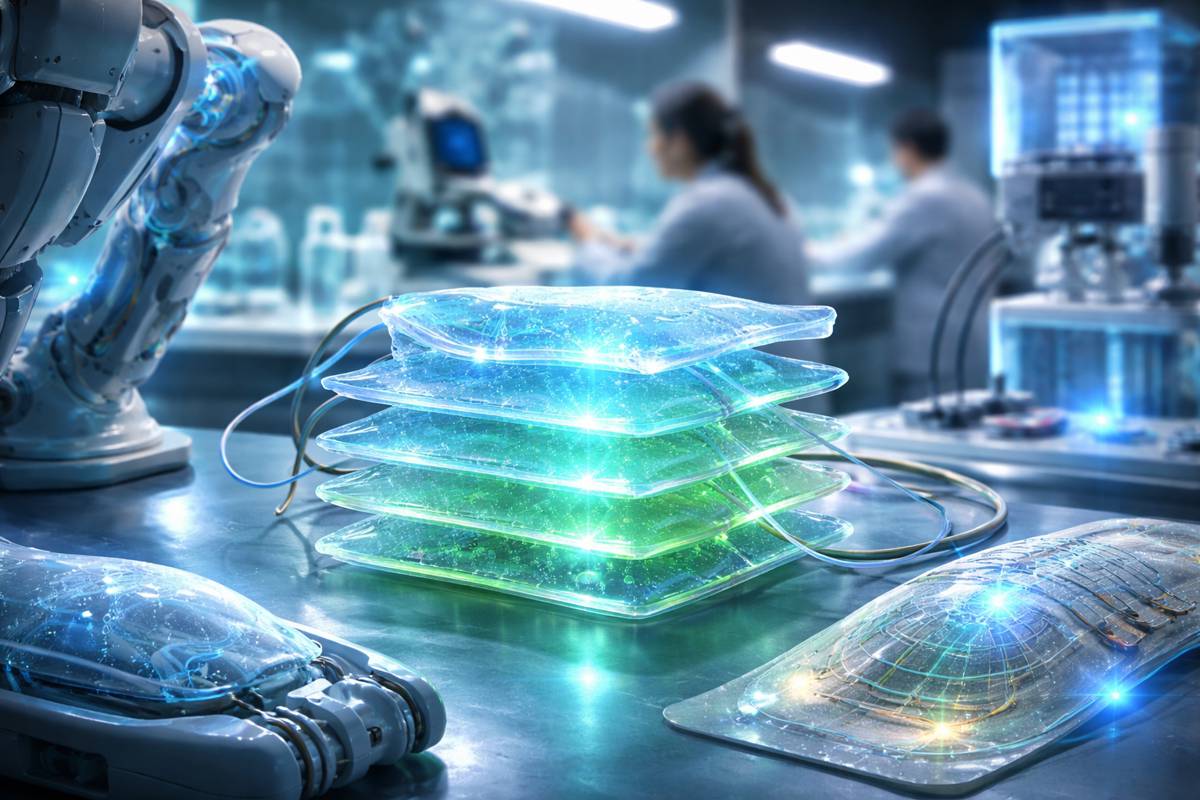
The researchers created a layered system made entirely from hydrogels. Four different hydrogel mixtures were deposited in a precise sequence using spin coating, a fabrication method that spreads materials into ultra thin layers by rotating a surface at high speed.
Each layer measured roughly 20 micrometres thick, significantly thinner than a human hair. That geometry proved essential. Electrical resistance inside soft materials often limits power output, but thinner layers shorten ion travel distance and improve performance.
Dor Tillinger, doctoral candidate and co first author, described the outcome: “We found that using thin hydrogel naturally reduced the internal resistance of the material, which increased the power densities we could output.”
Achieving that thinness required reengineering the chemistry itself. Conventional hydrogel mixtures would detach from the spinning surface during fabrication. The team adjusted viscosity and mechanical strength to ensure uniform coating.
Wonbae Lee, materials science doctoral candidate, detailed the process: “We had to carefully tune the chemical mixture so the hydrogel could spread uniformly during spin coating, remain mechanically stable and be thin enough to maintain low electrical resistance. Conventional formulations would simply fly off the spinning surface during spin coating. Optimizing the viscosity and mechanical strength of our hydrogel was essential to making this approach work.”
Performance Beyond Previous Soft Batteries
Electrochemical measurements conducted at Penn State’s Materials Research Institute showed the hydrogel power sources reached approximately 44 kilowatts per cubic metre. That figure exceeds previously reported hydrogel based power systems while maintaining flexibility and non toxicity.
Unlike earlier designs, the system also requires no mechanical support structure. Najem emphasised the importance of that achievement: “To our knowledge, this is the first power source entirely contained within a hydrogel solution that requires no external support.”
The material also demonstrated unusual environmental tolerance. By incorporating glycerol, the hydrogel remained functional at temperatures down to minus 80 degrees Celsius. Additionally, it retained moisture for days rather than minutes, maintaining electrical conductivity in open air conditions where traditional hydrogels quickly dry out.
Implications For Construction And Smart Infrastructure
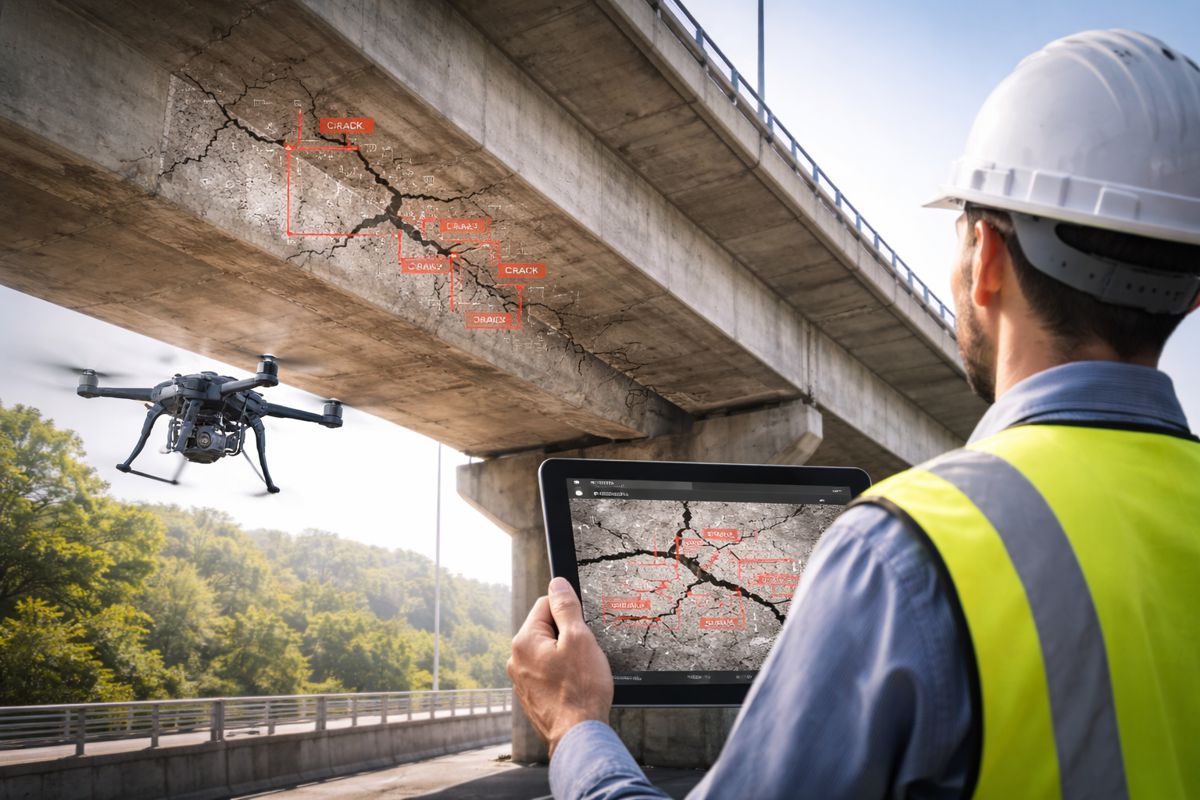
For infrastructure engineers, the significance lies in distributed sensing. Roads and bridges increasingly rely on embedded electronics to monitor strain, vibration and environmental degradation. However, installing sealed battery housings increases installation cost and failure risk.
A flexible non toxic power source could be embedded directly into structural materials such as asphalt binders, composite reinforcements or protective coatings. That opens the possibility of long term structural monitoring networks without periodic battery replacement.
In tunnelling and underground construction, moisture resistant power systems could support autonomous inspection robots or distributed monitoring nodes. In coastal infrastructure they could operate within saltwater exposure zones where corrosion rapidly destroys conventional batteries.
Soft robotics also has growing relevance in construction. Inspection robots capable of navigating pipes, ducts and confined structural cavities require deformable bodies. Rigid batteries restrict mobility and increase failure points. A hydrogel power source integrated into the body of the robot would improve durability and safety.
Biomedical And Human Integrated Engineering Applications
The most immediate applications may be medical devices, but those same systems increasingly overlap with construction and safety engineering. Wearable monitoring used for worker safety in hazardous environments depends on reliable soft electronics.
Najem highlighted the design philosophy: “For biomedical and near-biology applications, we have to make sure that batteries are compatible with their surroundings, flexible, safe and ideally capable of using available resources to recharge.”
Wearable sensors used on construction sites to monitor fatigue, heat stress or exposure conditions must operate safely against skin. Toxic leakage risks have limited adoption of continuous wearable systems in heavy industry. A hydrogel based power system could remove a key barrier.
Towards Self Charging Soft Power Systems
Future research will focus on improving recharge efficiency and exploring self charging capabilities. Biological inspiration again offers a path forward, since living organisms harvest energy from ionic gradients and chemical differences in their environment.
If such systems can harvest energy from moisture, temperature gradients or movement, infrastructure monitoring networks could become effectively maintenance free. That possibility aligns with the broader shift toward autonomous infrastructure management and digital twin modelling.
Funding And Research
The research was supported by the Air Force Office of Scientific Research, reflecting broader interest in resilient, flexible electronics capable of operating in extreme environments. Military, aerospace and civil infrastructure sectors increasingly share requirements for adaptable embedded systems operating without rigid housings.
The interdisciplinary team included Joseph Najem, Derek Hall and recent doctoral graduate Haley Tholen, with key experimental contributions from doctoral researchers Dor Tillinger and Wonbae Lee.
A Shift In How Engineers Think About Power
The importance of the work lies less in replacing lithium batteries immediately and more in redefining where energy storage can exist. Instead of being a separate component attached to a device, power may become part of the material itself.
As infrastructure evolves toward intelligent, sensing enabled networks, the boundary between material and machine is fading. Concrete already incorporates fibres, polymers and sensors. Future structures may incorporate energy systems as well. Hydrogels inspired by biological electricity suggest the first practical route toward that integration.
Rather than forcing electronics to survive harsh environments, engineers may design environments that inherently support electronics. That shift could quietly underpin the next generation of smart infrastructure.