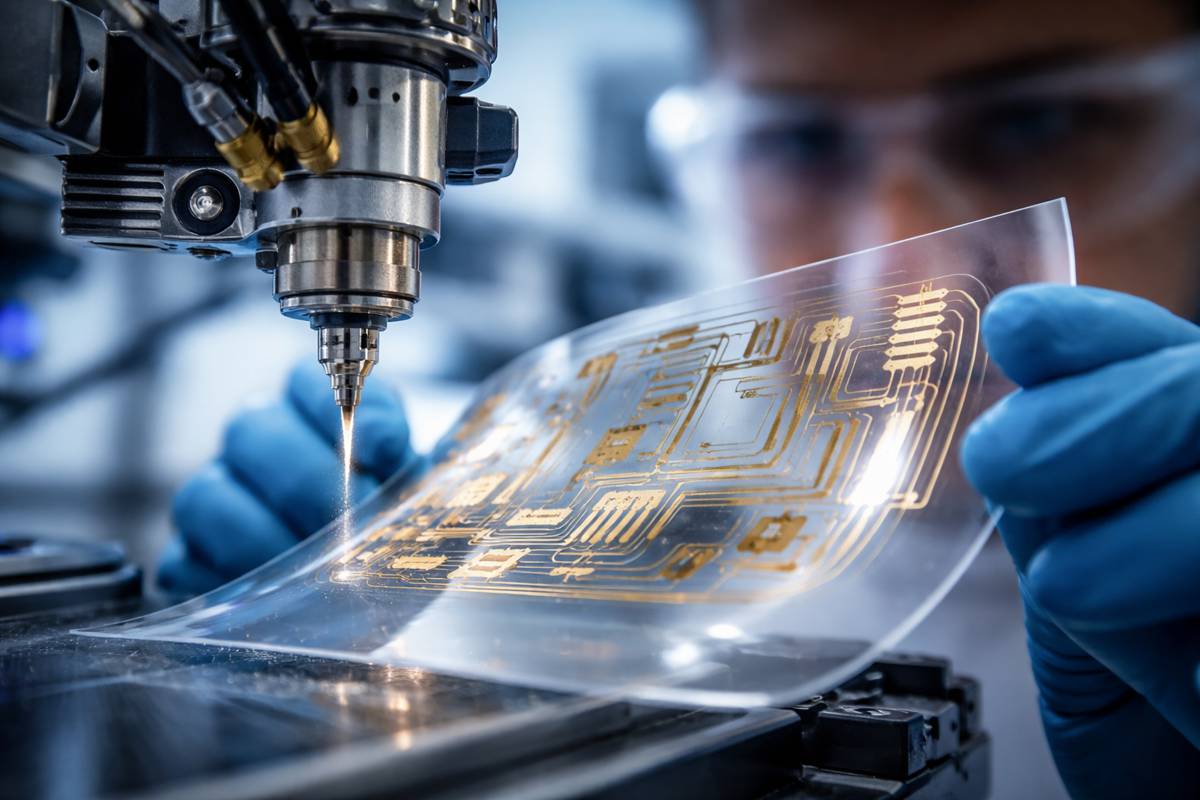
Printed Microelectronics for Smart Infrastructure
The idea of printing electronic devices might sound like science fiction. Yet researchers are steadily turning it into a practical manufacturing method that could reshape how sensors, smart surfaces and low power electronics are produced. New research from scientists at the U.S. Department of Energy’s Argonne National Laboratory highlights a significant step in that direction, demonstrating printed transistors created using specialised nanoparticle inks and a technique known as aerosol jet printing.
These tiny electronic switches sit at the heart of modern electronics. Transistors regulate electrical current in circuits, acting as the on and off gates that enable computing, sensing and communications. What makes the Argonne work particularly interesting is not simply that the devices were printed. Rather, it is how they were engineered to operate with very low power consumption while remaining durable enough to perform thousands of switching cycles.
For industries tied closely to infrastructure and industrial technology, this development carries broader implications. Printed electronics could drastically reduce the cost and complexity of producing distributed sensors, flexible monitoring devices and smart materials embedded directly into buildings, roads or industrial equipment. In other words, electronics might eventually be manufactured in ways closer to printing newspapers than assembling silicon chips.
Printed Electronics for Infrastructure Technology
Modern infrastructure increasingly depends on sensors and digital monitoring systems. Roads are being equipped with traffic monitoring technologies, bridges use embedded sensors to detect structural stress and energy systems rely on smart control networks. However, conventional electronic manufacturing remains relatively expensive and rigid, often limiting where and how devices can be deployed.
Printed electronics offer an alternative path. Instead of fabricating components on rigid silicon wafers in cleanrooms, devices can be produced layer by layer on flexible surfaces using specialised inks that contain conductive or semiconducting particles. The technology has already been explored for applications such as RFID tags, wearable electronics and flexible displays.
Research organisations including the Fraunhofer Institute in Germany and the University of Cambridge have demonstrated printed sensors, flexible circuits and even printed batteries in recent years. Market analysts at IDTechEx estimate that printed and flexible electronics could exceed $50 billion globally by the early 2030s as manufacturing techniques mature and new applications emerge.
For infrastructure operators, the attraction lies in scale and cost. Printed electronics could allow thousands or even millions of low cost sensors to be deployed across transport networks, construction sites or energy grids. That sort of density simply isn’t feasible with traditional semiconductor manufacturing methods.
Aerosol Jet Printing Enables High Precision Electronics
At the centre of the Argonne team’s work is aerosol jet printing, a manufacturing technique that operates somewhat like an inkjet printer but with considerably greater precision and versatility. Instead of depositing ordinary ink onto paper, the system atomises specialised nanoparticle inks into a fine aerosol mist.
This mist is then directed through a focused nozzle onto a surface, where the particles accumulate layer by layer to form conductive traces, semiconductor regions and other electronic components. Because the droplets are extremely small, aerosol jet printing can achieve fine patterns measured in micrometres while still working on irregular or flexible surfaces.
That flexibility is important. Traditional semiconductor fabrication typically requires flat, rigid wafers. By contrast, aerosol jet printing can deposit electronic materials onto polymers, glass, ceramics or metal surfaces, opening the door to electronics embedded directly into structural materials.
According to Argonne materials scientist Yuepeng Zhang, the printing process offers important advantages for experimentation and device development. He explained: “We chose printing methods for two main reasons. First, printing enables rapid prototyping and iterative design, which helps us optimize materials and device structures quickly. Second, printed electronics have benefits for device functionality, especially since our devices show a well-modulated current response to voltage, making them suitable for printed logic devices and niche applications.”
Rapid prototyping is no small benefit. Semiconductor fabrication normally involves lengthy manufacturing cycles and expensive facilities. Printing methods allow researchers to adjust materials and designs quickly, accelerating innovation.
Vanadium Dioxide Brings Unique Switching Behaviour
A key ingredient in the newly developed printed transistors is vanadium dioxide, a material that has attracted significant scientific interest for decades due to its unusual electrical properties. Unlike most materials used in electronics, vanadium dioxide can rapidly transition between two distinct states.
In one state it behaves like a conductor, allowing electricity to flow easily. In the other it acts as an insulator, blocking current. This transition can occur when temperature, voltage or chemical conditions change, making the material particularly useful for switching applications.
The Argonne researchers leveraged this property to create transistors capable of controlling electrical flow using very small voltage signals. In electronic circuits, the ability to switch between conductive and insulating states is essential for logic operations and memory storage.
Vanadium dioxide has previously been studied for applications in neuromorphic computing, adaptive electronics and smart windows that regulate heat transmission. The material’s ability to switch states quickly and reversibly makes it especially attractive for devices that must operate efficiently with minimal energy input.
For printed electronics, incorporating such materials opens up new possibilities. Instead of simply printing passive circuits, researchers can begin producing active components capable of performing logic functions.
Redox Gating Enables Low Voltage Control
Another notable aspect of the Argonne research is the use of redox gating to control the transistor’s behaviour. Redox reactions involve the transfer of electrons between chemical species. In the context of the printed devices, this mechanism allows the researchers to adjust the electrical state of the vanadium dioxide.
By applying a very small voltage, electrons can be added or removed from the material, effectively switching the transistor between its conductive and insulating states. Importantly, this process requires far less energy than many conventional switching techniques.
That efficiency could be critical for devices designed to operate in remote or distributed environments where power availability is limited. Sensors embedded in infrastructure, for instance, often rely on batteries or energy harvesting systems that generate only tiny amounts of electricity.
Because redox gating operates at voltages lower than those used in typical batteries, it could enable electronics that function reliably while consuming minimal power.
Durability Solves a Long Standing Challenge
While printed electronics have attracted interest for years, durability has often been a stumbling block. Early printed devices frequently degraded quickly, especially when switching repeatedly between electrical states.
The Argonne team’s work suggests that the redox gating approach may help overcome that limitation. According to Wei Chen, a chemist working with Argonne and the University of Chicago, the devices demonstrated impressive reliability.
He explained: “Redox gating is robust and does not damage the materials, so we can run thousands of cycles without issues. In previous methods, devices could only run a few times, sometimes just 10 cycles, before failing. Our devices can run thousands of cycles with no problem.”
That level of endurance moves printed electronics closer to real world deployment. Infrastructure monitoring systems, for instance, require components that can operate reliably over long periods with minimal maintenance.
Durability also plays a role in commercial viability. Devices that fail quickly simply cannot compete with conventional semiconductor technologies. Demonstrating thousands of operating cycles is therefore a key milestone.
Potential Applications From Smart Windows to Structural Sensors
Although the research remains at a laboratory stage, the potential applications extend well beyond academic curiosity. Printed electronics could eventually underpin a wide range of technologies relevant to infrastructure and industrial systems.
Flexible sensors are one example. Printed electronics could allow thin sensor networks to be integrated directly into construction materials, enabling continuous monitoring of stress, vibration or temperature. Such systems might provide early warnings of structural fatigue in bridges or tunnels.
Smart windows represent another possibility. Vanadium dioxide is already known for its ability to regulate heat transmission depending on temperature. Integrating printed electronics into window coatings could allow buildings to dynamically control light and thermal performance, improving energy efficiency.
Other potential uses include:
- Distributed environmental monitoring sensors
- Flexible electronics integrated into construction materials
- Low power Internet of Things devices for infrastructure monitoring
- Smart surfaces that respond to temperature or electrical signals
- Adaptive energy management systems in buildings
For construction and infrastructure operators, technologies like these promise improved safety, efficiency and sustainability.
A Glimpse of Future Manufacturing
The broader significance of this research lies in how it reimagines electronics manufacturing. Instead of relying solely on large semiconductor fabrication plants, future electronics may be produced using printing technologies that resemble additive manufacturing.
That shift could decentralise production and reduce manufacturing costs for specialised devices. Electronics could potentially be fabricated closer to where they are needed, integrated directly into products or structures during manufacturing.
For the infrastructure sector, where distributed sensing and monitoring are becoming essential, such manufacturing flexibility could prove transformative.
Printed electronics are unlikely to replace conventional silicon chips anytime soon. High performance processors and complex integrated circuits will continue to require advanced semiconductor fabrication. However, for low power sensors, flexible electronics and niche logic devices, printing technologies could open a completely different pathway.
Printed Electronics Move Closer to Real World Deployment
Research efforts like those at Argonne highlight how printed electronics are steadily advancing from experimental concepts toward practical devices. By combining specialised nanoparticle inks, aerosol jet printing and novel switching mechanisms, the team has demonstrated transistors that operate efficiently while remaining durable.
For industries tied to infrastructure, energy and transport systems, the implications are significant. Low cost electronics embedded across physical assets could dramatically expand the reach of digital monitoring and automation.
The ability to print electronic devices directly onto flexible or structural surfaces could change how infrastructure is built and maintained in the decades ahead. Sensors might become as commonplace as paint layers, quietly collecting data that helps keep roads, bridges and buildings safer and more efficient.
While there is still work to do before such technologies reach large scale deployment, the trajectory is clear. Electronics manufacturing is gradually moving beyond rigid silicon wafers toward more adaptable, scalable methods. If progress continues at its current pace, printing microelectronics may one day become as routine as printing documents.