Rethinking Concrete for a Circular and Low Carbon Future
Concrete has long been the backbone of global infrastructure, yet it remains one of the construction sector’s biggest environmental liabilities. Responsible for an estimated 7 to 8 percent of global CO₂ emissions, largely due to cement production, it sits squarely in the crosshairs of policymakers, investors and engineers seeking rapid decarbonisation. The European research initiative CARBCOMN is quietly reshaping how the industry might approach concrete altogether.
Rather than refining traditional methods, the project proposes something more fundamental. It reimagines concrete as a low carbon, circular material system that minimises resource use, eliminates unnecessary reinforcement, and enables reuse at the end of a structure’s life. Led by a consortium of European research institutions, architects and technology firms, the initiative reflects a broader shift across the construction sector where digital design, advanced materials and lifecycle thinking are converging.
The implications are far-reaching. If scalable, the approach could significantly reduce emissions across infrastructure and housing while also addressing the growing regulatory pressure around embodied carbon. It also aligns with the European Union’s Green Deal ambitions, which increasingly prioritise circular construction methods and low carbon materials.
Building Strength Through Geometry Instead of Mass
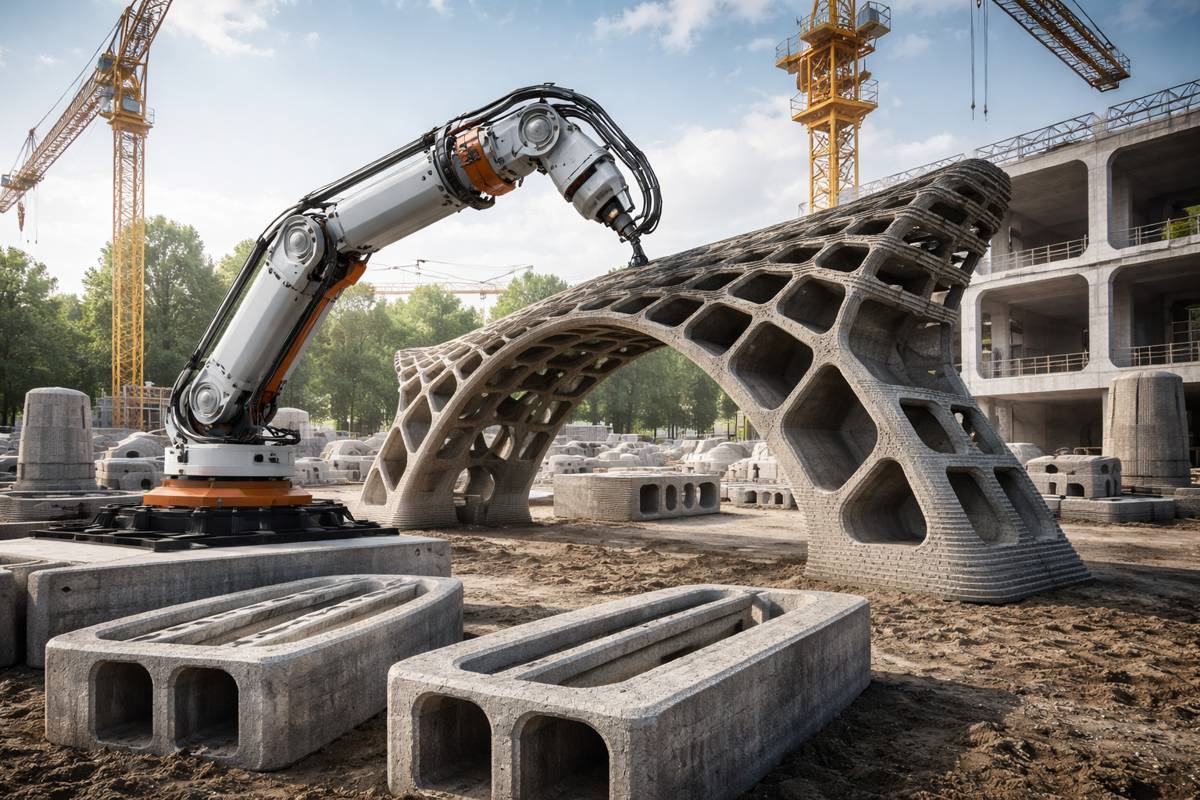
At the heart of the CARBCOMN concept lies a simple but powerful idea. Instead of relying on large volumes of material and heavy steel reinforcement, structural stability is achieved through geometry. This approach draws inspiration from historic masonry structures such as stone bridges, where arches distribute loads efficiently through compression.
Concrete performs exceptionally well under compression but struggles under tension. Traditional reinforced concrete compensates for this weakness with steel rebars, often adding complexity, weight and cost. CARBCOMN flips this model by designing structures that are predominantly subjected to compressive forces, thereby reducing or even eliminating the need for extensive reinforcement.
This shift is enabled by advanced digital design tools. Engineers can now model complex geometries that optimise load distribution while using significantly less material. It’s a case of working smarter rather than harder, leveraging computational design to achieve structural performance with minimal mass.
The benefits extend beyond material savings. Lighter structures reduce transportation emissions, simplify installation and, crucially, improve performance in seismic regions. Even modest reductions in weight can significantly lower earthquake-induced forces, making this approach particularly attractive for infrastructure projects in vulnerable areas.
Turning Industrial Waste into Structural Value
One of the most striking aspects of the CARBCOMN initiative is its use of industrial by-products as a substitute for cement. Instead of relying on traditional Portland cement, the project utilises steel slag, a waste material generated by the steel industry.
This substitution addresses two challenges at once. It reduces the demand for cement, which is energy intensive and carbon heavy, while also finding a high-value application for industrial waste that might otherwise end up in landfills. In doing so, it supports a more circular industrial ecosystem where waste streams become valuable inputs.
The material developed within the project consists almost entirely of recycled components. While alternative binders and supplementary cementitious materials have been explored for years, integrating them into fully structural applications has proven difficult. CARBCOMN pushes this boundary by combining material innovation with structural optimisation and digital fabrication.
It’s not just about sustainability for its own sake. Lower carbon materials are increasingly becoming a commercial necessity as clients, regulators and financiers demand measurable reductions in embodied emissions. Projects that fail to adapt risk being side-lined in a market that is rapidly moving towards net zero targets.
Digital Fabrication Unlocks Precision and Efficiency
The project’s reliance on 3D printing marks another step change in how concrete structures can be produced. By printing components layer by layer, the need for traditional formwork is eliminated, reducing both material waste and labour requirements.
More importantly, digital fabrication allows for precise control over internal geometry. Engineers can introduce cavities and voids exactly where material is not required, effectively sculpting the structure for maximum efficiency. This level of precision would be difficult, if not impossible, to achieve using conventional casting methods.
Automation also opens the door to more consistent quality and faster production cycles. As construction continues to grapple with labour shortages and productivity challenges, such technologies offer a pathway towards industrialised building processes that are both scalable and cost effective.
However, the shift to digital construction is not without its challenges. Standardisation, regulatory approval and integration with existing supply chains remain hurdles that must be addressed before widespread adoption can occur. Even so, the direction of travel is clear. Digital fabrication is moving from niche experimentation to practical application.
Selective Reinforcement with Smart Materials
While the CARBCOMN approach reduces reliance on steel reinforcement, it does not eliminate it entirely. Instead, reinforcement is used selectively and strategically, only where structural demands require it. This is where iron-based shape memory alloys, or Fe-SMA, come into play.
Unlike conventional steel, these alloys have the ability to contract when heated, introducing compressive forces into the structure. This property allows them to act as a form of post-tensioning without the need for complex pre-stressing systems.
The advantages are significant. Reinforcement can be added after the concrete has been printed, simplifying the manufacturing process and maintaining the integrity of automated workflows. It also enables precise placement, ensuring that materials are used only where they are genuinely needed.
Equally important is the ability to remove these elements at the end of a structure’s life. This supports the broader goal of deconstructable buildings, where components can be disassembled and reused rather than demolished and discarded. In a sector where demolition waste accounts for a substantial share of total waste generation, this represents a meaningful step forward.
Capturing Carbon as Part of the Curing Process
Perhaps the most innovative aspect of the project lies in how the concrete is cured. Instead of relying solely on traditional hydration processes, the printed components are exposed to CO₂ in a controlled environment. This triggers a chemical reaction that both strengthens the material and permanently binds carbon within it.
Carbon curing is not entirely new, but its integration into a fully circular, digitally manufactured system is noteworthy. By embedding CO₂ into the material itself, the process effectively turns concrete from a carbon source into a partial carbon sink.
This approach aligns with a growing body of research exploring carbon mineralisation as a pathway to reduce emissions in construction materials. While it is unlikely to offset all emissions associated with concrete production, it offers a tangible method for reducing the overall carbon footprint.
If scaled effectively, such technologies could play a crucial role in meeting global climate targets. Governments and industry alike are increasingly recognising that incremental improvements will not be enough. Transformational solutions like this are needed to bridge the gap.
Designing for Disassembly and Reuse
A defining feature of the CARBCOMN project is its emphasis on end-of-life considerations. Traditional construction often treats buildings as permanent fixtures, with little thought given to what happens when they are no longer needed. The result is a linear model of take, make and dispose.
CARBCOMN challenges this paradigm by designing components that can be dismantled and reused. Connections are engineered to allow disassembly, while materials are selected to facilitate separation and recovery. This approach mirrors practices in other industries, such as manufacturing, where modularity and reuse are standard.
For infrastructure owners and investors, this opens up new possibilities. Assets could be reconfigured, relocated or repurposed, extending their useful life and reducing the need for new materials. It also aligns with emerging regulatory frameworks that prioritise circularity and resource efficiency.
Of course, achieving this in practice will require changes across the entire value chain, from design and procurement to construction and maintenance. Yet the potential benefits are too significant to ignore.
Collaboration Across Disciplines and Borders
The scale and ambition of the CARBCOMN project reflect the complexity of the challenge it seeks to address. Bringing together eleven partners from across Europe, including leading research institutions, architectural firms and technology providers, the initiative represents a truly interdisciplinary effort.
Architects such as Zaha Hadid Architects and Mario Cucinella Architects contribute design expertise, exploring how free-form structures can be realised within the constraints of structural performance and sustainability. Meanwhile, institutions like ETH Zurich and Empa focus on materials science, engineering and digital fabrication.
This collaborative model is increasingly common in large-scale innovation projects. No single organisation has all the answers, particularly when dealing with systemic challenges like decarbonisation. By pooling expertise, the consortium is able to tackle the problem from multiple angles simultaneously.
Funded under the Horizon Europe programme, the project also highlights the role of public investment in driving innovation. With a budget of around six million euros, it provides the resources needed to move from concept to prototype, with a demonstrator expected by 2028.
A Practical Path Towards Low Carbon Construction
For all its technical complexity, the ultimate goal of CARBCOMN is straightforward. It aims to deliver practical, scalable solutions for residential and infrastructure construction that reduce emissions, conserve resources and support circularity.
The focus is not on creating architectural showpieces, but on developing robust, repeatable building systems that can be deployed at scale. This pragmatic approach increases the likelihood of real-world adoption, particularly in a sector that is often risk-averse and cost-sensitive.
As the construction industry faces mounting pressure to decarbonise, initiatives like this offer a glimpse of what the future might look like. Not a single breakthrough, but a combination of innovations working together to reshape how buildings are designed, constructed and reused.
It’s early days, of course. Challenges remain around cost, regulation and market acceptance. Yet the direction is unmistakable. Concrete, long seen as an environmental burden, may yet become part of the solution.