






AI Takes Control of John Deere Skid Steer in Hydraulic Robotics Breakthrough
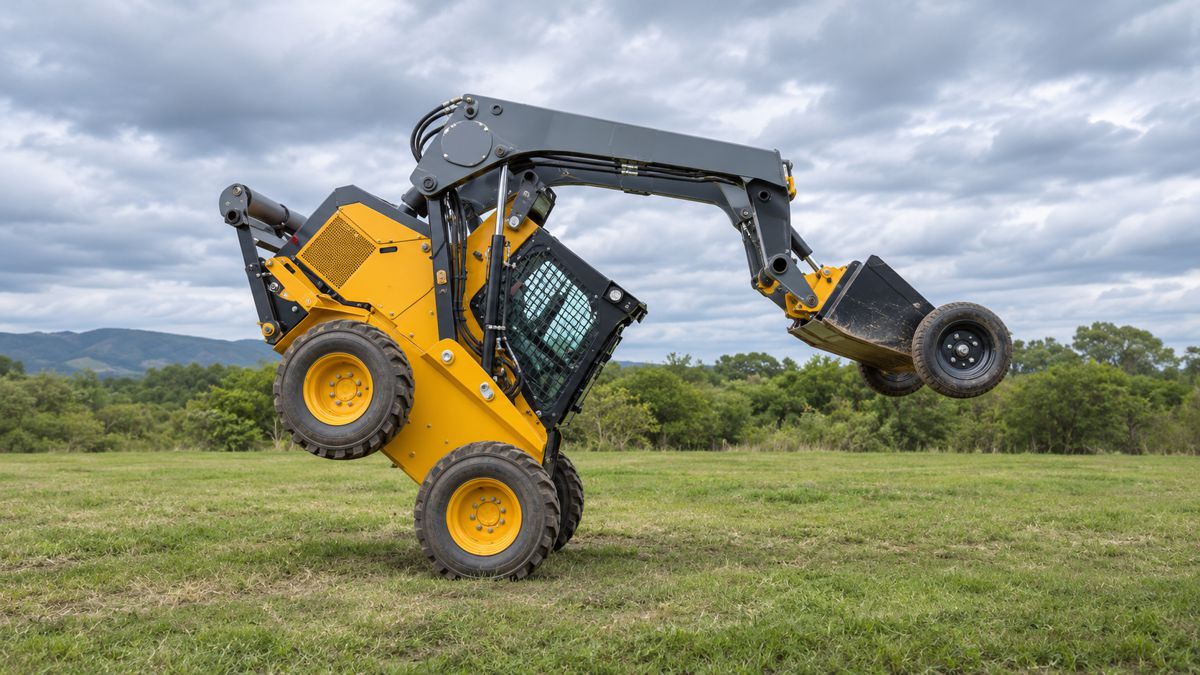
A five-tonne John Deere skid-steer loader has been taught to lift itself onto two wheels, maintain its balance while driving over rough terrain, spin in place and return to the ground under control, using artificial intelligence trained in simulation.
The demonstration, detailed in research published in Science Robotics on 11 November 2026, tackles one of the more persistent engineering problems in autonomous construction machinery: the unpredictable behaviour of hydraulic systems when equipment is subjected to rapid movements, changing loads and unstable operating conditions.
Researchers from ETH Zurich, Blue River Technology, Gravis Robotics and Intel developed a reinforcement-learning approach that combines a simplified representation of the machine with hydraulic behaviour learned from physical measurements. Their experiments show that controllers trained in a virtual environment can perform demanding manoeuvres on full-size construction equipment, including movements that challenge conventional model-based control systems.
The wheel-balancing exercise makes for an impressive demonstration, but the underlying research extends well beyond machinery acrobatics. Construction equipment must routinely accommodate uneven ground, changing centres of gravity and hydraulic responses that are difficult to predict precisely, particularly when operating without continuous intervention from a human operator.
Briefing
- Researchers trained reinforcement-learning controllers for a five-tonne John Deere 332G skid-steer loader.
- The machine balanced on its front wheels, performed controlled spins and traversed terrain undulations up to 75 cm high.
- Approximately 110 minutes of physical operating data helped develop a model of the loader’s hydraulic actuator behaviour.
- The learned controller outperformed a conventional model predictive control baseline in selected high-speed and rough-terrain tests.
- Published in Science Robotics on 11 November 2026, the research establishes a foundation for more advanced autonomous hydraulic machinery.
The Challenge of Controlling Hydraulic Machinery
Hydraulic systems provide the force needed to operate much of the world’s construction equipment, from compact loaders and excavators to large mining machines. Their strength and flexibility make them indispensable, although those same systems present considerable difficulties when engineers attempt to reproduce their behaviour accurately in software.
Hydraulic response depends on interacting physical effects, including fluid properties, friction, flexible hoses, mechanical tolerances and delays between a control signal and the resulting movement. These characteristics can vary with operating conditions, making it difficult to predict exactly how quickly a machine will respond or how its movement will develop once the command has been issued.
Conventional control techniques, including model predictive control (MPC), use mathematical representations of machinery to calculate appropriate actions. Such systems have demonstrated strong performance in hydraulic applications, particularly for controlled movements and trajectory tracking, but they become more demanding to implement when a machine approaches its physical limits or repeatedly changes its contact with the ground.
A skid steer balancing on its two front wheels provides a particularly challenging example. Its hydraulic drivetrain must continuously adjust wheel movement to compensate for momentum, changing machine attitude and disturbances caused by the ground. Raising or lowering the loader arm introduces further complications by altering the position of the machine’s centre of gravity.
The research team investigated whether reinforcement learning could handle these interactions through policies developed by repeated experimentation in simulation, reducing the dependence on an exceptionally detailed mathematical representation of the hydraulic system.
Training a Five-Tonne Loader in Simulation
The experiments used a John Deere 332G skid-steer loader with an operating weight of approximately five tonnes. Its existing hydraulic drivetrain and electronic control architecture provided the basis for the research, with computer-generated commands replacing signals normally supplied through the operator’s joysticks.
Before training the controllers, the researchers built a simplified rigid-body representation of the loader. Physical dimensions were measured directly, while the machine’s mass distribution and centre of gravity were established using truck scales and basic mechanical calculations.
The more difficult task involved representing the hydraulic drivetrain.
Rather than attempting to calculate every aspect of fluid flow, pressure variation and mechanical response, the researchers collected data while driving the loader backwards and forwards using different control sequences. The initial 90-minute dataset recorded how the machine’s wheel speeds responded to changing commands, allowing a neural network to learn the actuator behaviour, including its characteristic delays and nonlinearities.
A further 20 minutes of operating data gathered during balancing experiments subsequently improved the model.
This learned actuator representation was incorporated into the virtual machine, where reinforcement-learning controllers could practise manoeuvres through repeated simulated attempts. Successful movements were rewarded, while unsuccessful actions informed subsequent training, allowing the control policies to develop without exposing the physical loader to the consequences of repeated failures.
The team also used a technique known as domain randomisation, introducing variations in selected machine parameters and simulated sensor measurements. This encouraged the controllers to tolerate differences between the model and the real loader, an important consideration when even sophisticated simulations cannot reproduce physical machinery perfectly.
Individual policies were trained for distinct operations, including lifting the machine onto two wheels, maintaining balance, following commanded velocities and returning to a conventional four-wheel stance. Simple switching conditions coordinated the separate controllers during the complete manoeuvre.
When transferred to the physical loader, the policies operated using existing wheel-speed measurements and two additional inertial measurement units. A standard Linux laptop equipped with an Intel Core i7 processor and 16 GB of memory handled the control calculations without requiring a dedicated graphics processor.
Most of the computationally demanding work had already been completed during training, leaving relatively compact neural networks to execute the learned behaviour on the machine.
Balancing on Two Wheels
The first major demonstration required the skid steer to move from a stationary four-wheel position into a controlled balance on its front wheels.
Achieving this involved a carefully coordinated sequence of forward and backward movements. The controller initially accelerated the machine to build momentum before reversing its motion and bringing the loader into its upright balancing position. A separate stabilisation policy then took over, continuously adjusting the drivetrain to prevent the machine falling forwards or backwards.
Once balanced, the loader could respond to commanded movements, travel in either direction, rotate around its vertical axis and accommodate changes in arm position. The researchers also trained a landing controller that brought the machine back onto four wheels while limiting the impact and rebound that occurred when control commands were simply removed.
Given the machine’s weight and the forces involved, the experimental loader was fitted with additional protective hardware. A rear safety bar helped limit backward tipping, while auxiliary wheels attached to the bucket reduced the risk of damage if the machine made forward contact with the ground.
The researchers conducted repeated swing-up trials with the loader arm positioned at different angles, producing results that also revealed the boundaries of the controller’s learned behaviour.
At arm angles of 28° and 31°, the system completed all 23 trials successfully. When the arm was raised to 34°, however, the success rate fell to 78.6%, with 11 successful manoeuvres from 14 attempts. In the remaining three trials, the controller overshot its intended position and the bucket contacted the ground.
The controllers had been trained using arm configurations between 29° and 31°, so the higher position introduced a mass distribution and increased inertia that the system had not fully encountered during training. Although the trial numbers were relatively small, the difference provides a useful measure of how machine configuration can influence the reliability of a learned control policy.
Comparing AI With Conventional Control
The researchers assessed the reinforcement-learning system against a model predictive control baseline across several experimental tasks, examining how each approach responded to balancing disturbances, movement commands and changing ground conditions.
During stationary balancing, both controllers maintained the loader close to its desired position. The reinforcement-learning system produced oscillations of approximately ±1.6° around the nominal balancing angle, comparable with the conventional controller, while both approaches successfully accommodated movement of the loader arm.
Performance began to diverge when the researchers increased the commanded wheel speeds.
The reinforcement-learning controller maintained balance while tracking targets up to 4 radians per second, whereas the MPC baseline became unstable beyond approximately 3.5 radians per second. At higher speeds, the conventional controller could no longer prevent the machine from making contact with the bucket or returning to its rear wheels.
Both approaches also managed controlled spinning, although the MPC system exhibited smaller oscillations under some higher-rate rotation conditions.
The most substantial difference emerged during experiments involving uneven terrain. The research team constructed a test surface with undulations reaching 75 cm in height and instructed the balancing loader to travel across it in both directions.
Despite having been trained on flat ground and possessing no advance knowledge of the obstacles, the reinforcement-learning controller successfully negotiated the terrain. As the machine encountered each rise and depression, the policy adjusted its wheel-speed commands to accommodate the changing physical conditions while maintaining balance.
The conventional MPC controller remained upright but could not traverse the first major obstacle, even when the commanded speed was increased.
The researchers attributed the learned controller’s resilience partly to the variations introduced during simulation training, which had encouraged it to accommodate disturbances that were absent from the nominal machine model.
These findings apply to the particular controllers and experimental conditions examined. Conventional model-based techniques can be extended to account for more demanding operating scenarios, and the study does not establish reinforcement learning as universally superior. Nevertheless, the ability to maintain dynamic control over unexpectedly uneven terrain provides a compelling result for machinery intended to operate in variable environments.
Applications Beyond the Demonstration
Balancing a skid steer on two wheels is unlikely to become an everyday construction activity, although the individual control capabilities developed during the research have potential applications across a much wider range of machinery.
Autonomous loaders and excavators must respond to changing ground conditions, uneven weight distribution and disturbances caused by moving attachments or handling materials. These situations become particularly demanding when equipment is working on slopes, negotiating irregular surfaces or carrying out movements that bring it close to its stability limits.
The researchers suggest that dynamic balancing could eventually contribute to specialised tasks such as loading equipment onto transport vehicles without ramps, reducing tyre scrubbing during manoeuvres and recovering machines from difficult positions. Similar control techniques may also support obstacle negotiation and operation in unstructured environments where the precise physical conditions cannot be known in advance.
The study did not demonstrate these commercial applications directly. Its balancing and terrain-traversal experiments relied on measurements of the machine’s own movement rather than cameras or LiDAR systems capable of identifying obstacles ahead.
Future systems would need to combine learned machine control with environmental perception and higher-level decision-making, allowing autonomous equipment to understand its surroundings, select appropriate actions and maintain safe operation around other machinery and personnel.
The research team identifies additional sensing, online adaptation and the integration of individual control skills into more comprehensive policies as possible directions for further development.
Industrial Development and the Road to Deployment
The project brings together academic robotics research and industrial organisations already developing autonomous machinery for construction and other heavy-equipment applications.
Gravis Robotics, whose technology originates from research at ETH Zurich, works on autonomous and remotely operated earthmoving equipment. Its interest in machine-independent automation provides a relevant commercial setting for research into control systems that can adapt to different hydraulic platforms.
Blue River Technology, a John Deere company, has extensive experience applying artificial intelligence and robotics to working machinery. Deere has also been extending autonomy into construction and quarrying, including its 460 P-Tier autonomous articulated dump truck, introduced at CES 2025 as part of a wider programme using cameras, computer vision and AI to support independent machine operation.
Those developments address different elements of the autonomy challenge. While perception systems and route-planning technologies help machinery understand where it should travel and what obstacles it must avoid, the hydraulic control research concentrates on executing demanding physical movements once the appropriate commands have been determined.
The ability to learn actuator behaviour from measured operating data offers an attractive route for equipment developers working across multiple machine types. Construction machinery varies considerably in weight, geometry, hydraulic configuration and control response, making the development of individually calibrated automation systems a potentially expensive undertaking.
A methodology that combines relatively straightforward physical measurements with learned actuator models could reduce some of that development effort, although transferring the approach between machines would still require appropriate data collection, simulation and physical validation.
The study remains an experimental demonstration rather than an announcement of a production-ready autonomous control system. Its findings also expose the importance of operating boundaries, particularly when machine configurations differ from those encountered during training.
Before similar controllers could be deployed in commercial construction environments, developers would need to establish performance across broader working conditions, including changing payloads, different attachments, hydraulic wear, mechanical faults and prolonged operation. Predictable failure behaviour and integration with established machine safety systems would be equally important.
Training these demanding movements in simulation nevertheless provides a practical advantage. Engineers can expose virtual machinery to repeated failures, unexpected disturbances and demanding control scenarios without subjecting full-size equipment to the same risks throughout the development process.
The research published in Science Robotics demonstrates that this approach can produce sophisticated dynamic behaviour on a five-tonne hydraulic loader, using policies capable of responding to physical conditions that were not explicitly represented during training.
For autonomous construction machinery, extending those capabilities from controlled demonstrations to repeatable working operations will require further engineering. The ability to develop and test advanced control behaviour in simulation, however, offers another route towards machines capable of handling the unpredictable physical demands of real construction sites.
Key Industry Questions
- How does reinforcement learning control hydraulic construction machinery? Reinforcement learning develops control policies through repeated simulated experience. The system learns which commands produce successful movements, then applies those policies to physical machinery using real-time sensor measurements.
- Why are hydraulic systems difficult to automate? Hydraulic components exhibit nonlinear behaviour, friction and response delays that vary with operating conditions. These characteristics complicate the mathematical models used to predict machine movement.
- Which machine was used in the research? The researchers used a five-tonne John Deere 332G skid-steer loader equipped with additional inertial sensors, computer control and protective hardware.
- How much physical operating data was required? Approximately 90 minutes of initial actuator-response data and a further 20 minutes from balancing experiments were used to develop and refine the hydraulic behaviour model. The control policies were trained in simulation.
- Did reinforcement learning outperform conventional control? The learned controller achieved higher wheel-speed targets and successfully negotiated uneven terrain that the tested MPC baseline could not traverse. Both approaches performed comparably during simpler balancing operations.
- Can the AI controller operate without cameras or LiDAR? The demonstrated balancing and rough-terrain behaviours used machine-state measurements rather than environmental perception. More advanced autonomous operations would require additional sensing and planning capabilities.
- Could the technology be retrofitted to existing equipment? The experimental system controlled a production loader through its electronic interfaces, indicating a possible route for machine adaptation. Commercial retrofitting would require further engineering, compatibility assessment and safety validation.
- What limits the commercial application of learned control systems? Performance can deteriorate when equipment encounters configurations or conditions outside its training range. Developers must also demonstrate reliability, fault handling and safe operation across the varied conditions encountered on working sites.
Strategic Takeaways
- Machine-specific modelling: Learning hydraulic behaviour from operating data could reduce the effort required to develop detailed actuator models for different equipment platforms.
- Virtual development: Simulation enables demanding control behaviours to be practised repeatedly before physical testing, reducing exposure to equipment damage during experimental training.
- Dynamic performance: Reinforcement learning demonstrated advantages in selected high-speed and rough-terrain tasks, while conventional model-based control remained effective in other conditions.
- Adaptation across equipment: Compact learned policies offer potential for deployment across different hydraulic machines, provided their physical characteristics and operating limits are adequately represented.
- Industrial validation: Commercial deployment will depend on dependable performance across changing loads, attachments, ground conditions and equipment states, alongside established safety requirements.