How Talking Slows Eye Movements Behind the Wheel
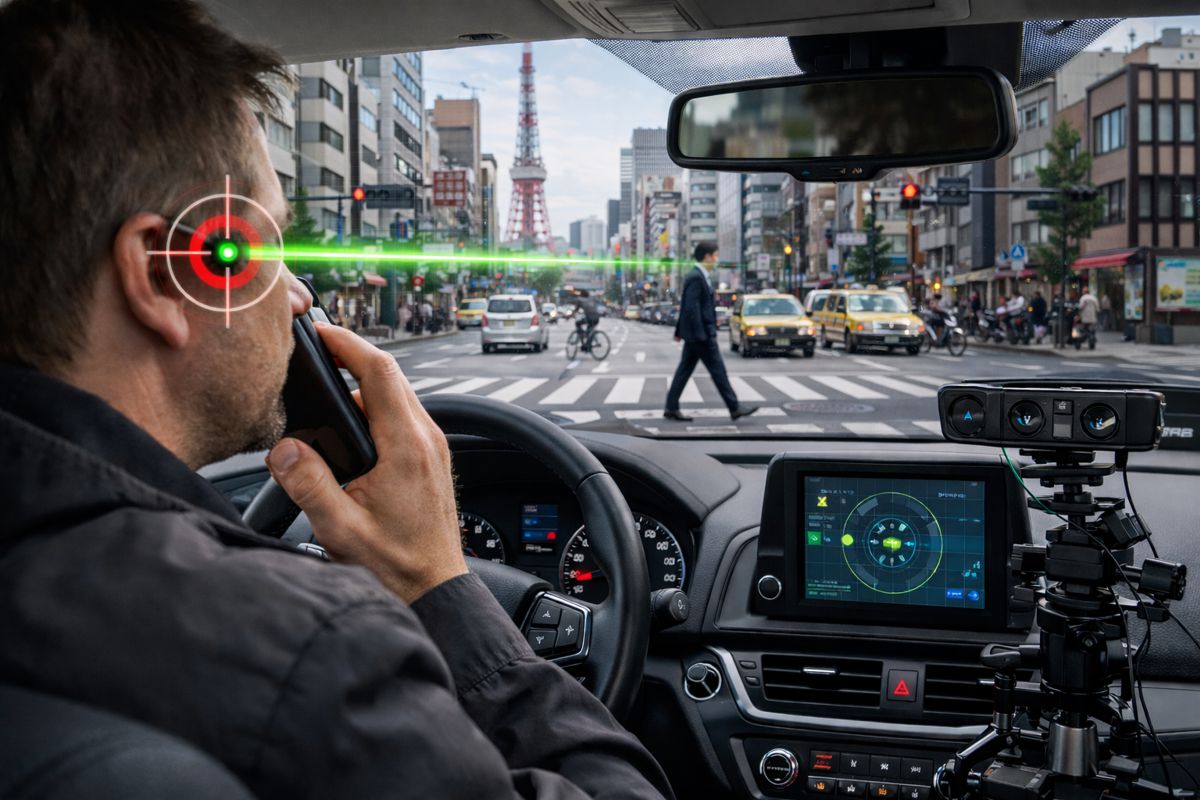
Modern vehicles are safer, quieter, and more connected than ever. Yet inside the cabin, one of the most ordinary human behaviours remains surprisingly risky. Talking. Not shouting, not arguing, just everyday conversation. New scientific evidence now suggests that speaking while driving can subtly interfere with the very first stage of safe driving: how quickly and accurately the eyes move.
A recent peer reviewed study has demonstrated that talking introduces measurable delays in eye movement initiation, execution, and stabilisation. Those delays occur before conscious decision making, braking, or steering. In other words, the risk begins earlier than many drivers realise. Long before a foot touches the pedal, the eyes are already running late.
This research sheds new light on cognitive distraction, reframing conversation as more than a mental nuisance. It reveals talking as a direct disruptor of gaze control, a system responsible for gathering nearly all the information a driver relies upon.
Why Eye Movements Matter More Than Drivers Think
Driving is often described as a motor task, but in practice it is a visual one. Around 90 percent of the information used by drivers comes through the eyes. From scanning junctions to tracking pedestrians, road signs, cyclists, and changing traffic flows, the eyes are constantly shifting, locking on, and stabilising.
These rapid eye movements, known as saccades, allow drivers to move their gaze from one point to another in fractions of a second. Once the eyes land, fixation enables the brain to extract detail and meaning. Any disruption to this process can ripple through the entire driving task.
If gaze initiation is delayed, hazards are noticed later. If eye movement is slowed, visual scanning becomes less efficient. If fixation is unstable, recognition and judgement suffer. Until now, it was unclear whether talking interfered with these foundational processes or simply distracted drivers at higher cognitive levels.
Investigating the Hidden Cost of Conversation
To answer that question, researchers from Fujita Health University designed an experiment that isolated eye movement behaviour under controlled cognitive conditions. Thirty healthy adult participants were asked to perform rapid eye movement tasks while either talking, listening, or performing no additional task.
The experiment used a centre out eye movement paradigm. Participants fixated on a central point and then moved their gaze as quickly and accurately as possible toward a peripheral target appearing in one of eight directions. This design mirrors the rapid visual shifts required during real world driving.
Crucially, the talking condition required participants to actively generate responses. They answered general knowledge and episodic questions adapted from the Wechsler Adult Intelligence Scale, alongside additional custom prompts. In contrast, the listening condition involved passive listening to passages from the Japanese novel I Am a Cat. Each condition was conducted on a separate day, with the order randomised to reduce learning effects.
What the Researchers Found
The results were both clear and consistent. Only the talking condition produced significant delays across all key temporal components of gaze behaviour. Three specific measures were affected:
- Reaction time, the delay between target appearance and the initiation of eye movement
- Movement time, the duration required for the eyes to reach the target
- Adjusting time, the period needed to stabilise gaze on the target
Listening alone did not produce these effects. Nor did the control condition. The implication is striking. It is not sound or speech in the environment that causes the disruption. It is the cognitive effort involved in formulating and producing speech.
As Associate Professor Shintaro Uehara explains: “We investigated whether the impact of talking related cognitive load on gaze behaviour varies depending on the direction of eye movement.”
The findings showed that the delays were broadly consistent across movement directions, reinforcing the idea that talking imposes a general cognitive burden on gaze control mechanisms rather than affecting a single visual pathway.
Small Delays, Real World Consequences
In laboratory terms, the observed delays may appear modest. Measured in milliseconds, they might seem trivial to the untrained eye. On the road, however, those milliseconds matter.
Driving is a continuous process of micro decisions. A fraction of a second can determine whether a pedestrian is noticed before stepping into the carriageway, whether debris is avoided or struck, or whether a cyclist emerging from a blind spot is seen in time.
These gaze delays also accumulate. Slower eye movement initiation leads to later fixation, which in turn delays recognition and physical response. In complex driving environments, especially urban streets, work zones, or adverse weather, the margin for error is already slim.
Importantly, the study suggests that even hands free conversations may carry risk. While hands free systems remove manual distraction, they do not eliminate cognitive load. The brain remains occupied with language production, memory retrieval, and response formulation.
Understanding Cognitive Load at the Earliest Stage
Much of the existing research on distracted driving focuses on downstream effects. Slower braking, reduced lane keeping, or missed traffic signals. This study adds a critical new layer by showing that talking interferes with the very first stage of visuomotor processing.
As the authors note, talking is not the sole cause of impaired driving performance. Factors such as divided attention, inattentional blindness, and task switching all play a role. Yet this research demonstrates that conversation introduces interference before perception even becomes conscious awareness.
Dr Uehara summarises this clearly: “These results indicate that the cognitive demands associated with talking interfere with the neural mechanisms responsible for initiating and controlling eye movements, which represent the critical first stage of visuomotor processing during driving.”
This insight challenges the common assumption that drivers can safely manage conversation as long as their hands remain on the wheel and their eyes on the road. The eyes may be open, but they are not operating at full speed.
Implications for Road Safety and Vehicle Design
The findings carry meaningful implications for road safety policy, driver education, and vehicle interface design. Understanding that conversation affects gaze behaviour may encourage drivers to be more selective about when they talk, particularly in complex or high risk driving scenarios.
For driver training programmes, this research provides evidence to support clearer guidance around cognitive distraction. Rather than focusing solely on mobile phones or physical tasks, training can address the hidden impact of conversation itself.
Vehicle designers may also take note. As in vehicle infotainment systems become more conversational and voice driven, designers face the challenge of balancing convenience with cognitive demand. Systems that require minimal verbal formulation may prove safer than those demanding active dialogue.
Policy makers, too, may find value in these findings. While banning conversation is neither practical nor desirable, recognising its impact could inform future recommendations and public awareness campaigns.
A Broader Perspective on Attention Behind the Wheel
Ultimately, this study reinforces a simple truth. Driving is a cognitively demanding task that relies on finely tuned visual and neural processes. Even familiar, everyday behaviours can interfere with those processes in subtle but significant ways.
By revealing how talking slows eye movements, the research invites drivers, designers, and regulators to rethink assumptions about distraction. Awareness of these hidden effects may help foster more mindful driving habits and support safer roads for everyone.
Study Details and Research Background
The study, titled Talking associated cognitive loads degrade the quality of gaze behaviour, was published in PLOS One on 6 October 2025. The research was conducted by Associate Professor Shintaro Uehara alongside Mr Takuya Suzuki and Professor Takaji Suzuki.
Fujita Health University is a private medical university based in Aichi, Japan. Established in 1964, it operates one of the largest university hospitals in the country and supports a faculty of around 900 members. Guided by its founding philosophy of “Our creativity for the people”, the university has earned international recognition for its research and societal impact.
The institution ranked eighth overall and second among private universities in Japan in the 2020 Times Higher Education World University Rankings. In 2024, it placed fourth globally in the Times Higher Education University Impact Rankings for contributions to the United Nations Sustainable Development Goal on Good Health and Well being. The same year, Fujita Health University was selected for Japan’s J PEAKS programme, supporting the development of a multi university research and education hub focused on innovative drug discovery.
Associate Professor Uehara’s research focuses on rehabilitation science and the neural mechanisms underlying human movement behaviour, including motor learning. His work combines behavioural experimentation with advanced motion tracking and electrophysiological methods. He earned his doctorate from Kyoto University in 2013 and has held postdoctoral positions in Japan and the United States. To date, he has authored more than 50 publications with over 500 citations.