InvestEU Helps Scale High Power EV Charging From the Baltic to the Adriatic
Central and Eastern Europe is about to get a sizeable boost in electric-vehicle charging capacity, and not in the slow, piecemeal way drivers have grown used to. A €35 million loan from the European Investment Bank (EIB) to network operator Eleport will support the rollout of more than 250 new ultra-fast charging hubs across eight countries: Croatia, Czechia, Estonia, Latvia, Lithuania, Poland, Slovakia and Slovenia.
On paper, it’s a clean infrastructure story with a clear climate message. In practice, it’s also about supply chains, investment confidence, cross-border travel, regional competitiveness and the real-world logistics of keeping people and goods moving. Charging infrastructure doesn’t just underpin private car ownership, it increasingly determines whether fleets can electrify cost-effectively, whether cities can meet air-quality targets, and whether the wider transport system can transition without pushing costs and inconvenience onto the public.
This is why the announcement matters. It isn’t simply more plugs in more places. It’s a structured attempt to compress the timeline for mass adoption in a region where electric mobility is expanding, but where infrastructure gaps can still make EV ownership feel like a compromise rather than a step forward.
Why Ultra-Fast Charging Has Become a Critical Piece of Transport Infrastructure
The EV conversation used to revolve around vehicle range. Now, the more pressing issue is often time and certainty: how quickly a vehicle can charge, how reliable that charger will be, and whether the driver can actually find it without detouring across town. Ultra-fast charging hubs have become the closest thing to the petrol station experience, and for many drivers and fleet operators, that familiarity is the tipping point.
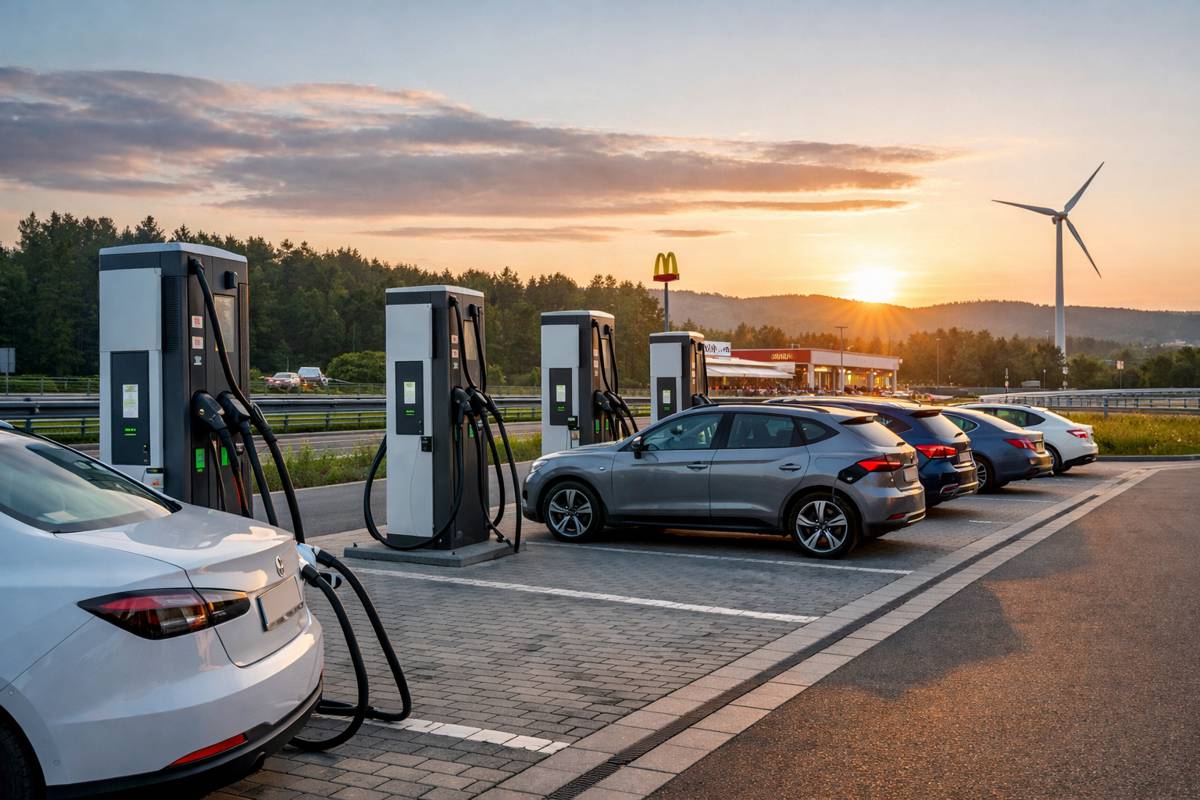
Eleport’s planned hubs will include up to 12 charging plugs per station, with power output of up to 400 kilowatts (kW) per plug. That specification is significant because it signals an ambition to keep pace with the direction of travel in the wider European market, where charging networks are moving beyond basic provision and into performance, throughput, and convenience.
For construction and infrastructure stakeholders, there’s another layer to this rollout. High-capacity charging hubs require enabling works, grid connection upgrades, power electronics, digital monitoring, and consistent maintenance regimes. In other words, they are infrastructure projects in their own right, often delivered in busy commercial environments where the work has to be planned and executed without disrupting daily operations.
Eight Countries, One Investment Signal and a Clear Deadline
The geography of the project is as telling as the euro amount. Croatia to Estonia spans a vast corridor of trade routes, tourism flows, industrial regions, and border crossings. This isn’t a single domestic market build-out. It’s an attempt to strengthen charging continuity across multiple national systems, each with its own pace of adoption, regulatory quirks and grid realities.
Eleport intends to deploy the hubs at major shopping and commercial centres, a detail that reflects how charging behaviour has evolved. Drivers don’t want charging to be a dedicated errand. They want it to happen while they’re already doing something else, grabbing groceries, picking up supplies, meeting a client, or stopping for food on a long journey.
Completion is planned by 2028, and while that might sound comfortably distant, infrastructure programmes have a habit of compressing very quickly once grid approvals, procurement and construction schedules are underway. For investors, the timeline is also a marker of delivery credibility, because the true test for a charging operator is not the press release, but the pace of commissioning, uptime, and network consistency at scale.
What the EIB Loan Really Represents for Regional Development
The EIB frames the loan as advancing EU goals to cut car pollution and support regional development. That is an accurate summary, but it understates the more practical reason public-backed finance matters in this space. Charging networks are capital intensive, and in rapidly growing markets, the risk profile is not always attractive for conventional lenders.
In this case, tailor-made financing structures are allowing the EIB to support a fast-growing company early in its growth journey, taking on higher credit risk with backing from the InvestEU programme. That’s not a small detail. It speaks to how Europe is trying to pull forward private-sector delivery by using public mechanisms to reduce perceived risk and unlock investment.
As EIB Vice-President Karl Nehammer put it: “Scaling up fast-charging infrastructure is essential to accelerate the shift to electric mobility and reduce emissions from road transport. This operation demonstrates how we can provide innovative, long-term financing to fast-growing companies delivering high-impact sustainable infrastructure.”
It’s a familiar model in major infrastructure transitions. Public finance doesn’t always build the assets directly, but it frequently sets the conditions for the market to scale.
Eleport’s Network Strategy and the Emergence of the “Electric Amber Road”
Eleport is not entering this project as an unknown name. The Tallinn-based start-up already operates more than 400 fast charging points (DCs) across six countries: Estonia, Latvia, Lithuania, Poland, Slovenia and Croatia. The new hubs will expand that footprint into additional markets while strengthening capacity where existing demand is already growing.
What makes the strategy more interesting is the company’s “Electric Amber Road” concept, described as a network inspired by the ancient Amber Road trade routes that once connected the Baltic and Adriatic coasts. While branding can often feel like fluff in infrastructure stories, the underlying idea is grounded in a real operational requirement: cross-border travel becomes dramatically easier when drivers can use a single app and consistent charging experience across multiple countries.
Fragmentation is one of the hidden costs of Europe’s charging ecosystem. Different operators, different payment systems, different reliability standards, and inconsistent data can turn a long journey into a low-grade logistical headache. A corridor-led approach is an attempt to solve that in a way that drivers can actually feel, without needing to understand the complexity behind the scenes.
Eleport Chief Executive Officer Jakub Miler highlighted that convenience-first approach: “This EIB loan is an important step in expanding reliable, high-quality charging infrastructure across Central and Eastern Europe. Our goal is for electric-vehicle drivers to be able to stop where they already need to be, plug in briefly and move on with their day.”
Why This Build-Out Matters to Fleets, Logistics and Commercial Mobility
Passenger cars might dominate the public narrative, but fleets are where electrification becomes a commercial transformation. Businesses don’t just want greener vehicles, they want predictable operating costs, route certainty, and minimal downtime. That’s where ultra-fast hubs, located at commercial centres and along key travel corridors, can change the operational maths.
While Eleport’s announcement focuses on electric cars, the broader infrastructure has implications for fleet electrification, especially for light commercial vehicles operating across borders. Delivery operators, service engineers, and regional logistics fleets are often the first to seek charging reliability because their vehicles don’t have the luxury of waiting.
There’s also a workforce implication. As charging networks expand, demand grows for electrical contractors, civils teams, operations and maintenance specialists, and software-driven monitoring and support functions. Charging infrastructure isn’t just a climate play, it’s a jobs pipeline and a skills challenge, and it can become a meaningful part of industrial policy in the regions where the assets are deployed.
Grid Capacity, Power Delivery and the Real-World Challenge of 400 kW Charging
Ultra-fast charging is as much about electricity infrastructure as it is about transport. A plug rated at up to 400 kW implies significant power delivery requirements, particularly when hubs scale to multiple plugs operating concurrently.
Even when a charger is technically capable of high output, real-world performance depends on grid connection capacity, site load management, and the availability of power electronics that can handle peaks safely. Many networks address this through smart charging strategies, dynamic load balancing, and phased power upgrades as utilisation grows.
For construction and infrastructure investors, that grid interface is the most revealing part of the story. Charging hubs may look like simple assets from the roadside, but they are often complex projects involving network operator coordination, permitting, and equipment supply chains. In some locations, delivery schedules are dictated less by construction speed and more by utility timelines, transformer availability, and grid reinforcement works.
That’s why long-term finance matters. It provides the runway to build properly, rather than rushing out underpowered sites that frustrate users and become liabilities later on.
Aligning With EU Climate Goals and InvestEU’s Investment Engine
The EIB classifies the project as 100% aligned with climate action and environmental sustainability. That classification reflects how transport decarbonisation is being treated as a core infrastructure priority, not a nice-to-have.
The loan agreement is backed by the InvestEU programme, which aims to trigger more than €372 billion in additional investment between 2021 and 2027. The ambition is big because the requirement is bigger. Electrification at scale demands coordinated investment across charging, generation, grids, supply chains and vehicle manufacturing. Without financing mechanisms that can absorb risk and stimulate activity, rollout can stall or remain concentrated in the most profitable urban pockets.
InvestEU’s focus on the green transition, competitiveness, innovation and sustainable infrastructure fits directly with the Eleport expansion, particularly in Central and Eastern Europe where infrastructure investment can have outsized economic effects. Better charging connectivity supports tourism routes, commercial travel, supply chain resilience and mobility access, and those effects ripple outwards.
A More Connected EV Future for Central and Eastern Europe
For drivers across Croatia, Czechia, Estonia, Latvia, Lithuania, Poland, Slovakia and Slovenia, more charging stations will mean something simple: fewer compromises. Less planning. Less range anxiety. More confidence in taking an EV across borders, through different landscapes, and across the everyday reality of work, errands and long-distance travel.
For policymakers, the project is a practical step towards environmental goals that often sound abstract at national level but become measurable at the roadside. Charging infrastructure is one of the few decarbonisation actions where the public can see the result, use it, and decide whether the transition feels workable.
For the construction, infrastructure and industrial technology sectors, the significance lies in the scale and the model. This is not a single-country initiative or a pilot programme. It is long-term finance backing a multi-market build-out with performance specifications that suggest serious intent. If delivered on schedule, the network could become a reference point for how regional EV infrastructure expands when capital, policy and operational delivery are pulling in the same direction.