Harvesting Energy From Industrial Compressed Air Systems
The quiet inefficiency of compressed air is one of industry’s best-kept open secrets. Across factories, processing plants, logistics hubs and infrastructure facilities, compressed air is generated in vast quantities, much of it vented, throttled or dissipated with little thought to recovery. In energy terms, it represents a stubbornly persistent loss stream.
New research emerging from Chung-Ang University introduces a concept that could reframe how engineers think about wasted airflow, electrostatics and non-contact power generation.
Rather than attempting to squeeze incremental efficiency gains from conventional turbines or compressors, the research team has turned to a very different physical phenomenon: the electrostatic potential of particulate matter suspended in air. By combining this effect with a Tesla turbine-inspired structure, the scientists demonstrate a contactless electricity generation system capable of producing high-voltage output using nothing more than practical compressed air. For an industrial sector under growing pressure to decarbonise, electrify and recover lost energy wherever possible, the implications are difficult to ignore.
What makes this work particularly notable is not just the voltage or current achieved, but the fact that it avoids many of the safety and durability constraints that have historically limited electrostatic and triboelectric energy harvesting. In doing so, it opens the door to applications well beyond laboratory-scale demonstrations.
Why Electrostatic Energy Harvesting Matters Now
Energy demand continues to rise across construction, infrastructure and heavy industry, driven by automation, electrification and digitalisation. While renewables and grid-scale storage dominate strategic discussions, there is growing recognition that energy efficiency and recovery are just as critical to achieving net-zero targets. Technologies that can reclaim energy from waste streams, particularly those already embedded in industrial processes, are gaining renewed attention.
Electrostatic energy harvesting has long been viewed as promising but problematic. Particulate matter in air carries significant electrostatic potential, especially in high-speed or high-pressure flow environments. However, uncontrolled electrical discharge introduces ignition risks, particularly in dust-laden or volatile industrial settings. Past attempts to mitigate these hazards, such as introducing additional particles or moisture, have reduced applicability and often undermined performance by neutralising the very charges being harvested.
This tension between potential and practicality has kept electrostatic approaches largely confined to niche or experimental use. The research challenges that status quo by demonstrating that electricity can be generated without frictional sliding or direct contact, dramatically reducing wear, heat generation and discharge risk.
Revisiting Tesla’s Turbine for a Modern Energy Problem
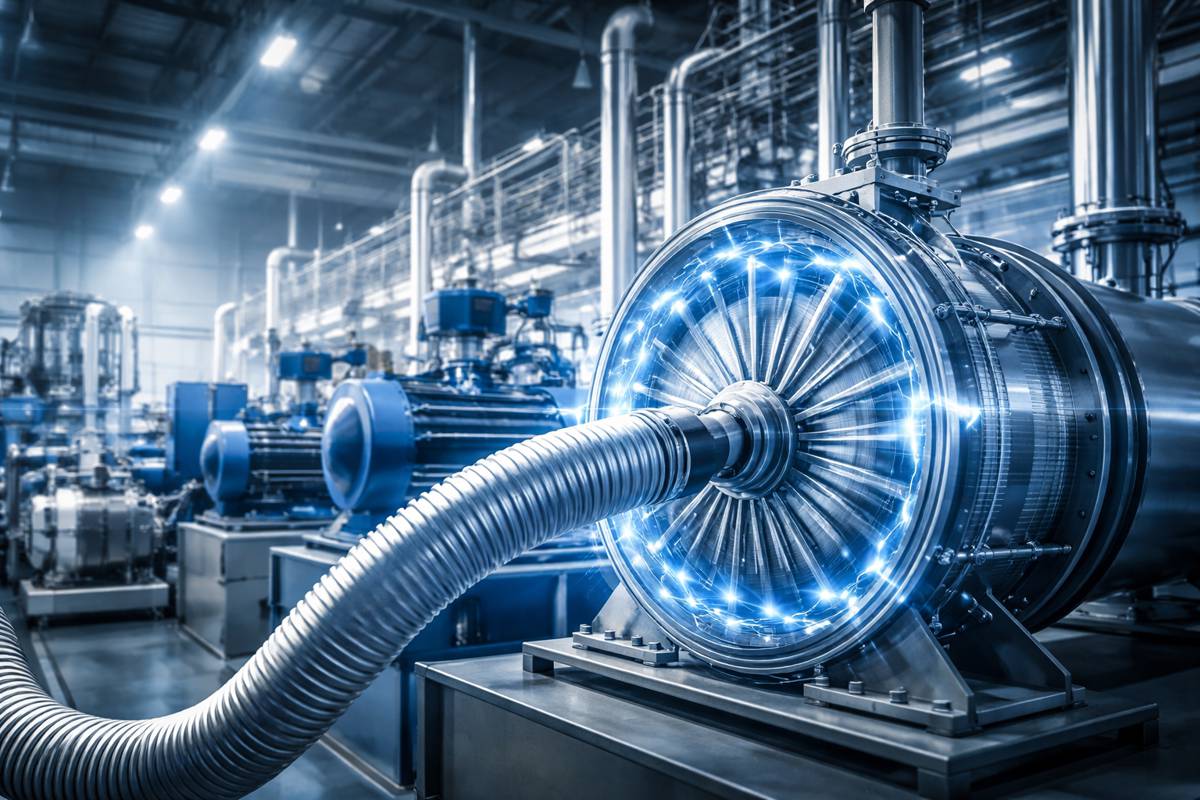
At the heart of the system is a structure inspired by Nikola Tesla’s bladeless turbine, a design that relies on viscous forces rather than traditional blades to induce rotation. While Tesla turbines have periodically resurfaced in discussions around compact power generation, their commercial impact has been limited. In this case, the inspiration is structural rather than literal, serving as a platform for a fundamentally different form of energy conversion.
Earlier work by the research group focused on triboelectric nanogenerators capable of harvesting low-speed wind energy. During that research, the team began exploring how high-speed or high-pressure air would interact with triboelectric layers. As the lead researcher explains: “During the research, we were curious about what would happen if high-speed—or high-pressure—wind blows onto the triboelectric nanogenerator. So, we fabricated a Tesla turbine-inspired triboelectric nanogenerator structure that can be operated with high-pressure air and analysed the data. From these results, we observed the particulate static effect: the particulate matter in air can also generate surface charge on the triboelectric layer,”
That observation proved pivotal. Rather than relying on mechanical contact to generate charge, the system exploits the particulate static effect generated as compressed air flows through the turbine-like structure. This shift from friction-based to contactless generation fundamentally changes the operating envelope of the device.
How Contactless Generation Changes the Engineering Equation
The operational mechanism centres on the interaction between compressed air, electrostatic charges and rotational motion. The viscous force of high-pressure air induces rotation within the device, while tribo-negative and tribo-positive layers acquire surface charge from airborne particulates. Crucially, this occurs without frictional sliding, allowing the system to behave more like a non-contact triboelectric generator.
As Dr Lee describes it: “The viscous force of compressed air induces rotational motion within the device. Tribo-negative and tribo-positive layers inside acquire surface charge from the particulate static effect without the need for frictional sliding, allowing operation similar to non-contact tribo-electric generators. This facilitates electricity generation via electrostatic induction in the rotating electrodes, and the frictionless rotation enables high-frequency peak outputs.”
From an engineering perspective, this matters because friction is the enemy of longevity, efficiency and safety. Eliminating sliding contact reduces mechanical wear, minimises heat generation and enables much higher rotational speeds. In this case, the device reached rotational speeds of 8,472 revolutions per minute, producing high-frequency electrical output that would be difficult to achieve with conventional triboelectric systems.
Performance Metrics With Industrial Relevance
Laboratory novelty alone rarely translates into industrial impact. What elevates this work is the scale of the demonstrated output and the rigour of the analysis underpinning it. By measuring transferred charge in compressed air and conducting electrostatic force microscopy mapping of the triboelectric layers, the researchers quantified the particulate static effect with precision.
The results are striking. The Tesla turbine-inspired generator achieved peak outputs of up to 800 volts and 2.5 amperes at a frequency of 325 hertz. These figures place the device firmly outside the realm of micro-scale energy harvesting and into a category that could support meaningful industrial functions.
Equally important is the stability of the output at high rotational speeds. Frictionless operation not only enables higher frequencies but also improves consistency, a critical factor for integrating such systems into real-world electrical architectures.
Demonstrated Functions Beyond Power Generation
Rather than stopping at electrical output measurements, the research team demonstrated a series of practical functions enabled by the high-voltage output. The generator was shown to power electronic devices directly, underscoring its potential as a localised energy source in environments where compressed air is readily available.
Beyond electricity, the system facilitated water collection from moisture in the air and effectively removed airborne dust. These secondary functions are far from trivial. Dust control and humidity regulation are ongoing challenges in construction sites, tunnelling operations, mining facilities and manufacturing plants. A single device capable of addressing energy recovery, air quality and moisture management would offer compelling operational value.
The ability to generate negative ions through high-voltage output also opens pathways into environmental control applications, particularly in enclosed or high-risk industrial environments.
Industrial Compressed Air as an Untapped Energy Asset
Compressed air systems account for a significant share of industrial electricity consumption, with global studies consistently highlighting inefficiencies, leakage and waste. In many facilities, excess airflow is vented after pressure regulation or process use, representing lost energy that cannot easily be recovered using conventional turbines.
The technology demonstrated here is well aligned with these realities. It requires no fuel, no combustion and no modification of existing air generation systems. Instead, it leverages airflow that already exists, converting electrostatic potential into usable electrical output.
Industries such as cement production, aggregate processing, mining, logistics and large-scale manufacturing all generate substantial volumes of compressed air. In these contexts, even partial energy recovery could translate into meaningful reductions in operational energy demand and associated emissions.
A Platform for Interdisciplinary Innovation
The broader significance of this research lies in its interdisciplinary reach. By bridging mechanical engineering, materials science, electrostatics and industrial energy systems, it introduces a framework that could inspire further innovation well beyond the specific device demonstrated.
The study was conducted by a collaboration spanning Chung-Ang University, Kumoh National Institute of Technology, the Massachusetts Institute of Technology and National Taiwan University, reflecting the global interest in unconventional energy harvesting approaches. The findings were published in Advanced Energy Materials, underscoring their relevance to the wider energy research community.
Future work may explore scaling, integration with existing compressed air networks, and adaptation to different particulate environments. Construction sites, for example, feature vastly different particulate profiles compared to clean manufacturing facilities, raising intriguing questions about optimisation and site-specific design.
Redefining Waste in the Infrastructure Economy
In an era where infrastructure investment is increasingly judged through the lens of sustainability, resilience and efficiency, technologies that redefine waste as a resource carry disproportionate weight. The Tesla turbine-inspired contactless generator does precisely that, reframing compressed air not as an unavoidable loss but as a latent energy carrier.
While commercial deployment will require further validation, durability testing and system integration, the conceptual shift introduced by this research is already significant. It challenges long-held assumptions about the limits of electrostatic energy harvesting and points towards a future where industrial by-products quietly power the systems around them.
For construction professionals, investors and policymakers alike, the message is clear. Innovation in energy does not always arrive as a new fuel or a larger turbine. Sometimes, it emerges from re-examining the physics of what is already flowing through the pipes.