Blyncsy Helps Alabama Link Highway Asset Data to Budget Decisions
Across the global highways sector, the pressure on road authorities is intensifying. Ageing assets, constrained budgets, rising safety expectations and political scrutiny are all converging on one uncomfortable truth: maintenance decisions can no longer rely on periodic inspections, historical allocations or subjective judgement. They have to be defensible, repeatable and grounded in measurable evidence.
The Alabama Department of Transportation’s decision to deepen its use of AI-driven asset analytics marks more than a routine software deployment. It signals a practical evolution in how infrastructure agencies translate condition data into financial decisions.
For more than a decade, performance based budgeting has been promoted as a smarter way to manage public infrastructure. In theory, it aligns funding with outcomes, not habit. In practice, however, the quality of the underlying data often determines whether the model delivers real value or simply repackages old assumptions. Alabama’s highway network spans roughly 11,000 miles, crossing rural corridors, urban arterials and freight routes critical to regional commerce. Maintaining consistent insight across that scale has traditionally required extensive manual surveys, staff time and inevitable compromises on coverage or frequency.
By integrating automated AI analytics into its established maintenance framework, ALDOT is attempting to close a long standing gap between policy intent and operational reality. The adoption of Bentley System’s Blyncsy platform is not about replacing existing processes, but about strengthening them with more consistent, network-wide evidence.
A Mature Budgeting Model Meets Modern Data Collection
Unlike many road authorities still transitioning away from reactive maintenance, ALDOT has been operating a performance based budgeting model for more than 15 years. That longevity matters. It means the agency already understands how asset condition, service levels and funding allocations interact over time. What it has lacked, until recently, is a scalable way to refresh asset condition data without escalating costs or variability.
Manual inspections, while valuable, are inherently constrained. They are time-consuming, dependent on staff availability and prone to subjective interpretation, particularly when assessments are spread across districts. Even with rigorous training, human judgement can drift. When those assessments feed directly into budget decisions, inconsistencies translate into financial noise.
ALDOT’s decision to incorporate automated analytics reflects a recognition that performance based budgeting only performs as well as the data behind it. By layering AI-derived condition insights into its existing state-wide survey, the department aims to preserve institutional knowledge while reducing friction in data collection. That balance is critical, especially for agencies wary of wholesale system change.
The shift also mirrors a broader trend across transport authorities worldwide. Rather than commissioning bespoke survey vehicles or launching disruptive data programmes, agencies are increasingly leveraging passive data sources that can be refreshed continuously at marginal cost.
How AI Analytics Extend Network Visibility
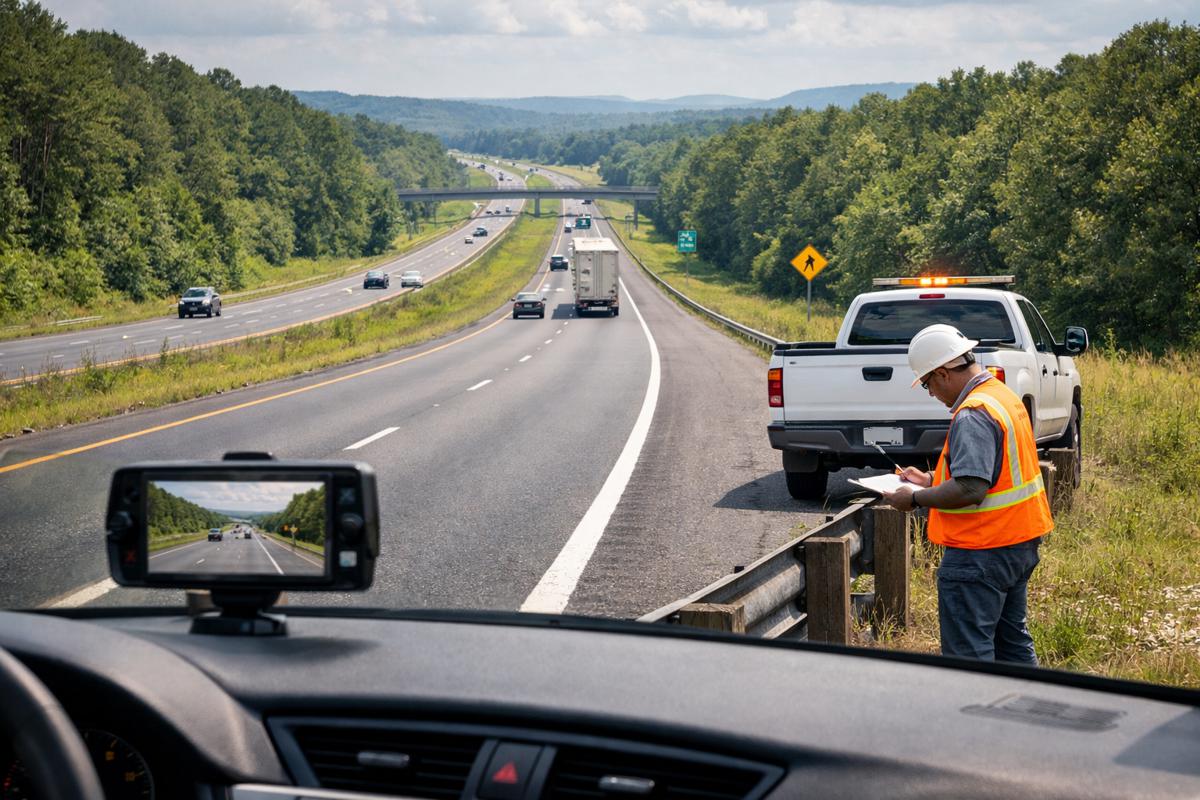
Blyncsy operates on a deceptively simple premise. Instead of deploying dedicated inspection fleets, it draws on crowdsourced, high-resolution dash camera imagery collected from vehicles already using the network. That imagery is then analysed using AI models trained to identify and classify roadway assets and conditions at scale.
The practical implications are significant. Guardrails, signage, pavement markings and other safety critical assets can be assessed consistently across an entire network, rather than sampled or inspected on rotational schedules. The result is not just more data, but more comparable data.
During an earlier pilot, Blyncsy’s AI models demonstrated 97 percent accuracy when benchmarked against traditional inspection results. For budgeting and planning teams, that level of reliability is essential. Financial models do not require perfection, but they do require confidence that trends are real rather than artefacts of measurement error.
For ALDOT, the value lies in how those insights integrate into existing decision frameworks. Rather than generating standalone reports, the AI outputs feed directly into condition assessments that inform funding allocations. That allows planners to adjust budgets based on observed deterioration or improvement, rather than relying on historical averages.
Turning Condition Data Into Financial Clarity
At the heart of performance based budgeting is the idea that money should follow need. That principle sounds straightforward, yet many agencies struggle to operationalise it across large, diverse networks. Without consistent data, budget negotiations often default to precedent or political pressure.
ALDOT’s approach aims to anchor those discussions in quantified evidence. As Morgan Musick, Assistant Maintenance Management Engineer at ALDOT, explained: “To strengthen our performance-based budgeting, we need consistent, quantified data to produce condition assessments across all districts. Bentley’s Blyncsy solution helps us enhance our existing statewide survey by automating certain asset inspections. This technology helps to give us an objective snapshot of our roadway network, enabling us to adjust budgets based on actual asset conditions and ensure funding goes to appropriate maintenance activities in order to better reach a target Level of Service for each asset.”
That emphasis on objectivity is telling. In large organisations, transparency in how funding decisions are made can be just as important as the decisions themselves. Data that is consistent, repeatable and network-wide reduces internal friction and supports clearer communication with policymakers and the public.
It also allows agencies to model scenarios with greater confidence. When condition data is refreshed frequently, planners can test the impact of deferred maintenance, accelerated interventions or changes in service level targets, then adjust budgets accordingly.
Asset Analytics Beyond Alabama
While this deployment is specific to Alabama, its implications extend far beyond state borders. Transport agencies globally are grappling with similar challenges: how to maintain expanding asset inventories under fiscal constraint, while meeting rising expectations around safety and resilience.
International studies from organisations such as the OECD and the World Bank have repeatedly highlighted that poor asset data leads to inefficient spending, often skewed towards reactive repairs rather than preventative maintenance. AI-driven analytics offer a practical route to address that gap, particularly when they can be integrated into existing workflows rather than imposed as parallel systems.
The use of crowdsourced imagery is especially relevant for regions with extensive rural networks, where traditional survey methods are costly and logistically complex. By lowering the marginal cost of inspection, agencies can afford to monitor assets more frequently, identify emerging risks earlier and prioritise interventions more effectively.
In that sense, ALDOT’s experience serves as a reference point for other authorities considering how to modernise asset management without triggering disruptive change programmes.
From Historical Precedent to Empirical Evidence
One of the most persistent challenges in infrastructure finance is inertia. Budget lines, once established, tend to persist regardless of shifting conditions. Over time, that can lead to misalignment between actual asset needs and funding allocations.
Mark Pittman, Senior Director of Transportation AI at Bentley Systems, framed the issue succinctly: “The future of infrastructure asset management depends on making financial decisions based on empirical evidence rather than historical precedent. By integrating AI-powered asset inspection into its performance-based budgeting process, ALDOT is setting a new standard for data-driven infrastructure planning.”
That shift from precedent to evidence is not purely technical. It requires organisational confidence in the data and a willingness to revisit established assumptions. Tools like Blyncsy can provide the evidence, but leadership still has to act on it.
In Alabama’s case, the long standing commitment to performance based budgeting suggests the institutional groundwork is already in place. AI analytics simply strengthen the feedback loop between observed conditions and financial response.
Building a More Predictable Maintenance Strategy
Beyond immediate budgeting decisions, consistent asset analytics support longer term planning. When condition trends are visible across years rather than snapshots, agencies can better anticipate future funding needs and avoid spikes in expenditure driven by deferred maintenance.
That predictability matters for contractors, suppliers and policymakers alike. Stable, data-informed maintenance programmes reduce the boom-and-bust cycles that often characterise infrastructure spending, creating a healthier ecosystem for delivery.
For ALDOT, integrating AI analytics into its survey programme is a step towards that stability. By reducing reliance on episodic inspections, the department can maintain a more current view of its assets and respond incrementally rather than reactively.
It also positions the agency to expand its use of analytics over time, potentially incorporating additional asset classes or linking condition data more directly with safety and performance outcomes.
A Quiet Shift With Systemic Impact
There is nothing flashy about highway maintenance. It rarely attracts headlines, yet it absorbs a significant share of public infrastructure budgets and has a direct impact on safety and economic performance. Improvements in how maintenance decisions are made therefore have outsized consequences, even when they occur quietly.
ALDOT’s use of AI-driven asset analytics illustrates how incremental changes in data collection can unlock meaningful improvements in financial governance. By enhancing an already mature budgeting framework rather than replacing it, the department has demonstrated a pragmatic path forward for agencies navigating similar constraints.
As infrastructure networks continue to age and public scrutiny intensifies, approaches that link objective condition data to funding decisions will become less optional and more expected. In that context, Alabama’s experience offers a practical example of how digital analytics can support not just better roads, but better stewardship of public investment.