Cincoze Industrial Touchscreens for Wet, Harsh and High-Visibility Environments
Industrial facilities rarely get excited about screens. Yet in modern manufacturing, the humble display has become a frontline tool for productivity, safety, and process control. From automated packaging lines to robotics cells and materials handling systems, operators increasingly rely on Human Machine Interface (HMI) screens to interpret live data, confirm workflows, and respond quickly when something drifts out of tolerance. As a result, the industrial display market is moving beyond “good enough” panels and towards purpose-built hardware designed for high uptime, harsh environments, and straightforward integration.
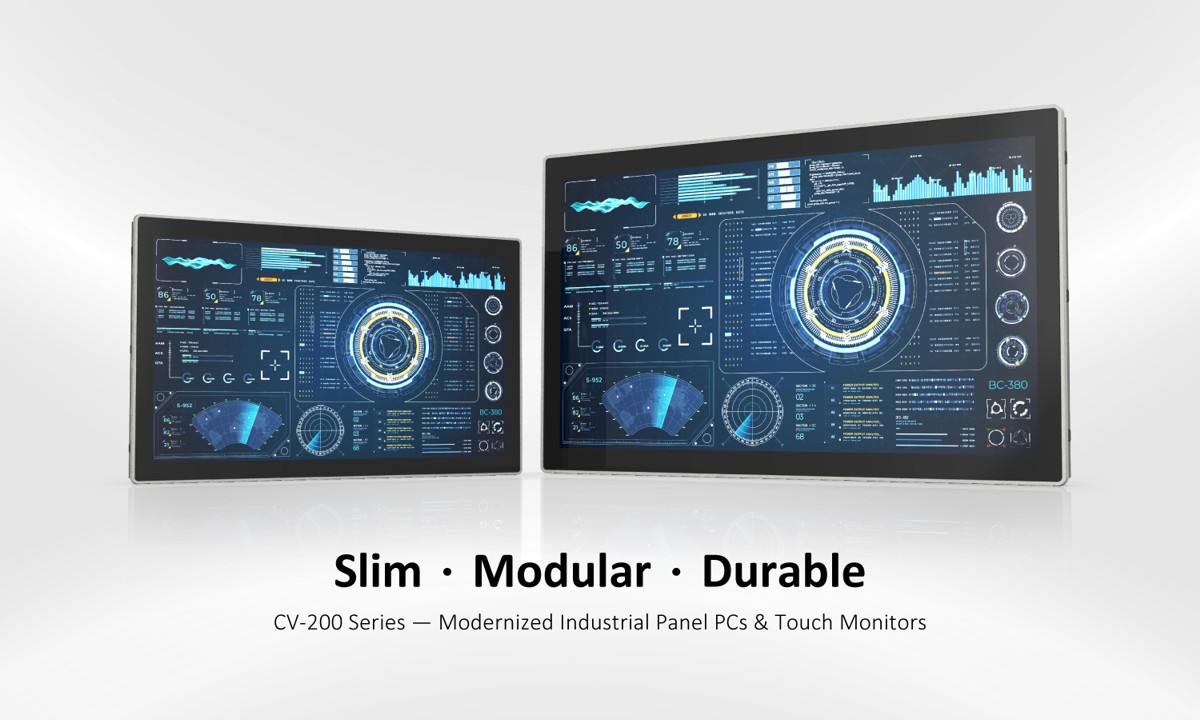
That’s the context for Cincoze’s latest move. The rugged edge computing brand has unveiled its CV-200 Series slim-bezel industrial displays, positioned for industrial panel PC and industrial touch monitor deployments. Rather than chasing consumer-style aesthetics, the CV-200 Series is engineered around the realities of factory life: glare, vibration, humidity, cleaning routines, and the constant need to minimise downtime. The series has been designed for factory HMI and process visualisation, aiming to balance industrial durability with easy equipment integration and operator-friendly interaction.
At launch, the first CV-200 models focus on the largest screen size in the range: 21.5-inch Full HD units, offered in almost ten configuration options for different application needs. Cincoze says the broader platform is modular, supporting screen sizes from 10 inches to 21.5 inches and enabling more than 40 possible configurations. For system integrators and plant engineers trying to standardise hardware while still catering to different machines and lines, that modular approach matters more than it might seem at first glance.
Why Industrial Displays Are No Longer Just a “Nice to Have”
Factory digitisation has changed what operators expect from an HMI. Production teams are no longer only dealing with basic status messages or simple button presses. Increasingly, they’re interacting with dashboards, diagnostics, trend charts, alarm histories, and process visualisation tools that help keep output stable and quality predictable. A display that’s hard to read from an angle, slow to respond, or vulnerable to water ingress doesn’t just frustrate staff, it creates genuine operational risk.
In many industrial settings, the display is also where time is won or lost. A touchscreen that behaves reliably when operators wear gloves, deal with moisture, or work in bright indoor lighting can reduce small delays that compound across shifts. Meanwhile, clearer visual information can support better decision-making when an alarm triggers, a line needs to be paused, or a safety interlock has been activated. In that sense, a display isn’t simply an “output” device anymore. It’s a control surface, a diagnostic window, and a human-friendly point of connection to increasingly complex systems.
Cincoze’s CV-200 Series enters this environment with a clear message: industrial displays can be rugged without being bulky, and they can be easier to integrate without sacrificing reliability. The combination of a slim profile, a narrow bezel, and industrial-grade design choices suggests Cincoze is targeting factories where space is tight and uptime is non-negotiable.
A Minimalist Bezel That Still Fits Industrial Reality
The most obvious visual change in the CV-200 Series is the ultra-slim bezel design. Cincoze states the bezel is less than 3mm wide, which increases the active display area without forcing changes to existing equipment layout. That detail may sound cosmetic, but in industrial control enclosures and equipment panels, millimetres add up. When machinery builders are trying to fit displays into crowded cabinets, or when retrofits need to align with existing cut-outs and mounting constraints, even small dimensional efficiencies can make a meaningful difference.
The CV-200 Series uses a die-cast aluminium alloy frame designed to maintain a slim, clean profile while still providing structural stability. In practical terms, that kind of construction is often preferred in industrial applications because it can offer a robust housing without excessive thickness or weight. For machine builders, it also supports a more streamlined look and a more consistent product line across different equipment variants.
Cincoze is clearly aiming to make integration into production line equipment easier. By combining a minimalist footprint with an industrial build, the company is leaning into what many factories are asking for right now: modernisation that doesn’t require a complete redesign of plant hardware.
Visibility, Viewing Angles, and the “Real World” of Factory Lighting
One of the simplest ways an HMI can fail operators is by being hard to read. In reality, nobody stands squarely in front of a panel at the perfect angle every time. Operators shift position while working, supervisors glance at dashboards while walking through a cell, and maintenance engineers may be crouched at awkward angles during troubleshooting.
Cincoze addresses this with a Full HD display and a 178-degree wide viewing angle, aiming to maintain crisp readability from different positions. For process visualisation, that matters because poor visibility can lead to misread values, slower response times, and unnecessary repeated inputs. The CV-200 Series is presented as offering clear visuals and smooth operation, with the expectation that daily interaction should feel intuitive rather than finicky.
On top of that, every model uses a projective capacitive (P-Cap) touchscreen with an anti-glare (AG) coating. Glare remains a persistent challenge in industrial environments, even indoors. Bright overhead lighting, reflective surfaces, and occasionally sunlit areas near loading bays or large windows can turn a screen into a mirror at exactly the wrong moment. Cincoze’s use of AG coating is intended to keep images clear in high-brightness indoor conditions, supporting day-to-day usability.
Touch response is positioned as fast and precise, with Cincoze describing a smoother and more natural operating experience for routine HMI tasks. In a world where consumer devices have trained everyone to expect responsive touch interaction, laggy or inaccurate touchscreens in industrial settings increasingly feel outdated, and they can lead to fatigue or frustration during long shifts.
Durability Where It Counts: Water, Humidity, and Harsh Conditions
Industrial environments are rarely gentle on equipment. Displays are exposed to cleaning, dust, vibration, temperature variations, and in many sectors, significant humidity. Some facilities also involve washdown routines, water spray, or frequent contact with wet gloves and damp hands.
Cincoze says the CV-200 Series is built for harsh and humid industrial environments, featuring an IP66-rated front panel. That front-facing protection is especially important because the display surface is the part that gets touched, wiped, sprayed, and exposed daily. A robust front panel can help prevent ingress-related failures that may otherwise shorten the service life of the unit.
To support real-world use, the CV-200 touchscreen incorporates Wet Tracking technology, designed to keep touch operation reliable even with wet fingers or splashes of water. In practical environments, this kind of detail can separate “lab-ready” from “factory-ready.” It’s not just about meeting a specification, it’s about ensuring the display behaves predictably when conditions aren’t perfect.
Cincoze also highlights a 50,000-hour backlight lifespan, which is aimed at long-term use without frequent maintenance intervention. In industrial operations, planned maintenance is always preferable to unplanned downtime. If a display becomes unreliable or begins to dim prematurely, it can trigger replacement costs, operator disruption, and delays to production schedules.
Durability is further supported through the use of a 7H hardness Glass-Glass (GG) panel. While the press material doesn’t specify impact ratings, the mention of hardness indicates an emphasis on scratch resistance and surface robustness. For HMIs that are operated multiple times per minute, day after day, surface wear is not a minor issue. Over time, damage and scuffing can reduce readability and contribute to a “tired” look that undermines the perceived condition of critical control systems.
Industrial-Grade EMC Compliance and the Importance of System Stability
In factories packed with motors, drives, power electronics, and switching devices, electromagnetic compatibility (EMC) is more than a paperwork requirement. Interference can cause erratic behaviour, signal disruption, and in the worst cases, system faults that are incredibly difficult to diagnose. When the display is the operator’s interface to the machine, any instability can become a production headache.
Cincoze states the CV-200 Series meets the IEC 61000-6-4 industrial EMC standard. For plant managers and integrators, that compliance is part of the trust equation. It signals that the display is intended to function stably in industrial electrical environments, supporting long-term operation.
The company frames this as delivering peace of mind, and that’s not an overstatement. A display that works perfectly during commissioning but develops intermittent issues months later can be a costly distraction. If technicians are repeatedly called to investigate “random” touchscreen faults or display flicker, the time cost can eclipse the original hardware investment.
Modularity as a Strategy for Uptime and Lifecycle Cost
Where the CV-200 Series becomes particularly interesting for industrial buyers is in its modular system approach. Cincoze’s Convertible Display System (CDS) technology enables the same display platform to pair with either an embedded computer module or a monitor module. In other words, it can be configured as an industrial panel PC or as a standalone industrial touch monitor, depending on the use case.
The CV-200 Series can be matched with embedded computer modules from the P2000 and P1000 Series, or with monitor modules from the M1000 Series. That gives customers flexibility to select display size, computing performance, and functional requirements without committing to a single fixed architecture.
This matters commercially because factories rarely operate with one identical machine type. One area might need a full panel PC for local processing and edge control tasks, while another line might only require a reliable monitor connected to a central system. By building around a plug-and-play modular design, Cincoze is aiming to simplify deployment and allow equipment builders to standardise around a consistent display platform.
Just as importantly, modularity supports maintenance strategies. If repairs are needed, Cincoze says only a single module needs to be replaced. That approach can reduce downtime, lower maintenance costs, and streamline future upgrades. In industrial settings, the ability to replace a module quickly rather than removing an entire unit can be a very practical advantage, particularly for facilities running tight production schedules.
It also hints at a longer-term lifecycle play. If computing requirements increase in future, upgrading the embedded module could potentially extend the value of the display hardware already installed. That kind of incremental upgrade path is increasingly attractive as industrial digitisation accelerates, but budgets remain cautious.
What the CV-200 Launch Signals for Factory Digitalisation
Cincoze’s CV-200 Series isn’t trying to reinvent industrial visualisation. Instead, it reflects a steady shift in what factories expect from HMI and process monitoring equipment. Displays must now combine high visibility, consistent touch performance, rugged protection, and straightforward maintenance planning. They also need to fit into mixed environments where old machinery and new automation systems operate side by side.
The release of 21.5-inch Full HD models first also makes sense. Larger screens are often favoured for process visualisation, where more information can be shown at once without clutter. Whether it’s production throughput, alarm panels, or live system status, the trend towards richer dashboards pushes demand for more screen real estate. If Cincoze can deliver that larger display format with slim integration and industrial protection, it has a clear place in modern production line design.
At the same time, the broader promise of 10-inch to 21.5-inch screen sizes and more than 40 configurations points towards scalability. For integrators serving multiple industries and machine types, a flexible display family can reduce procurement complexity and simplify spare parts strategies. In today’s industrial landscape, reducing variation without limiting functionality is often the fastest way to improve reliability across a plant.
Ultimately, the CV-200 Series appears to be a practical response to an industrial reality: the display is no longer a passive component. It’s a critical interface that can either support stable operations or become an unexpected weak link. By focusing on slim-bezel design, anti-glare visibility, wet-condition touch reliability, and modular maintainability, Cincoze is aiming to make that interface more resilient, more adaptable, and easier to live with over the long haul.