Southeast Asia’s Growth Corridors Need More Than Roads and Ports
For decades, governments and development partners across Southeast Asia have treated transport connectivity as the master key to regional growth, yet one long-running experiment has shown it’s only part of the answer.
Drawing on insights from an Asian Development Bank blog post published in January 2026 by Pamela Asis-Layugan, Regional Cooperation Specialist in ADB’s Southeast Asia Department, the story of the Brunei Darussalam–Indonesia–Malaysia–Philippines East ASEAN Growth Area (BIMP-EAGA) reveals a more grounded truth: roads, ports and airports can unlock access, but lasting development depends on what gets built around them, including aligned policies, local investment, skills development and the protection of natural resources.
Today, BIMP-EAGA covers a vast and diverse geography across four countries, from coastal trading hubs to interior farming regions and island communities reliant on tourism and fisheries. According to the post, the subregion now represents a combined economy valued at $1.34 trillion, accounting for more than 18% of the four countries’ combined GDP. That scale matters. It means BIMP-EAGA isn’t a side project anymore. It’s a serious regional experiment in how to deliver growth without leaving whole provinces behind.
What BIMP-EAGA Proved About Transport-Led Growth
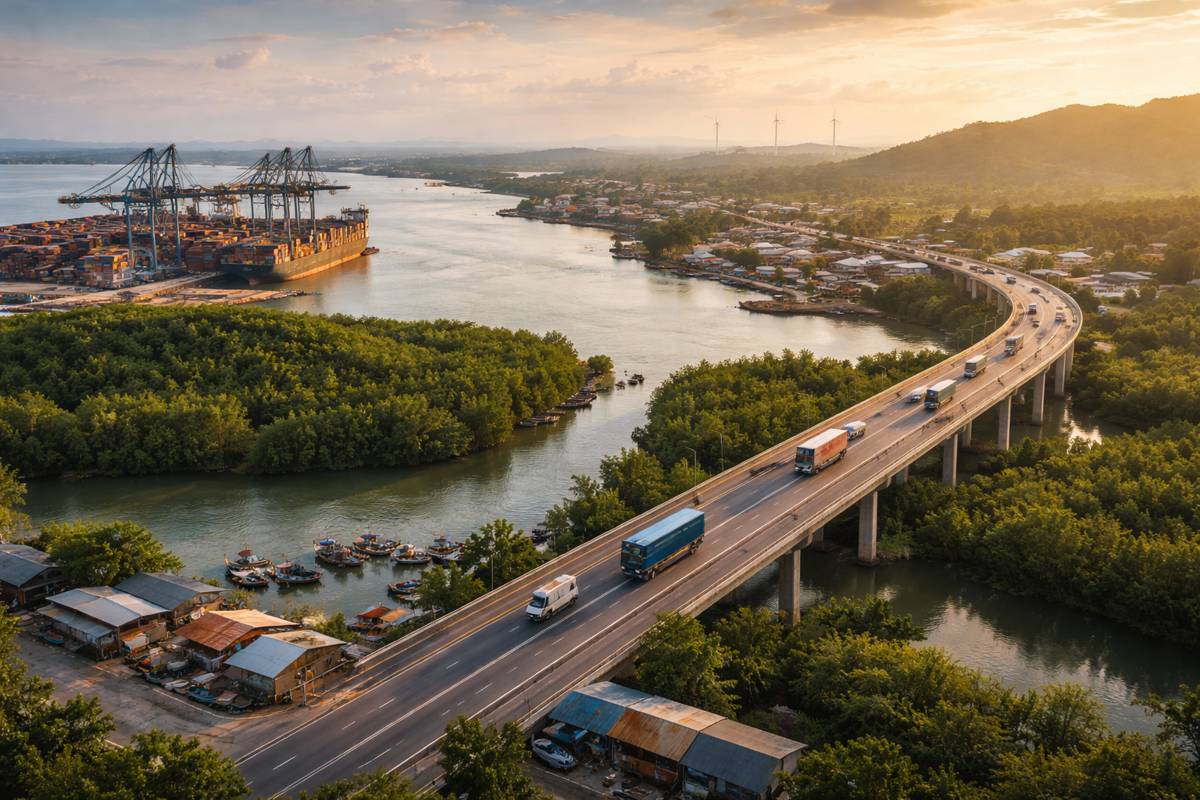
The original push inside BIMP-EAGA was familiar to anyone who’s worked in infrastructure: identify bottlenecks, finance the hard assets, and connect economic centres. Roads, ports, and airports were the early priorities, designed to reduce travel times and logistics costs across borders. The corridor model was built to do what corridors do best: move goods and people faster, more reliably, and at greater volume.
By those narrow measures, progress happened. Transport links improved and activity increased. But the ADB blog post points to a stubborn limitation that many corridor programmes quietly wrestle with: better roads don’t automatically translate into integrated markets. Trade can rise overall while local participation stays thin. Big projects can succeed while smaller communities remain locked out.
In fact, trade within the subregion remained limited. In 2024, trade among the four economies accounted for less than 2% of their $165.95 billion in total trade, with most trade continuing to flow to partners outside the subregion. That’s the uncomfortable proof point. A corridor can be physically connected and still economically fragmented.
The lesson isn’t that infrastructure investment failed. It’s that infrastructure on its own is incomplete. It’s the enabling layer, not the operating system. Without aligned policies, local enterprise development, and a deliberate effort to create investable economic nodes, transport can become a fast lane that mainly benefits external markets and dominant centres.
From “Transport Corridors” to “Opportunity Corridors”
BIMP-EAGA’s evolution is where the story gets more relevant for infrastructure planners globally. The focus shifted from simply expanding transport networks to shaping corridors that spread opportunity and reduce disparities. That change sounds subtle, but it’s a different philosophy entirely.
Rather than treating the corridor as a line on a map, planning began to incorporate industrial estates, cross-border production areas, and tourism zones as anchor points. These weren’t meant to function as isolated hubs. They were intended to become economic magnets that pull in surrounding provinces, cities, and border towns, providing jobs, services, and supply chain connections where growth had previously struggled to land.
The most interesting part of this shift is what it implies for investment priorities. A new road can shorten a journey, but it can’t create a market by itself. A port upgrade can increase throughput, but it won’t automatically generate local value-added industry. Corridor strategies that actually reshape regional economies tend to include “soft infrastructure” alongside the hard assets: the rules, institutions, and business ecosystems that decide who can trade, who can invest, and who can grow.
This is why BIMP-EAGA’s newer approach frames connectivity as a tool for regional inclusion rather than a trophy project. It treats infrastructure as a platform for economic participation, not merely an engineering accomplishment.
Policy Alignment Is Where Corridors Win or Lose
One of the most practical takeaways from BIMP-EAGA is that the most important work often happens after the ribbon cutting. Getting goods and people across borders efficiently requires more than asphalt and concrete. It requires administrative coordination that is both dull and decisive: border procedures, trade rules, customs processes, and the kind of regulatory alignment that can either encourage cross-border supply chains or quietly strangle them.
The ADB highlights that governments have sought to align border procedures, simplify trade rules, and support cross-border production networks in sectors where the subregion has advantages, including agriculture and higher-value manufacturing. That’s significant because it points to corridors not just as trade routes, but as industrial strategies.
It’s also where corridor ambition meets political reality. Policy alignment is slow because it forces agencies to cooperate across ministries, across jurisdictions, and sometimes across competing national interests. But when it works, it changes the economics of a corridor. Logistics become predictable. Compliance becomes manageable. Investors gain confidence that cross-border operations won’t be crushed by friction costs.
In other words, it’s not glamorous work, but it’s the difference between a corridor that carries traffic and a corridor that carries prosperity.
Skills and Local Enterprise Decide Who Benefits
Infrastructure can create access, but it doesn’t guarantee participation. BIMP-EAGA’s experience underlines that education, skills training, and support for local enterprises are what determine whether communities actually capture the benefits of new connectivity.
As corridors expanded, local authorities and partners introduced training programmes, entrepreneurship support, and assistance for small businesses. Universities and technical training centres across the subregion also worked together to build skills and share practical know-how. That’s a strong reminder that corridor development is partly a workforce programme, whether policymakers admit it or not.
The difference is visible on the ground. A rural community connected to a tourism zone still needs skills to deliver services that tourists will pay for. Farmers connected to new logistics networks need capacity to meet quality standards, move goods consistently, and negotiate fair market access. Smaller firms need help with compliance, financing, and digital capabilities to compete in supply chains that don’t tolerate delays or inconsistency.
What BIMP-EAGA seems to have learned is that inclusive corridor growth requires deliberate “on-ramps” into the economy. If those on-ramps don’t exist, the corridor becomes a bypass.
Growth Without Nature Protection Isn’t Growth That Lasts
Corridors don’t cross empty land. They cut through ecosystems, coastlines, forests, fisheries, and communities that have survived for centuries because nature provided a stable living. BIMP-EAGA includes areas of exceptional biodiversity, including the Coral Triangle, and the ADB blog post stresses that natural resource protection has become central as development advanced.
This matters in a way that infrastructure investors are increasingly forced to recognise. Biodiversity loss, coastal degradation, and unsustainable land use aren’t just environmental issues anymore. They’re operational risks. They trigger permitting delays, community opposition, reputational damage, and growing difficulties in accessing international financing, especially where lenders and institutional investors apply ESG screening.
Corridor planning in BIMP-EAGA increasingly includes safeguards for land and seas, cleaner technologies, and tourism models that limit damage to fragile environments. Some corridors are being shaped around renewable energy production, while others focus on coastal livelihoods linked to fisheries and marine services alongside conservation. That blend is becoming the new definition of “bankable” infrastructure in sensitive regions: not just built, but defensible, resilient, and socially sustainable.
Lessons for Infrastructure Investors and Policymakers Worldwide
BIMP-EAGA’s story travels well. The challenges it faced are not unique to Southeast Asia. Governments worldwide are trying to connect lagging regions, unlock trade routes, and spread growth beyond capital cities. But corridor development is often oversold as a purely physical endeavour, as though prosperity can be poured like concrete and set in place.
The first lesson from the ADB post is that cooperation works best when countries look past borders and align rules and resources, rather than focusing only on roads and ports. Development is more effective when plans are shaped around local conditions rather than a one-size-fits-all corridor blueprint.
The second lesson is about governance. Large corridor projects perform better when national agencies, local authorities, businesses, and communities are involved from the start. The ADB post suggests that because coordination is difficult, temporary working groups can help agencies share information, solve problems, and build habits of cooperation before more formal arrangements are put in place. That’s the sort of understated recommendation that can save years of bureaucratic friction.
The third lesson is that growth is stronger when transport is matched with support for farming, energy, communications, tourism, trade, and workforce skills. This is essentially a reminder that corridors succeed when they are treated as multi-sector economic programmes rather than transport projects. It’s not a bolt-on. It’s the whole point.
Finally, broad-based growth requires widening participation. Bringing more provinces and states into development plans and focusing on places that generate jobs and services spreads benefits more evenly. And, crucially, long-term progress depends on protecting land and seas while economies grow, because the fastest growth in the world doesn’t help if it burns out the resources that made the region valuable in the first place.
A Corridor Model Built for the Next 30 Years
If BIMP-EAGA has demonstrated anything, it’s that regional development can’t be engineered through infrastructure alone. The roads and ports matter, of course they do, but they are simply the beginning of the work. The real development outcomes are shaped by what happens next: whether policies align, whether communities can build skills and businesses, whether investment is local as well as international, and whether natural capital is protected rather than quietly consumed.
For the global construction and infrastructure ecosystem, this is a timely message. As governments accelerate spending on connectivity, energy transition, and resilient infrastructure, the biggest risk isn’t building too little. It’s building the wrong kind of progress, where physical links exist but economic inclusion doesn’t.
BIMP-EAGA’s evolution offers a more grounded blueprint: pair new connections with clear rules, invest in people as seriously as in assets, and treat nature protection as economic strategy rather than charity. Do that, and corridors stop being transport lines and start becoming something far more valuable: platforms for lasting regional prosperity.